For those of you interested in solar-climate connections, I strongly recommend reading DamonLaut2004.pdf from which one may quote gems such as: Analysis of a number of published graphs that have played a major role in these debates and that have been claimed to support solar hypotheses [Laut, 2003; Damon and Peristykh, 1999, 2004] shows that the apparent strong correlations displayed on these graphs have been obtained by incorrect handling of the physical data. The graphs are still widely referred to in the literature,and their misleading character has not yet been generally recognized. Readers are cautioned against drawing any conclusions, based upon these graphs, concerning the possible wisdom or futility of reducing the emissions of man-made greenhouse gases. In particular the analysis of Eigil Friis-Christensen and Knud Lassen's 1991 Science paper is interesting.
Thanks to Thomas Palm for pointing out the link, over on sci.env.
2020 update: see-also 2007's The Use of Damon and Laut.
2005-03-31


2005-03-28
Tim Lambert is good for your health
Or at least, he is good for my visitor-count, which more than trebled to an all-time record of 300+ on friday after he mentioned my most excellent post on GW myths. And I got another $0.29 in google adsense fees, taking my total to a dizzying $1.63, only $98.27 from my first paycheque :-).
TL also found this junk from Paul so I have another one to add to the myths: that heat pollution is a significant source of warming (this one isn't intrinsically silly, though the post by Paul certainly is: people did use to worry about it, till they realised it was small compared to CO2 effects).
TL also found this junk from Paul so I have another one to add to the myths: that heat pollution is a significant source of warming (this one isn't intrinsically silly, though the post by Paul certainly is: people did use to worry about it, till they realised it was small compared to CO2 effects).
2005-03-26
More myths of the Near Future
I thought 11 myths was fair going (#10 wasn't exactly carefully reasoned, though true) but still I forgot a few. Thanks to those who reminded me. I'm at my mothers house now with (horrors) only a dial up line and no wireless connections, so I'm a bit crippled for facts (who says greenies aren't in favour of technological advance?). But I'll post these myths here now, and probably do an update in a day or two with added facts - in the meantime, anyone who has a nice fact to fill in is welcome to comment.
1. Its all models Well obviously the measurements of the current temperature rise aren't (except the ones from the satellites, which do have to be passed through a model, ha ha, so its ironic that the same people who will argue "its all models" tend to prefer the satellite record...), nor are the observed rise in GHG's. But projections of future change inevitably come through models. But these models are themselves constrained by observations (match to the past century) and theory (basic radiative transfer; feedbacks; etc).
Consensus science is not science. Incredibly, some people are capable of arguing something along the lines of:
This is obviously silly. It is true that science isn't done by consensus - but so what: no one is saying it is. But when you're thinking of science advice to policy making, you ought to follow the consensus/majority view.
I've sort-of done this before.
3. All the scientists say the same thing because otherwise they will lose their jobs. This one fails to explain the existence of skeptics like Lomborg, Lindzen, Spencer or Svensmark. And it fails completely to understand the nature of scientific society. It isn't some kind of Sekret Kabal. Its an open process: if there are holes in a theory, you can make a name for yourself by pointing this out. I would say that consensus-busting papers stand more chance of being published (on an assumption of equal technical merit) than those supporting it: purely because of the requirement for novelty which journals impose.
4. Water vapour is the dominant greenhouse gas. Well no, it isn't (since I blogged this myself, I'm embarassed to have forgotten it). Its the submissive GHG :-)
5. CO2 saturates within 1m/10m. This one is fairly technical so not very popular as a myth, because it requires a bit to even understand it. The idea is that increasing CO2 won't matter, because the CO2 absorption regions are saturated anyway. Now this isn't one of my strong points (Josh?) but as I understand it this is why the radiative response to CO2 is linear (v low CO2 levels) to sqrt (moderate) and log (current levels).
6. There are not enough fossil fuels available to increase CO2 levels. This one is fairly rare and I'm not sure anyone really believes it. Oil might run out but I don't think there is any shortage of coal, tar sands and misc gunk to get us to at least four times pre-industrial CO2. I find it hard to believe that the future emissions scenario constructers failed to consider this point.
7. Its all the sun. Solar forcing has probably increased over the last century, but as far as can be told its small compared to GHG's. And it has (I think) decreased recently (last few decades)). The solar stuff tends to rely on correlations, whose significances are hard to assess - because the std statistical analyses rely on you doing the assessment once, not on keeping searching for things to correlate till you get a result. Mention here for Paul Farrars work on aliasing of ENSO onto the cloud signal, and the changing-their-minds stuff about polar or mid-latitude clouds. And the bit about the dodgy numbers at the ends of the record (Laut?). Sorry: life is hell without a proper connection...
8. Its all hype to get funding. This one has a grain of truth to it. Agencies do tend to look favourably on proposals which are relevant to the real world. Amusingly, this is probably why a number of solar type folk have got interested in GW and are pushing the solar-GW connection: its good for funding. Which shows up the converse: of the skeptics, plenty have tenure; plenty of tenured people aren't skeptics. But if you want large funds and high salaries... you don't go into science to start with, or stay there.
9. CO2 lags temperature in cores. In facts its pretty hard to tell whether is does or not, because the CO2 comes from the air trapped in the bubbles but the temperature signal comes from the ice itself. And this leaves an uncertainty as to the age of the CO2 relative to the ice, because the pores in the ice only close off slowly - leaving uncertainties up to about 800 y in high cold cores like Vostok. And when you're plotting picture to play with the data yourself, its hard to know what adjustments have been made, so be careful. However, having said that, I think that what indications there are do tend to indicate temperature leading CO2. But: this is not terribly relevant. Trying to explain the last 800 kyr of ice ages, there is a puzzle as to the size of the forcing, which needs an amplifier to produce the size of response. CO2 feedback is one candidate. In which case, you would expect T to lead CO2. But in the case of current climate change, we know full well that the forcing is CO2, not temperature.
10. Fred Singer has anything useful to say about global warming. The traditional number 10: not one that many people believe. Did you know that of those listed on the board of advisers to SEPP, three are dead? Play a fun game: see if you can guess which they are (no cheating by looking at the wiki page).
1. Its all models Well obviously the measurements of the current temperature rise aren't (except the ones from the satellites, which do have to be passed through a model, ha ha, so its ironic that the same people who will argue "its all models" tend to prefer the satellite record...), nor are the observed rise in GHG's. But projections of future change inevitably come through models. But these models are themselves constrained by observations (match to the past century) and theory (basic radiative transfer; feedbacks; etc).
Consensus science is not science. Incredibly, some people are capable of arguing something along the lines of:
- Science is not done by consensus
- There is a consensus on X
- Therefore, X is wrong.
This is obviously silly. It is true that science isn't done by consensus - but so what: no one is saying it is. But when you're thinking of science advice to policy making, you ought to follow the consensus/majority view.
I've sort-of done this before.
3. All the scientists say the same thing because otherwise they will lose their jobs. This one fails to explain the existence of skeptics like Lomborg, Lindzen, Spencer or Svensmark. And it fails completely to understand the nature of scientific society. It isn't some kind of Sekret Kabal. Its an open process: if there are holes in a theory, you can make a name for yourself by pointing this out. I would say that consensus-busting papers stand more chance of being published (on an assumption of equal technical merit) than those supporting it: purely because of the requirement for novelty which journals impose.
4. Water vapour is the dominant greenhouse gas. Well no, it isn't (since I blogged this myself, I'm embarassed to have forgotten it). Its the submissive GHG :-)
5. CO2 saturates within 1m/10m. This one is fairly technical so not very popular as a myth, because it requires a bit to even understand it. The idea is that increasing CO2 won't matter, because the CO2 absorption regions are saturated anyway. Now this isn't one of my strong points (Josh?) but as I understand it this is why the radiative response to CO2 is linear (v low CO2 levels) to sqrt (moderate) and log (current levels).
6. There are not enough fossil fuels available to increase CO2 levels. This one is fairly rare and I'm not sure anyone really believes it. Oil might run out but I don't think there is any shortage of coal, tar sands and misc gunk to get us to at least four times pre-industrial CO2. I find it hard to believe that the future emissions scenario constructers failed to consider this point.
7. Its all the sun. Solar forcing has probably increased over the last century, but as far as can be told its small compared to GHG's. And it has (I think) decreased recently (last few decades)). The solar stuff tends to rely on correlations, whose significances are hard to assess - because the std statistical analyses rely on you doing the assessment once, not on keeping searching for things to correlate till you get a result. Mention here for Paul Farrars work on aliasing of ENSO onto the cloud signal, and the changing-their-minds stuff about polar or mid-latitude clouds. And the bit about the dodgy numbers at the ends of the record (Laut?). Sorry: life is hell without a proper connection...
8. Its all hype to get funding. This one has a grain of truth to it. Agencies do tend to look favourably on proposals which are relevant to the real world. Amusingly, this is probably why a number of solar type folk have got interested in GW and are pushing the solar-GW connection: its good for funding. Which shows up the converse: of the skeptics, plenty have tenure; plenty of tenured people aren't skeptics. But if you want large funds and high salaries... you don't go into science to start with, or stay there.
9. CO2 lags temperature in cores. In facts its pretty hard to tell whether is does or not, because the CO2 comes from the air trapped in the bubbles but the temperature signal comes from the ice itself. And this leaves an uncertainty as to the age of the CO2 relative to the ice, because the pores in the ice only close off slowly - leaving uncertainties up to about 800 y in high cold cores like Vostok. And when you're plotting picture to play with the data yourself, its hard to know what adjustments have been made, so be careful. However, having said that, I think that what indications there are do tend to indicate temperature leading CO2. But: this is not terribly relevant. Trying to explain the last 800 kyr of ice ages, there is a puzzle as to the size of the forcing, which needs an amplifier to produce the size of response. CO2 feedback is one candidate. In which case, you would expect T to lead CO2. But in the case of current climate change, we know full well that the forcing is CO2, not temperature.
10. Fred Singer has anything useful to say about global warming. The traditional number 10: not one that many people believe. Did you know that of those listed on the board of advisers to SEPP, three are dead? Play a fun game: see if you can guess which they are (no cheating by looking at the wiki page).
2005-03-24
Myths of the Near Future
This post is about myths of global warming, but calling it that would be dull; it was going to be called Fables of the deconstruction but MotNF seemed better and perhaps more obscure. Partly, its a feeble attempt to gain wordshare by recycling some old posts, but there is some new stuff. To save time and space I haven't trawled for the evidence of people that believe these myths.
1. In the 70's, everyone was predicting an ice age: fairly common in disrespectable circles but comprehensively refuted by the excellent if over-long and byzantine http://www.wmconnolley.org.uk/sci/iceage/, and more comprehensibly by www.realclimate.org/index.php?p=94. Yes I know I mentioned this only recently (and JF picked up on it).
2. Its all the Urban Heat Island: no it isn't: see The Surface Temperature Record and the Urban Heat Island. In fact, recent evidence suggests less UHI that reported by the IPCC TAR.
3. The surface may be warming but satellites show the atmosphere is cooling: not true: depending on how you built the satellite record, it shows a warming of between 0.08 oC/decade and 0.26 oC/decade, from 1979 to 2004 (ish). See http://en.wikipedia.org/wiki/Satellite_temperature_measurements for the details. There is a kernel of truth to the myth: once upon a time (last in 1996) the satellite record did show cooling, but never as large as the warming it now shows.
4. The hockey stick is broken and therefore the current warming is not unusual: the MBH98 "hockey stick" graph was groundbreaking in its day, but there are now several other reconstructions: the best pic I know of is at http://en.wikipedia.org/wiki/Image:1000_Year_Temperature_Comparison.png. But... its by no means clear at the moment which (if any is correct); and all show the current temperatures and rate of rise to be unusual. Its also true that the hockey stick is not quite as important as the septics often like to claim: What If … the “Hockey Stick” Were Wrong? at RealClimate is interesting.
5. The current CO2 rise is natural, not man-made: this one is totally absurd. To believe this, you have to believe that CO2 and other GHG's were stable at pre-industrial concentrations for thousands of years, then suddenly, just as humans started emitting them, some natural process started emitting them, while at the same time removing from the atmosphere an equivalent quantity of the man-made GHGs (yes I know about the resident fraction...). This is the obvious argument; more complex ones from isotopic measurements can be made, e.g. at How do we know that recent CO2 increases are due to human activities? (update). BTW, notice I've used "man-made": I could have said "anthropogenic" but this is just man-made said in greek.
6. Climate is always changing. True, but so what? We care about the magnitude and speed of current and likely future changes; "climate is always changing at current rates" is definitely false; its all about timescales. See Why do people say... Climate change 'is the norm'?
7. Global warming will cause cooling! Or, the "Day after tomorrow" effect; or Thermohaline shutdown: people love this one because it appears paradoxical. The basic idea (twisted so badly by TDAT (as I understand it; I never watched the stupid movie) that its unrecognisable) is that GW will, by freshening the waters of the north atlantic, lead to a shutdown of the thermohaline circulation, a shutdown of the gulf stream, and therefore massive cooling over northern Europe. THC shutdowns have probably occurred in the past, as a result of freshwater discharges, but only while there are large ice sheets over north america. The Gulf Stream is not the same thing as the THC. And as far as can be told, the probability of a THC shutdown is not high: in fact, it doesn't happen "by itself" in coupled models runs, you have to force it to happen; what you get is instead a slight slowdown and although there is a cooling tendency from the slowdown, the overall effect is warming, even over northern europe. The TAR, section 9.3.4.3 Thermohaline circulation changes is good, as always.
8. The ozone hole and climate change. Not really a myth, just a confusion: the connections between ozone hole (or, better, ozone depletion) and GW is thin. They are: (a) ozone holes require very cold conditions; GW will warm the troposphere but (possibly confusingly) cool the stratosphere where the ozone is; hence, there will be a tendency for GW to cause more depletion. OTOH CFC levels are expected to decline. (b) ozone depletion represents a radiative forcing of the climate system, overall a net negative forcing: ie, it tends to cool the troposphere and surface (c) both GW and OD tend to cool the stratosphere; this cooling is observed but not as useful as it might be as a fingerprint of GW, because of the ozone changes.
9. The greenhouse effect keeps greenhouses warm: not so.
10. Nils-Axel Mörner has something useful to say about sea level rise: fortunately, very few people believe this one... perhaps this is why...
11. Uncertainty. Once the septics have run through about every other excuse they are down to pressing the virtues of uncertainty: that because we don't know in enough detail the effects and size of GW, we should do nothing yet. Of course they don't really mean "do nothing"; they mean "do nothing to reduce our emissions of GHG's". This seems to be the current position of the Bush govt: obliged to admit the reality of the current temperature rises, and even describing it as "sharply rising" (thus stomping on the std.septics, but they keep quiet about that), the POTUS continues... We do not know how much our climate could, or will change in the future. We do not know how fast change will occur, or even how some of our actions could impact it.. Well, this isn't really right: we do in fact know that emitting CO2 will warm the climate. But anyway, (as Michael Tobis has argued on sci.env better than I can, sadly I can't find it right now) uncertainty should make you feel unsafe, not be some sort of we-don't-know-its-ok cocoon.
Well, thats enough myths for now. If I've forgotten some, I hope you'll let me know.
1. In the 70's, everyone was predicting an ice age: fairly common in disrespectable circles but comprehensively refuted by the excellent if over-long and byzantine http://www.wmconnolley.org.uk/sci/iceage/, and more comprehensibly by www.realclimate.org/index.php?p=94. Yes I know I mentioned this only recently (and JF picked up on it).
2. Its all the Urban Heat Island: no it isn't: see The Surface Temperature Record and the Urban Heat Island. In fact, recent evidence suggests less UHI that reported by the IPCC TAR.
3. The surface may be warming but satellites show the atmosphere is cooling: not true: depending on how you built the satellite record, it shows a warming of between 0.08 oC/decade and 0.26 oC/decade, from 1979 to 2004 (ish). See http://en.wikipedia.org/wiki/Satellite_temperature_measurements for the details. There is a kernel of truth to the myth: once upon a time (last in 1996) the satellite record did show cooling, but never as large as the warming it now shows.
4. The hockey stick is broken and therefore the current warming is not unusual: the MBH98 "hockey stick" graph was groundbreaking in its day, but there are now several other reconstructions: the best pic I know of is at http://en.wikipedia.org/wiki/Image:1000_Year_Temperature_Comparison.png. But... its by no means clear at the moment which (if any is correct); and all show the current temperatures and rate of rise to be unusual. Its also true that the hockey stick is not quite as important as the septics often like to claim: What If … the “Hockey Stick” Were Wrong? at RealClimate is interesting.

5. The current CO2 rise is natural, not man-made: this one is totally absurd. To believe this, you have to believe that CO2 and other GHG's were stable at pre-industrial concentrations for thousands of years, then suddenly, just as humans started emitting them, some natural process started emitting them, while at the same time removing from the atmosphere an equivalent quantity of the man-made GHGs (yes I know about the resident fraction...). This is the obvious argument; more complex ones from isotopic measurements can be made, e.g. at How do we know that recent CO2 increases are due to human activities? (update). BTW, notice I've used "man-made": I could have said "anthropogenic" but this is just man-made said in greek.
6. Climate is always changing. True, but so what? We care about the magnitude and speed of current and likely future changes; "climate is always changing at current rates" is definitely false; its all about timescales. See Why do people say... Climate change 'is the norm'?
7. Global warming will cause cooling! Or, the "Day after tomorrow" effect; or Thermohaline shutdown: people love this one because it appears paradoxical. The basic idea (twisted so badly by TDAT (as I understand it; I never watched the stupid movie) that its unrecognisable) is that GW will, by freshening the waters of the north atlantic, lead to a shutdown of the thermohaline circulation, a shutdown of the gulf stream, and therefore massive cooling over northern Europe. THC shutdowns have probably occurred in the past, as a result of freshwater discharges, but only while there are large ice sheets over north america. The Gulf Stream is not the same thing as the THC. And as far as can be told, the probability of a THC shutdown is not high: in fact, it doesn't happen "by itself" in coupled models runs, you have to force it to happen; what you get is instead a slight slowdown and although there is a cooling tendency from the slowdown, the overall effect is warming, even over northern europe. The TAR, section 9.3.4.3 Thermohaline circulation changes is good, as always.
8. The ozone hole and climate change. Not really a myth, just a confusion: the connections between ozone hole (or, better, ozone depletion) and GW is thin. They are: (a) ozone holes require very cold conditions; GW will warm the troposphere but (possibly confusingly) cool the stratosphere where the ozone is; hence, there will be a tendency for GW to cause more depletion. OTOH CFC levels are expected to decline. (b) ozone depletion represents a radiative forcing of the climate system, overall a net negative forcing: ie, it tends to cool the troposphere and surface (c) both GW and OD tend to cool the stratosphere; this cooling is observed but not as useful as it might be as a fingerprint of GW, because of the ozone changes.
9. The greenhouse effect keeps greenhouses warm: not so.
10. Nils-Axel Mörner has something useful to say about sea level rise: fortunately, very few people believe this one... perhaps this is why...
11. Uncertainty. Once the septics have run through about every other excuse they are down to pressing the virtues of uncertainty: that because we don't know in enough detail the effects and size of GW, we should do nothing yet. Of course they don't really mean "do nothing"; they mean "do nothing to reduce our emissions of GHG's". This seems to be the current position of the Bush govt: obliged to admit the reality of the current temperature rises, and even describing it as "sharply rising" (thus stomping on the std.septics, but they keep quiet about that), the POTUS continues... We do not know how much our climate could, or will change in the future. We do not know how fast change will occur, or even how some of our actions could impact it.. Well, this isn't really right: we do in fact know that emitting CO2 will warm the climate. But anyway, (as Michael Tobis has argued on sci.env better than I can, sadly I can't find it right now) uncertainty should make you feel unsafe, not be some sort of we-don't-know-its-ok cocoon.
Well, thats enough myths for now. If I've forgotten some, I hope you'll let me know.
2005-03-23
Search terms...
I've been poking into the stats for my website, http://www.wmconnolley.org.uk/. Astonishingly, I've used up 800+M of my rate quota this month, this may mean I need to buy a better service before long. If I read the stats right, not that many of my referrals are from searches, but of those that are, the top are:
I don't understand "still life" or "watch tv" (we don't have one!).
Oh... and did I mention that my wife got through to the second round of the advanced III category EPTA piano competition, playing Rachmaninov Etudes Tableaux in F minor, G minor and C major? Well she did.
1 301 28.05%  bee
2 103  9.60%  head lice
3  74  6.90%  bees
4  64  5.96%  potty
5  30  2.80%  old shed
6  29  2.70%  legoland
7  20  1.86%  swarm of bees
8  13  1.21%  still life
9  13  1.21%  swarm
10 11  1.03%  watch tv
I don't understand "still life" or "watch tv" (we don't have one!).
Oh... and did I mention that my wife got through to the second round of the advanced III category EPTA piano competition, playing Rachmaninov Etudes Tableaux in F minor, G minor and C major? Well she did.
2005-03-22
Gone a bit quiet.
Things seem to have gone a bit quiet. I haven't posted much recently (and my traffic has suffered... though I suppose it could be because people read via the excellent PlanetFleck, I do :-). RealClimate had quite a big gap from late Feb to early March (incidentally, the RC site counter has just gone over 200k). Though there have been some good ones recently (glaciers; CO2 lifetime; two reports from IPCC AR4 meetings): and Will spring 2005 be a bad one for Arctic ozone? was quite prescient since just this week we've measured ozone down to 230 DU in Cambridge. And sci.env has been pretty dull: there really isn't a lot of news recently.
I did have a letter printed in the New Scientist: in response to some tedious skeptic (here, but you need a subscription to read the interesting bits), I said:
I did have a letter printed in the New Scientist: in response to some tedious skeptic (here, but you need a subscription to read the interesting bits), I said:
Kevin Mayfield manages to make two errors in one short letter (5 March, p 32). The second (confusing weather with climate) is commonplace. The first (believing that 30 years ago an ice age was predicted) is less common but just as wrong. See: www.realclimate.org/index.php?p=94 for a readable explanation or www.wmconnolley.org.uk/sci/iceage/ for more detail.
but this is hardly a new thing.
2005-03-18
Cafe Scientifique: afterwards
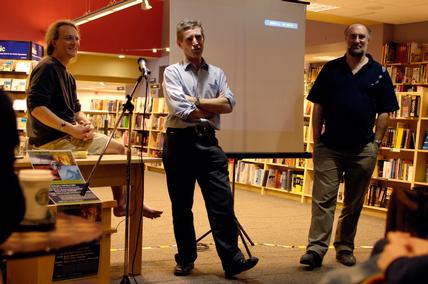
I posted that I was doing a talk at Cafe Scientifique on Wednesday 16th, and now I've done it, and the photo is the proof: me (left); Howard Griffiths (centre) and Pete Convey (right). Its at the question time, afterwards.
So... how did it go, I hear you ask? Quite well, I reply. A decent audience (70+), I presented my stuff well (aided by having 20 mins, about twice as long as I was originally expecting) and so did the others with theirs. You can if you wish read my ppt presentation (or my sxi presentation, if you prefer :-) at http://www.wmconnolley.org.uk/sci/gw/ but I fear you may find it unilluminating without my voiceover.
I was midly disappointed by the questions afterwards. Where have all the skeptics gone, for one thing. And perhaps a lack of deep knowledge for another (obviously you wouldn't expdct DK from everyone, but I would have hoped for a few). Perhaps everyone was quite convinced... Also the bios (somewhat to my surprise) were able to find plenty of examples of cl ch showing up in the biology, but nothing you could call bad, in and of itself.
And afterwards to the Castle for some Oyster Stout with friends.
2005-03-17
Spring!
 Its spring, and the flowers are out, and once again I've neglected to dig my allotment thoroughly over the winter, and stuff like that.
To celebrate, here is a picture of a daffodil with the sun behind it that I took on the rec today.
There was a good sunset too, with hints of iridescence in the upper clouds.
Meanwhile, says the news, Brent Crude is now over $56 per barrrel, due to surging demand, especially from China :-(
2005-03-13
Global warming news from Het Taylor
Het maintains a long long list of links to GW news at http://www.autobahn.mb.ca/~het/gwnews.html. Its somewhat intimidating because there is so much there. One game to play is to visit and see how many links are dark blue, because you've visisted those already. I score quite a few (well he has the good taste to link here, and to wiki, and RC :-) but I'm missing quite a few Quark Soups I should have read - I seem to check PlanetFleck nowadays, and QS doesn't have an RSS feed :-(
[Update 2005/03/17: I discover that Het is HET: Harvey Elmer Taylor. Sorry about that. It makes no real difference, but it does alter my mental picture of him: I thought Het sounded Dutch, and I portrayed him as a somewhat dour Dutch chap, perhaps a bit like a bargee with a pipe and a cap. Now I know he is a Harvey, well, I'm not sure what a Harvey looks like :-)]
[Update 2005/03/17: I discover that Het is HET: Harvey Elmer Taylor. Sorry about that. It makes no real difference, but it does alter my mental picture of him: I thought Het sounded Dutch, and I portrayed him as a somewhat dour Dutch chap, perhaps a bit like a bargee with a pipe and a cap. Now I know he is a Harvey, well, I'm not sure what a Harvey looks like :-)]
2005-03-12
Wot I did in February
New science being a bit thin on the ground (I'm doing some interesting stuff at work comparing radiosonde data with S+C MSU around Antarctica, and finding quite good agreement, but thats not ready for the world yet) I thought I'd point you towards:
http://www.wmconnolley.org.uk/diary/2005/02/
ie, what I did in february.
http://www.wmconnolley.org.uk/diary/2005/02/
ie, what I did in february.
2005-03-07
Cafe Scientifique
 I 'ad that Brian G come inta me office - looking shifty - I knows sumfink were up - sure 'nough, 'e sez to me (sorry, I'll give up the accent now) "would you like to be famous" (or words to that effect). Distaining the obvious "but I am already" I listened to what he had to say, which was an invitation to take up an invitation he had to appear at "Cafe Scientifique" (if you still see a poster for some cyborg stuff, its because they haven't updated it from last time...) which is part of the naked scientists. TNS's, manfully swallowing their disappointment at getting humble me rather than the somewhat more famous Brian, have nonetheless put a brave face on it, so if you're in Cambridge next wednesday evening (16th March, 8pm) then come along to Borders and listen (and contribute if you like) to a panel discussion on Climate Change.
[Updated to include picture: someones been having fun with stoatoshop!]
2005-03-05
Wikipedia as soap opera
While I'm fighting the good fight over the various Global warming related articles on Wikipedia, Miriam has been taking another approach - wiki as soap opera. It started when she followed the RFC against me, and continued in the various edit wars. I keep urging her to get an account - it takes only a few seconds - and to start posting on, say, classical music; but no; she is a lurker.
But wiki as a soap opera can provide you with hours of entertainment if you want, with the added thrill that at any time you feel like, you can participate. Soap opera is all about conflict of course, so a good place to start is Requests for arbitration. This is, as the page says, the end of the dispute resolution process, when all else has failed. One that I have an passing interest in is the case of 172, who I only know from his unwise protect of the GW page. Elsewhere he may be quite sensible, but he has certainly riled some people and it looks like his case will be accepted - ie considered for arbitration. See also the 3 reverts rule enforcement page for the full bizarre history - he ended up having a blocking war with other admins, only ended when Ed "capricious" Poor stepped in and de-sysop'ed them all. Ed gets away with lovable-but-stupid things like this because it all works out well in the end (so perhaps they aren't stupid...). I got an hours ban for sarcasm from him just recently (and M says I should have got another for this). Hmpf. The other case I've been interested in (indeed I started the RFA) is RFA:JonGwynne who (thank goodness) now appears to have gone away entirely, presumably since the case went so badly against him.
Other places to look for exciting conflict on wiki are Requests for comment where people can list pages or people they think are bad, biased or in some way in need of comment from the wider community. Browsing that recently I picked Wave-particle_duality and made some notable improvements... I think... well check the history. Why don't you pick one on the list and go and help it out?
Another way to follow strands is to pick a page - GW, or any page - and click on the "history" tag at the top, to find the list of contributors, then click on one of the users who has contributed to see their user page, then click on "user contributions" (probably in the "toolbox" in the sidebar to the left, though this can vary if you have a different "skin" selected) to see what else they have been up to. Miriam does this for the GW related pages to see if the people I am in conflict with to see if they have genuine and productive edit histories elsewhere.
And if all else fails, you can look at the Recent changes list.
But wiki as a soap opera can provide you with hours of entertainment if you want, with the added thrill that at any time you feel like, you can participate. Soap opera is all about conflict of course, so a good place to start is Requests for arbitration. This is, as the page says, the end of the dispute resolution process, when all else has failed. One that I have an passing interest in is the case of 172, who I only know from his unwise protect of the GW page. Elsewhere he may be quite sensible, but he has certainly riled some people and it looks like his case will be accepted - ie considered for arbitration. See also the 3 reverts rule enforcement page for the full bizarre history - he ended up having a blocking war with other admins, only ended when Ed "capricious" Poor stepped in and de-sysop'ed them all. Ed gets away with lovable-but-stupid things like this because it all works out well in the end (so perhaps they aren't stupid...). I got an hours ban for sarcasm from him just recently (and M says I should have got another for this). Hmpf. The other case I've been interested in (indeed I started the RFA) is RFA:JonGwynne who (thank goodness) now appears to have gone away entirely, presumably since the case went so badly against him.
Other places to look for exciting conflict on wiki are Requests for comment where people can list pages or people they think are bad, biased or in some way in need of comment from the wider community. Browsing that recently I picked Wave-particle_duality and made some notable improvements... I think... well check the history. Why don't you pick one on the list and go and help it out?
Another way to follow strands is to pick a page - GW, or any page - and click on the "history" tag at the top, to find the list of contributors, then click on one of the users who has contributed to see their user page, then click on "user contributions" (probably in the "toolbox" in the sidebar to the left, though this can vary if you have a different "skin" selected) to see what else they have been up to. Miriam does this for the GW related pages to see if the people I am in conflict with to see if they have genuine and productive edit histories elsewhere.
And if all else fails, you can look at the Recent changes list.
2005-03-02
Why does the stratosphere cool under GW?
One of the strongest predictions of global warming is that the stratosphere will *cool* - unlike the troposphere, which will warm, of course. See the IPCC here for example. This turns out to be not as useful for *detecting* climate change as it might be, because ozone decreases also lower the stratospheric temperature. However...
The interesting question is, *why* does the stratosphere cool? From asking colleagues, its quite clear that very few people have thought about this, and of those few who do think about it few get the right answer. Indeed, I'm not absolutely sure that what I've written below *is* the right answer, but I think it is. For a long (and possibly doomed) attempt to explain it, see this at RealClimate.
[Clarification: 2005/03/05: I fear I may not have been quite as explicit as I might have been: this post is about why the stratosphere cools if all you do is change the GHG's, e.g. CO2. It is not about what happens if you decrease the ozone - that, trivially, cools the stratosphere. Consequently, I am not talking about the observed decrease in temperature in the strat - which is caused by a mixture of ozone depletion and GHG increase - but about what *would* happen in a though experiment if GHG's are increased but ozone is held fixed.]
Anyway: my explanation (thanks HKR) is:
in a uniformly grey non-convecting atmosphere (ie, if the atmosphere were equally transparent at all wavelengths, and uniformly through its depth) heated from below (ie, solar radiation warming the surface; assuming of course that we've relaxed the grey assumption to let the solar through), then increasing the greenhouse gases (GHG's) *doesn't* lead to a cooling at the top: instead, the whole atmosphere warms, though not uniformly. You can see some calcs and pictures and code here;
of course, the real atmos does convect; isn't totally transparent to solar; etc; but the real difference is:
the reason that the real atmosphere has a stratosphere is because of ozone absorbing UV, thereby warming that portion of the upper atmosphere;
hence the stratosphere is considerably warmer than it would be under just longwave (LW, or IR) forcing; and CO2 is only effective in LW frequencies;
hence, increasing CO2 *increases* the stratospheres ability to radiate in the LW, but doesn't substantially increase its ability to gain heat, because most of that comes from the SW;
hence it cools.
In the troposphere (ignoring convection etc etc; the real atmos is complex...) increasing CO2 increases both the ability to gain and lose heat, and this first-order argument doesn't tell you what will happen; as it turns out, it warms.
Note: of course the fact that many people couldn't explain this makes no difference at all to the fact that climate models produce the correct answer: they just integrate the equations, and don't care about *why* things happen.
[Update in response to comment: the troposhere is the lowest bit of the atmosphere - up to about 8km. Temperature generally decreases with height at about 7 oC/km. The stratosphere comes next, temperatures *increase* with height (the temp min defines the interface, called the tropopause) until the mid-strat, then declines again to - I think - the stratopause. See IPCC glossary for more.
CO2 is only radiatively active in the LW - ie the infrared portion of the spectrum. Its just about transparent to visible (SW) light]
The interesting question is, *why* does the stratosphere cool? From asking colleagues, its quite clear that very few people have thought about this, and of those few who do think about it few get the right answer. Indeed, I'm not absolutely sure that what I've written below *is* the right answer, but I think it is. For a long (and possibly doomed) attempt to explain it, see this at RealClimate.
[Clarification: 2005/03/05: I fear I may not have been quite as explicit as I might have been: this post is about why the stratosphere cools if all you do is change the GHG's, e.g. CO2. It is not about what happens if you decrease the ozone - that, trivially, cools the stratosphere. Consequently, I am not talking about the observed decrease in temperature in the strat - which is caused by a mixture of ozone depletion and GHG increase - but about what *would* happen in a though experiment if GHG's are increased but ozone is held fixed.]
Anyway: my explanation (thanks HKR) is:
in a uniformly grey non-convecting atmosphere (ie, if the atmosphere were equally transparent at all wavelengths, and uniformly through its depth) heated from below (ie, solar radiation warming the surface; assuming of course that we've relaxed the grey assumption to let the solar through), then increasing the greenhouse gases (GHG's) *doesn't* lead to a cooling at the top: instead, the whole atmosphere warms, though not uniformly. You can see some calcs and pictures and code here;
of course, the real atmos does convect; isn't totally transparent to solar; etc; but the real difference is:
the reason that the real atmosphere has a stratosphere is because of ozone absorbing UV, thereby warming that portion of the upper atmosphere;
hence the stratosphere is considerably warmer than it would be under just longwave (LW, or IR) forcing; and CO2 is only effective in LW frequencies;
hence, increasing CO2 *increases* the stratospheres ability to radiate in the LW, but doesn't substantially increase its ability to gain heat, because most of that comes from the SW;
hence it cools.
In the troposphere (ignoring convection etc etc; the real atmos is complex...) increasing CO2 increases both the ability to gain and lose heat, and this first-order argument doesn't tell you what will happen; as it turns out, it warms.
Note: of course the fact that many people couldn't explain this makes no difference at all to the fact that climate models produce the correct answer: they just integrate the equations, and don't care about *why* things happen.
[Update in response to comment: the troposhere is the lowest bit of the atmosphere - up to about 8km. Temperature generally decreases with height at about 7 oC/km. The stratosphere comes next, temperatures *increase* with height (the temp min defines the interface, called the tropopause) until the mid-strat, then declines again to - I think - the stratopause. See IPCC glossary for more.
CO2 is only radiatively active in the LW - ie the infrared portion of the spectrum. Its just about transparent to visible (SW) light]
2005-03-01
Pratting around with the format
I've fiddled my formats a bit. The page is now wider (I couldn't work out how to auto-size it) and the font is smaller. And stuff. But I was guessing.
Someone who shall remain anonymous said my posts were too long. So I'll stop now :-)
Someone who shall remain anonymous said my posts were too long. So I'll stop now :-)
2005-02-28
Global cooling, again.
I wrote about the Global cooling myth on RealClimate a while ago; and there is a more complete but less organised set of stuff at http://www.wmconnolley.org.uk/sci/iceage/. I had hoped that the RC peice would throw up some interesting new references; but only one appeared:
From Physical Geology by Eugene Mitacek, 1971:
WILL THE ICE AGES RETURN? Climatologists report that the world's weather is turning sharply cooler. Signs of this are evident. Drifting icefields have hindered access to Iceland's ports for the first time in this century. Since 1950 the growing season in England has been shortened by two weeks. Director Reid Bryson of the Institute for Environmental Studies at the University of Wisconsin reports that, if this trend continues, it will affect the whole human populace.
A long term study of climactic conditions would place the first half of the twentieth century into an exceptionally warm period. The warming trend peaked in 1945, and the temperatures have been dropping since. The drop to date is on 1.5 degrees C, far from the 10 degrees C drop necessary for a new Ice Age. If this trend is not reversed, however, the planet may be caught in an ice-forming cycle similar to that of the Pleistocene.
That quote is probably copied from http://www.kuro5hin.org/story/2001/3/2/03449/27856. Note that the drop-to-date of 1.5 oC is wrong (by todays climatology, and probably by what they had then). The global cooling from peak (1940's) to trough (1970's) is barely 0.2 oC (see the SPM) and the northern hemisphere only somewhat larger (about 0.3 oC: see fig 2.7). If you took peak-to-trough for individual years (which you shouldn't, because only slightly different years would then get you a warming) you might get 0.6 oC. But not 1.5 oC. However, thats from modern records: what was available at the time might be wilder.
The reference turns out to be wrong (initially I suspected it might simply be invented, but no). The real ref is Physical Geology, Principles, Processes, and Problems by Charles J. Cazeau, Robert D, Hatcher, Jr.; and Francis T. Siemankowski, 1976 (not 1971; thats a relief because 1971 would be an implausible date for a quote of this sort). The confusion arises because the endpapers are a geological chart by Mitacek, which *is* copyright 1971. With the ref sorted out (thanks JM) I got a copy from abebooks, which arrived today (the wonders of the internet; once apon a time getting hold of a copy would have been too tedious to bother with).
However although the ref needed correction the quote, somewhat to my surprise, is in context (you wouldn't believe the out-of-context quoting that goes on elsewhere). The book continues (thanks JM):
Long range weather forecaster Edward M. Brooks believes that the present cooling trend follows a 40-year cyclic pattern. He feels that this trend will continue until 1985. We will not need to wait much longer to see if the trend will reverse. Both Bryson and Brooks are in agreement, however, that the world is heading into a period of weather unfavorable for agriculture. This is extremely bad news because of the explosion of population in many countries of the world. It appears as if we will be producing less, rather than more, food. As food reserves dwindle we may move into a period of massive, unimaginable tragedy. Long-range plans to feed as ever-growing population must be made.
In the last paragraph of the chapter it also says the following:
It is difficult to forecast the outcome of the present cooling trend. Climatologists differ regarding whether a new Ice Age lies ahead. There is agreement, however, in predictions of shorter growing seasons and lower crop yields for the next 10 years.
Now, what do I say to this? Bad news for the good guys? Well no (surprised?). I think it accurately reports Brysons views, but not the general views of the time. The views of the time were "we don't have good enough theory and measurements to predict the future (100 years) climate, and we know it" (see, e.g., the conclusions of the NAS report, 1975). This is a textbook, not the primary literature. So how do we explain the presence of this stuff in a textbook? Its only a tiny fraction (less than one page out of more than 500) and its a geology book not a climatology book. Textbooks are (I presume) not peer-reviewed in the way papers are; and even if it was reviewed it would have been sent to geologists, since its a geology book. People often make mistakes when they go out of their field...
On the authors:
Charles J. Cazeau (1931-1999) was a prof of geology at the State University of New York at Buffalo: this is the major google hit :-); he also seems to have been marginally invovled in debunking "nessie".
Robert D. Hatcher is rather easier to find: he is currently Tectonics and Structural Geology UT Distinguished Scientist and Professor of Geology Department of Geological Sciences University of Tennessee.
Francis T. Siemankowski I couldn't find much on - mostly refs to this book. The book says he is in the dept of science education, so he may well not be a geologist, somewhat supported by this.
Refs
* [Added 2021] Reid Bryson: The crisis climatologist
Civil liberties and terrorism
This one *isn't* science and it definitely *is* my personal opinion on some political issues. Recently, I've discussed (in the real world) our goverments attempts to bang people up without trial, on the grounds of vague terrorist threats. To which I would say They that can give up essential liberty to obtain a little temporary safety deserve neither liberty nor safety following Benjamin Franklin, Historical Review of Pennsylvania, 1759 (found here). After the end of internment, the IRA were still killing people and we didn't need these powers. Now, terrorists have killed *no-one* in then UK for years and sudddenly we need house arrest. No we don't.
Read the Liberty briefing on it.
BTW, I don't believe in some conspiracy, vast or otherwise, to take these liberties away. A more plausible explanation seems to be that the politicians would be dreadfully embarassed if there was some attack, and they hadn't been pushing the boundaries of what is permissible to try to stop it. That is an ignoble motive. [Don't you think you should soften that a bit, says my wife. Otherwise you're pontificating. Well, I'll leave it].
[Update (as I'm writing this): the govt have finally backed down partially and made the house arrest dependent on a judges say-so not the govts. Listening, over the past few weeks, to ministers on the radio explaining why this was really not possible made me want to bash my head against the wall because of its total illogic. Now they have essentially confessed they have been lying to us for weeks.]
Read the Liberty briefing on it.
BTW, I don't believe in some conspiracy, vast or otherwise, to take these liberties away. A more plausible explanation seems to be that the politicians would be dreadfully embarassed if there was some attack, and they hadn't been pushing the boundaries of what is permissible to try to stop it. That is an ignoble motive. [Don't you think you should soften that a bit, says my wife. Otherwise you're pontificating. Well, I'll leave it].
[Update (as I'm writing this): the govt have finally backed down partially and made the house arrest dependent on a judges say-so not the govts. Listening, over the past few weeks, to ministers on the radio explaining why this was really not possible made me want to bash my head against the wall because of its total illogic. Now they have essentially confessed they have been lying to us for weeks.]
2005-02-27
Looking at: www.globalwarming.org
In my last post I looked at FOE's climate stuff and commented. I said I'd look at the "dark side" too (there are no prizes for guessing where my sympathies lie, but I'll try to be honest anyway). I struggled to find something sensible to analyse. Exxon's search engine found not a single match for "global warming" on their pages, so it looks like they've ducked out. In the end I settled for the Cooler Heads Coalition & their website, http://www.globalwarming.org/, though I'm not sure this is what I really wanted.
Top pic: two laughing children in a bush. Motto: be happy? be irrelevant? Not sure.
They don't have quite such a clear policy section as FOE, but if you go to resources you can find Global Warming In Brief - Q&A so I'll look at that. Its dated November 2000 (though the copyright notice is 2004), but presumably they still consider it up to date. In fact, leaving it un-updated from 2000 may be a deliberate ploy: there is a lot of good research since then, most of it going "against" them and what they write. If challenged, they can perhaps just say "oops we forgot to update it". I'm going to measure it against current science.
So we have: under the header (theirs in italics, mine in std):
According to Accu-Weather, the world’s leading commercial forecaster, "Global air temperatures as measured by land-based weather stations show an increase of about 0.45 degrees Celsius over the past century. This may be no more than normal climatic variation...[and] several biases in the data may be responsible for some of this increase.". This is a bit weird, why ask accu-weather? They don't do climate monitoring. The true answer is about 0.6 oC, and studies show that its probably not all natural, and that biases (if they mean urban heat island) are small.
Satellite data indicate a slight cooling in the climate in the last 18 years. These satellites use advanced technology and are not subject to the "heat island" effect around major cities that alters ground-based thermometers.. This was written in 2000. The satellite record starts in 1979. 1979+18 is not equal to 2000. They have missed some years out... why? For the std septic reason: the satellite record (S+C version) shows cooling if you take the trends up to about 1996-7. If you take the trends past then, it shows warming. If you take the record to end 2000, the warming is 0.047 oC/decade. So, they are lying. The UHI stuff, as noted before, is spurious: http://en.wikipedia.org/wiki/Urban_heat_island for more
Projections of future climate changes are uncertain. Although some computer models predict warming in the next century... well no, *all* the models predict warming these models are very limited. The effects of cloud formations, precipitation, the role of the oceans, or the sun, are still not well known and often inadequately represented in the climate models --- although all play a major role in determining our climate. There are uncertainties, true. The models are as likely to underestimate change as overestimate it. And... when did you notice them make the same caveats about economic models? Scientists who work on these models are quick to point out that they are far from perfect representations of reality, and are probably not advanced enough for direct use in policy implementation. Dubious. Interestingly, as the computer climate models have become more sophisticated in recent years, the predicted increase in temperature has been lowered. Very dubious indeed. The 1.5-4.5 oC range for doubled CO2 didn't change much up to the SAR; by the TAR it had increased somewhat.
98% of total global greenhouse gas emissions are natural (mostly water vapor); only 2% are from man-made sources. This is standard septic nonsense. See water-vapour-is-not-dominant.
By most accounts, man-made emissions have had no more than a minuscule impact on the climate. Although the climate has warmed slightly in the last 100 years, 70% percent of that warming occurred prior to 1940, before the upsurge in greenhouse gas emissions from industrial processes. (Dr. Robert C. Balling, Arizona State University). I don't think thats true: http://www.grida.no/climate/ipcc_tar/wg1/figspm-1.htm. But more than that, they are ignoring the vast bulk of attribution analysis which say things like "Statistical assessments confirm that natural variability (the combination of internal and naturally forced) is unlikely to explain the warming in the latter half of the 20th century".
A Gallup survey indicated that only 17% of the members of the American Meteorological Society and the American Geophysical Society thought the warming of the 20th century was the result of an increase in greenhouse gas emissions. I guess this may be true, but unsourced and with no way to tell what the actual question was, I wouldn't trust it.
The idea that global warming would melt the ice caps and flood coastal cities seems to be mere science fiction. A slight increase in temperature -- whether natural or mankind induced -- is not likely to lead to a massive melting of the earth ice caps, as sometimes claimed in the media. Also, sea-level rises over the centuries relate more to warmer and thus expanding oceans, not to melting ice caps. The idea that GW would melt ice caps is entirely reasonable. It won't happen in a hurry - centuries for Greenland - though. It does correctly point out that much of the warming is predicted to come from thermal expansion... but so what? Are we suppose to say "this flood is OK because its from thermal expansion not ice caps"? Weird. Recent research (it is fair that they didn't take this into account) does suggest that we are not far (decades perhaps) from irreversibly setting Greenland on a course to melt. It still wouldn't be quick, but it would commit us to 5m rise in 200-500 years.
Contrary to some groups' fear mongering about the threat of diseases, temperature changes are likely to have little effect on the spread of diseases. Experts say that deterioration in public health practices such as rapid urbanization without adequate infrastructure, forced large scale resettlement of people, increased drug resistance, higher mobility through air travel, and lack of insect-control programs have the greatest impact on the spread of vector-borne diseases. As far as I can tell, they are right about that, though this isn't my area.
Larger quantities of CO2 in the atmosphere and warmer climates would likely lead to an increase in vegetation. During warm periods in history vegetation flourished, at one point allowing the Vikings to farm in now frozen Greenland. Could be, and to be fair there certainly will be some winners from GW as well as some losers. But theres a lot of stuff they are omitting here - ecosystem responses to T change tends to get predicted as -ve not +ve in general.
Overall: poor. On the science: is GW occurring, and are we to blame, their stuff is a woeful summary of current state-of-play. On will-it-be-harmful (which should be their strong suit) they do better.
[Oops: it looks like I stopped after 3 headers and omitted the policy bits. Well, I'm sick of them for now, tomorrow maybe... :-)]
Top pic: two laughing children in a bush. Motto: be happy? be irrelevant? Not sure.
They don't have quite such a clear policy section as FOE, but if you go to resources you can find Global Warming In Brief - Q&A so I'll look at that. Its dated November 2000 (though the copyright notice is 2004), but presumably they still consider it up to date. In fact, leaving it un-updated from 2000 may be a deliberate ploy: there is a lot of good research since then, most of it going "against" them and what they write. If challenged, they can perhaps just say "oops we forgot to update it". I'm going to measure it against current science.
So we have: under the header (theirs in italics, mine in std):
Is global warming occurring?
According to Accu-Weather, the world’s leading commercial forecaster, "Global air temperatures as measured by land-based weather stations show an increase of about 0.45 degrees Celsius over the past century. This may be no more than normal climatic variation...[and] several biases in the data may be responsible for some of this increase.". This is a bit weird, why ask accu-weather? They don't do climate monitoring. The true answer is about 0.6 oC, and studies show that its probably not all natural, and that biases (if they mean urban heat island) are small.
Satellite data indicate a slight cooling in the climate in the last 18 years. These satellites use advanced technology and are not subject to the "heat island" effect around major cities that alters ground-based thermometers.. This was written in 2000. The satellite record starts in 1979. 1979+18 is not equal to 2000. They have missed some years out... why? For the std septic reason: the satellite record (S+C version) shows cooling if you take the trends up to about 1996-7. If you take the trends past then, it shows warming. If you take the record to end 2000, the warming is 0.047 oC/decade. So, they are lying. The UHI stuff, as noted before, is spurious: http://en.wikipedia.org/wiki/Urban_heat_island for more
Projections of future climate changes are uncertain. Although some computer models predict warming in the next century... well no, *all* the models predict warming these models are very limited. The effects of cloud formations, precipitation, the role of the oceans, or the sun, are still not well known and often inadequately represented in the climate models --- although all play a major role in determining our climate. There are uncertainties, true. The models are as likely to underestimate change as overestimate it. And... when did you notice them make the same caveats about economic models? Scientists who work on these models are quick to point out that they are far from perfect representations of reality, and are probably not advanced enough for direct use in policy implementation. Dubious. Interestingly, as the computer climate models have become more sophisticated in recent years, the predicted increase in temperature has been lowered. Very dubious indeed. The 1.5-4.5 oC range for doubled CO2 didn't change much up to the SAR; by the TAR it had increased somewhat.
Are humans causing the climate to change?
98% of total global greenhouse gas emissions are natural (mostly water vapor); only 2% are from man-made sources. This is standard septic nonsense. See water-vapour-is-not-dominant.
By most accounts, man-made emissions have had no more than a minuscule impact on the climate. Although the climate has warmed slightly in the last 100 years, 70% percent of that warming occurred prior to 1940, before the upsurge in greenhouse gas emissions from industrial processes. (Dr. Robert C. Balling, Arizona State University). I don't think thats true: http://www.grida.no/climate/ipcc_tar/wg1/figspm-1.htm. But more than that, they are ignoring the vast bulk of attribution analysis which say things like "Statistical assessments confirm that natural variability (the combination of internal and naturally forced) is unlikely to explain the warming in the latter half of the 20th century".
A Gallup survey indicated that only 17% of the members of the American Meteorological Society and the American Geophysical Society thought the warming of the 20th century was the result of an increase in greenhouse gas emissions. I guess this may be true, but unsourced and with no way to tell what the actual question was, I wouldn't trust it.
If global warming occurs, will it be harmful?
The idea that global warming would melt the ice caps and flood coastal cities seems to be mere science fiction. A slight increase in temperature -- whether natural or mankind induced -- is not likely to lead to a massive melting of the earth ice caps, as sometimes claimed in the media. Also, sea-level rises over the centuries relate more to warmer and thus expanding oceans, not to melting ice caps. The idea that GW would melt ice caps is entirely reasonable. It won't happen in a hurry - centuries for Greenland - though. It does correctly point out that much of the warming is predicted to come from thermal expansion... but so what? Are we suppose to say "this flood is OK because its from thermal expansion not ice caps"? Weird. Recent research (it is fair that they didn't take this into account) does suggest that we are not far (decades perhaps) from irreversibly setting Greenland on a course to melt. It still wouldn't be quick, but it would commit us to 5m rise in 200-500 years.
Contrary to some groups' fear mongering about the threat of diseases, temperature changes are likely to have little effect on the spread of diseases. Experts say that deterioration in public health practices such as rapid urbanization without adequate infrastructure, forced large scale resettlement of people, increased drug resistance, higher mobility through air travel, and lack of insect-control programs have the greatest impact on the spread of vector-borne diseases. As far as I can tell, they are right about that, though this isn't my area.
Larger quantities of CO2 in the atmosphere and warmer climates would likely lead to an increase in vegetation. During warm periods in history vegetation flourished, at one point allowing the Vikings to farm in now frozen Greenland. Could be, and to be fair there certainly will be some winners from GW as well as some losers. But theres a lot of stuff they are omitting here - ecosystem responses to T change tends to get predicted as -ve not +ve in general.
Overall: poor. On the science: is GW occurring, and are we to blame, their stuff is a woeful summary of current state-of-play. On will-it-be-harmful (which should be their strong suit) they do better.
[Oops: it looks like I stopped after 3 headers and omitted the policy bits. Well, I'm sick of them for now, tomorrow maybe... :-)]
2005-02-22
Looking at FOE's "Energy and Climate Change"
There is a certain vein of thought that says that "both sides of the global warming debate fling around wild inaccuracies" and so neither can be trusted. This is a tempting point of view for people who feel vaguely guilty but would rather like an excuse for not doing anything or trying to find out the science. In fact (as I've argued before) the state of discussion is better characterised by a vast weight of science in the middle, with small but loud extremes at each end. I've seen it recently argued in comments at RealClimate (see e.g. comments 27 and 34 to this post) that most of the extremism comes from the anti-GW crowd. So... I thought I would examine some recent stuff from Friends of the Earth - who are really quite environmental - to see what they say. Specifically, I'll pick their Energy and Climate Change document, since its conveniently available. What do we see?
Front cover: a hurricane from space (I think; it might be a visualisation of model output). Presumably there to put the idea of dangerous weather in your mind.
Page 2: text starting "Top scientists agree – climate change is real, it’s happening and it’s time to take action to stop it." As I've argued elsewhere, the first two are OK but the vital point - time to take action - is more controversial. I don't have a firm opinion myself, and indeed nor am I sure whether its up to scientists - top or otherwise - to be deciding. "... the burning of fossil fuel energy is largely to blame for the climate changes we are now experiencing worldwide." Fair enough, though what the changes are has been left undefined.
Page 3: graphic showing split of energy use: about 1/4 transport, 1/4 domestic, 1/2 industrial.
Page 4: Headlined "Climate Change Hurts", presumably to justify point 3 above. "An overall rise in average global temperatures is changing the world’s weather. Scientists use complex computer models to predict what may happen. Rising sea levels, caused by melting glaciers and the thermal expansion of sea water, will lead to the flooding of huge areas of lowlying nations like Bangladesh. Extreme weather events like floods and storms may be much more common across the world, devastating homes and livelihoods.". Reasonably fair. Sea level is predicted to rise 0.5m by 2100-ish, which (I presume) won't flood huge areas. Extreme weather *may* be more common... or may not. Examples: NH sea ice thinning by 40% (probably scaled back by more recent publications, but fair enough); spring 3 weeks earlier, possible problems for plants (true; though some people might welcome an earlier spring); higher T bleaches coral.
Page 5: Picture of severe rainstorm in New Orleans, captioned something like "over the past 30 years the number of extreme weather events has trebled". Very dodgy. Economic damage may have trebled, but not the events. See IPCC: "Some important aspects of climate appear not to have changed... Changes globally in tropical and extra-tropical storm intensity and frequency are dominated by inter-decadal to multi-decadal variations, with no significant trends evident over the 20th century. Conflicting analyses make it difficult to draw definitive conclusions about changes in storm activity, especially in the extra-tropics... No systematic changes in the frequency of tornadoes, thunder days, or hail events are evident in the limited areas analysed." The temptation to try to link nice big weather changes - rather than small-sounding temperature changes - to GW is too strong, it appears.
Page 6: "Costly energy": fossils finite and problems; vested interests from energy companies; nuclear not the answer. Nuclear power is certainly hopelessly uneconomic (even now, given oil price rises?) in the UK, making that obvious was a benefit of privitisation, not that it stops the govt propping it up. Note the slight contradiction between worrying about climate change and fossil fuels are finite. Also text box: "There is enough coal to last for around 200 years but to avoid climate change we must not use it.". True. But that means fossil fuels aren't finite enough, from the climate POV...
Page 7: oil-slicked beach photo. Motto: oil is evil, in the wrong place.
Page 8: Clean, green future. Benefits, possibilities, examples of renewables.
Page 9: photo of house with PV solar cells on the roof. "Sunny delight: Susan Roaf lives in an ordinary-looking, six bedroom house in Oxford with extraordinary energy saving thanks to south facing windows, triple glazing, solar panels and good insulation. It costs £120 for a year’s energy and produces only 140 kg CO2. (A similar sized poorly insulated house produces 4,000-5,000 kg CO2 per year)." No mention of the economics of the PV system, but you can find it here (scroll down). By my calculation, the PV roof is producing electricity worth something like 1% of its installation cost per year. Thats not economic as it stands.
Page 10-13: What you can do. Various sensible suggestions, including "If you can only do one thing, then keep putting pressure on the decision makers".
Page 14: Friends of the Earth’s Climate Campaign. OK.
Page 15: Energy and climate change directory. OK. Links include IPCC, and (no surprise) none of the septics.
Overall: a bit thin on the economics; over-emphasises the certainty of dangers but not vastly so. Definitely not neutral. And yet... the public do need to be alerted to the potential dangers of climate change, and this tries to do so. Anyone who wants the full IPCC picture can just read it themselves so there is not much point reproducing it.
Coming soon... an analysis of the Dark Side. If I can think of something suitable.
Front cover: a hurricane from space (I think; it might be a visualisation of model output). Presumably there to put the idea of dangerous weather in your mind.
Page 2: text starting "Top scientists agree – climate change is real, it’s happening and it’s time to take action to stop it." As I've argued elsewhere, the first two are OK but the vital point - time to take action - is more controversial. I don't have a firm opinion myself, and indeed nor am I sure whether its up to scientists - top or otherwise - to be deciding. "... the burning of fossil fuel energy is largely to blame for the climate changes we are now experiencing worldwide." Fair enough, though what the changes are has been left undefined.
Page 3: graphic showing split of energy use: about 1/4 transport, 1/4 domestic, 1/2 industrial.
Page 4: Headlined "Climate Change Hurts", presumably to justify point 3 above. "An overall rise in average global temperatures is changing the world’s weather. Scientists use complex computer models to predict what may happen. Rising sea levels, caused by melting glaciers and the thermal expansion of sea water, will lead to the flooding of huge areas of lowlying nations like Bangladesh. Extreme weather events like floods and storms may be much more common across the world, devastating homes and livelihoods.". Reasonably fair. Sea level is predicted to rise 0.5m by 2100-ish, which (I presume) won't flood huge areas. Extreme weather *may* be more common... or may not. Examples: NH sea ice thinning by 40% (probably scaled back by more recent publications, but fair enough); spring 3 weeks earlier, possible problems for plants (true; though some people might welcome an earlier spring); higher T bleaches coral.
Page 5: Picture of severe rainstorm in New Orleans, captioned something like "over the past 30 years the number of extreme weather events has trebled". Very dodgy. Economic damage may have trebled, but not the events. See IPCC: "Some important aspects of climate appear not to have changed... Changes globally in tropical and extra-tropical storm intensity and frequency are dominated by inter-decadal to multi-decadal variations, with no significant trends evident over the 20th century. Conflicting analyses make it difficult to draw definitive conclusions about changes in storm activity, especially in the extra-tropics... No systematic changes in the frequency of tornadoes, thunder days, or hail events are evident in the limited areas analysed." The temptation to try to link nice big weather changes - rather than small-sounding temperature changes - to GW is too strong, it appears.
Page 6: "Costly energy": fossils finite and problems; vested interests from energy companies; nuclear not the answer. Nuclear power is certainly hopelessly uneconomic (even now, given oil price rises?) in the UK, making that obvious was a benefit of privitisation, not that it stops the govt propping it up. Note the slight contradiction between worrying about climate change and fossil fuels are finite. Also text box: "There is enough coal to last for around 200 years but to avoid climate change we must not use it.". True. But that means fossil fuels aren't finite enough, from the climate POV...
Page 7: oil-slicked beach photo. Motto: oil is evil, in the wrong place.
Page 8: Clean, green future. Benefits, possibilities, examples of renewables.
Page 9: photo of house with PV solar cells on the roof. "Sunny delight: Susan Roaf lives in an ordinary-looking, six bedroom house in Oxford with extraordinary energy saving thanks to south facing windows, triple glazing, solar panels and good insulation. It costs £120 for a year’s energy and produces only 140 kg CO2. (A similar sized poorly insulated house produces 4,000-5,000 kg CO2 per year)." No mention of the economics of the PV system, but you can find it here (scroll down). By my calculation, the PV roof is producing electricity worth something like 1% of its installation cost per year. Thats not economic as it stands.
Page 10-13: What you can do. Various sensible suggestions, including "If you can only do one thing, then keep putting pressure on the decision makers".
Page 14: Friends of the Earth’s Climate Campaign. OK.
Page 15: Energy and climate change directory. OK. Links include IPCC, and (no surprise) none of the septics.
Overall: a bit thin on the economics; over-emphasises the certainty of dangers but not vastly so. Definitely not neutral. And yet... the public do need to be alerted to the potential dangers of climate change, and this tries to do so. Anyone who wants the full IPCC picture can just read it themselves so there is not much point reproducing it.
Coming soon... an analysis of the Dark Side. If I can think of something suitable.
2005-02-21
Lost. One submarine. (Doesn't) answer to the name "autosub".
We seem to have lost autosub, as the Guardian reports today. Is this a Beagle II moment? Its hard to know. I always found the fact that it was powered by a gigantic number of "D" cells rather funny, and its impossible to resist jokes like "oh they probably used some cheapo ones they got from a bloke on the market". I'm being unfair, of course.
OTOH, using autonomous vehicles under the ice shelves is fun (I wanted them to go under the sea ice to profile the ice thickness in winter; sadly thats not on the cards yet; if Autosub had stuck to sub-sea-ice and kept away from sub-ice-shelf, they could have got it back). "Gliders" are probably the future, though navigation under ice is tricky.
OTOH, using autonomous vehicles under the ice shelves is fun (I wanted them to go under the sea ice to profile the ice thickness in winter; sadly thats not on the cards yet; if Autosub had stuck to sub-sea-ice and kept away from sub-ice-shelf, they could have got it back). "Gliders" are probably the future, though navigation under ice is tricky.
He now has Isengard to fear as well as Minas Tirith
He now has Isengard to fear as well as Minas Tirith.
You can have a point if you can work out why I've posted this, and another for the details. It may be too easy, since I didn't cheat :-) Reading http://www.inkstain.net/planetfleck/ may help.
You can have a point if you can work out why I've posted this, and another for the details. It may be too easy, since I didn't cheat :-) Reading http://www.inkstain.net/planetfleck/ may help.
Subscribe to:
Posts (Atom)