I'd delighted to announce that I am joining such august company as Chris Mooney, Tim Lambert, and many more in being assimilated by the Borg, aka Scienceblogs. It looks like I'm now online at http://scienceblogs.com/stoat/; there are still a few minor setup issues (I hope "who is that in the picture"? won't be an issue by the time you go over and check).
Fear not! My editoiral independence is unchanged, and I still get to be called Stoat.
2006-02-24


The cost of climate research
One of the many absurd arguments against global warming is that scientists are only in it for the money. From the comments of a recent post on RC:
But... how much does climate research cost? Apparently someone said at AAAS this year that globally, roughly $2 billion is spent on climate research, half of that is in the US, and a quarter each in the EU and the rest of world. And I've heard similar numbers elsewhere. I'm going to accept it, because it fits rather nicely with another number I've just found, from the Economist, wot sez: Monitoring local government currently costs £2.5 billion a year, and that does not include the cost to councils of being inspected (this is in the context of the emasculation of local govt in the UK: since they cannot raise much in taxes, but are paid from central taxation, the central govt insists on minutely monitoring what goes on).
So... assuming that figure is accurate: the costs of simply *monitoring* local govt (not actually doing anything) in one small country exceeds the global climate spend. Do we look forward to skeptics now pronouncing that local govt inspectors are only in it for the money?
However... there is more. The $2 billion annual spend is not all on salaries. Whenever this gets discussed, people usually say that this includes a large chunk spent on satellites, which are expensive. I presume that the costs of the newly approved Cryosat II will get included in the annual climate spend. Its a bit like including the costs of CERN hardware when working out whether particle physics is lucrative or not.
Part of the reason for this post is to invite anyone with better figures to post them. What does Dr Google say?
Bush's proposed budget for ... 2004 ... U.S. spending on climate change this year to $4.3 billion.... Ah yes, but that includes "Tax Incentives for Renewable Energy and Hybrid and Fuel-Cell Vehicles...", about $1b/y. Further down, "Federal Climate Change Science Program (CCSP): Includes $1.7 billion in FY '04 budget request to fund Federal, multi-agency research program, with $185 million requested for the Climate Change Research Initiative in FY '04." And this accuses Bush of cooking the books, anyway.
Although the United States spends $1.8 billion a year on climate research, only 6 percent goes to modeling... England, on the other hand, has focused its spending, with $50 million for the European Center for Medium Range Weather Forecasting and another $25 million for Hadley Centre for Climate Prediction and Research.
Um. So, anyone got any bettter numbers?
Scientists are people too. The money and perks available to IPCC people are extensive. If oil company scientists are unenthusiastic about GW, then it can be argued that IPCC scientists might be enthusiastic from the same kind of incentives.
[Response: The idea that there are vast wealth and perks to be made from climate science is wrong, and would raise a laugh (albeit a rather bitter one) from anyone "inside" - William]
[Response: Money and perks! Hahahaha. How in the world did I miss out on those when I was a lead author for the Third Assessment report? Working on IPCC is a major drain on ones' time, and probably detracts from getting out papers that would help to get grants (not that we make money off of grants either, since those of us at national labs and universities are not paid salary out of grants for the most part.) We do it because it's work that has to be done. It's grueling and demanding, and not that much fun, and I can assure everybody that there is no remuneration involved... RayPierre]
But... how much does climate research cost? Apparently someone said at AAAS this year that globally, roughly $2 billion is spent on climate research, half of that is in the US, and a quarter each in the EU and the rest of world. And I've heard similar numbers elsewhere. I'm going to accept it, because it fits rather nicely with another number I've just found, from the Economist, wot sez: Monitoring local government currently costs £2.5 billion a year, and that does not include the cost to councils of being inspected (this is in the context of the emasculation of local govt in the UK: since they cannot raise much in taxes, but are paid from central taxation, the central govt insists on minutely monitoring what goes on).
So... assuming that figure is accurate: the costs of simply *monitoring* local govt (not actually doing anything) in one small country exceeds the global climate spend. Do we look forward to skeptics now pronouncing that local govt inspectors are only in it for the money?
However... there is more. The $2 billion annual spend is not all on salaries. Whenever this gets discussed, people usually say that this includes a large chunk spent on satellites, which are expensive. I presume that the costs of the newly approved Cryosat II will get included in the annual climate spend. Its a bit like including the costs of CERN hardware when working out whether particle physics is lucrative or not.
Part of the reason for this post is to invite anyone with better figures to post them. What does Dr Google say?
Bush's proposed budget for ... 2004 ... U.S. spending on climate change this year to $4.3 billion.... Ah yes, but that includes "Tax Incentives for Renewable Energy and Hybrid and Fuel-Cell Vehicles...", about $1b/y. Further down, "Federal Climate Change Science Program (CCSP): Includes $1.7 billion in FY '04 budget request to fund Federal, multi-agency research program, with $185 million requested for the Climate Change Research Initiative in FY '04." And this accuses Bush of cooking the books, anyway.
Although the United States spends $1.8 billion a year on climate research, only 6 percent goes to modeling... England, on the other hand, has focused its spending, with $50 million for the European Center for Medium Range Weather Forecasting and another $25 million for Hadley Centre for Climate Prediction and Research.
Um. So, anyone got any bettter numbers?
2006-02-23
BBC goes cpdn
The BBC seems to be promoting the Climateprediction.net stuff: go to http://bbc.cpdn.org/. Good for cpdn I guess.
A Few Things Ill Considered
Coby Beck now has a blog, A Few Things Ill Considered. Coby has for quite a while now been doing an excellent job on sci.env answering the assorted wackos and skeptics, and now he reveals his sekret debating techniques :-)
2006-02-18
Greenland Melting?
"Melting Greenland fuels sea level rise says" Greenpeace. "A new report sheds light on Greenland's quickening meltdown — and why that's distressing" says Time. "Greenland's Glaciers Moving Faster, Losing Mass" says Kansas City Infozine. You get the idea (all of that via google news). Though the best one seems to be "Greenland ice melting faster than thought" by physorg.com. So what can they mean? Can it be "Recent Ice-Sheet Growth in the Interior of Greenland" in Science? Oops no, wrong sign, and anyway that was sooooo 2005 :-) Although to be fair even that mentions thinning below 1,500m.
Nope, it must be "Changes in the Velocity Structure of the Greenland Ice Sheet" Science, 17 February 2006:
Which is similar to "Rapid and synchronous ice-dynamic changes in East Greenland" by Adrian Luckman et al in the less visible GRL, though New Scientist found it, as did the BBC.
90 to 220 km^3/y is an increase of about 0.4 mm/y in global sea level according to a quick calc (and I'm sure the arithmetic fiends will be quick to jump on me if I'm wrong...). This is 20% of the current 2 mm/y obs (or 13% of the 3 mm/y obs, if you take the more recent satellite obs). Or if you think it *caused* the increase from 2 to 3, its about half of that... The TAR estimates put Greenland into context (as they were then; oh, and here).
So... what does it all mean? I don't know. I wrote this post to find out... originally it was going to be about Luckman, then I realised there was the Rigot thing too. How confusing. Maybe RC will do it properly :-)
Nope, it must be "Changes in the Velocity Structure of the Greenland Ice Sheet" Science, 17 February 2006:
Using satellite radar interferometry observations of Greenland, we detected widespread glacier acceleration below 66° north between 1996 and 2000, which rapidly expanded to 70° north in 2005. Accelerated ice discharge in the west and particularly in the east doubled the ice sheet mass deficit in the last decade from 90 to 220 cubic kilometers per year. As more glaciers accelerate farther north, the contribution of Greenland to sea-level rise will continue to increase.
Which is similar to "Rapid and synchronous ice-dynamic changes in East Greenland" by Adrian Luckman et al in the less visible GRL, though New Scientist found it, as did the BBC.
90 to 220 km^3/y is an increase of about 0.4 mm/y in global sea level according to a quick calc (and I'm sure the arithmetic fiends will be quick to jump on me if I'm wrong...). This is 20% of the current 2 mm/y obs (or 13% of the 3 mm/y obs, if you take the more recent satellite obs). Or if you think it *caused* the increase from 2 to 3, its about half of that... The TAR estimates put Greenland into context (as they were then; oh, and here).
So... what does it all mean? I don't know. I wrote this post to find out... originally it was going to be about Luckman, then I realised there was the Rigot thing too. How confusing. Maybe RC will do it properly :-)
2006-02-17
Joke consensus
RP Sr has a weird post about "consensus". He has written a paper with four colleagues, and oddly enough they agree. Which is what usually happens when people write papers together. If they don't agree, they tend to write papers separately. And yet apparently this is to be a new model for the whole community: This paper shows not only can we document a weather event using a variety of climate metrics, but colleagues can work in good faith to produce a truly consensus assessment. This is the model that the global climate change community should adopt. Wooo-eee! yes, lets get 5 people to write the next IPCC report, then there would be no problem with getting agreement.
New wiki toy
I've discovered a new wiki toy to show you your edits graphically. This is me. Fun, no? I seem to peak at 10pm; the BBC R4 news usually reminds me to tail off; and I've usually stopped by 11 :-)
Meanwhile we have mediawiki installed at work, and very useful it is too. It will be even more useful when they work out how to turn on image uploads :-)
Meanwhile we have mediawiki installed at work, and very useful it is too. It will be even more useful when they work out how to turn on image uploads :-)
2006-02-16
Detecting and Attributing Hurricanes
[Stop Press! Chris Rapley says "in the long term, cities such as London may have to be relocated" - heard on R4 10pm news. There will be more, no doubt...]
Well, obviously enough detecting hurricanes isn't too hard. But the question exercising many people minds is *attribution*: has GW lead to an increase in hurricanes? Attributing individual hurricanes is difficult/impossible (the line taken by RC); we're talking about over all trends & stats.
JA (when not blogging about pet food) has a nice article about attribution here, though he means attribution in general. And there is a nice article about an interview with Judith Curry (top quote: William Gray is one of some "hurricane scientists who don’t know a lot about global climate").
But the point I wanted to make is that failure to attribute to GW does *not* amount to an attribution to anything else: natural cycles, etc etc. And failing to determine a human signal is not the same thing as ruling out a human signal (BTW, I'm not actually asserting that this "failure" has occurred). Which brings me to RPs beastly rough post Slouching Toward Scientific McCarthyism (also read the comments). He quotes "NOAA attributes this increased activity to natural occurring cycles in tropical climate patterns near the equator" (my emphasis). RP believes that disagreeing with "The increased activity since 1995 is due to natural fluctuations and cycles of hurricane activity" (again, my emphasis) is bizarre, since the statement is "fully supportable by peer-reviewed science". But is it? For it to have been so, there would have to be a proper attribution to natural causes. If there is any such papers, what are they?
[Minor updates: at least one cultured person has complained that my calling RPs post "beastly rough" was a bit over the top. They have missed the allusion, which I think RP originally intended in his title, to "Slouching to Bethlehem": to quote the second stanza:
I like that; and that was the bit I remembered. But it starts "Turning and turning in the widening gyre / The falcon cannot hear the falconer / Things fall apart; the centre cannot hold;" which fits a hurricanes discussion quite nicely :-)
And secondly, my somewhat flippant "detecting hurricanes is easy enough" is not really right; there are problems with detection in remote regions in the early days.]
Well, obviously enough detecting hurricanes isn't too hard. But the question exercising many people minds is *attribution*: has GW lead to an increase in hurricanes? Attributing individual hurricanes is difficult/impossible (the line taken by RC); we're talking about over all trends & stats.
JA (when not blogging about pet food) has a nice article about attribution here, though he means attribution in general. And there is a nice article about an interview with Judith Curry (top quote: William Gray is one of some "hurricane scientists who don’t know a lot about global climate").
But the point I wanted to make is that failure to attribute to GW does *not* amount to an attribution to anything else: natural cycles, etc etc. And failing to determine a human signal is not the same thing as ruling out a human signal (BTW, I'm not actually asserting that this "failure" has occurred). Which brings me to RPs beastly rough post Slouching Toward Scientific McCarthyism (also read the comments). He quotes "NOAA attributes this increased activity to natural occurring cycles in tropical climate patterns near the equator" (my emphasis). RP believes that disagreeing with "The increased activity since 1995 is due to natural fluctuations and cycles of hurricane activity" (again, my emphasis) is bizarre, since the statement is "fully supportable by peer-reviewed science". But is it? For it to have been so, there would have to be a proper attribution to natural causes. If there is any such papers, what are they?
[Minor updates: at least one cultured person has complained that my calling RPs post "beastly rough" was a bit over the top. They have missed the allusion, which I think RP originally intended in his title, to "Slouching to Bethlehem": to quote the second stanza:
A shape with lion body and the head of a man,
A gaze blank and pitiless as the sun,
Is moving its slow thighs, while all about it
Reel shadows of the indignant desert birds.
The darkness drops again; but now I know
That twenty centuries of stony sleep
were vexed to nightmare by a rocking cradle,
And what rough beast, its hour come round at last,
Slouches towards Bethlehem to be born?
I like that; and that was the bit I remembered. But it starts "Turning and turning in the widening gyre / The falcon cannot hear the falconer / Things fall apart; the centre cannot hold;" which fits a hurricanes discussion quite nicely :-)
And secondly, my somewhat flippant "detecting hurricanes is easy enough" is not really right; there are problems with detection in remote regions in the early days.]
Refs
2006-02-12
Analogy Police
Do you ever find it annoying when people attempt to win arguments using invalid analogies? Dilbert has the answer...
Your comment was denied for questionable content (Jennifer Marohasy)
Don't worry Roger, not you this time :-) Over at www.jennifermarohasy.com/blog/archives/001176.html there is some debate, with a pile of the usual errors being made. I tried to post the below, and got rejected, so I'll post it here instead:
Gosh what fun. Some comments:
Firstly, Schneider and Rasool isn't. Getting them the wrong way round is always a bit of a tell-tale of a cp from a sketpic source. Its Rasool and Schneider; more here: www.wmconnolley.org.uk/sci/iceage/
As for the Genesis Strategy predicting cooling, this is obviously wrong, if you actually read the book: www.wmconnolley.org.uk/sci/iceage/schneider-genesis.html.
"Crazy" LH said: R+S said: "It is found that, although the addition of carbon dioxide in the atmosphere does increase the surface temperature, the rate of temperature increase diminishes with increasing carbon dioxide in the atmosphere." So Ender, Phil, and whoever, this clearly shows that as CO2 keeps increasing, the surface temperature actually starts decellerating. Do any of you actually read and think about what you have read? Then increased CO2 causes cooling.
LH is wrong (well of course he is, he's wrong about everything!). Increasing CO2 increases T roughly logarithmically. This is well known, and its what S is saying. But adding CO2 always causes warming in those models.
All this Hockey Stick stuff is just not as important as people seem to think it is - it wasn't central to the TAR; thats just septics puffing it for reasons of their own. And it has little to do with attribution of current changes. See The Big Picture
Was the MWP global? Castles doesn't seem to have read the TAR: the relevant bit is http://www.grida.no/climate/ipcc_tar/wg1/070.htm, to quote "As with the “Little Ice Age”, the posited “Medieval Warm Period” appears to have been less distinct, more moderate in amplitude, and somewhat different in timing at the hemispheric scale than is typically inferred for the conventionally-defined European epoch. The Northern Hemisphere mean temperature estimates of Jones et al. (1998), Mann et al. (1999), and Crowley and Lowery (2000) show temperatures from the 11th to 14th centuries to be about 0.2°C warmer than those from the 15th to 19th centuries, but rather below mid-20th century temperatures. The long-term hemispheric trend is best described as a modest and irregular cooling from AD 1000 to around 1850 to 1900, followed by an abrupt 20th century warming..." and so on. M.K. Hughes and H.F. Diaz, "Was there a 'Medieval Warm Period?", Climatic Change 26: 109-142, March 1994 is worth a read.
If you're interested in how the MWP/LIA were viewed in the various IPCC reports, then [[MWP and LIA in IPCC reports]] is your source.
Castles quotes "Finally, on the realclimate site William Connelley [sic] says that it's about time that Castles and Henderson got off their bums and produced their own scenarios!". Yes indeed. In fact even people like Tol admit that using your assumptions makes essentially no difference to the end product.
Gosh what fun. Some comments:
Firstly, Schneider and Rasool isn't. Getting them the wrong way round is always a bit of a tell-tale of a cp from a sketpic source. Its Rasool and Schneider; more here: www.wmconnolley.org.uk/sci/iceage/
As for the Genesis Strategy predicting cooling, this is obviously wrong, if you actually read the book: www.wmconnolley.org.uk/sci/iceage/schneider-genesis.html.
"Crazy" LH said: R+S said: "It is found that, although the addition of carbon dioxide in the atmosphere does increase the surface temperature, the rate of temperature increase diminishes with increasing carbon dioxide in the atmosphere." So Ender, Phil, and whoever, this clearly shows that as CO2 keeps increasing, the surface temperature actually starts decellerating. Do any of you actually read and think about what you have read? Then increased CO2 causes cooling.
LH is wrong (well of course he is, he's wrong about everything!). Increasing CO2 increases T roughly logarithmically. This is well known, and its what S is saying. But adding CO2 always causes warming in those models.
All this Hockey Stick stuff is just not as important as people seem to think it is - it wasn't central to the TAR; thats just septics puffing it for reasons of their own. And it has little to do with attribution of current changes. See The Big Picture
Was the MWP global? Castles doesn't seem to have read the TAR: the relevant bit is http://www.grida.no/climate/ipcc_tar/wg1/070.htm, to quote "As with the “Little Ice Age”, the posited “Medieval Warm Period” appears to have been less distinct, more moderate in amplitude, and somewhat different in timing at the hemispheric scale than is typically inferred for the conventionally-defined European epoch. The Northern Hemisphere mean temperature estimates of Jones et al. (1998), Mann et al. (1999), and Crowley and Lowery (2000) show temperatures from the 11th to 14th centuries to be about 0.2°C warmer than those from the 15th to 19th centuries, but rather below mid-20th century temperatures. The long-term hemispheric trend is best described as a modest and irregular cooling from AD 1000 to around 1850 to 1900, followed by an abrupt 20th century warming..." and so on. M.K. Hughes and H.F. Diaz, "Was there a 'Medieval Warm Period?", Climatic Change 26: 109-142, March 1994 is worth a read.
If you're interested in how the MWP/LIA were viewed in the various IPCC reports, then [[MWP and LIA in IPCC reports]] is your source.
Castles quotes "Finally, on the realclimate site William Connelley [sic] says that it's about time that Castles and Henderson got off their bums and produced their own scenarios!". Yes indeed. In fact even people like Tol admit that using your assumptions makes essentially no difference to the end product.
2006-02-11
Wiki bio's
The stuff about some US politico's editing their wiki bio's was on the news recently. Wiki's view of that is here; and amusingly, people have filed an RFC against them. Really, who could possibly so tasteless as to edit their own wikipedia entry ;-)?
A bee on the side
Fairly often, I get requests for people to use my pictures, usually one of the bee ones. I have a christmas card from someone in the US who took my honeycomb pic and added peoples faces in the various cells. But better than that is Maslab where they get to have fun playing with robots... beats climate science any day! There are some notes, see the ppt, slide 27 for my bee, which is apparently to be an exemplar for future robots :-)
2006-02-10
Tripe on TCS
Warning! Don't read on if you've already seen enough septic tripe demolished. But if not... JF points me to The End Is Not Nigh? Johns eagle eye had spotted:
Ironically, just as global warming scare-mongering reaches new heights, the global cooling hypothesis is making a come back. It should be recalled that the frightening images of imminent global warming disaster are of fairly recent vintage. After all, in the 1960s and 1970s various prominent climatologists held the view that it was not global warming that formed a mortal threat to humanity but global cooling.This is traditional septic tripe, there is probably a plug-in for Word to auto-generate it. The traditional answer is http://www.wmconnolley.org.uk/sci/iceage/. More recently, a novel answer of http://www.realclimate.org/index.php?p=94 has become available. Who is writing this tripe? Hans Labohm, co-author of Man-Made Global Warming: Unravelling a Dogma, recently became an expert reviewer for the United Nations Intergovernmental Panel on Climate Change. Aha! He has become an expert reviewer for IPCC! Obviously a man of some status (isn't it funny how even the septics still cling to IPCC as the gold standard?). However, IPCC expert reviewer means little. I'm one too (err...). All you have to do is nominate yourself. It implies no great expertise. Though of course people of expertise do become reviewers... Why is he writing it? Probably because he has just written Man-Made Global Warming: Unravelling a Dogma. Published by... Multi-Science Publishing Co., Ltd, UK. And where have we heard of them before? Aha, yes: E&E. Sigh. As for the rest of it, there's nothing much worth noting, except that he asserts that "various renowned scientists have distanced themselves from the IPCC", and puts Hans Oerlemans in this category. This is odd; Hans was a lead author for FAR, SAR, TAR and even that bogey-man of the septics, ACIA (see his page). And given his recent Science paper the assertion seems even more odd. Probably septic desperation.
2020 update: the IPCC has finally put out a note, including "because the review is essentially open to all through a self-declaration of expertise, it follows that having been a registered expert reviewer does not by itself serve as a qualification of the expert or support their credibility in a different context" (h/t PT).
2006-02-08
Methane and Kuhn
I'm reading Kuhn, "The structure of scientific revolutions". I'm only up to chapter 7 so far, and not desperately impressed. Perhaps it gets better later. Anyway, by curious co-incidence, a piece of it is relevant to the "methane debate", recently energised by Keppler et al. (btw, don't miss the clarification). We had a "discussion group" about this at work: mostly ice core folks whose ultimate interest was interpreting delta-C-13 in ice cores; but most of the discussion was trying to make sense of the paper. And the thing that came up repeatedly is that the *mechanism* for the methane production is unknown. Given that, its really not clear what to measure. At some point, the mechanism will be understood, or at least there will be a testable hypothesis, and suddenly there will be a mini-paradigm-shift (K states that P-shifts are not always major revolutions; they are allowed to be little things in their own area).
To illustrate this: the paper measures methane production from both dead and living leaves. The dead stuff produces much less methane (order of magnitude). Is this because the methane in this case is the breakdown product of some molecule produced by the living plant? In which case a time series would be instructive. But the paper doesn't present this. Then again: for living plants, the paper asserts that production is bigger in sunlight. The measurements weren't terribly well controlled, as the paper notes make clear: "sunshine" is defined as what you get in Heidelburg. And then the problem is: if you expose the plant to sunlight, it will get warmer. And elsewhere they note the strong temperature sensitivity of their results. So all of this is rather typical of the early stages: something odd is found, but the measurements are all in a bit of a fog and its not clear exactly what you are trying to measure.
A bit more commentary on the results: all this turns out to come from about 10 living plants, extrapolated to the planet. So the error bars are huge. It may turn out that these plants are quite atypical. Or, they may turn out to be quite typical. In which case, the methane budget is overthrown? Well, probably not that either. The sinks in the methane budget seems to be well known (mostly atmos oxidation); the sources (wetlands, rice paddies, gas leaks) have pretty big error bars. Most of the overall budgets people construct from these various sources add up to about the same number, but that is because people know the number they are supposed to get: viz, the number that makes the current observed increase work out about right. So (especially if the new results come in at the low end of their range) they can be fitted into the existing methane budget quite easily.
[Update: when I wrote the above, I didn't put any numbers in cos I was doing it from memory. But now I have the data: this (may not be subscription). From which you see, firstly, that Nature says the current methane source-sinks is negative (-47 Tg/y; thats based on a range of sources of 500-600 and deciding, for some unknown reason, that 530 is the best value; IPCC seems to use much the same data but get an *increase*, which is correct...), from those estimates: whereas the atmos measurements clearly show an increase (14 Tg/y). So at the very least, flipping that to +47 could be done without surprising anyone: ie, there is room for an extra source of 94 Tg/y. Kepplers estimates are 62-236 Tg/y, so the lower end can be accomodated without trouble: it would even help! And there is even more scope for fiddling (or, put another way, accomodating the new source without changing much else): Nature sources the current balance to IPCC table 4.2. Is the wetlands source 115, 237, 225, 145 or 92 Tg/y? Is rice 100, 88, 25-54, 60 or 53? Confused?]
To illustrate this: the paper measures methane production from both dead and living leaves. The dead stuff produces much less methane (order of magnitude). Is this because the methane in this case is the breakdown product of some molecule produced by the living plant? In which case a time series would be instructive. But the paper doesn't present this. Then again: for living plants, the paper asserts that production is bigger in sunlight. The measurements weren't terribly well controlled, as the paper notes make clear: "sunshine" is defined as what you get in Heidelburg. And then the problem is: if you expose the plant to sunlight, it will get warmer. And elsewhere they note the strong temperature sensitivity of their results. So all of this is rather typical of the early stages: something odd is found, but the measurements are all in a bit of a fog and its not clear exactly what you are trying to measure.
A bit more commentary on the results: all this turns out to come from about 10 living plants, extrapolated to the planet. So the error bars are huge. It may turn out that these plants are quite atypical. Or, they may turn out to be quite typical. In which case, the methane budget is overthrown? Well, probably not that either. The sinks in the methane budget seems to be well known (mostly atmos oxidation); the sources (wetlands, rice paddies, gas leaks) have pretty big error bars. Most of the overall budgets people construct from these various sources add up to about the same number, but that is because people know the number they are supposed to get: viz, the number that makes the current observed increase work out about right. So (especially if the new results come in at the low end of their range) they can be fitted into the existing methane budget quite easily.
[Update: when I wrote the above, I didn't put any numbers in cos I was doing it from memory. But now I have the data: this (may not be subscription). From which you see, firstly, that Nature says the current methane source-sinks is negative (-47 Tg/y; thats based on a range of sources of 500-600 and deciding, for some unknown reason, that 530 is the best value; IPCC seems to use much the same data but get an *increase*, which is correct...), from those estimates: whereas the atmos measurements clearly show an increase (14 Tg/y). So at the very least, flipping that to +47 could be done without surprising anyone: ie, there is room for an extra source of 94 Tg/y. Kepplers estimates are 62-236 Tg/y, so the lower end can be accomodated without trouble: it would even help! And there is even more scope for fiddling (or, put another way, accomodating the new source without changing much else): Nature sources the current balance to IPCC table 4.2. Is the wetlands source 115, 237, 225, 145 or 92 Tg/y? Is rice 100, 88, 25-54, 60 or 53? Confused?]
2006-02-05
The Stern Report
Sounds like a US TV show, no? In more detail Stern Review on the economics of climate change. Sponsored by the treasury, but nominally an independent review. What relation is it to the failed House of Skeptics Lords report? The HoS reported in early July 2005; co-incidentally the "Chancellor announced on 19 July 2005 that he had asked Sir Nick Stern to lead a major review of the economics of climate change, to understand more comprehensively the nature of the economic challenges and how they can be met, in the UK and globally." I don't know. Best guess is convergent evolution: the problems that need to be addressed are obvious. But it may be a response/corrective.
The Stern review isn't finished; we have a Discussion Paper from 31 January 2006 (together with a pile of similar-looking stuff related to a lecture/press: see the index).
Stern appears to have got one thing right that the HoS got badly wrong: rather than waste time listening to skeptics over the science, he has taken the IPCC view as standard, slightly updated. So we have from the executive summary:
The fun thing, though, is that Stern has put all the evidence submitted online, which makes for some fun reading. Boehmer-Christiansen seems to have failed to do even a basic punctuation and spelling check before she submitted. However, her evidence itself is deeply boring and carefully avoids the science. British Airways also wimps out of the science - perhaps they (correctly) regard it as a foregone conclusion - and spend a lot of words saying "please don't tax aviation fuel" in a coded way. To my surprise the CBI don't quibble the science: In view of the scientific consensus about the level to which concentrations of carbon need to be reduced, we think it right that the government’s ambition should be for the world’s developed economies to cut greenhouse gas emissions by around 60% by around 2050 – and that the UK should put itself on a path towards achieving such reductions. Well well.
Someone called Pielke, P :-) has also submitted, and has said what you would expect. While we're on the miss-spellings, "Exxon Mobile" (the fly-by-night branch?) couldn't be bothered to write a proper submission so they dump a pile of old reports on poor Stern, all of which (you guessed it) carefully avoid any mention of the science, which appears to be their current strategy (a step up from trying to poke holes in it, as they used to).
Rahmstorf argues for Sea level rise as a defining feature of dangerous interference with the climate system which harks back to what-is-dangerous: In the UNFCCC, most nations of the world have agreed to stabilise greenhouse gas concentrations in the atmosphere at a level that will prevent “dangerous interference with the climate system” (Article 2). A key question for policy thus is: what level can this be? We here propose a criterion involving long-term sea level rise. We argue that a significant likelihood of causing a global sea level rise in the range of 3-5 m over the next few centuries (say, by the year 2300) would constitute a “dangerous interference”, since such a sea level rise would destroy much of the current world coastlines, including small island states, many large cities, most beaches and many coastal ecosystems.
John Quiggin responded to the Castles-Henderson critique of the IPCC - good grief, has the entire blogosphere written to Stern? :-)
I suppose I ought to look at the NERC response... hmm, well, apart from having the name "Helen" associated with it, it seems to do its best to mention all the NERC institutes, as expected :-)
But enough serious stuff, I was wanting to look through the skeptics, sadly they don't label them so you have to look through for keywords like Kininmouth. Who mentions that well-known piece of science, The Day After Tomorrow. Its always convenient when people start off with stuff like that, so you know not to bother taking them seriously (if you think I'm being impolite, he has the gall to call t' hockey stick "fraudulent", so is beyond the Pale). Oooh, but thats not the best bit: apparently "There are ongoing efforts by the climatology establishment to suppress any meaningful debate on the science of greenhouse gases". And his evidence? "The first serious problem with the theory of anthropogenic global warming is that tropospheric temperatures, which have been measured by satellites since 1979, show no significant upward trend". But this is botty-wipes, as [[Satellite temperature measurements]] will show you. Come on: if you're going to be a septic, at least don't be a cr*p one. The Marshall Insititute has a submission, but its so dull and stupid I won't bother link to it. "Allan MacRae" (who he) rants on: The current scientific basis of the Kyoto Protocol is deeply flawed - its greatest weaknesses include excessive reliance on: 1) The IPCC 2001 Summary for Policymakers (SPM) report, which is now in disrepute... etc etc. He seems to be connected to Baliunas, somehow.
So... nothing too surprising. Science 1, septics 0; prize for most interesting piece of science evidence goes to Rahmstorf.
The Stern review isn't finished; we have a Discussion Paper from 31 January 2006 (together with a pile of similar-looking stuff related to a lecture/press: see the index).
Stern appears to have got one thing right that the HoS got badly wrong: rather than waste time listening to skeptics over the science, he has taken the IPCC view as standard, slightly updated. So we have from the executive summary:
Climate change is a serious and urgent issue... There is now an overwhelming body of scientific evidence that human activity is increasing the concentrations of greenhouse gases in the atmosphere, and causing warming. We are already seeing significant impacts. There remain uncertainties about the nature and scale of impacts in the longer term, but the most recent science indicates that some of the risks are more serious than had first appeared. The problem is global in its cause and consequences. Greenhouse gases have broadly the same impact on the climate wherever in the world they are emitted. And in terms of its consequences, no region will be left untouched. But impacts will be unevenly felt throughout the world. Some of the most severe impacts will be felt in the poorest countries that are least able to adapt to the changes. The economic challenges are complex. At its most basic level, climate change is an externality: the emission of greenhouse gases damages others. But these costs will be felt over a long period and over the entire globe; their exact nature is uncertain; they interact with other market failures and imperfections; and those most affected – future generations – are not able to speak up for their interests. This points to a long-term international collaborative response. Effective collaboration will require a shared understanding of the incentives and institutions needed, and careful attention to the complex ethical issues involved.Actually that seques from the science to the economics, but I'm happy with it so far (RP will quibble the some of the risks are more serious than had first appeared and perhaps I will too... oh hold on, they give examples later: for example release of greenhouse gases from thawing permafrost or the dieback of the Amazon forest. Yes thats fair enough). After that we're on econ/pol, which I'll ignore.
The fun thing, though, is that Stern has put all the evidence submitted online, which makes for some fun reading. Boehmer-Christiansen seems to have failed to do even a basic punctuation and spelling check before she submitted. However, her evidence itself is deeply boring and carefully avoids the science. British Airways also wimps out of the science - perhaps they (correctly) regard it as a foregone conclusion - and spend a lot of words saying "please don't tax aviation fuel" in a coded way. To my surprise the CBI don't quibble the science: In view of the scientific consensus about the level to which concentrations of carbon need to be reduced, we think it right that the government’s ambition should be for the world’s developed economies to cut greenhouse gas emissions by around 60% by around 2050 – and that the UK should put itself on a path towards achieving such reductions. Well well.
Someone called Pielke, P :-) has also submitted, and has said what you would expect. While we're on the miss-spellings, "Exxon Mobile" (the fly-by-night branch?) couldn't be bothered to write a proper submission so they dump a pile of old reports on poor Stern, all of which (you guessed it) carefully avoid any mention of the science, which appears to be their current strategy (a step up from trying to poke holes in it, as they used to).
Rahmstorf argues for Sea level rise as a defining feature of dangerous interference with the climate system which harks back to what-is-dangerous: In the UNFCCC, most nations of the world have agreed to stabilise greenhouse gas concentrations in the atmosphere at a level that will prevent “dangerous interference with the climate system” (Article 2). A key question for policy thus is: what level can this be? We here propose a criterion involving long-term sea level rise. We argue that a significant likelihood of causing a global sea level rise in the range of 3-5 m over the next few centuries (say, by the year 2300) would constitute a “dangerous interference”, since such a sea level rise would destroy much of the current world coastlines, including small island states, many large cities, most beaches and many coastal ecosystems.
John Quiggin responded to the Castles-Henderson critique of the IPCC - good grief, has the entire blogosphere written to Stern? :-)
I suppose I ought to look at the NERC response... hmm, well, apart from having the name "Helen" associated with it, it seems to do its best to mention all the NERC institutes, as expected :-)
But enough serious stuff, I was wanting to look through the skeptics, sadly they don't label them so you have to look through for keywords like Kininmouth. Who mentions that well-known piece of science, The Day After Tomorrow. Its always convenient when people start off with stuff like that, so you know not to bother taking them seriously (if you think I'm being impolite, he has the gall to call t' hockey stick "fraudulent", so is beyond the Pale). Oooh, but thats not the best bit: apparently "There are ongoing efforts by the climatology establishment to suppress any meaningful debate on the science of greenhouse gases". And his evidence? "The first serious problem with the theory of anthropogenic global warming is that tropospheric temperatures, which have been measured by satellites since 1979, show no significant upward trend". But this is botty-wipes, as [[Satellite temperature measurements]] will show you. Come on: if you're going to be a septic, at least don't be a cr*p one. The Marshall Insititute has a submission, but its so dull and stupid I won't bother link to it. "Allan MacRae" (who he) rants on: The current scientific basis of the Kyoto Protocol is deeply flawed - its greatest weaknesses include excessive reliance on: 1) The IPCC 2001 Summary for Policymakers (SPM) report, which is now in disrepute... etc etc. He seems to be connected to Baliunas, somehow.
So... nothing too surprising. Science 1, septics 0; prize for most interesting piece of science evidence goes to Rahmstorf.
2006-02-02
Too busy for science posting...
I seem to be a bit too busy for science blogging at the moment. Firstly there is stuff at work, secondly I seem to be busy being an admin on wiki. Ah the sweet taste of power!
Excitingly, I've been involved on a couple of articles about things you've probably heard of: [[Jyllands-Posten Muhammad cartoons controversy]] - oddly enough, this seems to attract frenzied editing, how curious. It got semi-protected (see talk; actually there is so much talk you need to look into the archive). And then there is [[Jack Abramoff]], which appears to be subject to a persistent campaign by a pile of Israeli IPs (see the history). Any techie folk out there who can track 62.0.xxx.xxx and 85.250.xxx.xxx and 217.132.xxx.xxx and others to anything closer that an Israeli ISP, do let me know...
Meanwhile, the US attempt to keep decent cheese out of their country is reaching desperate lengths :-)
Excitingly, I've been involved on a couple of articles about things you've probably heard of: [[Jyllands-Posten Muhammad cartoons controversy]] - oddly enough, this seems to attract frenzied editing, how curious. It got semi-protected (see talk; actually there is so much talk you need to look into the archive). And then there is [[Jack Abramoff]], which appears to be subject to a persistent campaign by a pile of Israeli IPs (see the history). Any techie folk out there who can track 62.0.xxx.xxx and 85.250.xxx.xxx and 217.132.xxx.xxx and others to anything closer that an Israeli ISP, do let me know...
Meanwhile, the US attempt to keep decent cheese out of their country is reaching desperate lengths :-)
2006-01-30
More Hansen
The "Hansen gagging" story has been around a bit... now I find (via Roger on sci.env) this: I am writing in response to several recent news articles indicating that officials at NASA may be trying to "silence" Dr. James Hansen, the director of the Goddard Institute for Space Studies. It ought to go without saying that government scientists must be free to describe their scientific conclusions and the implications of those conclusions to their fellow scientists, policymakers and the general public. Any effort to censor federal scientists biases public discussions of scientific issues, increases distrust of the government and makes it difficult for the government to attract the best scientists. And when it comes to an issue like climate change, a subject of ongoing public debate with immense ramifications, the government ought to be bending over backward to make sure that its scientists are able to discuss their work and what it means. And so on.
[And now checking, I see Prometheus has this already]
[And now checking, I see Prometheus has this already]
"Rising concentrations of greenhouse gases may have more serious impacts than previously believed, a major new scientific report has said"
Umm... whats happened? (I wondered to myself, lying fuzzy in bed at 8 a.m. listening to this stuff on the R4). Did they publish the AR4 a year early with major revisions to the conclusions? No. All this is about (source: BBC) the conference report from the Exeter conference in Feb '05. So (a) its not news; anything in the report (should!) have been said a year ago; and (b) I don't recall the Exeter conf saying much new at the time, either (backed up by the RC post I wrote at the time). And is this a "major report"? Probably not.
The Beeb (check out the video...) picks up on the sea level rise from Greenland: It fears the Greenland ice sheet is likely to melt, leading sea levels to rise by seven metres over 1,000 years. OK, this is fair enough (depending on your scenario it might be more or less than 1000 years, and it might not all be gone for quite a bit thereafter, but its fair enough to be going with... say 5m in 1000 years). But again, its not news, its pretty well in line with the TAR (isn't it? I can't say I've bothered to check). 5m in 1000y is 5mm/yr which is more than the 2-3 mm/yr we have at the moment (and is effectively additional to it) and presumably wouldn't be linear but would come in spurts. Current (and TAR-like) projections for Greenland for the 21st century are much smaller - about 40 mm - which is about right: increasing T increases ppn, but also ablation, so past some (TA-DA!) "tipping point" the SLR contribution from Greenland goes up a lot. But... that pushes the problem a way into the future. Is it reasonable for us to "commit" our descendants to a melting Greenland? (assuming the std.science is correct, and no magic is found, this is what we would be doing).
What else? Above two degrees the risks increase very substantially, involving potentially large numbers of extinctions or even ecosystem collapses. This is onto the bio stuff: could be plausible, I can't comment usefully (I could make it up if you like...). This is linked to the 2oC target the EC has; see my RC post. So, supposing you didn't want to break +2oC (with probability X) you need to limit CO2 to Y; X=60% apparently translates into Y=450 ppmv; since we're currently at 380 my guess is we'll go through 450.
And then it got onto Slashdot which (finally) prompted me to get a slashdot ID and post a comment. See if you can find it. I don't think I'll pursue commenting there... there is just so many comments, so much junk (though some good). This one I quite liked, though others didn't.
[Update: RP has a link to the report pdf itself (I haven't read it yet). Sadly RP also has some dumb comments by Peiser; still, no-one is perfect :-) ]
The Beeb (check out the video...) picks up on the sea level rise from Greenland: It fears the Greenland ice sheet is likely to melt, leading sea levels to rise by seven metres over 1,000 years. OK, this is fair enough (depending on your scenario it might be more or less than 1000 years, and it might not all be gone for quite a bit thereafter, but its fair enough to be going with... say 5m in 1000 years). But again, its not news, its pretty well in line with the TAR (isn't it? I can't say I've bothered to check). 5m in 1000y is 5mm/yr which is more than the 2-3 mm/yr we have at the moment (and is effectively additional to it) and presumably wouldn't be linear but would come in spurts. Current (and TAR-like) projections for Greenland for the 21st century are much smaller - about 40 mm - which is about right: increasing T increases ppn, but also ablation, so past some (TA-DA!) "tipping point" the SLR contribution from Greenland goes up a lot. But... that pushes the problem a way into the future. Is it reasonable for us to "commit" our descendants to a melting Greenland? (assuming the std.science is correct, and no magic is found, this is what we would be doing).
What else? Above two degrees the risks increase very substantially, involving potentially large numbers of extinctions or even ecosystem collapses. This is onto the bio stuff: could be plausible, I can't comment usefully (I could make it up if you like...). This is linked to the 2oC target the EC has; see my RC post. So, supposing you didn't want to break +2oC (with probability X) you need to limit CO2 to Y; X=60% apparently translates into Y=450 ppmv; since we're currently at 380 my guess is we'll go through 450.
And then it got onto Slashdot which (finally) prompted me to get a slashdot ID and post a comment. See if you can find it. I don't think I'll pursue commenting there... there is just so many comments, so much junk (though some good). This one I quite liked, though others didn't.
[Update: RP has a link to the report pdf itself (I haven't read it yet). Sadly RP also has some dumb comments by Peiser; still, no-one is perfect :-) ]
Gazillion year old ice
Before the post, a quick joke, brought on by the word "Gazillion": Bush in the White House; an Aide says "Mr Prez, I'm afraid that 3 Brazillian soldiers were killed in Baghdad today". Bush is shocked, to an unlikely degree, and the surrounding Toadies are surprised. Bush asks: "Just how big is a Brazzillion, anyway?" (here is one source). And if you didn't like that, you can try The Onion.
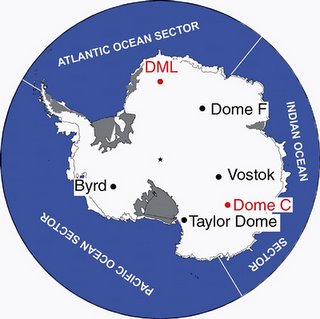 But onto more serious matters. Nature has a report about some new ice cores from Antarctica (thanks het, who has more links), and something of a race for the first "million year old ice". Kohnen Station in Antarctica's Dronning Maud Land has a new core, and Preliminary tests show that the bottom of the core might be as much as 900,000 years old. They sensibly hedge their bets with The age will have to be confirmed in their laboratory back in Germany, "but we're pretty confident,". But no sooner is this in, than Japanese scientists working at the Fuji Dome Antarctic research station said they have retrieved an ice core sample that could be up to one million years old (again, hedged). If you're wondering where all these various cores are, then look at the pic; original here.
But the important thing about ice is not how old it is (if you want super-old ice, go mine a comet; mind you that might be quite expensive too...) its how well preserved it is and its stratigraphic sequencing. There are, if you look closely at the Nature report, hints of this: The Kohnen core should also provide more detailed climate evidence than the one from Dome C, at least for more recent times. In the upper parts of the core, ice accumulated more than twice as fast as at Dome C, so it will be easier to distinguish between ice layers laid down in consecutive years. The ice at the bottom of the core, however, seems to be at least as old as that at the bottom of Dome C, so it must be very compressed. Err yes. So we'll get a more detailed *recent* record (which may have some value, e.g. looking again at D-O events in the Antarctic) but that could have been got from a much shallower core. And we'll get a record from a different sector (nice to see how things co-vary). But... a more detailed recent record implies a less detailed deep record; which is probably the greatest interest. The EPICA core goes down reliably to 780 kyr; does the Kohnen core provide useful info for [780,900] kyr? It will be good if it does. OTOH, since Kohnen isn't at a dome, the bottom is probably smeared, and very hard to work out where it came from.
And a postscript, on how rapidly things get sensationalised: Researchers dig up million-year-old ice (bad headline, text not so bad). Ditto from physorg.
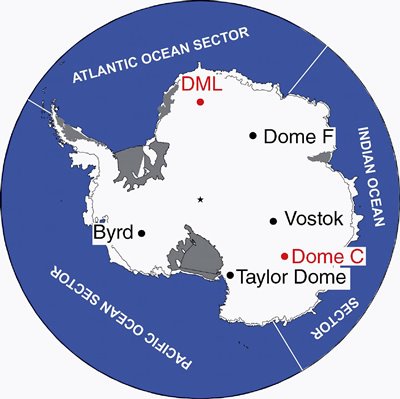 But onto more serious matters. Nature has a report about some new ice cores from Antarctica (thanks het, who has more links), and something of a race for the first "million year old ice". Kohnen Station in Antarctica's Dronning Maud Land has a new core, and Preliminary tests show that the bottom of the core might be as much as 900,000 years old. They sensibly hedge their bets with The age will have to be confirmed in their laboratory back in Germany, "but we're pretty confident,". But no sooner is this in, than Japanese scientists working at the Fuji Dome Antarctic research station said they have retrieved an ice core sample that could be up to one million years old (again, hedged). If you're wondering where all these various cores are, then look at the pic; original here.
But the important thing about ice is not how old it is (if you want super-old ice, go mine a comet; mind you that might be quite expensive too...) its how well preserved it is and its stratigraphic sequencing. There are, if you look closely at the Nature report, hints of this: The Kohnen core should also provide more detailed climate evidence than the one from Dome C, at least for more recent times. In the upper parts of the core, ice accumulated more than twice as fast as at Dome C, so it will be easier to distinguish between ice layers laid down in consecutive years. The ice at the bottom of the core, however, seems to be at least as old as that at the bottom of Dome C, so it must be very compressed. Err yes. So we'll get a more detailed *recent* record (which may have some value, e.g. looking again at D-O events in the Antarctic) but that could have been got from a much shallower core. And we'll get a record from a different sector (nice to see how things co-vary). But... a more detailed recent record implies a less detailed deep record; which is probably the greatest interest. The EPICA core goes down reliably to 780 kyr; does the Kohnen core provide useful info for [780,900] kyr? It will be good if it does. OTOH, since Kohnen isn't at a dome, the bottom is probably smeared, and very hard to work out where it came from.
And a postscript, on how rapidly things get sensationalised: Researchers dig up million-year-old ice (bad headline, text not so bad). Ditto from physorg.
Torture and Terrorism
From the Grauniad, an interesting article about torture, but its about the Inquisition. The assertion that Torture and execution were always carried out by the secular authorities, not church officials is new to me, and perhaps has modern-day analogies. The interesting bit is the quotes from Very Rev Joseph Augustine Di Noia, attempting to put it all into context. He says:
Moving right along, we come to... Terrorism. Which brings me to Israel's shooting of young girl highlights international hypocrisy, say Palestinians (also from the G). And of course links to the recent Hamas victory (for which I'll refer you to CIP and subsequent). And the demands for Hamas to eschew Violence. Which is total nonsense: *we* don't eschew Violence, and nor do the Israelis (what do you think all those guns, tanks and warplanes are for?). Oh... you didn't mean *Violence* from the dictionary definition... you mean Violence excluding anything we do? And as for the equally slippery Terrorism: The army said the boys planned to throw rocks at Israeli cars, which the military defines as terrorism ah yes, Terrorism is what we define it to be. But shooting dead 9 year old girls definitely *isn't* terrorism ...as long as the right side is doing it, of course.
It is a mistake to torture people. However, torture was regarded as a perfectly justified, legitimate way of producing evidence and it was therefore legally justified. Killing people over ideas, generally speaking, seems to us not to be a very good idea after 2,000 years of history ... and generally we disapprove deeply of this kind of purgation, but it seems to me it is possible to understand it within the context of its times and also to understand it within the sociology of religion, how communities react to threats which they regard to be dire or fatal.There are things to quibble here. Describing killing people as not to be a very good idea is a bit weak; and the "is" of the first sentence seems to delicately assert that it might not have been a mistake in the past. But the arguement that it can all be understood "within the sociology of religion" makes sense to me. But then, I'm an atheist, not a member of a church that claims to be the One True Faith, and on occaision, claims inerrancy. So is this the new Catholic policy? No Eternal Verities, just religion understood from within sociology and context. Sounds radical.
Moving right along, we come to... Terrorism. Which brings me to Israel's shooting of young girl highlights international hypocrisy, say Palestinians (also from the G). And of course links to the recent Hamas victory (for which I'll refer you to CIP and subsequent). And the demands for Hamas to eschew Violence. Which is total nonsense: *we* don't eschew Violence, and nor do the Israelis (what do you think all those guns, tanks and warplanes are for?). Oh... you didn't mean *Violence* from the dictionary definition... you mean Violence excluding anything we do? And as for the equally slippery Terrorism: The army said the boys planned to throw rocks at Israeli cars, which the military defines as terrorism ah yes, Terrorism is what we define it to be. But shooting dead 9 year old girls definitely *isn't* terrorism ...as long as the right side is doing it, of course.
[Hmm. I would't write this now (2024/09); and (2025/10) I would be a good deal more suspicious of the report. See Polling Pales for more recent style. But the nonsense about everyone-should-eschew-violence does still grate.]
Subscribe to:
Posts (Atom)