2017-10-30

Trump adviser lied about Russian links

Trump adviser George Papadopoulos lied about Russian links, the Pope shits in the woods, SpaceX successfully launches another rocket, and in other news Record surge in atmospheric CO2 seen in 2016. Last year's increase was 50% higher than the average of the past 10 years. Um well Aunty I'm glad you phrased it like that; I like so many other people are thoroughly familiar with what the average rise was over the past 10 years so that immeadiately puts it into context. Or, perhaps more helpfully, 2016 saw average concentrations of CO2 hit 403.3 parts per million, up from 400ppm in 2015. Is 3.3 ppmv really so much larger? And then when I go looking for the actual numbers I find Carbon Dioxide Is Rising at Record Rates from ClimateCentral which tells me the rate in 2016 was 3, just a shade less than 3.03 in 2015. Ah, and the source of the Beeb's article is the WMO.

Refs


* Donald trump, ha ha ha

2017-10-27

Catalexit

So the nice Catalonians have declared independence and the nasty Spaniards have revoked regional autonomy. Both sides now have to try to make their ideas into reality, ideally without doing too much damage to the real world in the process.
But the main point of the post - other than weakly declaring my support for self-determination, which I hope you've already guessed - is to note the disappointing role played by the EU in all of this. In my idea of Europe - and nominally, of the EUs too I think - nationanlism becomes less important. You're not setting economic policy locally, your borders with fellow EU entities are nearly meaningless, so whether you're part of one state, or another, or independent to whatever degree should matter much less. And this should be one of the major advantages of EU membership.Notice that, unlike Scotland, which would run such a massive deficit that it wouldn't meet the EUs rules for admission, Catalonia would qualify.

But instead of acting as any kind of shining ideal, the EU is falling back on a strictly nationalist thuggish "enforcer" role, making it look unattractive. Also, Rajoy is clearly a tosser. So is May, but you knew that already.

[Update: to avoid confusion - and to record my opinion for my own future reference - the above should not be mistaken for full-throated endorsement of Catalan actions. I'm with Hobbes: you're allowed to revolt against central authority, but only if you have a good chance of success.]

Refs

* Catalonia and Scotland at core of Europe's geopolitical conundrum - euobserver
* Llamas
* Timmy agrees

2017-10-25

Keep your identity small

DSC_2561 Is a 2009 post by Paul Graham. I read his Hackers and Painters in 2008 and recommended it then. I return to him via johnlawrenceaspden but I don't want to go down that road now; instead, I want to look at the identity post:
any mention of religion on an online forum degenerates into a religious argument... people don't feel they need to have any particular expertise to have opinions about it. All they need is strongly held beliefs, and anyone can have those. No thread about Javascript will grow as fast as one about religion, because people feel they have to be over some threshold of expertise to post comments about that. But on religion everyone's an expert... Politics, like religion, is a topic where there's no threshold of expertise for expressing an opinion.
And - as I'm sure I've bemoaned in the past - you could add global warming to the list. PG continues with some of the obvious explanations for why those topics end up like this:
they deal with questions that have no definite answers, so there's no back pressure on people's opinions. Since no one can be proven wrong, every opinion is equally valid, and sensing this, everyone lets fly with theirs.
And one could include GW by replacing "definite" with "currently well-known from observation". But this doesn't quite satisfy him, since he observes the obvious, that other issues with unclear answers don't end up such a mess. Instead, he offers:
they become part of people's identity, and people can never have a fruitful argument about something that's part of their identity. By definition they're partisan... you can have a fruitful discussion about a topic only if it doesn't engage the identities of any of the participants. What makes politics and religion such minefields is that they engage so many people's identities.
I think that's correct; or at least part of the correct answer. PG deduces from this that:
If people can't think clearly about anything that has become part of their identity, then all other things being equal, the best plan is to let as few things into your identity as possible.
Because if you do that, you'll be able to think clearly about as many things as possible. Do you see where this is going now? Oh, good. Just in case you don't, I refer you to stuff like Rejecting Climate Change: Not Science Denial, but Regulation Phobia? where I've been criticising "my own side" and getting nothing but grief for it. To be fair, I've probably forgotten why I thought it was a good idea, but the PG post provides part of the answer: I'm complaining about people who have gone off and let too much GW into their identity.

You weren't expecting a fully formed coherent system of thought, were you?

Refs


* Dilbert 2017/10/25.

2017-10-22

Autumn beekeeping

Always late. But this time, not so bad. Apart from the bit of Apistan I found, which must have been left in since last autumn, which is bad. Altogether it has been a much better year than 2016.

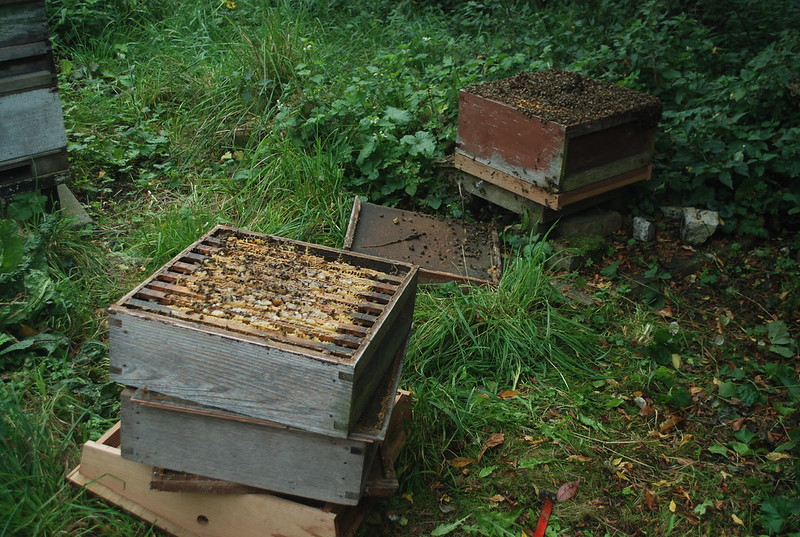
First (but I actually did it second) is what used to be the first hive but is now the second. Here you can see the result of not giving the poor bees enough frames; but actually it's all right and they'll be happy. For the sake of a simple life I decided not to take any honey off this one; it was getting rather late in the day and the amounts would have been marginal anyway.
    DSC_7133


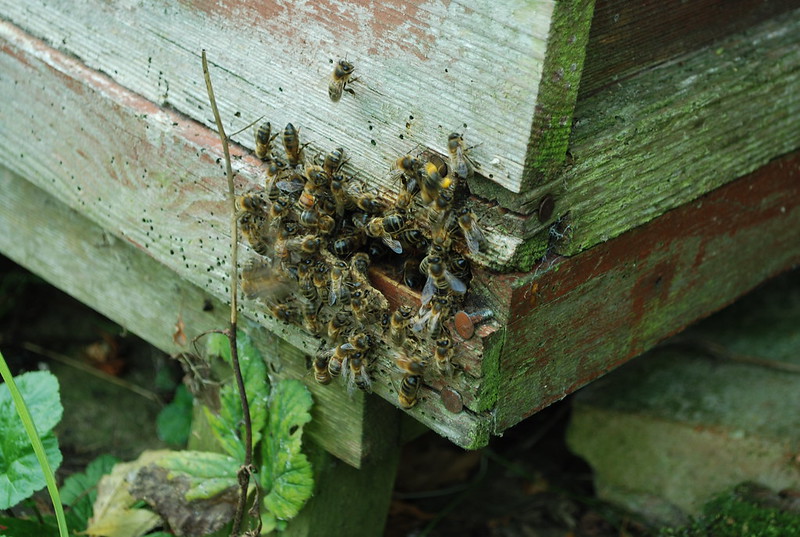
What is now the first hive got a new copper roof this summer, but as can be seen the floor was past it's best and really needs replacement or repair: there's a hole in the side (woodpecker maybe?) big enough to let something much larger than a bee through. Note the bright yellow pollen though: a good sign.

DSC_7119

A full super is heavy, so getting the floor replaced meant taking both supers off (though it is being run as brood-and-a-half due a slight accident a few years back, gosh was it really 2009?, and I wasn't going to change it now), lifting the brood plus old floor off the stand - it promptly stuck, of course - putting the new floor on the stand on and then lifting the brood box onto the new floor. The bees being creatures of habit are still clustered around the hole that is no longer there, I hope (on the corner nearest us).

DSC_7127

The whiteish stuff visible on the super is just crystallised (rape) honey that I ought to deal with. I took off most of the top super. I mostly spun off, though some had set; and I stuffed it all back in again in the evening, leaving melting down till next spring.

DSC_7130

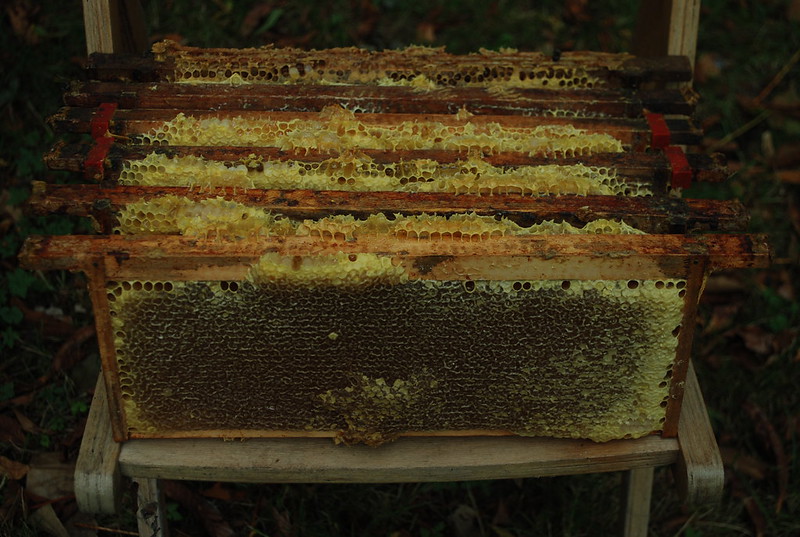
Here are some of the frames I took off, looking suitably dark and not too messy.

Refs


* Ladislav R. Hanka: The Honeybee Scriptures - from the Amsterdam Quarterly, via SB.

2017-10-21

Ocean heat content dogfight!

2015-08-22 13.22.44 Gosh, how exciting! A little while ago I noticed several posts and twits about ocean heat content, which I ignored, because it is dull. But now it turns out to be exciting, because someone has stolen RP Sr's idea! (archive, since the Peilke's do not have a stellar record on keeping blogs going). Well, you can read RP Jr for his opinion (I found this via Retraction Watch).

My memory of this is having long, ultimately fruitless arguments with RP Sr (all arguments with RP Sr were ultimately fruitless) pointing out that OHC was undoubtedly a very nice thing, but the time series wasn't as long as the sfc temperature one and so wasn't so useful. So I can confirm Jr's point that Sr was indeed very interested in the idea quite some time ago. Looking back for posts of mine on the issue I don't find much. Here's Detecting anthro change from 2005 - Barnett; and Hansen, not RP - gosh, can you imagine a time so far in the past that people were interested in detecting climate change? I also find this from 2007 which is interesting only insofar as it refers to, e.g. http://climatesci.colorado.edu/2007/12/02/misinterpretion-of-reality-check-1-by-william-m-connolley-on-the-weblog-stoat/http://climatesci.colorado.edu/2007/12/02/misinterpretion-of-reality-check-1-by-william-m-connolley-on-the-weblog-stoat/, which sadly seems to have vanished from the wub. I hate it when people don't take care of their old blogs, couldn't he take the trouble to archive things properly?

Jr presents Sr's brilliant idea as originating in BAMS in 2003. Which is an odd idea; the idea of detecting change through the oceans isn't exactly a difficult one; it seems unlikely that was the first occurrence of the idea; and indeed, the presence of "Barnett, T. P., D. W. Pierce, and R. Schnur, 2001:
Detection of anthropogenic climate. Change in the world’s oceans. Science, 292, 270–274" in the reference lists suggests otherwise.

The paper that raises Jr's ire, Taking the Pulse of the Planet, seems as stupid as the original pushing. Let me share some of their brilliant game-changing insights with you: we suggest that scientists and modelers who seek global warming signals should track how much heat the ocean is storing at any given time. What, really? And apparently they're so convinced that this is a new idea that they go on termed global ocean heat content (OHC). Err, there's a f*ck*ng wikipedia article on Ocean Heat Content, you really don't have to treat the idea as though it's new (yes, yes, I know; I exaggerate for effect. But still). Anyway, as it happens, scientists already do track OHC so there is no particular need for EOS to suggest they start.

Looking further, the even the dispute doesn't seem original. In Pielke Senior has a blog, I find... well, more links to dead RP blog posts, archive your stuff children, it is really annoying when you don't [Update: thanks to L, here's an archive of the wayback machine's copy.]. Anyway, I do find this rather delightful review comment, whose full context future historians of really rather dismissive reviews will doubtless find enthralling: The exchange is not worthy of publication. In fact, I do not understand why P&C even wrote their piece in the first place. They continually destroy whatever point they had in mind by noting Hansen ‘did it right’... None of the participants in this pathetic exchange seem to have the slightest clue about the large decadal noise that exists in the oceans and some ocean models.

Update: Gavin provides this rather ironic twit (archive); more (archive).

Notes


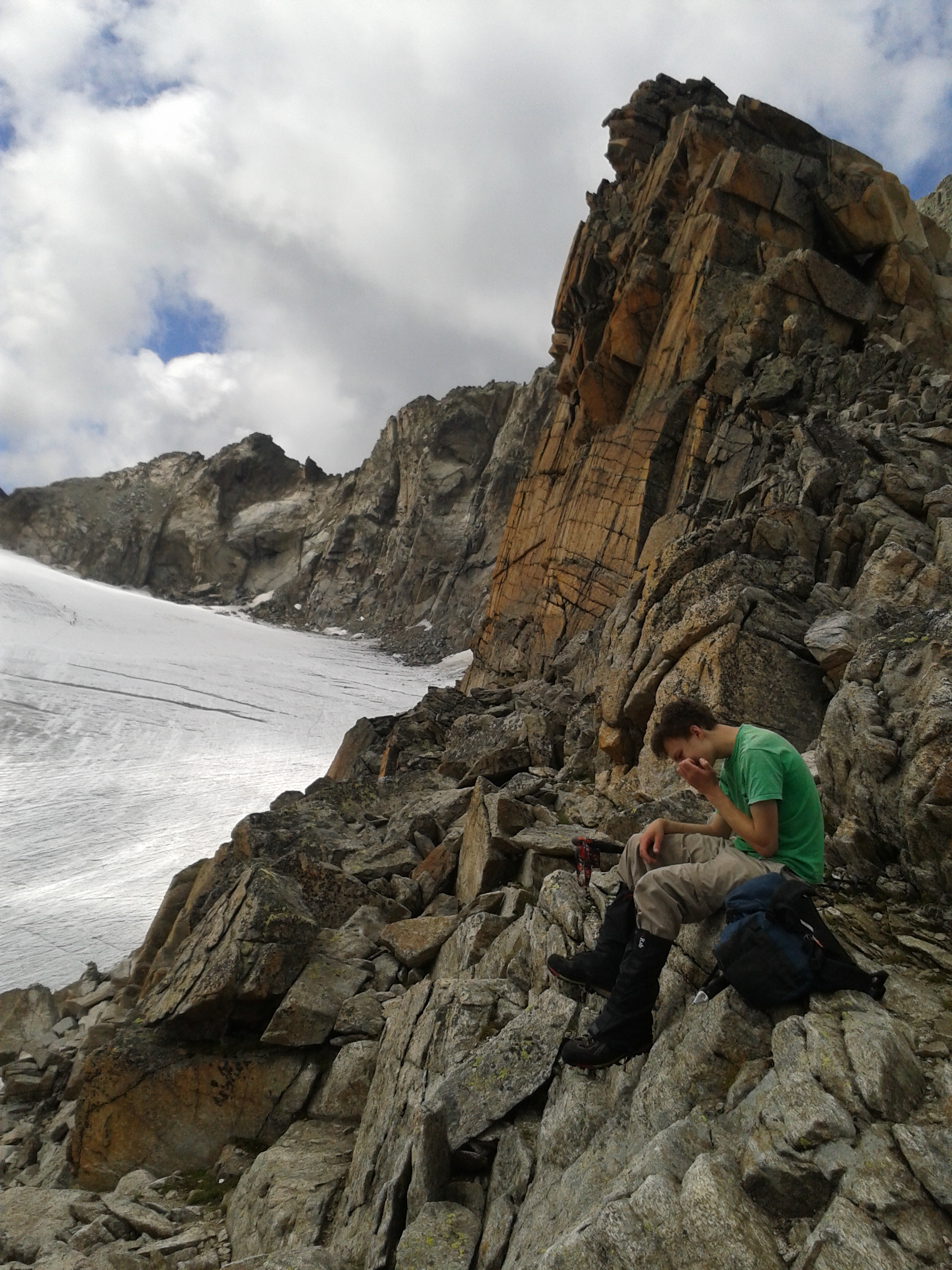
* Pic: Daniel, 2015, Stubai, on the wand leading to the Lisenserfernerkogel, I think. Normally snow covered but it was a dry year.

Refs


* Oh no, not again - not really relevant to anything, but I like my "RP Sr’s one-man kamikaze attack against the IPCC continues".
* ATTP notices that it doesn't get better. Weird, that.
* Pielkes all the Way Down - Only in it for the Gold, Friday, August 14, 2009

2017-10-16

Rejecting Climate Change: Not Science Denial, but Regulation Phobia?

Rejecting Climate Change: Not Science Denial, but Regulation Phobia is a paper by Professor Edward L. Rubin of the Vanderbilt University Law School. Is he respectable? I don't know. I come to this from an article in the Graun recommended by Bart, who is normally sensible. When I came to read the abstract I recognised it, but as something that I hadn't felt inclined to finish when I first saw it. So now I'll try a bit harder.

The beginning, it seems clear that the most significant impediment to a worldwide effort to combat the disastrous consequences of climate change is the United States.1 It seems equally clear that the reason why the United States has assumed such a counterproductive role is the existence of a set of attitudes within its political discourse that is generally described as climate change denial is perhaps defensible but not how I'd put it. For reasons I tried to explain just recently. This could be described as a matter of exposition of interpretation. But a few paras later we come to footnote 3: Climate change denial is the official position of the Republican Party. This is quite simply a lie. You may strongly dislike the GOPs position on GW, and you may well think it unwise, unscientific, unthinking, and un-many-other-things; I certainly do. But to allow your enthusiasm to overrun into lying that it is their official policy is denial unacceptable. Is this really an academic paper, that passed peer review? Or is it just one bloke's ranting? Certainly, there's no pretence at unbias.

But continuing we come to Underlying these two groups of elite actors, however, is a broad base of support within the American populace. Business firms, whose self-interest is obvious, would have difficulty persuading people ofsomething they were not prepared to believe. Politicians whose positions depend on being elected are unlikely to announce or support views that are antithetical to a large majority of their constituents, which I'm happier with. As regular readers know, I've said much the same myself.

Then we immeadiately hit the problematic, and central, ...number of studies that assess public attitudes toward climate change... agree on several basic observations regarding those who deny that anthropogenic global warming is a reality. First, the deniers are willing to reject an overwhelming scientific consensus that the problem exists and poses a serious or possibly catastrophic threat to the welfare of future generations. I don't think it is reasonable to characterise a substantial number - close to 50% perhaps - of USAnians as denialists. It is certainly true (IMO) that if you allowed a popular vote on "should Obama's plans for dealing with GW be implemented?", then a majority would vote no. But that is a different question. Most would be voting largely on ignorance, not denial. The number of actual denialists is much smaller; perhaps 10%; I wouldn't really want to try to put a number on it.

Again, I point you towards my earlier work: Talking past each other: Trump Pick for Top Environment Post: Carbon Dioxide Is 'The Gas of Life'. But I need to expound it further, it seems:

Most people (you must be aware of this) don't make decisions on how to vote, or on what attitude to have towards various issues, based on a close and careful (and expensive, in terms of time) study of the issues. They adopt attitudes based on friends, family, respected pols, meeja, and (importantly) how they fit into their world view in general. And, conversely, how they see those issues presented by their "enemies". If people you dislike tell you in strident terms that you must do such-and-such a thing or you will be a Bad Person in their eyes... can you really believe that works? What if these people not only tell you that, but wrap up all presented solutions to the problem in the guise least favourable to your worldview? That is what we're seeing with GW. This is what we're seeing with this paper (including the comical ideas at the end).

The abstract ends with The reason they do so in this case is that a rational policy to combat climate change seems to demand a major alteration of society. Combatting climate change not only expands the scope of regulation, but involves regulations that effect a major transformation of our basic economic system and our personal lifestyles. Almost uniquely (toleration would be another case), it demands a transformation of internalized attitudes. This has produced what can be fairly described as a phobic reaction among many people, that is, an irrational and persistent fear of a given situation. The article concludes by considering some policies that might circumvent this phobic reaction: mass transit for commuting, intelligent homes, and the encouragement of local food production. In each case, these policies create appealing options for people without demanding major changes in their lifestyle.

You're a Nice Person, no doubt. Maybe you're even Dutch :-). When you read the bit about "mass transit for commuting" your head nodded happily: you like mass transit (although obviously bicycles are better). Everyone should like mass transit (second to bicycles). How could anyone think differently? You might have felt a touch queasy about "the encouragement of local food production"; it causes you to wonder if that is really going to help against GW? Is it really sufficiently important to mention at this level; indeed, would it help at all? But nonetheless the author clearly has his "heart in the right place" so you feel reassured. But unfortunately the Bad People don't feel like that, so all these happy ideas are doomed. They all amount to Moah Regulation and Moah government. Because they are minor, and because they would (being market-distorting ideas) effectively generate rents for some people, there is some chance they might actually happen; sometimes it seems that in general, the stupider the idea the more chance it has of happening.

Really, I'm trying to say a variation of what I said in Morality and economics. And that didn't get through, so I doubt this will. That if you want to speak to the perhaps 50% who don't agree with you, you'll need to find a better way to speak; and to present solutions that aren't designed to grate.

Refs


* IoT Cybersecurity: What's Plan B? by Schneier on Security is probably an example of what might be good regulation (but it looks to be meeting the fate of all good things).
* PUBLIC CHOICE THEORY AND THE POLITICS OF GOOD AND EVIL - contains some decent thoughts, even if I don't agree with it all.

2017-10-15

Talking past each other: Trump Pick for Top Environment Post: Carbon Dioxide Is 'The Gas of Life'

InsideClimateNews (via Twitter) sez President Donald Trump has picked Kathleen Hartnett White, a former Texas regulator and unapologetic advocate of expanding U.S. fossil fuel production... White has argued against the federal government's "endangerment finding" that carbon dioxide, the principal greenhouse gas feeding worldwide climate change, is a danger to human health and the environment. "Argued against" is a link leading to a piece by KHW entitled Restrain the imperial EPA. Which begins The growing power of the administrative state is the defining feature of this era. Federal regulations now touch almost every area of American life, and almost all economic activity. Aggressive regulatory bodies like the Environment Protection Agency (EPA) increasingly impose these mandates by seizing what is the exclusive legislative power of Congress.

So you can if you like complain about stuff like Carbon dioxide is an odorless, invisible, harmless and completely natural gas lacking any characteristic of a pollutant. It doesn't contaminate or defile the air, as actual pollutants do. Ambient levels of carbon dioxide in the air we breathe have zero adverse health effects, in contrast to high levels of genuine pollutants listed in the Clean Air Act like lead and mercury but that kinda misses the point. I think she has a genuine principled belief in the restraint of govt, just like you have a genuine principled belief in doing something about GW. If you don't - and I rather sense that most of my readers don't - think that regulatory overreach is a problem, then you'll dismiss her merely as a denialist as ICN does. Meanwhile, she will dismiss you as a bunch of pinko-leftie-crypto-greenies, and the total lack of dialogue will continue.

Update: Bart rather regrettably falls for this. Bart quotes The Graun, but notice most of that article is just John Gibbons ranting. The only bit of any value is just a ref to Rejecting Climate Change: Not Science Denial, but Regulation Phobia. The paper itself I think is flawed and I might even blog it [update: I did]; notice the icky last para of the abstract.

Refs


* Economist: An assessment of the White House’s progress on deregulation: Donald Trump has blocked new regulations with ease. Repealing old ones will be harder
* Paid to? CH on Jerry Taylor and the generic topic of are-people-that-disagree-bad?
* [2020] The Trump Regulatory Record by Thomas Firey

Moah gunz

I don't want to end up wrapped around the second amendment, because that way lies madness. But there's an interesting take on it, You’re wrong about Second Amendment rights by Gene Yoon (archive), so I'm noting it here for my own use. His idea in brief is that it protects the "right of rebellion", that gunz are only incidental and in the present day irrelevant, and that nowadays it should be interpreted as protecting encryption and stuff. It is a nice idea, and new to me, but sufficiently obvious that I'm sure it is part of the std scholarship. But IMO it has no chance of getting past the courts, so is only useful for philosophical and legal debate.
  DSCN1031-rip

Refs 


 * Gunz: constitutionalism and majoritarianism (archive)

2017-10-14

Hello, good evening, and welcome

As foreshadowed, life stirs again in the old place. I start with a poem:

From far, from eve and morning
And yon twelve-winded sky,
The stuff of life to knit me
Blew hither: here am I.

Now---for a breath I tarry
Nor yet disperse apart---
Take my hand quick and tell me,
What have you in your heart.

Speak now, and I will answer;
How shall I help you, say;
Ere to the wind's twelve quarters
I take my endless way.

I offer no interesting insights into the demise of Sb, so don't ask. it is likely to cease existing at the end of the month and I fully expect the site to disappear. I have already engaged the STOAT (or Stoat Terminating Official Archiving Task) which amounts to sending all my old posts off to archive.is. I'm sure there are other ways of doing it, but this I think will do. Constructing an index to them all is tedious; so far I'm partway through 2006. Perhaps doing it by hand isn't the best way; I might try rustling up some scripty thing.

Sb - or at least my part it in - started in February 2006, so Sb lasted more than 10 years. I started there as a scientist; left science for software in late 2007; but it took me a few years to fall out of touch. Lately I feel less and less interested in the direct science of global warming; it all feels like fiddling with details (I say this with no intent to be impolite to those who are interested; there are lots of things I'm not interested in), whereas I become more interested in aspects of politics and economics. As you may perhaps have noticed.

When I can be bothered, I'll tart up the banner and sidebars and so on.

2007-12-31

2007 at scienceblogs.com/stoat

For no good reason, I jumped to mid-2007. I'll go back to finish 2006.

* Alarmist global warming claims melt under scientific scrutiny? July 2, 2007
* Heat or Temperature? July 2, 2007
* Comics July 4, 2007
* Holy Science Museums, Rapman! July 5, 2007
* Cr*p weather July 5, 2007
* No solar hiding place for greenhouse sceptics? July 5, 2007
* What do we learn from Glaciers in the Highest Altitudes In The Alps? July 10, 2007
* VNC: argh July 10, 2007
* Emulating TGGWS July 10, 2007
* World Climate Report: lying by omission July 11, 2007
* Many Arctic temperature trends July 12, 2007
* Meanwhile, back at TGGWS… July 13, 2007
* Wasting time on glaciers with RP Sr July 16, 2007
* TVs and computers breeding generation of ‘screen kids’? July 16, 2007
* Summer July 20, 2007

* Back from holiday August 5, 2007
* Pordage August 9, 2007
* Bray and von S August 9, 2007
* Urbanisation, again August 9, 2007
* The reaction to Smith August 11, 2007
* Corbyns cr*p predictions August 12, 2007
* Sensitivity by Schwartz, and Irreducible imprecision August 19, 2007
* Theisraelproject.org spam August 20, 2007
* Runaway tipping elements of no return August 21, 2007
* Climate protests at Heathrow: why? August 21, 2007


2006-12-31

2006 at scienceblogs.com/stoat

For or perhaps from the records.

* The cost of climate research February 24, 2006
* Schelling: Wall Street Journal op-ed page, 2/23/06 February 25, 2006
* Hurricanes update February 26, 2006
* von Storch in the blogosphere February 27, 2006
* Whats your Mann number? February 28, 2006

* Wild IPCC excitement! March 1, 2006
* Wild wiki excitement! March 1, 2006
* Climate sensitivity is 3C… March 2, 2006
* GRACE puzzle March 3, 2006
* Kuhn, Paradigm shifts, String Theory and Observations March 4, 2006
* The worst conservative science columnist, ever? March 8, 2006
* Give us back our crown jewels March 9, 2006
* Various titbits from Nature March 9, 2006
* Talking about global warming and wikipedia March 12, 2006
* Two new blogs & misc March 13, 2006
* UK fuel prices March 15, 2006
* A “balanced” conference? March 15, 2006
* Only in America… March 16, 2006
* Wikipedia and the Economist March 17, 2006
* The CCSP report endgame: Temperature Trends in the Lower Atmosphere: Steps for Understanding and Reconciling Differences March 17, 2006
* Record CO2 levels March 20, 2006
* Is my font too small? March 21, 2006
* Science March 23, 2006
* Wikipedia vs Britannica; continued March 23, 2006
* Media garbling: “Scientists forecast metre rise in sea levels this century” March 24, 2006
* Freeman Dyson on global warming March 26, 2006
* Minister to admit failure on key climate change emissions target March 28, 2006
* Breaking up is hard, but keeping dark is hateful March 28, 2006
* Pielke Sr. and Jr. Profiled in Nature March 29, 2006
* More incomprehensible Bush on GW March 30, 2006
* Science – Significant Warming of the Antarctic Winter Troposphere March 31, 2006

* April 1st April 1, 2006
* EGU: Monday April 3, 2006
* Big Gav April 4, 2006
* EGU: Tuesday April 4, 2006
* EGU: Wedsnesday April 5, 2006
* EGU: Thursday April 6, 2006
* EGU: Friday April 7, 2006
* Science and Religion April 11, 2006
* EU CO2 Emission Prices Hit New Record High April 13, 2006
* David King: Death, famine, drought: cost of 3C global rise in temperature April 17, 2006
* Yet more blogging? April 19, 2006
* The septics are cr*p (part XVII…) April 19, 2006
* More junk from Milloy April 24, 2006
* Stupidity from Melanie Phillips this time… April 25, 2006
* Wii… April 29, 2006

* The von S affair May 1, 2006
* River trip May 1, 2006
* Yet another pointless pile of septics May 2, 2006
* Today is Jedi day! May 4, 2006
* Model projections of the North Atlantic thermohaline circulation for the 21st century assessed by observations May 4, 2006
* US govt leaks IPCC report May 4, 2006
* The £4 trousers May 7, 2006
* “Report Reconciles Atmospheric Temperature Trends” May 8, 2006
* CO2 from cement? May 11, 2006
* the U.S. and torture May 14, 2006 [Archive of KV's post]
* Dying Science Museum? May 14, 2006
* UK CO2 (again) May 15, 2006
* Economist wants slice of IPCC pie… May 15, 2006
* CO2 scenarios again May 17, 2006
* Ask a science blogger? May 20, 2006
* 400th comment May 21, 2006
* Depressing Grey Day May 21, 2006
* New moderated env sci forum May 24, 2006
* Aegypt May 29, 2006
* David Appell back May 29, 2006

* Leaking of AR4 precedented June 1, 2006
* Pix of retreating Swiss glaciers June 1, 2006
* Lee Raymond retires with stonking payoff June 1, 2006
* Gmail drive June 1, 2006
* Global warming and extremes June 2, 2006
* Yet another cool google earth thingy June 5, 2006
* Balmy Arctic Stymies Climate Modelers? June 5, 2006
* UK appoints ‘climate ambassador’ June 8, 2006
* Killing themselves was unnecessary. But it certainly is a good PR move June 12, 2006
* New banner? on June 13, 2006
* The managers role June 14, 2006
* Scientists respond to Gore’s warnings of climate catastrophe June 15, 2006
* Secret voting for whales June 18, 2006
* Interesting Nature June 19, 2006
* Global warming featured on wikipedia June 21, 2006
* NAS report June 22, 2006
* NRC report not as interesting as expected June 24, 2006
* Wisdom from John Fleck June 26, 2006
* Zen sticks June 30, 2006

* Climate change in HadGEM1 July 3, 2006
* We’re number 3! July 6, 2006
* What if GW were natural? July 7, 2006
* Characterising Pielke (Jr) July 7, 2006
* Climate of the Past July 9, 2006
* Betting on climate change? July 11, 2006
* The Wegman report July 14, 2006
* Who is Wegman? July 18, 2006
* von S’s testimony July 19, 2006
* Zidane July 19, 2006
* Hurricanes less interesting than expected July 27, 2006
* Warming Wine July 27, 2006
* IREA more interesting than expected July 28, 2006
* Boring old climate sensitivity July 28, 2006


2006-02-24

Assimilated by the Borg

I'd delighted to announce that I am joining such august company as Chris Mooney, Tim Lambert, and many more in being assimilated by the Borg, aka Scienceblogs. It looks like I'm now online at http://scienceblogs.com/stoat/; there are still a few minor setup issues (I hope "who is that in the picture"? won't be an issue by the time you go over and check).

Fear not! My editoiral independence is unchanged, and I still get to be called Stoat.

The cost of climate research

One of the many absurd arguments against global warming is that scientists are only in it for the money. From the comments of a recent post on RC:


Scientists are people too. The money and perks available to IPCC people are extensive. If oil company scientists are unenthusiastic about GW, then it can be argued that IPCC scientists might be enthusiastic from the same kind of incentives.

[Response: The idea that there are vast wealth and perks to be made from climate science is wrong, and would raise a laugh (albeit a rather bitter one) from anyone "inside" - William]

[Response: Money and perks! Hahahaha. How in the world did I miss out on those when I was a lead author for the Third Assessment report? Working on IPCC is a major drain on ones' time, and probably detracts from getting out papers that would help to get grants (not that we make money off of grants either, since those of us at national labs and universities are not paid salary out of grants for the most part.) We do it because it's work that has to be done. It's grueling and demanding, and not that much fun, and I can assure everybody that there is no remuneration involved... RayPierre]


But... how much does climate research cost? Apparently someone said at AAAS this year that globally, roughly $2 billion is spent on climate research, half of that is in the US, and a quarter each in the EU and the rest of world. And I've heard similar numbers elsewhere. I'm going to accept it, because it fits rather nicely with another number I've just found, from the Economist, wot sez: Monitoring local government currently costs £2.5 billion a year, and that does not include the cost to councils of being inspected (this is in the context of the emasculation of local govt in the UK: since they cannot raise much in taxes, but are paid from central taxation, the central govt insists on minutely monitoring what goes on).

So... assuming that figure is accurate: the costs of simply *monitoring* local govt (not actually doing anything) in one small country exceeds the global climate spend. Do we look forward to skeptics now pronouncing that local govt inspectors are only in it for the money?

However... there is more. The $2 billion annual spend is not all on salaries. Whenever this gets discussed, people usually say that this includes a large chunk spent on satellites, which are expensive. I presume that the costs of the newly approved Cryosat II will get included in the annual climate spend. Its a bit like including the costs of CERN hardware when working out whether particle physics is lucrative or not.

Part of the reason for this post is to invite anyone with better figures to post them. What does Dr Google say?

Bush's proposed budget for ... 2004 ... U.S. spending on climate change this year to $4.3 billion.... Ah yes, but that includes "Tax Incentives for Renewable Energy and Hybrid and Fuel-Cell Vehicles...", about $1b/y. Further down, "Federal Climate Change Science Program (CCSP): Includes $1.7 billion in FY '04 budget request to fund Federal, multi-agency research program, with $185 million requested for the Climate Change Research Initiative in FY '04." And this accuses Bush of cooking the books, anyway.

Although the United States spends $1.8 billion a year on climate research, only 6 percent goes to modeling... England, on the other hand, has focused its spending, with $50 million for the European Center for Medium Range Weather Forecasting and another $25 million for Hadley Centre for Climate Prediction and Research.

Um. So, anyone got any bettter numbers?

2006-02-23

BBC goes cpdn

The BBC seems to be promoting the Climateprediction.net stuff: go to http://bbc.cpdn.org/. Good for cpdn I guess.

A Few Things Ill Considered

Coby Beck now has a blog, A Few Things Ill Considered. Coby has for quite a while now been doing an excellent job on sci.env answering the assorted wackos and skeptics, and now he reveals his sekret debating techniques :-)

2006-02-18

Greenland Melting?

"Melting Greenland fuels sea level rise says" Greenpeace. "A new report sheds light on Greenland's quickening meltdown — and why that's distressing" says Time. "Greenland's Glaciers Moving Faster, Losing Mass" says Kansas City Infozine. You get the idea (all of that via google news). Though the best one seems to be "Greenland ice melting faster than thought" by physorg.com. So what can they mean? Can it be "Recent Ice-Sheet Growth in the Interior of Greenland" in Science? Oops no, wrong sign, and anyway that was sooooo 2005 :-) Although to be fair even that mentions thinning below 1,500m.

Nope, it must be "Changes in the Velocity Structure of the Greenland Ice Sheet" Science, 17 February 2006:

Using satellite radar interferometry observations of Greenland, we detected widespread glacier acceleration below 66° north between 1996 and 2000, which rapidly expanded to 70° north in 2005. Accelerated ice discharge in the west and particularly in the east doubled the ice sheet mass deficit in the last decade from 90 to 220 cubic kilometers per year. As more glaciers accelerate farther north, the contribution of Greenland to sea-level rise will continue to increase.


Which is similar to "Rapid and synchronous ice-dynamic changes in East Greenland" by Adrian Luckman et al in the less visible GRL, though New Scientist found it, as did the BBC.

90 to 220 km^3/y is an increase of about 0.4 mm/y in global sea level according to a quick calc (and I'm sure the arithmetic fiends will be quick to jump on me if I'm wrong...). This is 20% of the current 2 mm/y obs (or 13% of the 3 mm/y obs, if you take the more recent satellite obs). Or if you think it *caused* the increase from 2 to 3, its about half of that... The TAR estimates put Greenland into context (as they were then; oh, and here).

So... what does it all mean? I don't know. I wrote this post to find out... originally it was going to be about Luckman, then I realised there was the Rigot thing too. How confusing. Maybe RC will do it properly :-)

2006-02-17

Joke consensus

RP Sr has a weird post about "consensus". He has written a paper with four colleagues, and oddly enough they agree. Which is what usually happens when people write papers together. If they don't agree, they tend to write papers separately. And yet apparently this is to be a new model for the whole community: This paper shows not only can we document a weather event using a variety of climate metrics, but colleagues can work in good faith to produce a truly consensus assessment. This is the model that the global climate change community should adopt. Wooo-eee! yes, lets get 5 people to write the next IPCC report, then there would be no problem with getting agreement.

New wiki toy

I've discovered a new wiki toy to show you your edits graphically. This is me. Fun, no? I seem to peak at 10pm; the BBC R4 news usually reminds me to tail off; and I've usually stopped by 11 :-)

Meanwhile we have mediawiki installed at work, and very useful it is too. It will be even more useful when they work out how to turn on image uploads :-)

2006-02-16

Detecting and Attributing Hurricanes

[Stop Press! Chris Rapley says "in the long term, cities such as London may have to be relocated" - heard on R4 10pm news. There will be more, no doubt...]

Well, obviously enough detecting hurricanes isn't too hard. But the question exercising many people minds is *attribution*: has GW lead to an increase in hurricanes? Attributing individual hurricanes is difficult/impossible (the line taken by RC); we're talking about over all trends & stats.

JA (when not blogging about pet food) has a nice article about attribution here, though he means attribution in general. And there is a nice article about an interview with Judith Curry (top quote: William Gray is one of some "hurricane scientists who don’t know a lot about global climate").

But the point I wanted to make is that failure to attribute to GW does *not* amount to an attribution to anything else: natural cycles, etc etc. And failing to determine a human signal is not the same thing as ruling out a human signal (BTW, I'm not actually asserting that this "failure" has occurred). Which brings me to RPs beastly rough post Slouching Toward Scientific McCarthyism (also read the comments). He quotes "NOAA attributes this increased activity to natural occurring cycles in tropical climate patterns near the equator" (my emphasis). RP believes that disagreeing with "The increased activity since 1995 is due to natural fluctuations and cycles of hurricane activity" (again, my emphasis) is bizarre, since the statement is "fully supportable by peer-reviewed science". But is it? For it to have been so, there would have to be a proper attribution to natural causes. If there is any such papers, what are they?

[Minor updates: at least one cultured person has complained that my calling RPs post "beastly rough" was a bit over the top. They have missed the allusion, which I think RP originally intended in his title, to "Slouching to Bethlehem": to quote the second stanza:

A shape with lion body and the head of a man,
A gaze blank and pitiless as the sun,
Is moving its slow thighs, while all about it
Reel shadows of the indignant desert birds.
The darkness drops again; but now I know
That twenty centuries of stony sleep
were vexed to nightmare by a rocking cradle,
And what rough beast, its hour come round at last,
Slouches towards Bethlehem to be born?


I like that; and that was the bit I remembered. But it starts "Turning and turning in the widening gyre / The falcon cannot hear the falconer / Things fall apart; the centre cannot hold;" which fits a hurricanes discussion quite nicely :-)

And secondly, my somewhat flippant "detecting hurricanes is easy enough" is not really right; there are problems with detection in remote regions in the early days.]

Refs