 George Monbiot, in the Graun
, with
a lead pipe. By which I mean it is the usual bludgeoning. He has various points, many of them semi-valid, including the
superior efficiency of a
non-beef diet, to which I feel a great deal of sympathy. But I don't want to talk about that, I want to look at a thing he points at for his cropland doom, the United Nations Convention to Combat Desertification's
Global Land Outlook. I went expecting to be disappointed and they didn't disappoint me about being disappointing. You can skip the next couple of paragraphs if you don't care about that stuff but only want the
yields are already declining on 20% of the world’s croplands stuff. I find some interesting discussion of vaguely similar points from
a 2008 post of mine. In 2009 I looked at
Could Food Shortages Bring Down Civilization? but failed to say "Betteridge".
As you'd expect, the report isn't friendly to agribiz; their solutions are about "managing" things. Bureaucrats good, never
markets. And we get stuff like
Small-scale farmers, the backbone of rural livelihoods and food production for millennia, are under immense strain from land degradation, insecure tenure, and a globalized food system that favors concentrated, large-scale, and highly mechanized agribusiness. No, that's not the right way to think about that kind of problem; this is more longing for the Merrie England Happy Peasant type stuff that no-one who can possibly avoid it will actually choose to live with. People abandon peasant agriculture when they can, for the obvious reasons. Their Happy Peasant culture of dancing around maypoles
will be lost, just like ours has been.
Much of the early sections reads like boilerplate; things that other people have written, and they've copied, without even thinking about. Take, for instance,
The widening gulf between production and consumption, and ensuing levels of food loss / waste, further accelerates the rate of land use change, land degradation and deforestation. What does that even mean? There can't be a large excess of consumption over production, the gulf can't be that way round, otherwise we'd run out of things to consume, which is physically impossible. So they must mean that production now greatly exceeds consumption. If true, that would be mad, but it would also be a cause for hope: because if you could then cut down on the waste - presumably, the "gulf" in that case comes from waste, I think even the EU has stopped just throwing food away, though even that is indeed waste - you could feed more people from the same land, which would be good. Is that what they mean? I don't know. I get the feeling they've been told to bang out a report, lots of references, at least 1" thick 2" would be good, never mind about the actual words too much.
Anyway, so much for intro, the bit I wanted was
A significant proportion of managed and natural
ecosystems are degrading and at further risk from
climate change and biodiversity loss. From 1998 to
2013, approximately 20 per cent of the Earth’s
vegetated land surface showed persistent declining
trends in productivity, apparent in 20 per cent of
cropland, 16 per cent of forest land, 19 per cent of
grassland, and 27 per cent of rangeland. These
trends are especially alarming in the face of the
increased demand for land-intensive crops
and livestock.
But we also learn, from the start of Chapter 4, that
Over the last 20 years the extent of land area harvested has increased by 16 per cent, the area under irrigation has doubled, and agricultural production has grown nearly threefold. These two ideas aren't incompatible of course. We can be increasing productivity in some places while losing it in others. We could be grabbing good new land while throwing wrung-out old land away. Maybe.
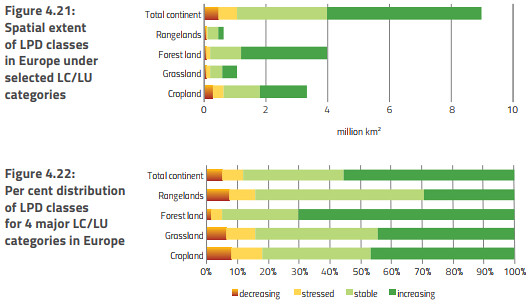
But as Chapter 4 says,
Measuring the extent of land degradation is difficult, so we didn't try to do it we just nicked The
World Atlas of Desertification (WAD) instead. It appears to be an EU product. For an example pic, see Europe inlined above. I've cheated; Europe is the greenest. But is that cheating? Europe is intensively inhabited and intensively farmed; why isn't it desertifying, if that's the problem we're worried about? The answer is obvious: Europe is also run by wealthy people who look after the land, in general. Perhaps that's the solution?
The report is keen to guide your eye, and will tell you for example that
Indications of decreasing productivity can be
observed globally, with up to 22 million km2
affected, i.e., approximately 20 per cent of the
Earth’s vegetated land surface shows persistent
declining trends or stress on land productivity. But if you look at Europe, you'll see that more than 50% is deep-green, which is to say "increasing". That doesn't get a mention (they can't avoid mentioning Europe entirely of course, so they say
Local farming practices often result
in water and wind erosion and other degradation
phenomena that, however, cannot be captured
universally at the scale of analysis with the current
datasets available; they
know there's a problem, even if they can't see it). Even globally, the "deep green" total is bigger than the red-plus-yellow bits. That doesn't mean all is well, but it does deserve noticing; I can't think that a report that doesn't notice that is balanced.
I'd better stop before I channel any more of the spirit of Bjorn Lomborg. Global warming is bound to bring shifts to rainfall patterns that are bound to disrupt our agriculture and natural ecosystems in ways that are hard to predict in any kind of detail. I do caution against
lack of caution.
Refs
*
Does Eating Meat Contribute to Global Warming?
 A recent slightly dodgy RC post from Stephan triggered my knee-jerk. It is about knocking back, yet again, the stupid denialist idea that the recent CO2 rise could possibly be natural. That's all fine, of course, anyone discussing GW with those not really capable of thought comes across this idea; I can find myself mentioning it back in 2005, and I'm sure I did so earlier too.

 Lord
Lord 
 [This is a direct copy of my

 Or, ZOMG! We're all doomed, part N. Via fb (but not so far Twitter),
  Via
Via 