2019-08-22

A dangerous new form of climate denialism is making the rounds?

MVIMG_20190806_080736 So says Twatter, pointing to an exciting Op-Ed in Newsweek. But the newness turns out to be not-so-new (you're astonished, aren't you?): it's just Marco Rubio opining We should choose adaptive solutions. In some ways MR's rather useless article is a step forward, since he is obliged to start Florida will be forced to continue making adjustments in the coming decades because of the changing climate. Trend lines suggest sunny day flooding will become increasingly common as local sea levels rise from a variety of causes. So despite the tell-tale signs of denialism ("continue", suggesting the familiar "climate has always changed" trope; the weaselly "a variety of causes") he's still obliged to confess the reality of sea level rise.

There's then a rather illogical through a carbon tax... The cost would set our state back, depriving us of the resources we desperately need to continue to adapt. So apparently the state raising tax revenue would deprive the state of tax revenue for use in adaption? Or perhaps he imagines that all adaption will be done by private individuals. I bet his retiree-constituents are looking for "the state" aka someone else to pick up the tab, not them as private individuals.

Then comes the interesting Through proactive adaptation alone, the Environmental Protection Agency predicted in 2017, Americans could reduce damage caused by climate change to coastal property through 2099 by 90%. 90% seems a touch on the optimistic side, even for a pol trying to reassure people. Via FOURTH NATIONAL CLIMATE ASSESSMENT: CHAPTER 29: REDUCING RISKS THROUGH EMISSIONS MITIGATION AND SHOUTING A LOT (More than half of damages to coastal property are estimated to be avoidable through well-timed adaptation measures, such as shoreline protection and beach replenishment.2,5,196) I get (it's ref 2) Multi-Model Framework for Quantitative Sectoral Impacts Analysis: A Technical Report for the Fourth National Climate Assessment. U.S. Environmental Protection Agency, Washington, D.C. which says
Without adaptation, cumulative discounted damages to coastal property in the contiguous U.S. are estimated at $3.6 trillion through 2100 under both RCPs. Damages under RCP4.5 are reduced by $92 billion compared to RCP8.5. 
Well-timed adaptation measures significantly reduce cumulative discounted costs to an estimated $820 billion under RCP8.5 and $800 billion under RCP4.5. In comparison, reductions in damages under RCP4.5 are modest, with the majority of benefits projected to occur late in the century.
Ter be onest I have some problems with that. The most obvious is the trivial difference in costs between RCP8.5 and 4.5. That just doesn't seem believable1. Also, I can't really parse the second sentence in the second paragraph. However, overall, while 820 isn't 10% of 3600 it isn't far off, indeed in pol terms it is spot on, so ol' MR isn't totally full of it.

Notes


1. They do notice though, and say:  Global sea level rise is similar under the RCPs scenarios through mid-century. It is not until the second half of the century when the benefits of reduced sea level rise under RCP4.5 become apparent, which are more heavily affected by discounting. In addition, some of the effects on coastal property are due to land subsidence which is assumed to occur at an equal rate under the sea level rise projections of the two RCPs. Could be.

Refs


We need to save the Amazon, but not for the sake of oxygen
* PC – As In “Patriotically Correct” by DON BOUDREAUX from Alex Nowrasteh
Harold Demsetz’s 1982 lecture “Competition in the Public Sector” via CH
Voters can only choose process characteristics and hope for results. Consumers buy results and leave the process to those with specialized knowledge of such things - Thomas Sowell

2019-08-16

Monckers him jump shark

68426185_1226120984250886_2337706435279847424_o You might object that Monckers has already saltated the Chondrichthye but I submit that his most recent missive, faithfully conveyed to wider public attention by the esteemed Dr Seitz pushes absurdity so far that one cannot but wonder if this is not a False Flag Operation.

Stripped of the windbaggery - which is to strip out almost everything - Monckers is sad that the recent somewhat weird Nurture piece "Discrepancy in scientific authority and media visibility of climate change scientists and contrarians" calls him a denier and so on; whether it does I don't know because obviously I didn't bother read it, because it was tedious dull and unoriginal. He wants an apology and threatens legal action if not satisfied; since he won't get his apology but has posted his screed in full public view, one wonders how he will disguise his inevitable climb down. Probably he won't disguise it; the Watties will give him a free pass.

Well, if you didn't like that you can always enjoy the picture. As the caption says, "Confusing medieval depiction of Roman god Saturn devouring his son, which mixes the Greek Chronos (Χρόνος), the personification of time in pre-Socratic philosophy and later literature, known for devouring his own children, with the Titan Cronus (Κρόνος), who castrated his father Uranus with a scythe". I'll skip the bit about what Aphrodite is bathing in.

Update 2019/08/30: Monkers keeps going. I didn't bother read it though.

Alpine climbing routes crumble as climate crisis continues

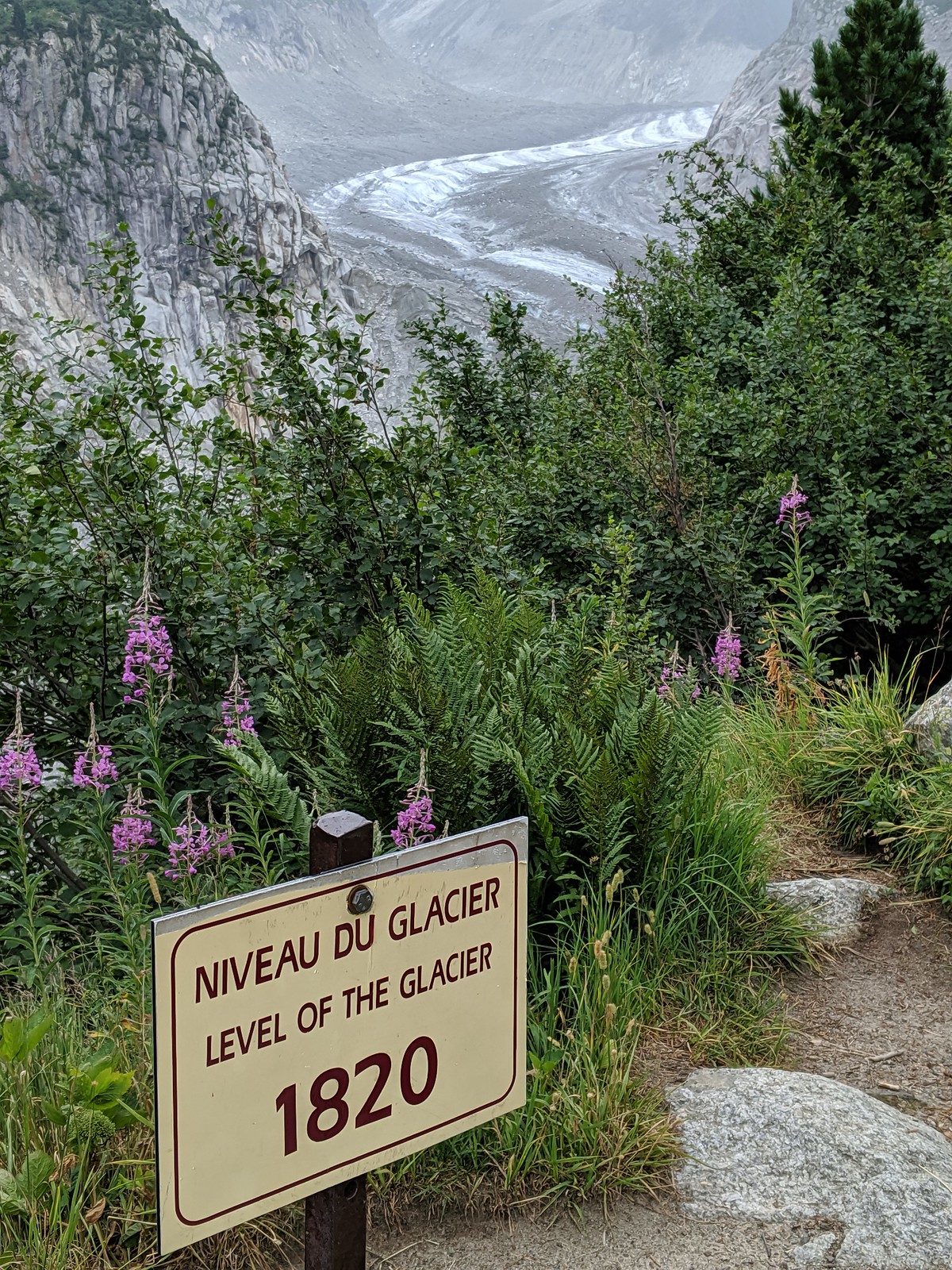
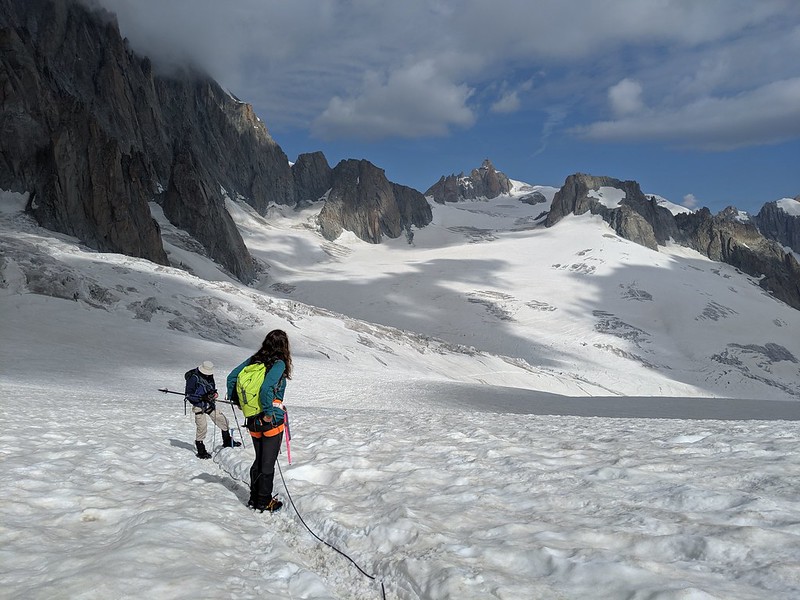
Notes the Graun, and I won't quibble. The most obvious thing you notice when going up is that the glaciers have retreated away from the huts and paths. Here's a sign above the Mer de Glace:

MVIMG_20190727_125052

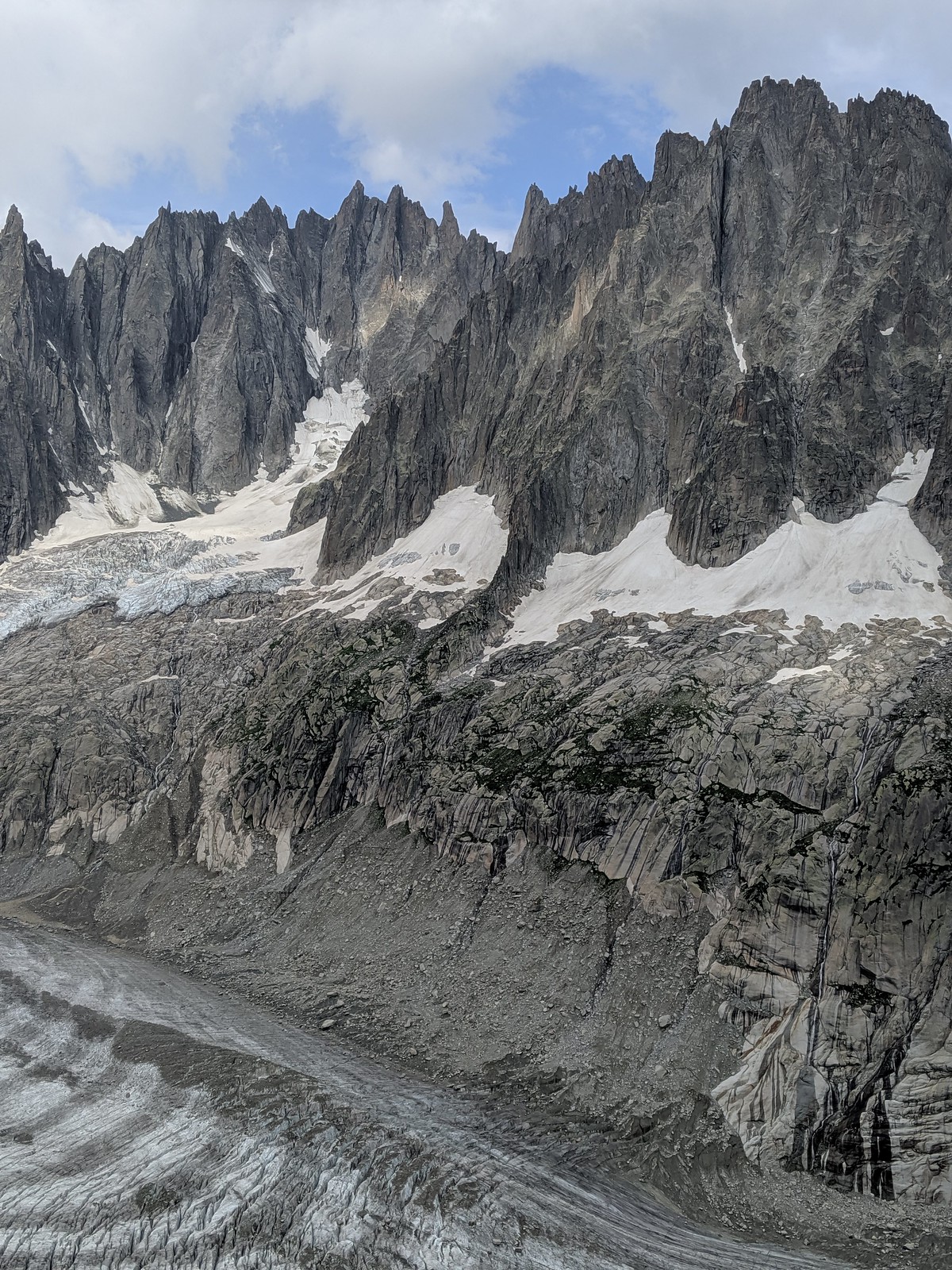
(regrettably it isn't in any other way interesting as a photo). That's above about 100 m of path leading down to about 100 m of ladders leading down to the moraine (the ladders on the other side up to Couvercle are even more exciting) from which you scramble onto the glacier. Looking across from the L (Couvercle) side (as you go up), here's a view across to the Aiguilles, and (if you click for the enlarged version and know what to look for) you can just see the refuge Envers des Aiguilles on the rock rib in the center of the pic.

MVIMG_20190727_091718

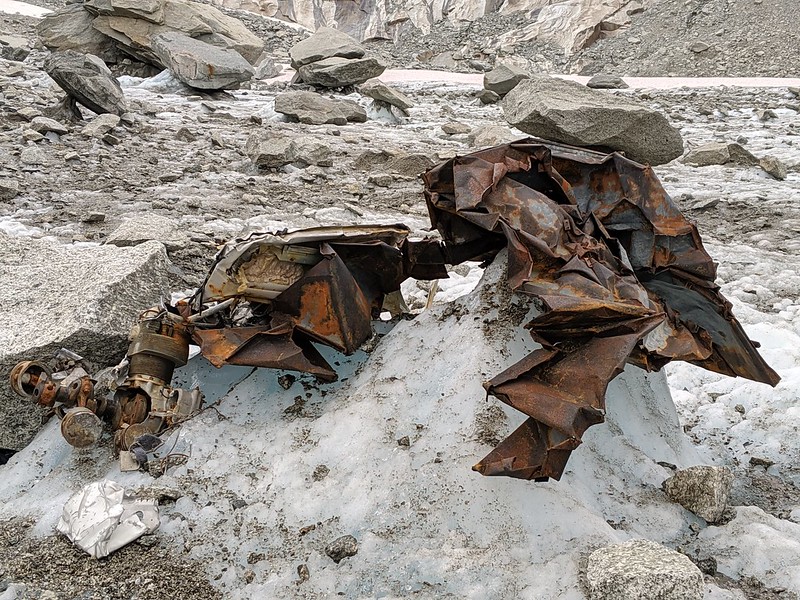
You can also see how massively the glacier has retreated (though to be fair not all of that is recent; it was a long way up the Envers ladders in 1992). As for the old things melting out of the ice, here's part of what I assume is a helicopter crash, unknown vintage, Talefre glacier.

MVIMG_20190726_155556

Also speaking of melting out, the ridge down from the Aiguille du Midi telepherique onto the glacier now has old bales of straw and bits of wood appearing, instead of the pure snow it used to be. Perhaps the residue of some old hut.

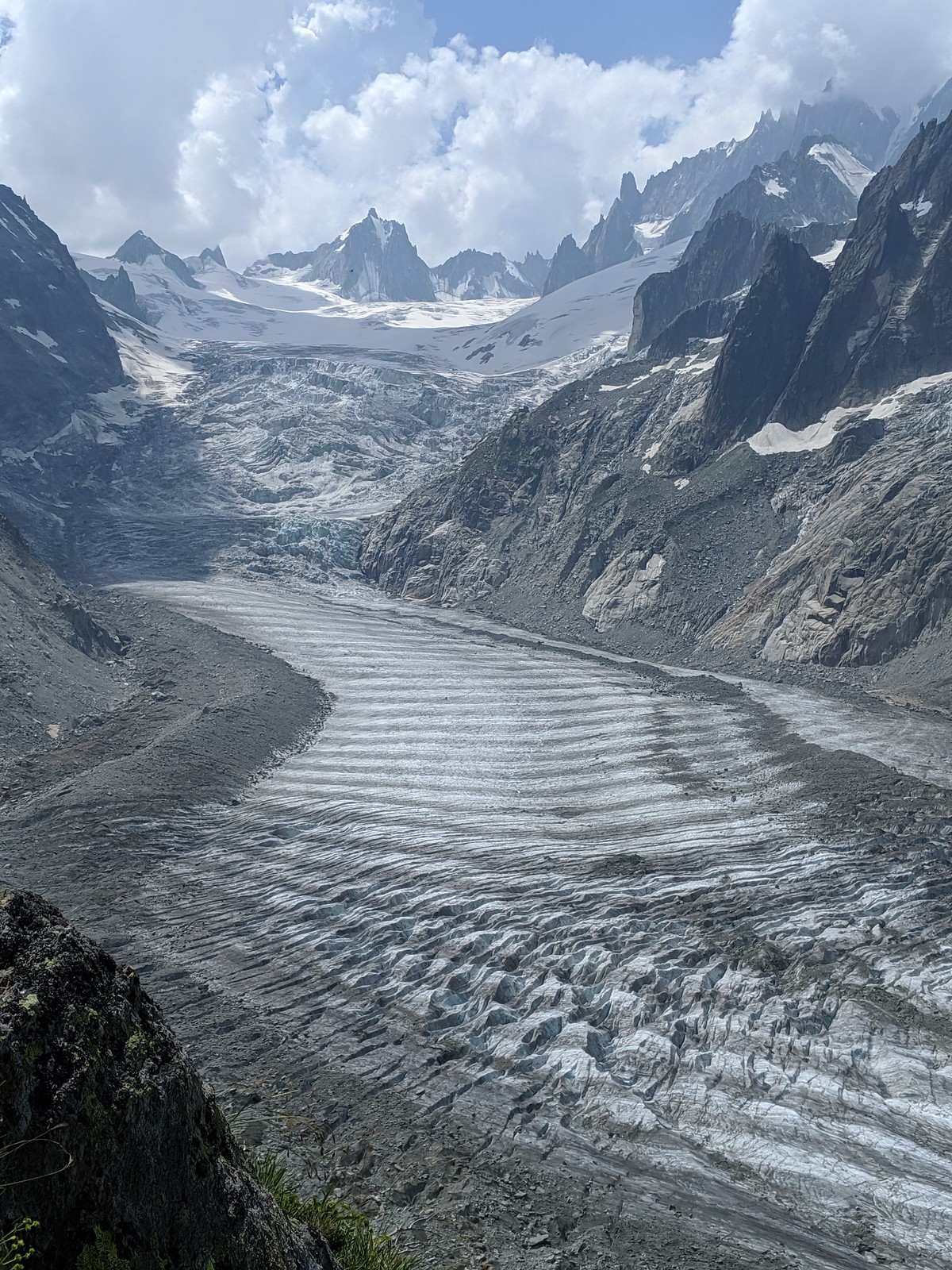
The Mer de Glace is bare and excitingly striped. You can just make out the Requin hut on the ridgeline in the center, in front of the icefall.

MVIMG_20190725_132014

It is sad that the ice is melting, and the character of so many routes is changing. One of the reasons we went to Chamonix this summer is that by comparison, elsewhere, it can be hard to find reliable snow and ice. Mostly the changes are making things harder: the Dome de Neige des Ecrins is no longer Facile due to opening up of crevasses high up; a route we did this year on Pointe Isabella is now icy glacier; glacier; brief ice; rock ridge; snow ridge; rock; snow; and rock; whereas my old guide book shows it as continuous snow before brief summit rock. Though to be fair, that makes the route more interesting.

MVIMG_20190726_075354

Pointe Isabella (the peak on the skyline half-right; the one half-left, apparently lower but actually a bit higher, is the Aiguille du Triolet). Go up the glacier, take the snow-ramp to the R before the ice-fall, get over the icy bit and take the snow ridge (not seen) to the visible snow ridge, leave that to the R for the rock ridge (excellent views of the ice-fall) and then you're on the near-summit ice slopes. Though if you're us you've got to 3650 m at noon, and prudently decide to turn around cos bad weather is forecast.

But the Graun's assertion that everything is falling apart is dubious, I think. The ice is retreating, yes, of course. But there are still acres of good granite to climb on. Here's some of it - there was so much I didn't bother to take proper pix. This is on the way from Cosmiques (Aig Midi on the skyline) to Torino.

MVIMG_20190806_100530

Yes, this post was just a thinly-disguised excuse for some holiday snaps.

Refs


The Antarctic ice sheet is melting and, yeah, it’s probably our fault - Eric at RC. Refs me!
Iceland's Okjokull glacier commemorated with plaque
Mont Blanc: Glacier in danger of collapse, experts warn - 2019 / 09
Shrinking glaciers: Mont Blanc from the air, 100 years on - 2019 /10

2019-08-10

Another one bites the dust: Theodor Landscheidt

MVIMG_20190728_160940 Those from ye olde dayes will - indeed, it is practically a test of whether you were around then - recall Theodor "don't mention astrology" Landscheidt. He doesn't show up on "mustelid" and only appears in the scienceblogs era via comments, and asides at that, so interest in him faded rather quickly post-death (I only really know of his existence from sci.env, and even then he was curiously shy). But! He is about to die a second time, how malign is fate: WP:AFD will take him down this time (I can't be bothered to !vote; he survived in 2008). There's a User:Landscheidt who apparently coincidentally has been recently adding gumpf to Planet Nine.

Speaking of wiki: if interested you should see the disastrous WP:FRAM.

Anyway, for the records, here is:

* the page history,
* the state of the page when most useful,
* the current page state.

Image: from the tour Batiaz in Martigny; the abeilliary (right); vines (left) and the track up to the tower (center).

Refs


Freedom Is Not Protected By Its Violation - CafeHayek
This lack of motivation is connected to another important psychology – the willingness to fail conventionally - Dominic Cummings (yes him)
My days among the dead - Southey
* The Persistence of Poverty: It's Complicated - by Bryan Caplan
* For Most Things, Recycling Harms the Environment? by Michael Munger; see-also Chasing Rainbows: How the Green agenda defeats its aims

2019-08-08

I'm back

I've been on holiday. You may have noticed the lack of action here. But I'm back now so the usual diet of thinly spread out ill-informed opinions interspersed with bees can resume.

PANO_20190803_102625.vr

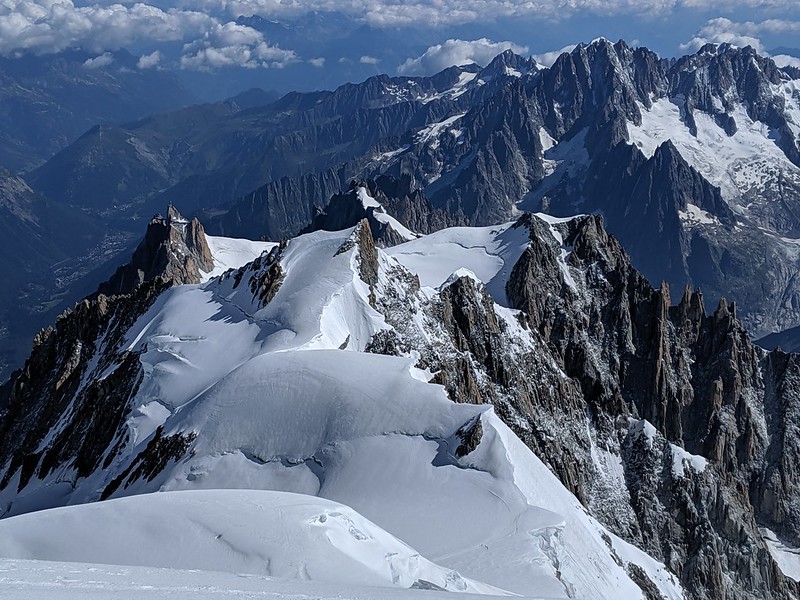
You'll immeadiately recognise the summit of Mt Blanc, 'twas a glorious sunny day though bitterly cold and windy. But don't worry I'll be boring you with more of that anon.

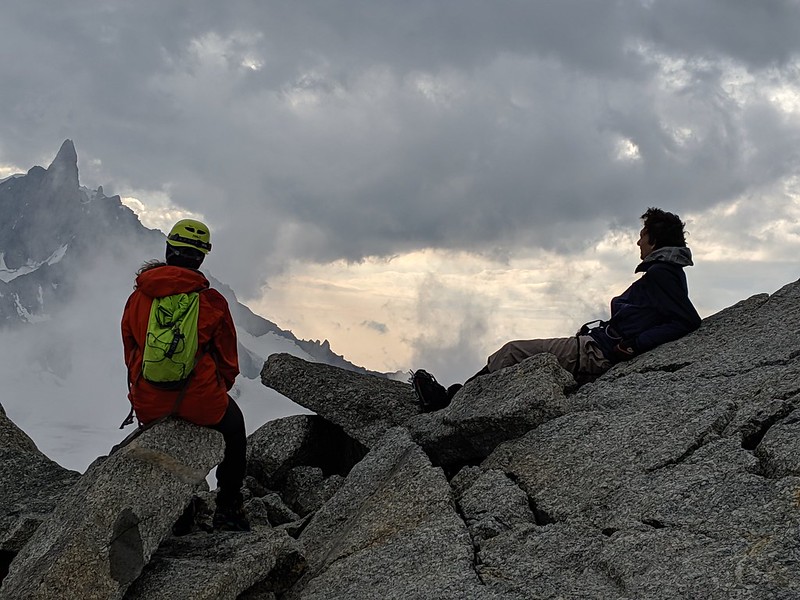
Of course when I say "you'll recognise", I now realise it's pretty hard for me, and I took it. Foreground, left, Miranda in red crouches against the wind and Daniel leans on his ski stick. Further left background is the Aiguille du Midi. So the track leading off left-forward is the top of the Trois Monts route, and the Gouter route goes back behind the pile of people on the right. I'm moderately sure that the peak near-center is Mt Blanc de Courmayeur. We took the Gouter route, but, starting from Tete Rousse.

Refs


Capitalists need friends - TF.
* France 2019: notes and Troyes.

2019-08-01

France 2019: Mt Blanc: Tete Rousse / Gouter

This is just a inserted-out-of-time post to link to France 2019: Mt Blanc: Tete Rousse / Gouter, on my "personal" blog, mostly for my own reference.

MVIMG_20190803_102856

It was a mixture of the unutterably glorious with slog, but the expected value is very high.

2019-07-16

This year's model

On 5, I thought we were pointing out too far; but as bow there was nothing I could do. And anyway we start at 11, so you want to point out a bit. And then the gun went and we had a clean start through the winds to the lengthen to the rhythm all on autopilot really which is how you want it. After about 20 strokes I glanced down and my heart was at 160 which is good for me so I didn't need to put any more in. Past the outflow and all continued well; by first post we were gently dropping City two which was no great surprise as I'd watched their practice start and it was a little tentative and ragged. Around Grassy we were - and this was a surprise - on station with Nines two ahead, despite their double bucket rig and bucket hats. Everything was smooth, all was well, all the nerves had smoothed out. Half way down the reach Nines bumped Robs with us still nearly on station, which bodes well for tomorrow. The eagerly awaited question of this year was settled there, as Nines one had caught Tabs; and for good measure, Robs one, City one. Tabs three had wound down a bit so we pretended to chase to top finish for the over bump and got to a length, which was fun; but City two and three and possibly Nines three behind got confused and continued past bottom finish, forgetting that they are lower table folk. Trace.

Day 2: we were even more blatantly pointed out today, to the extent that Harry had to back down on 10 to try to correct, and I was so distracted that I only squared up on 5. But despite being able to feel the swerve we still got a good start and gained a little. However, we didn't gain enough, and while it felt fine I think we fell victim to that old bumps trap, the waiting game: grinding them down on the Reach as a plan. As it happens we did end up closing to 3/4 by the bridge, but that's not enough, even though it was more of a serious effort than yesterday's finish: my heart went up to 167 which is very close to my red line. Afterwards, general agreement that tomorrow we should hammer FP, the Gut and Plough reach harder, and some genteel conflict between keeping the rate high off the start - which would be my preference - and needing to settle somewhere. We are, we think, better at rowing than them; they are younger and fitter en masse; to capitalise on our advantage I think we need to push the rating up. Trace.

Day 3: much better pointing, and we tried to execute our "somewhat harder off the start" plan but, well, essentially discovered we were already going as hard as we possibly could. What we also rather ominously got to see was Peterboroug bumping City 2 behind us just after FP, which doesn't bode well. We got a whistle earlier, but still only one. On the finish line, Robs very nearly caught but were just a fraction late, which is sad, as it would have been nice to chase someone slower. Trace. The camera is pointed a little more inboard this time so you get to see my grey beard and astonishing biceps.

Day 4: rain on the way down - rain when I was marshalling W2 earlier - but not raining during the race. After what seems like days of not being pushed from behind, so much have we got used to it, Peterborough have moved up behind us and seem to be catching City boats quite fast. So the thrill is back. We go off the start fast, and keep the rating high down FP, and ever so slightly to our own surprise this works: not only do P stay on station but we get a whistle on Robs before FP. Sadly that doesn't get any closer but then again neither do P. There's a bit of swerving around a bumped-out Robs on Ditton but our cox handles that well; now there's nothing ahead of us but the Reach and... then it's over, with P distant. After that only a night down the Waterman then City and despite my self-promises too much beer. Trace.


Of M2


Paul Holland blogs M2: day1, day2.

2019-07-14

The One Viable Solution To Climate Change?

An article so bad it unites mt and WUWT, albeit for slightly differing reasons. The article by Steve Denning (who?), uncritically channelling a Manhattan Institute report, sees solar, wind and nooks as unviable, and concludes, in mt's rather accurate paraphrase, "Let's get the smart people to come up with something nobody's ever thought of that doesn't have drawbacks!" which has echoes of John McCarthy's solutions.

The article starts with
we are near the theoretical limits of what is possible from efficiency improvements in existing hydrocarbon technology or from wind, and solar energy and battery storage... [and] Hydrocarbons collectively supply 84% of the world’s energy. wind, solar, and batteries provide about 2% of the world’s energy and 3% of America’s.
The second part is meant to show you how piffling renewables are; the first presumably is to convince you that renewables can't grow much more.

But these are both non-arguments. They're direct from the MI report, and I suspect our author hasn't managed to think his way around them, so I will do it for you, in the unlikely event that you can't.

Theoretical limits


The argument that we're close to the limits on efficiency, and are therefore stymied, is silly because that's not where the increase in wind or solar will come from: it will come from more deployment. Which people consistently underestimate. I could write more words, but really his error is that simple.

Nooks: public unease


His killer argument against nooks is public unease. There is truth in this, but to quote the quoteable but not entirely accurate EW at WUWT: Has anyone else noticed how weak green excuses for not embracing nuclear power are? I mean, on one hand greens tell us the world will end in 12 years or by 2050 or whatever, yet in the same breath they tell us nuclear power is too dangerous because there might be a few meltdowns. How could the risk of a few meltdowns possibly be worse than the end of the world? And of course in some places - e..g. France - this unease seems to be overcome. I once thought we would be obliged to overcome this, now I'm doubtful: solar will probably take over instead.

Proportion of supply


Their 2% value isn't really an argument, just a note about the present. And a somewhat deceptive one; this says that renewables (mostly hydro) account for more than 20% of global electricity. It does tell you something about the maturity of wind+solar though: if it is currently a small proportion, we're not well used to integrating large proportions of it into supply. Though the UK survived well enough recently.

Sources


While I'm here, this report from the IEA says that "modern" bioenergy is bigger than hydropower, which is bigger than wind+solar combined. I find that somewhat surprising.

Video


I haven't bored you with rowing for a bit, and didn't have any other pic to hand. Town bumps is next week, we've been tapering and doing a few short starts; I tried pointing the riggercam onboard as an experiment. Yes, two could sharpen his catches a little.

Refs


Can planting trees save our climate? - RealClimate by Stefan

2019-07-10

The Jeffrey Epstein Case Is Like Nothing I’ve Seen Before?

Quiet, innit? Don't worry, there have been plenty of fireworks behind the scenes. It turns out that there are places where writing "I like stoats" is a mistake. But moving right along - skipping for now the Graun's Molly Scott Cato: ‘It’s the wealthy who are causing climate change’, but don't worry, I'll get back to it5 - we come to The Jeffrey Epstein Case Is Like Nothing I’ve Seen Before; Great wealth insulates people from consequences, but not always, absolutely, or forever by Ken White in The Atlantic. This post will be another attempt to discuss some of the ODOV ideas I tried to discuss in Aristotle's politics. Do not fear! I know this discussion is doomed, just like the previous one: I'm really just writing down my thoughts.

Anyway, let's begin by quoting enough of the article to get the substance of the case:
In 2006 and 2007, [billionaire Jeffrey] Epstein—once a reliable companion of the well connected—faced extensive, detailed allegations that he paid multiple minors for sexual contact and for their services in procuring other minors. Most people, hammered with that kind of evidence, would spend the rest of their lives in prison. But Epstein could afford the lavish attention of a defense team staffed by legal luminaries such as Alan Dershowitz and Kenneth Starr. Most of us hope an attorney will defend us competently at trial, but the superrich can afford to go on the offense. Epstein’s lawyers hounded the U.S. Attorney’s Office for the Southern District of Florida, which was considering federal charges... Epstein’s team secured the deal of the millennium... Epstein agreed to plead guilty to state charges, register as a sex offender, and spend 13 months in county jail, during which time he was allowed to spend 12 hours a day, 6 days a week, out of the jail on “work release.” In exchange, the Southern District of Florida abandoned its criminal investigation of Epstein’s conduct, agreed not to prosecute him federally...
Why did the Department of Justice cut such a deal? the article plaintively cries, before answering with the obvious "because he was very rich"1. There is an ideal that justice is the same for all. Indeed, this is one of the bedrocks of the liberal society, and a society that did not strive towards this ideal would be poorer. But we all know that in practice the ideal isn't true. If you're rich, you can afford better lawyers. In some senses, this is a condemnation of our legal system: a good legal system would be far more immune to quality-of-lawyer in cases. But we2 don't have a good legal system: we have a tolerable4 one. This is the point to recall Adam Smith's quote: Little else is requisite to carry a state to the highest degree of opulence from the lowest barbarism, but peace, easy taxes, and a tolerable administration of justice.... Generally people quote that for the easy taxes bit, and sometimes for the justice part (when contrasting with, say, Russia or Nigeria or Venezuela) but people usually omit the "tolerable" from consideration; or if they include it, they read it as tolerable-or-above. But the thought I wish to think here is that AS meant "at least tolerable, and not too strict". Law is custom, and so an over-strict attempt to adhere rigidly to the written law, if that doesn't fit custom, will not succeed; or will strain society; whichever you prefer3,6. This is but one particular example; there are many others, which of course escape my mind at present.

Update


Not strictly relevant here - I didn't even mention his name - but via the Economist I see Editor’s note: Alexander Acosta announced his resignation on July 12th 2019. See-also Aunty.


Notes


1. As a light side-issue - which is why it's down in the notes - I draw your attention to the article's "The personal attacks on the prosecution likely helped too: Federal prosecutors aren’t used to being on the defensive". I think this is true, but actually just points to a different problem on the other side: rephrased, it could be "FPs are used to being high-n-mighty and having people tremble before them".

2. Countries of the West: the US, the UK, Europe, other happy countries.

3. In a doomed attempt ot prevent people falsely accusing me of suggesting rich malefactors should get off scott-free, I point out that I didn't suggest that, and he didn't.

4. Arguably rather better than tolerable in some ways, in view of the next few sentences, but I couldn't think of a better word.

5. Update: actually, I can't be bothered.

2019-06-23

Should the Judiciary Be Making US Climate Policy?

In the usual way of such headlines, the answer is No. The link is from twatter, the original in Forbes from Nives Dolsak and Aseem Prakash. What do they have to say? Our key point is that asking the judiciary to mandate climate policies might have the unintended effect of concentrating policymaking power in the judiciary, thereby affecting the long-term health of the US democracy. What a brilliantly insightful suggestion, one I've never heard before. Well done for originality chaps. In more detail:
The US constitution outlines the separation of powers in Articles 1-3. It vests the legislative authority with the Congress. The executive branch is supposed to implement the law, while the judiciary is expected to interpret it. Yet, it seems that with the judicialization of politics, the judiciary is accumulating more policy power than what the constitution intended. In the context of climate policy, we focus on two issues: the inability of the Environmental Protection Agency (EPA) and the California regulators to agree on automobile tailpipe emission standards and the Juliana case, where citizens are petitioning the judiciary to mandate a climate policy.
This of course has been done to death elsewhere, most obviously in Alsup but elsewhere: people, desperate for progress because they can't get their faves through Congress, try an end-run with the Judiciary. A nice try if you can do it, but of course it leaves you vulnerable to the bad guys doing the same thing.

Our authors, in their discussion of Juliana-like stuff carefully avoid mentioning Alsup, because it answers their question, and where would talking heads be if questions were actually answered? So let's look at the emissions standards. This one is delicious, as such things often are, and this aspect is new to me: California, as we know, has strict emissions standards which often become national defaults due to the size of the Californian market. They have a "waiver" from the EPA from the Clean Air Act allowing them to set stricter-than-national standards, on the grounds of the particular nature of their pollution1. The Trump administration, desperate to pump CO2 into the atmosphere, would like to remove the waiver. But, can they? This is exactly the kind of question that does belong in the supreme court, so I think our authors are on dodgy grounds arguing the courts should keep out. Someone called Jonathon Adler argues that Trump probably can remove the waiver, for GW type stuff, since the "special conditions" argument doesn't apply to GW. I'm somewhat doubtful on more basic grounds, since it isn't clear what powers the Feds have to restrict State law, except as permitted by the constitution, and I'm not sure what they're claiming in this case: the articles I've seen don't mention this. JH points out the irony of... there is something odd about an administration that has proclaimed its support for “cooperative federalism” now bending over backwards to preclude individual states from making their own regulatory decisions.


Refs


Happer, Koonin, Lindzen vs Alsup
Mass starvation is humanity’s fate if we keep flogging the land to death?
* Two areas where I am out of step by Scott Sumner
* Historically Hollow: The Cries of Populism by Bryan Caplan
* A Delight in Despotism: The Case of Vaping by Pierre Lemieux
* Why It Must Be the People Who Preserve the Flame of Liberty by Barry Brownstein
* Should we ban bicycles in major urban areas? by  Tyler Cowen

Notes


1. As I hope is clear, this waiver stuff is new to me. Feel free to correct me (with sources) if I've misinterpreted it.

2019-06-22

A majority of USAnians think someone else should pay for global warming

MVIMG_20190609_154809 In truely shocking news just in, it turns out that people would like someone other than themselves to clean up their own mess, just like children. Idiot Naomi Oreskes twat1 "A majority of Americans hold fossil fuel companies responsible for damages from global warming", and as far as I can tell she did this with a straight face. The survey is here; the most relevant quote is:
When asked more specifically about whether fossil fuel companies or taxpayers should pay for the costs of the damages caused by global warming, a majority of Americans (53%) think fossil fuel companies rather than taxpayers should pay for most or all of the costs. Only 12% of Americans think taxpayers and fossil fuel companies should pay an equal share, and just 6% think taxpayers should pay for most or all of the costs.
This is all wearily familiar. People won't face up to their own actions and want someone else to blame.

Update: Politics: loan sharks and abortions


Suddenly struck by a thought, I'll put it here. Left-wingers are generally keen on generally-available abortions, and right-wingers unkeen. Left-wingers correctly point out that making abortions illegal or unobtainable will do little to suppress demand, leading to people resorting to unsavoury methods. Now for the "analogy". I signal it so you won't miss it. Left-wingers are generally keen on schemes to cap interest rates on loans to avoid "predatory" lending, and right wingers correctly point out that cutting off a source of credit will not reduce demand, leading to those seeking credit to turn to less savoury sources. So in one case one side can recognise supply and demand and the inevitable logic, but are unable to apply it to cases where the answer doesn't favour their desired solution.

Notes


1. Past tense of the verb "to twit". No insult implied, of course.

Refs


Yet more bollox from Oreskes

2019-06-15

Red team goes down

minty Day one was wet, torrentially so in the morning but merely a bit of rain by The Time. The Red Team went off well, the Yellow team were a shadow of last year's glory, and the Pale Blue team went down to the Minty Blue team who put in an impressively powerful display - a joy to watch. Unbeknownst to me the Purple Team pulled a blinder and got the Yellow team not far from the finish - unprecedented in living memory that far up -, setting up an exciting situation for day two. Which was similarly wet. The Purple team surprised no-one by going all out off the start but the Red team proved strong manly and unflappable, with the Purples fading and caught by another burst of raw power from Minty Blue; the Yellows fell further out of our range of interest. Day three, now sunny, was inevitable, though I won a fiver on it: the Minty Blues took down the Reds with more raw power and quality, and the Purples had nowhere to go. Day four saw the Minties well clear, the Purples as expected closed the Reds off the start whilst I looked elsewhere - at the deeper Blues and the deeper Purples and the still deeper Blues. And yet, there it was, just before the finish: the Reds down to the Purples.

oglaf-dick An allegory for our times, no doubt.

Meanwhile, we return you to our traditional "Red team" cartoon, because this nonsense is coming round again. Really, all I'm going to do is link to Gavin's post We watch long YouTube videos so you don’t have to, in response to some bloke called Steven "Steve" Koonin. But really, the Blue team have already won, which is why no-one dares to set up a Red team, since they're fully aware that it would be an embarrassing failure, as I said in February.

Refs


* The full playlist is here, but there's a lot in that, so you may prefer just day one, day two, day three and day four.
Digital legibility and incentives towards moral behaviors - TF
NSC'S JOHN BOLTON OFFERS NEW RED TEAM RATIONALE
* Poke out one of my eyes by Scott Sumner
Trump White House shelves ‘adversarial’ review of climate science via RS
  64488477_10157195841407350_2552905750171090944_n

62539263_10157198143672350_5041472142923792384_n

2019-06-03

Does J R Oppenheimer ask: can science provide better models for democracy?

60789145_1163461953850123_1190781572601610240_n As with all good headlines, the answer is "no". The question "Can Science Provide Better Models for Democracy?" is asked by mt in a guest post at ATTP's. Fathering it on JRO is a little odd, as is doing it in such a way that you can't really tell so are forced to ask. This is perhaps a quibble, but I found it distracting. And indeed although applying-science-to-politics is clearly what mt is interested in, it isn't clear that it's what JRO is interested in; whether there are elements in the way of life of the scientist which need not be restricted to the professional, and which have hope in them for bringing dignity and courage and serenity to other men, can obviously be applied outside politics; even the social problems of the day and try to think what one could mean by approaching them in the scientific spirit… In short, almost all the preconditions of scientific activity are missing… can be.

However, I now drop that quibble and consider mt's question.

As usual with mt's stuff about politics, whilst I find it interesting and stimulating I also find it almost completely wrong. One piece of wrongness, although not the most important, is Ah but come back those twenty years later, and who has made progress? The scientific landscape is utterly altered, while the political landscape is the same mess. It is certainly true that not all political problems have been solved, but then the same is true of science. But politics progresses: the percentage of those living under democracy has increased in the last 20 years, and is part of a long upwards curve. Extreme poverty is decreasing. General acceptance that all people have equal fundamental "rights" spreads. And so on.

But the main wrongness, to me, is the familiar one: the desire to have govt do stuff for you. If you look at science and at politics, and despair for the progress of pols compared to science, then one reaction is to try to import some science-y-ness into pols; but another is to have govt do less. It hasn't done a very good job (the decrease in poverty, for example, is due mostly to trade / globalisation / captialism, not govt) so the best thing is to have less of it. Sadly, one of the failures of politics since the 1980's is to appreciate the likes of Thatcher and Hayek.

Related to that is Our present problems seem rooted in a lack of ecumenism, a stupid failure to see the commonality of our collective fate... It’s one world. It thrives or fails as one. This is also not really true, and the sort of thinking that leads to top-down failed stuff like Kyoto. Trying to co-ordinate a world that thrives or fails as one is too difficult; problems can only be solved by being broken down into smaller pieces. Thinking of the world is great, as an abstract concept, of course.

Refs


* Electricity from Large Dams Does NOT Count as Renewable Energy by David Henderson
MUSCLE CARS ON THE INFORMATION SUPERHIGHWAY - RS
GOP support for Trump has moved from transactional to fanatical
BRINGING AGW DOWN TO EARTH - RS
Governed by Imbeciles
* Beware the Candidate with a Plan by Bruce Yandle
Why don’t people pay attention to the future of their own world?
Not everyone cares about climate change, but reproach won’t change their minds
YES, WE HAVE NO AZOLLA - RS
* The 7 Worst Ideas for Regulation This Century by David R. Henderson

2019-05-31

The electricity mix during two weeks without coal in Great Britain

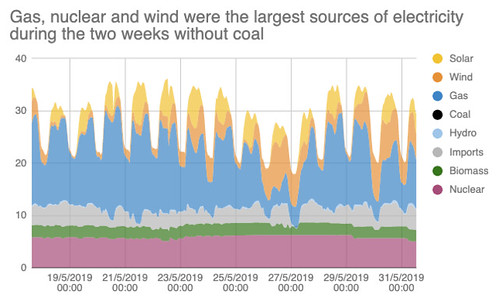
D75sYB-W4AAuIuj.png_largeA nice pic of  the electricity mix during two weeks without coal in Great Britain, from CarbonBrief. Nukes are near-constant, as expected, as is biomass; gas is reactive; solar and wind are variable. I wonder what we ascribe the imports to? French nukes probably.

This shows I think that there is scope for more solar and wind before getting problems with running out of the gas+imports buffer, but that we'll start hitting limits eventually. An alternative view is provided in this twit, showing percent not absolutes, but it is somewhat misleading; notice how nooks look like they're variable, but of course they aren't.

Some people are very anti-gas, including the predictably-wrong David Roberts, but I think that's misguided. I was going to rant about that post but decided I couldn't be bothered. I was also going to rant about A call to climate action by that nice Jonathan Overpeck in that rag Science but realised that was misguided: he has nothing new to say, and I have nothing new to say in response.

Refs


* Down with pumped hydro storage, Up with dispatchable hydropower! - Brian
* RS elaborates on the idea: THE UPHILL FIGHT FOR DISPOSABLE DISPATCH
* Speaking of which: Stemming the Plastic Tide: 10 Rivers Contribute Most of the Plastic in the Oceans / The Yangtze alone pours up to an estimated 1.5 million metric tons into the Yellow Sea. None of them are in the West, who could possibly have guessed?
* Why is Immigration a "Contentious Issue in Classical Liberalism"? by Bryan Caplan
* 100 years of electricity generation in Great Britain... Just look how rapidly things have changed over the last decade! @Draxnews Electric Insights. https://electricinsights.co.uk
* British coal plants fired up to meet temporary electricity shortfall: Remaining UK coal plants, including Drax, supply 6% of grid’s electricity to cover power supply drop and colder weather - now (2020/11), turning on coal is a notable thing in itself.

2019-05-30

Weird shit from Mann

61587538_1166425846887067_41158319410249728_o The Dems are terribly sad about a nasty video about Pelosi1. Meh; this is politics. But in their flailing around trying to express how outraged they are about it, they are doing strange things. Which leads me to Facebook is a big obstacle to averting climate catastrophe, scientists say by unthinkprogress, as endorsed by and indeed quoting da Mann. The irony of complaining about fb on fb is entirely lost on Mann. The blindness of failing to see that Mann and many others used and still uses fb to spread information, ditto.
.
This is all rather reminiscent of our more parochial Brexit: Boris Johnson ordered to appear in court over £350m claim. To which the answer is Free Speech. And yes that does include the "right to lie", somewhat dependent on context; but in this case the context was political campaigning and so yes you are allowed to lie. Because the alternative is judges policing what pols are allowed to say, which is far worse. And no you do not get to say "but this lie was blatant; whereas the routine lies that my favourite pols trot out were nuanced / white / things I don't notice / things I'm happy for people to lie about"2.

"scientists say" is possibly technically correct, in that unthink have found two people who say it: the aforementioned Mann, and "environmental sociologist Robert Brulle". But two is a very small number.

I find unthink's What was particularly shocking is that in defending this move, Facebook told the Washington Post, “We don’t have a policy that stipulates that the information you post on Facebook must be true.” particularly fuckwitted. There should be no shock at all. Why should fb have to go around policing whether all the info on it is true or not? And do we really expect fb to go around removing all the drivel that AOC says?

Mann appears to have joined the ranks of the "all those who are not 100% for us are against us" idiots.

Notes


1. Disclaimer: I haven't bothered watch it. Why would I?

2. To take an example that has just arrived, consider the Graun's US energy department rebrands fossil fuels as 'molecules of freedom. Is this true? No, it isn't: it is only considering natural gas, not all fossil fuels. Moreover, it isn't rebranding: it's just one press release. So since it isn't true it must be false and therefore should be banned?

Refs


* FACEBOOK CATASTROPHE LINKED TO CLIMATE REBELLION, SENATOR WALKER DEMANDS IMPERIAL TROOPS INTERVENE
* Tom Padget by Spiers and Boden
There are two sorts of people in the world...
* Climate Proposals Fail at Exxon, Chevron Shareholder Meetings (note to self: this refs my unpublished "At Exxon, a failure of governance on climate risk?" post
* Where are they now? Skeptics Are Being Recruited for an "Adversarial" Review of Climate Science

2019-05-28

Bollocks to Brexit

61245671_2283880105025220_3126558212338221056_o The EU elections provides some test of Brexit. Arguably, they were also about other things, but if they were, I didn't notice those other things and I saw nothing about them in the EU press. VV offers A historical climate election in Germany as an interpretation from Over There if you're interested in the other things.

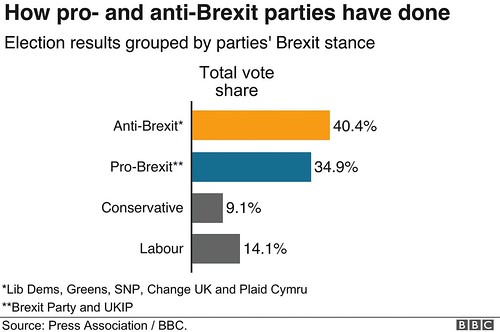
The graphic here shows one way to think about it, and nicely - sez oi - relegates the two "traditional" "major" parties to has-beens. It also nicely shows that anti-Brexit1 did better than pro-Brexit. If you measure it by vote share. Alas, as is traditional, the good guys split up (mostly into LibDem and Green) and so got fewer seats overall2. Miriam found another analysis that split up the Labour vote as 80% remain, and the Tory as 60% leave (or some such, I forget the details3) and again got Remain ahead in vote share. Another way to measure this is to note that votes for the Brexit Party were 5,244,893; whereas the Petition to revoke Article 50 got 6,085,017 signatures.

But that brings me to my main point, which is that after all the fuss and all the talk and dominating the headlines for months, still only 37% of those eligible bothered to turn out to vote. So the true winner was still the Don't Give A Toss party. And if you believe JA - that Brexit will eventually fall apart under the weight of it's own contradictions - then perhaps they were right.

I voted LibDem, if you care. It was that or Greens. If it had been clear what maximised my chance of a Remain MEP, I'd have done that, but it wasn't clear, so I went for maximising the vote share of a clearly Remain party. So in a way I was in the DGAT party too: I (rationally) didn't bother put a great deal of effort into working out what my "best" vote was.

Notes


1. But never call yourself anti-X; because it concedes a part of the argument to X. Arguably, in this case, correctly. I am more strongly anti-Brexit than I am pro-Remain, if that makes any sense. On the grounds that our MPs are too much of a bunch of clueless incompetents to manage Brexit.

2. The Change UK people, who look increasingly like roadkill, got stoated as I think they deserved. Their problem is that the only sensible thing for them to do is to merge into the LibDems, but they can't quite bring themselves to do it.

3. Ashcroft's poll provides enough info to do the split yourself, if you want to: So while Leavers and Remainers have gravitated to parties who are unambiguous about Brexit, those who have stuck with the main parties are also polarised: two thirds (67%) of Tory Euro-voters want to leave the EU, while nearly two thirds (63%) of Labour Euro-voters want to remain.

Refs


* Governance is hard
Brexit schmexit [2019/03]
Brexit, again [2018/12]
My Euro-election post-vote poll: most Tory switchers say they will stay with their new party - Lord Ashcroft Polls
Say no to Brexit and Post-referendum thoughts and Brexit means Brexit? [2016]
* Labor Income For Top 0.1% Exceeds Income from Capital by David Henderson
* More double standards - American policy - by Scott Sumne
* Typical - CafeHayek on who will run the world
* War for Poverty by Bryan Caplan
Britain’s constitutional time-bomb - the Economist

2019-05-25

Sweden’s Expressen newspaper is now going to publish daily CO2 levels in the atmosphere

little-known Swedish teenager writes Sweden’s Expressen newspaper are now going to publish daily CO2 levels in the atmosphere “due to climate emergency”!! Very hopeful! Who will be the next to follow? An even less well known English greybeard replies That's gonna be pretty dull. They don't change much day-to-day. A more hopeful colonial inquires Can they take it to hundredths of ppm or something or are there detector limits or noise overwhelming signal problems? And this is a reasonable question.

So: "reporting" on day-to-day global CO2 levels is silly, because they don't change much day to day. Indeed, the annual round of There is more CO2 in the atmosphere today than any point since the evolution of humans is dull too. CO2 is increasing, at about 2.5 ppm per year, but there's a seasonal cycle of about 4 ppm, so there's a peak every year, at which point the "news" that there's a new peak is breathlessly released. And if you were to report, daily, the global average, you'd be reporting declining CO2 levels for maybe a third of the year, which is probably not what the "climate emergency" folk want to see. But can you rescue the interest by reporting the measurements to hundredths of ppm? I don't think so.

Those global measurements are of course made up of lots of little individual measurements and the pretty graph shows how those typically vary by latitude. So, it's kinda like global temperature measurements, which are also going up but which also have a seasonal cycle and spatial variation; and the accuracy of the global average is better than the accuracy of the individual measurements.

Finally, you can look at individual measurements like the Keeling ones at Mauna Loa, and you see how they vary during the day. And you notice that the daily average is very much not the average of the hourly average. If that makes you think "aha! Gotcha you lying scientists can't even do averages properly" then you need to read Dumb America; which will lead you to Eli if you want more detail and How we measure background CO2 levels on Mauna Loa for even more excruciating detail.

Refs


EXTINCTION REBELLION THREATENS UNDEAD LANGUAGES
How confident are you about confidence intervals? - quiz
* Eli being rather less patient with deniers
* Less wrong isn't necessarily right - TF on How the Rural-Urban Divide Became America’s Political Fault Line by Emily Badger
* A call to climate action - Jonathan T. Overpeck, Cecilia Conde - Science  31 May 2019 / Vol. 364, Issue 6443, pp. 807 / DOI: 10.1126/science.aay1525.
* Can Journalism Be Saved? Nicholas Lemann; New York Review of Books

2019-05-19

Rearranging deckchairs defo the right thing to be doing now

qgOiUoI As I said to that nice Richard Betts. Context: Why the Guardian is changing the language it uses about the environment From now, house style guide recommends terms such as ‘climate crisis’ and ‘global heating’. Or you may prefer RS's take.

Update: ATTP notes something I should have mentioned," suggesting using climate science denier instead of climate sceptic". This is fair enough, for the majority of the denialists who simply are; be cautious about labelling the less committed as such.

Refs


* Peter Gabriel - FAMILY SNAPSHOT (Melt)
* The Style Guide at the End of the World - citizen joe smith
* Antitrust’s Sordid History by Donald J. Boudreaux
ASPIRING CLIMATE REFUGEES CROWD EVEREST SUMMIT - RS

2019-05-13

There are two sorts of people in the world...

D6STVOUWsAEho1z ...those who divide the people of the world up into two sorts, and those who don't. I'm one of the latter :-), Tamino it would appear is one of the former:
When it comes to man-made climate change, there are two kinds of people: those who take it seriously enough, and those who don’t. Joe Biden says he has a climate plan, but everything I hear about it (from both Joe and his opponents) leads me to believe he’s in the second group: he doesn’t take it seriously enough. Not even close. Anyone who claims we can deal with the problem but avoid a “radical transformation of the economy” is a fool...
So that leaves poor old Joe Biden, me, Donald Trump and Antony Watts in the second group, whilst the Pure of Heart stand proud in the first group. This reminds me of something I'm actually able to find, just for once: Oedipus Tex, and other Choral Calamities. And to spell out the obvious: when it comes to man-made climate change, there are many kinds of people. One group of people - distinct from Trump and Watts and Tamino - are those including me who "believe in" GW but think the GND is not just stupid but would in the unlikely event of it being imposed be actively harmful; and at best a pointless distraction.

And, no. I'm not teaching you how to think for yourself, or even offering to.


Refs


* The Guardian view on a Green New Deal: we need it now - Editorial
Trump Calls The Majority Who Voted Against Him Enemies And Losers In New Year’s Message?
* Partisanship is no substitute for values - Rich Puchalsky

2019-05-07

IMF working paper 2019: Global Fossil Fuel Subsidies Remain Large: An Update Based on Country-Level Estimates

I think this is going to turn into an update to Fossil fuels subsidised by $10m a minute, says IMF? from 2015. The report (WP/19/89) itself is available from here. We read:
This paper updates estimates of fossil fuel subsidies, defined as fuel consumption times the  gap between existing and efficient prices (i.e., prices warranted by supply costs, environmental costs, and revenue considerations), for 191 countries. Globally, subsidies remained large at $4.7 trillion (6.3 percent of global GDP) in 2015 and are projected at $5.2 trillion (6.5 percent of GDP) in 2017. The largest subsidizers in 2015 were China ($1.4 trillion), United States ($649 billion), Russia ($551 billion), European Union ($289 billion), and India ($209 billion). About three quarters of global subsidies are due to domestic factors—energy pricing reform thus remains largely in countries’ own national interest—while coal and petroleum together account for 85 percent of global subsidies. Efficient fossil fuel pricing in 2015 would have lowered global carbon emissions by 28 percent and fossil fuel air pollution deaths by 46 percent, and increased government revenue by 3.8 percent of GDP.
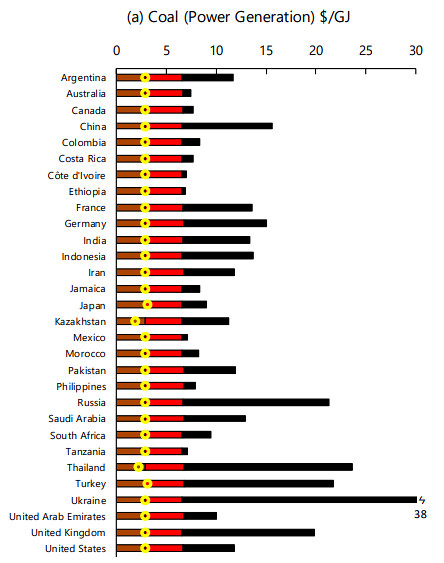
coalSo that's nice - they have told us what they mean by "subsidy". Now I look, the previous report (WP/15/105) has much the same authors but a somewhat different abstract; my quibbles from before about what should "really" count as a subsidy remain. As before the "implicit" subsidies are much larger than the "explicit" ones. Let's look at one of their pictures, to try to make this clearer.

The pic tries to compare existing and efficient prices across the world for coal. One obvious puzzle is that the retail price (yellow circles) is near constant. Coal is globally trafficked, but that degree of constancy seems weird. GW is accounted for (red) at $40 per tonne. And for coal, the rest is local pollution. Some of this makes sense - presumably the Ukrainians burn bad coal badly in densely populated areas; ditto Thailand, China, Russia. The very low values for Mexico, Tanzania and Ethiopia are harder to understand. World-averaged, their calculations are that about 2/3 of coal "subsidies" are local pollution, and 1/3 GW.

gas Maybe looking at petrol will make things clearer. We see now what we already knew, that retail prices vary wildly. But we see something else that we probably didn't realise, that part of the implicit subsidy for petrol is "accidents". Another quite large one is congestion. Leading to the apparently bizarre conclusion that a country could potentially reduce it's fossil fuel subsidies by building more roads. Wait, what?

In a very few (basket) cases retail cost is less than supply cost, and these are the usual suspects: Saudi Arabia, Iran. These are unquestionably subsidies. Glboally, about 2/5 of petrol "subsidy" is local pollution; 2/5 other local factors; and the rest a mix.

So there you have it. This is of course not an IMF official document merely a working paper, but that won't stop people saying The IMF — no enemy of business — estimates that globally fossil fuels, which poison our future, are being subsidized $5.2 TRILLION annually...

Incidentally, I have no objection at all to their defining a quantity that is "the  gap between existing and efficient prices (i.e., prices warranted by supply costs, environmental costs, and revenue considerations)". That seems like a useful quantity; I'm just doubtful that the bare word "subsidy" is a useful shorthand for that quantity.

Refs


* Why is carbon pricing in some countries more successful than in others? by Franziska Funke and Linus Mattauch
* The Hidden Subsidy of Fossil Fuels - A new report says that the world subsidized fossil fuels by $5.2 trillion in just one year. But that calculation is less tidy than it seems -  by Robinson Meyer, The Atlantic.
* Walmart Bullied by Government, or Was It? by Pierre Lemieux
What Can A Research-Minded Metal Detectorist Do In Sweden? Aardvarchaeology – by Dr. Martin Rundkvist
* Fossil fuel subsidies by Max Roser, Our World in Data - nice maps, no real thought as to what an actual "subsidy" is.