2018-08-31

Touch me... how can it be?

The sun always shines on TV (oh, but Love will tear us apart). What has that got to do with anything? Nothing. I'm just listening to it.

This is but a minor post, to muse on something said explicitly at Cafe Hayek (I write it that way to put off all the H-haters) as almost an aside. The main point is worth saying again; the text is from Dawkins: if you start with a complicated working mechanism... there are many more ways of making it worse than of making it better. Obvious but easily missed; and very obvious when you see wazzocks like Trump or Maduro flailing around desperately trying to change things; by now we're into their phase n, where they're trying to patch up the results of phase n - 1, which was them trying to patch up the multi-order consequences of their previous actions.

Anyway, onto what DB wants to say, which is
there are many more ways of making the economy worse than there are of making it better. Therefore, the wise course is to devolve decision-making down to as low as level as possible. Let each person survey his or her immediate economic surroundings and, using his or her unique knowledge and perspective, adjust. If that person adjusts in a mistaken way, the harm will be localized and he or she has a powerful incentive to get it right on subsequent tries. Private property and contract rights encourage this localized decision-making. But state intervention is not localized; it’s systemic and large-scale. The chances that the state will get it right are slim; the unintended, unseen ill-consequences of such intervention are always almost certain to swamp whatever benefits such intervention brings.
I largely agree, but (and I thought of commenting there, but I know it won't work, so didn't bother) the idea that everything should devolve down seems wrong, by analogy to solving fluid dynamics equations. The kind of thing I'm thinking of is stuff like multigrid, terribly popular when I was doing my doctorate. If you just solve problems locally, global convergence is very slow, and gets worse as your local grid becomes finer. I'm not sure how good an analogy that is, though, because that's about the flow of information, and nowadays information flows very well, to anyone interested. One could think about the flow of rules, perhaps. There's no absolute boundary, but I'd travel in the direction that DB suggests, from where we are today.

Refs


* My exciting response to mt's anti-driverless-car urtext on Medium, which I don't much like.
* Venezuela’s tragedy shows the folly of messing with markets.


2018-08-30

Basic Science of a Changing Climate?

ohdear
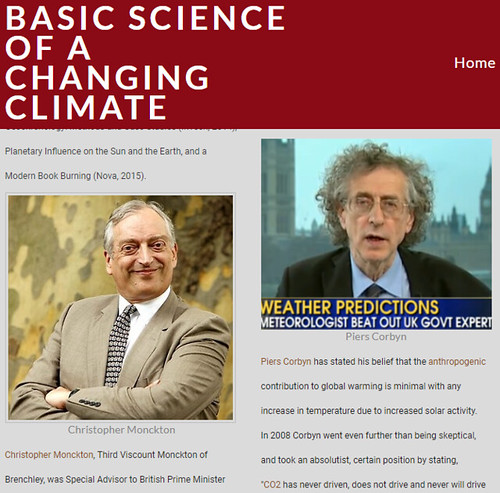
I don't seem to have taken the piss out of the nutjobs recently, so it seems only fair to post this. This is a conference, "Basic Science of a Changing Climate". I haven't of course looked at the details but with these two, and Nils-Axel Mörner also on this list, it can't be good.

What amazes me is the lack of grooming, or rather the lack of effective grooming, and now I think about it the ability of both to look terrible, for completely contrasting reasons. Lord M has clearly been groomed to within an inch of his life, but the pic is still crap, he looks smug and self-satisfied. Piers... is clearly a disaster area, visually; scientifically I'll defer to myself in an earlier incarnation. Maybe he is trying for the mad scientist look?

Anyone wishing to claim "you're no picture yourself" is invited to gaze in awe at the pic below. Don't blame me for the framing, my wife took it.

DSC_7985

Taken in Argentiere in the "Petit Verte", gazing up at the Verte, which appears to be a 5-star mountain.

Refs


*  I am Peter Wadhams, and will have later additions to make to this stub - Wadhams appears to rather regret the "Three scientists investigating melting Arctic ice may have been assassinated, professor claims" story.
* THE SHADOW PM'S MORE INTELLIGENT OLDER BROTHER.

2018-08-29

Landscape with the Fall of Icarus


TF is having an Auden jag, so I got to read Musée des Beaux Arts (text), which is another of those weird things, like Dover Beach, that somehow touches my heart: About suffering they were never wrong.

The painting is striking; I am saying nothing new of course. The style is antique but the concept seems modern; or rather I mean that it seems odd that the antients would have thought it: to put the peasant figure of the ploughman in the centre, and then to so weirdly stylise his ploughing1.

Why the antients were so good and so much of modern art rubbish is a mystery easily solved: selection. Over the centuries the trash has been discarded; in a century we'll discover what tiny fraction of modern art was considered worth keeping.

This then (yes at long last I'm coming to my rather ill-defined point) links to a conversation with CIP that I've recorded under Conservatives find liberals deficient in some other stuff; you will (and, I suspect, so will I in a year's time) rather struggle to understand what all that is about; the key (as far as I am concerned) is this comment: Liberals and radicals, the conservative says, are imprudent: for they dash at their objectives without giving much heed to the risk of new abuses worse than the evils they hope to sweep away.

Since I'm on pix, here are some fragments from the Uffizi. In case you're wondering: no, don't go there in August.

DSC_7678

(which is a fragment of this)

DSC_7666

(I liked the parrot wings. A fragment of this)

DSC_7651

(the angel is so tentative, uncertain of his reception perhaps)

DSC_7650

(the dynamism)

DSC_7656

Notes

1. Wiki tells me: Though the world landscape (a type of work pioneered by Joachim Patinir where the title subject is represented by small figures in the distance) was an established type in Early Netherlandish painting, the choice to have a much larger unrelated "genre" figure in the foreground is original and represents something of a blow against the emerging hierarchy of genres. Other landscapes by Bruegel, for example The Hunters in the Snow (1565) and others in that series of paintings showing the seasons, show genre figures in a raised foreground, but not so large relative to the size of the image, nor with a subject from a "higher" class of painting in the background.

2018-08-27

L'affaire Hayhoe, part II

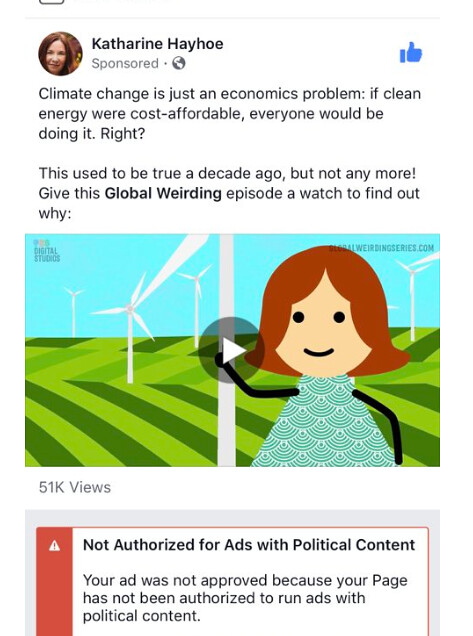
hey_ho Someone kindly sent me a screenshot of what fb blocking your campaign looked like while I was on hols, and I've finally got round to looking at it. In the course of which I went back to my original post, and then to KH's original tweet. or rather, I tried to, and got what my screenshot shows: "You are blocked from following @KHayhoe and viewing @KHayhoe's Tweets". Which doesn't exactly raise KH in my estimation. Does it raise her in yours? Let's hope not.

In case KH is blocking you too, I can reveal that it is trivial to view the super-sektrit tweet, for example via this archive.

ho_hum Aanyway, here's what fb telling you that your account isn't authorised for political content looks like.

Seems pretty clear to me: the bit about "your account not authorised" is obvious, but strangely didn't make it's way into KH's original tweet. Getting a bit pissed off when something you're worked on can't be promoted because you can't be bothered to jump through the appropriate hoops is entirely understandable. I hate bureaucracy too.

But lying to people by omitting important readily available facts isn't excusable.

Note: per The Science Video Facebook Did Not Want You To See? I left a comment on Dan Satterfield's blog.

2018-08-26

Yet more climate suing

DSC_7576 Or, Youth Climate Case in Washington State Dismissed by King County Judge. This isn't Photogenic teens sue US government, but it's kinda the state-level version; the other is the federal one. The result, in an eerie echo of the Alsup case and the New York City suit, is King County Superior Judge Michael Scott sent this one to an early defeat, ruling that these issues should not to be resolved by a court, but are political questions best addressed by the legislative and executive branches. There are so many of these things; watching all of them getting tossed out is going to get dull.

In the course of poking this, I found Strategies in and outcomes of climate change litigation in the United States, Sabrina McCormick, et al., Nature Climate Change (2018). It's paywalled so I haven't read it, but it starts rather dubiously with The courts have played a central role in climate policy, so I doubt it is much cop. Here's someone else writing about it.

In vaguely related news that oddly enough you won't see prominently displayed elsewhere, SEC Ends Investigation, Will Not Punish Exxon Over Climate Risks. That was always a pile of dingo's kidneys anyway, however much the believers in fairy stories closed their eyes and wished very hard.

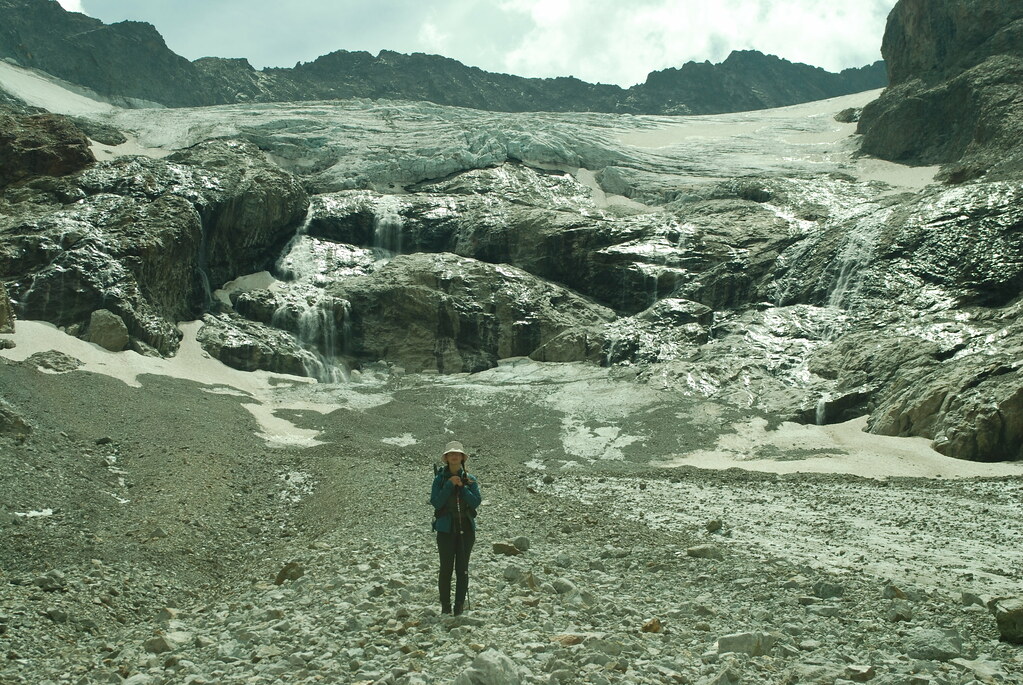
My picture shows Darling Daughter still on nominal glacier, though it is somewhat rubble covered, above the Sele hut. The route to the col sweeps left, then from L to R above the rock band on the now you-have-to-be-a-bit-careful upper glacier. We didn't make the Boeufs Rouges, but we did get to Pointe 3402.

Refs

* A classic screed that few would read - TF
* A shilling life will give you all the facts - TF
* A mean wind blows over Lake Żabińskie - Richard Telford

2018-08-25

Did you miss me (yeah) when I was away?

DSC_7992 Glitter isn't entirely in fashion nowadays for regrettable reasons, but hey I like the song. My three week odyssey around Europe is complete; having driven through France, Italy, Switzerland, and back through France2 without hitting anything, no mean feat on narrow mountain roads and around lake Garda, I managed to prang someone in Waitrose car park. Is that fair?

There will be a pile of pictures at some point, but in the meantime Climate change is melting the French Alps, say mountaineers looks like a suitable text for a cheapo post. It is of course fundamentally true; you can't walk or climb high in the mountains without noticing the obvious signs of glacial retreat over the past few decades. We went to the top of the Sele pass from the Sele hut side, and looked down into the Pilatte basin. The descent is a most unattactive steep scree followed by ice and crevasses; though I suspect it's really not that hard. But 25 years ago it was pleasant snow for most of it. And the Glacier Blanc hut has a nice map of the glacial tongue showing it's retreat over the years. Though to be fair you also can't walk there without seeing the clear signs of much older retreat.

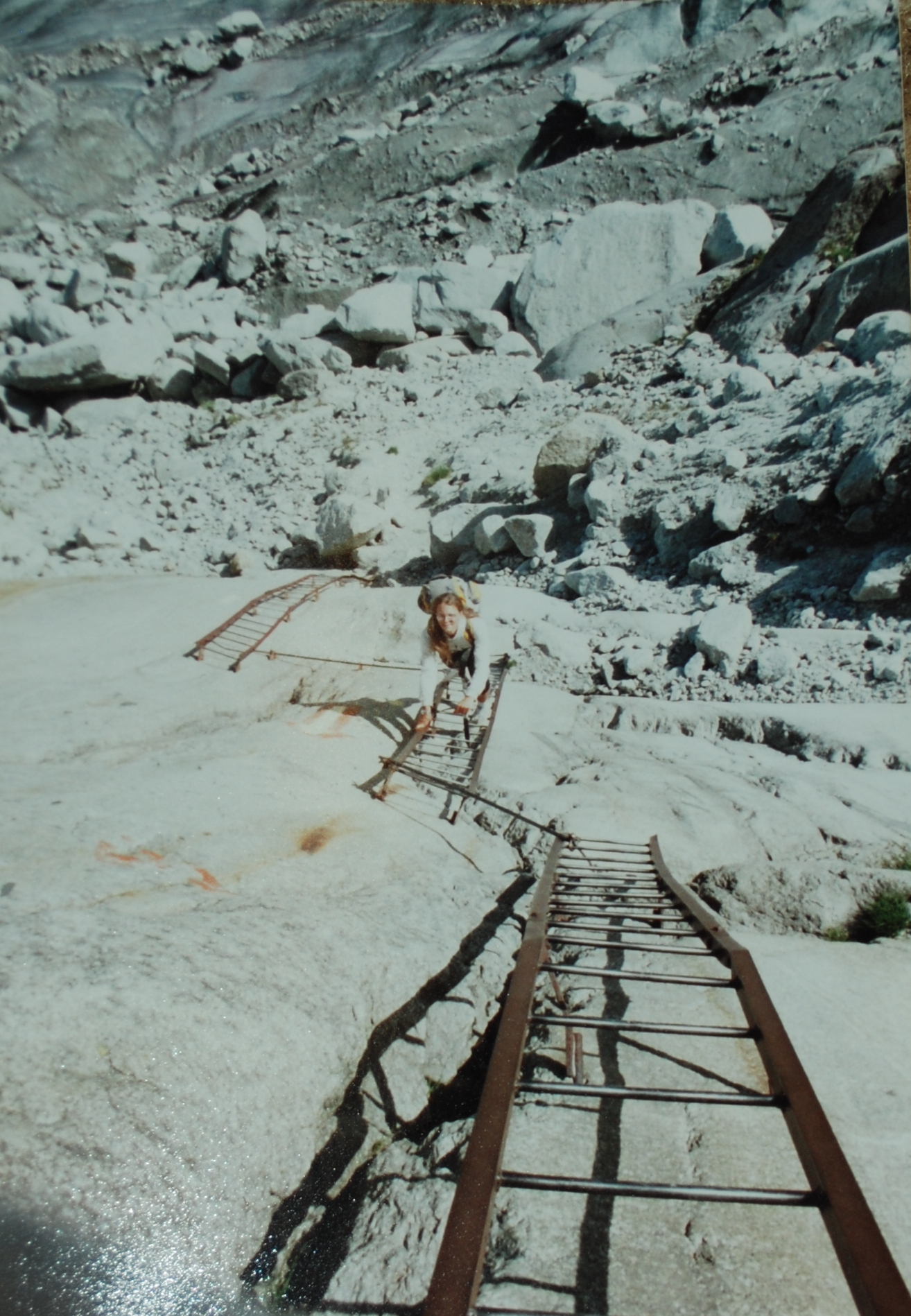
Because it's a newspaper article, the journo is obliged to throw in something stupid an innumerate. Our man Simon Birch has chosen to demonstrate that he is an idiot with Another key impact of climate change in the mountains is that it is leading to an increase in the number of rockfalls; more than 550 occurred in the Mont Blanc massif alone between 2007 and 2015. I won't bother point out the obvious problem. I'm a touch dubious about A stark consequence of the melting Mer de Glace is that 100m of ladders have now been bolted onto the newly exposed vertical rock walls for mountaineers to climb down onto the glacier. As my pic shows, there were pretty damn extensive ladders there 25 years ago; I doubt they've grown as much as 100 m since then. The source of the article seems to be more about permafrost melting leading to more rockfalls; that could easily be true, and might also be somewhat worrying, as in general you kinda hope for all the serious rockfalls to happen out of season.

There's also Significantly, climate change is happening almost twice as fast in high mountains as compared to the rest of the planet. That's sourced directly to a scientific paper - good heavens - Mountain Climates and Climatic Change: An Overview of Processes Focusing on the European Alps by Martin Beniston. Sourcing to a paper is to be commended1, though in general newspaper should - like wiki - avoid referencing the primary literature, although the paper is an overview. But it is from 2005, and the mountain-vs-world temperature comparison it uses is for the Swiss Alps only, dates from 1997, and actually says it is three-fold higher; perhaps that seemed implausibly large to the journo who decided to tone it down to two-fold. It's not a focus of the paper, though, and isn't even mentioned in the conclusions. Perhaps a better source would have been Elevation-dependent warming in mountain regions of the world, by the "Mountain Research Initiative EDW Working Group", an irritating group of people who link to some of their papers - because the metric all scientists care about more than anything else is papers - and some (inevitably mangled) press coverage, but don't actually bother to tell us what their conclusions were. Never mind, it was enhanced warming compared to the global average (inevitably, since land warms more than ocean) and likely more than the land average, given obvious albedo-y effects and so on.

Notes


1. Actually reading the paper would be even more commendable.

2. On about 4- tanks of diesel, so since I was one of four my personal contribution is about 80 litres. Apparently a Jumbo from London to New York burns about 70k litres of similarish stuff, between 450 people, which is about 160 litres each, and my daughter recently went both ways, so I'm at least doing better than her.

Refs


* Global Carbon Sink Holding Up So Far


2018-08-16

Hothouse tipping elements of no return

39196777_10156512217517350_3994653278469095424_o The undiscovered link between global warning and the English constitutional conflicts of the 17th century is the role of the sectaries; those for whom incremental change was not good enough, they must push for the kingdom of god on earth. They didn't get it, of course: they got the restoration.

Today we have Will Steffen offering us the problem is neoliberal economics. But he isn't totally wrong: he does get the solution has more to do with economics than science correct. I think the term "neoliberal economics" is poorly defined; I think WS has little idea of what it means1; I think he's using it as a vague bugaboo for "things I don't like and which get in the way of me reorganising the world in the way I would like".

Before I return to the wild-eyed fanatics, I delegate my commentary on the underlying "paper" itself to Richard Betts who has a clear advantage over me: he's read it (so has ATTP; that weed JA hasn't ventured a commentary2). I shall pick out his They argue – or perhaps speculate; and One thing that strikes me about the scientific literature on “tipping points” is that there are a lot of review papers like this that end up citing the same studies and each other.

one of the main barriers between us and a stable planet — one that isn’t actively hostile to human civilization over the long term — is our economic system


Mmmmm. But this, as always with such things, ignores the benefits of the economic system. The current economic-political-scientific-engineering world system supports 7 billion people, albeit at some cost to the long-term sustainability of the planet. Most of those people would die if the Evil Economic System were removed. If the system were suddenly, sharply, changed it is likely the disruption would kill lots of people. FWIW, I think a more liberal economic system and a smaller less corrupt political system would be a benefit. And it would be nice if we could have an intelligent press, too. It's hard to run an intelligent voting system if the voters are fed pap.

We need to immediately stop deforestation of the Amazon rainforest and other tropical forests, and start reforesting them. That means a U-turn in terms of how we operate the world’s economic systems


I'm all for stopping deforestation. Indeed, I am the proud owner of a "reforest the Earth" tee-shirt of thirty years vintage, that I still wear sometimes. But I'm doubtful that economics is the main reason for deforestation; I'd say it is mainly the corrupt politics. Which is fed by money, yes, but that's different. If you want to solve problems you need to get the right analysis.

What is actually going to solve the problem? Certainly not physical scientists spouting off about economics and politics. I grow hopeful that solar photovoltaics will be important. One barrier to these is the idiot Trump administration's tariffs on Chink panels; the solution to which is Free Trade; which all people of Good Will are in favour of... right? Oh.

Refs


* Runaway tipping elements of no return (2007).
* Why Liberal Media Need Conservative Columnists.
* Engine summer.

Notes


1. These two statements are not contradictory. "neoliberal economics" is generally used as a term of disapprobation by the "progressives", but that's about as far as an agreed definition goes. To my surprise, "site:mustelid.blogspot.com neoliberal" returns no hits. Over at wordpress, I find myself taking the piss out of someone called "Paul Mason" for writing By neoliberalism I mean the global capitalist system shaped around a core of neoliberal practices and institutions, which is the sort of thing I'd expect WS to write.

2. At last, the maestro writes: Steffen nonsense.

2018-08-15

English Constitutional Conflicts of the Seventeenth Century

20180813_174053 English Constitutional Conflicts of the Seventeenth Century is, as I think is well known, a book by J R Tanner that is largely a collection of lecture notes on the obvious subject. Although it might not be well known, it may just happen to be that I own it. My notes inside the front cover indicate that I got as far as page 9 some while back; but a recent holiday has given me the opportunity to read further, and so to recommend it to you. It forms a rather useful prelude to  Thomas Paine's The Rights of Man, which - I warn you - I shall trouble you with somewhat later. These are only some incomplete notes; they reflect my own interests more than the book.

Before I go on, recall: The past is a foreign country; they do things differently there.

The complex history of the 17th century stands in stark contrast to the simplicities of TRoM; and clearly influences the framers of the USAnian constitution, and aided them by many illustrative examples of how to do it wrong3. The most obvious of these is the need for separation of church and state; time and again people fall apart over the forms or substance of religion; the association between religions and various political factions; the degree of toleration to be afforded some but not all other religions. As the bible itself tells us, no man may serve two masters; as Hobbes pointed out this means there cannot be both an ultimate civil and religious authority; and yet the sectaries were so blinded by their religious enthusiasm they were unable to see they could not live on earth their way. Even the concept of general toleration or separation seems to have not been thought of; everyone, though keen for toleration of their own pet thought would not extend that to all others.

The other great point to come out of all this is money. Or, if you prefer, resources. Or, said another way, economics. Does that sound at all familiar? Problems come to a head when the sovereign runs out of money - often, ultimately, the money to pay the troops - and then the power of the people - or at least, of those who are being taxed - comes sharply into play. And this in a sense shows the truth of the idea that ultimate power comes from the consent of the governed4, in which case it is better to align the nominal structures with the underlying reality.

An aspect I'm interested in, that becomes clear in the course of the history but which isn't stressed, and which Hobbes ignores entirely, is something that perhaps doesn't have a name but could be called the weight of the fabric of society. If law is custom, and your authorities have been stable, then you have a reasonable idea of where you stand. But if your form of government is shifting, if the "foundation" is a constitution of no clear status which can apparently be re-written on desire and which has no clear interpreter1, then all except the most ardent will long for the Olde Wayes. For example, (p. 253) James II asserted that his dispensing power enabled him to override the Test Act and the judges agreed (Godden vs Hales), at a stroke removing all the protections that parliament thought it had put in place against a Catholic army and civil service.

"The power of kings had been a mysterious uncertainty" (p. 216) but by putting it to the test that uncertainty had been removed: kings could be beaten in battle by not-kings; Heaven would not intervene. To us this is obvious; to them it was, as far as I can understand it, uncertain. They preferred not to put it to the test until there was no alternative.

The book is a work of history, not political philosophy. It presents the often somewhat confused arguments people made at the time, applying where possible the precedents and law they knew, in response to the often confusing situations they found themselves in; rather than a principled statement of "rights" from which to attempt to derive a logical structure.

And lastly: if we ignore details - like the English Civil War and the Protectorate - then we could say that England had a relatively smooth transition from the monarchy of the Tudors to the modern parliamentary democracy with a nominal monarch; whereas the unfortunate Frogs went through the abrupt transition of the Terror and all that Napoleonic stuff, to end up at roughly the same place. Is either path better, or in the long run does it all just wash out?


Notes


1. The James Naylor incident apparently (p 190) brought home to Cromwell the need to have some body to interpret the Instrument of Government. Because of there is no interpreter, who can say if the Commons do something outside their powers, that they claim is within? Cromwell's answer2 was a second chamber, but as Hobbes pointed out, if someone else is in charge of interpreting the law,  then they're effectively in charge.

2. Well, his proposed ultimate constitutionally stable answer. His immeadiate answer was of course that he was in charge.

3. An expert is someone who has made every possible mistake in a given field.

4. He who pays the piper calls the tune, perhaps. Not all life can be reduced to proverbs, but much of it can be. Interestingly, the "consent" in this case comes from money, not vote count; see ODOV from Aristotle's Politics.

2018-08-02

In the decade that ran from 1979 to 1989, we had an excellent opportunity to solve the climate crisis?

That's the claim from the NYT. Weird, I know. Or in more detail:
The world’s major powers came within several signatures of endorsing a binding, global framework to reduce carbon emissions — far closer than we’ve come since. During those years, the conditions for success could not have been more favorable. The obstacles we blame for our current inaction had yet to emerge. Almost nothing stood in our way — nothing except ourselves.
I don't think the overall sentiments are true. The last part - nothing except ourselves - is sort-of but not really true as well. And the idea that something like GW could be solved by a couple of signatures is magical thinking; or, put another way, confuses law with legislation.

One can argue a lot about exactly when "we knew enough", and what "enough" means, or even what "we" or "knew" means (who exactly is "we"? Scientists? The political elite? The public?) and I've tried to do that before, but I find it hard to believe that even the first IPCC report would be considered sufficient evidence. So any time before 1990 is definitely unreasonable.

Before then - in the 1980's - there was little public awareness of the issue, and no political support for anything GW related that would cause the electorate any kind of pain (so if there was "nothing but ourselves" in the way, that wouldn't help, because we were in the way). The scientific support for anyone who would want to suggest such a thing was lacking. And the technological support for solutions was also lacking (so it wasn't true that only ourselves were in the way; we lacked any kind of fix).

The NYT tells us:
A broad international consensus had settled on a solution: a global treaty to curb carbon emissions. The idea began to coalesce as early as February 1979, at the first World Climate Conference in Geneva, when scientists from 50 nations agreed unanimously that it was “urgently necessary” to act.
But my notes from the same say:
of possible warming from CO2 rises they say: "...increased the amount of CO2 in the atmosphere by about 15% during the last century and it is at present increasing by about 0.4% per year. It is likely that an increase will continue in the future... it appears plausible that an increased amount of CO2 in the atmosphere can contribute to a gradual warming of the lower atmosphere, especially at high latitudes". This isn't a prediction of warming such as you would find in the 2001 IPCC TAR, its a much weaker statement of plausib[i]lity appropriate to the level of knowledge of those times.
And I wrote that more than a decade ago. The NYT's description of the 1974 CIA report on climate change also somewhat differs from mine. Most importantly, the NYT has failed to realise that the author of the CIA report was clueless about climate (though doubtless an excellent spy).

After that there are an awful lot of words, many of them doing that tedious journalistic thing, the "personal story" (Jim cut down on his work hours, leaving the Goddard Institute at 5 o’clock each day, which allowed him to coach his children’s basketball and baseball teams), rather than recounting facts. And as to the things that are facts, I'm not at all convinced it is a reliable history of what happened; you're much better off with Spencer Weart's version. There are so many documents out there from those times that you can, by selective quotation, get almost anything you want.

Refs


* The world is losing the war against climate change - the Economist (via RS)
* Joe Romm doesn't like the NYT piece either (h/t DB) but IMO for the wrong (i.e., not the same as my) reasons. Instead, he is as usual keen to make sure all the world's ills are blamed on Evil Industry and the Evil GOP. After all, it is hardly possible that anyone else could be "to blame", is it?
* The Krypton Cataclysm: Why So Few Survivors?
* Discounting the Future - CIP

2018-07-29

L'affaire Hayhoe

Katharine Hayhoe says:
Facebook says this episode of our @PBSDS show, Global Weirding, which tackles clean energy myths like “wind turbines slow the earths rotation!” has too much “political content” to be eligible for promotion. What do YOU think?
I think that's an odd thing to say. Facebook allows promotion of a lot of blatantly political stuff. Her video is mildly political, particularly at the beginning, but it would be very strange if it were too political to be promoted. This being the era of Fake News, naive young bunnies leapt upon the tweet without troubling themselves to think too hard about whether it really made sense, writing headlines like The Science Video Facebook Did Not Want You To See or Facebook Still Unclear on Climate Science. But, of course, fb has no particular opinion on GW; though I'm sure if you asked MZ he'd be a believer. And anyway, the video isn't about GW science. It's about the cost of renewables.

I asked
What did fb actually say? Their guidelines (https://newsroom.fb.com/news/2018/05/ads-with-political-content/) appear to only require labelling.
And KH replied:
No: they said my account was not approved for political advertising. I have heard (second hand) that such approval is fairly arduous: and anyways as a resolutely non-partisan climate scientist I don’t see why I would need it!!
And there I think you have it: KH is a Nice Person. fb's rules about labelling political advertising should not apply to her, because she is Nice. Or, perhaps, she is unable to see that her video might have political dimensions, because she knows she is Right1. Politics is what Bad People do? But that Obama seemed so Nice.

Twatter is a compressed medium, of course, but I think that KH might have found space for the "my account is not approved for political advertising" in the first Tweet; fewer people might then have been mislead.

Other reaction includes "Facebook is hurting itself & our public discourse w half-baked double-standards & interference in our informational sovereignty", which sentiment KH was happy to endorse. And yet quite what is the double standard? To demonstrate that, you'd need to know that some political stuff that you didn't like had been promoted via an account not approved for political promotion. That sounds like a rather hard thing to know2. As for your "informational sovereignty" what of XKCD?

Refs


* L'affaire Peter Ridd
* I was a teenage Exxon-funded climate scientist?
* Hulme: In what ways is religious belief relevant for understanding climate change?
* Should Facebook Censor Videos by Climate Deniers?

Notes


1. In the sense of being correct, of course. Not in the sense of being politically on the Right. But that's so obvious I didn't need to say it, of course. In this context, though, that isn't a compliment.

2. At which point I cannot resist quoting Hobbes beautiful For if a man pretend to me that God hath spoken to him supernaturally, and immediately, and I make doubt of it, I cannot easily perceive what argument he can produce to oblige me to believe it.

2018-07-26

Acronym watch: MARKET CHOICE

Would you believe "Modernizing America with Rebuilding to Kickstart the Economy of the Twenty-first Century with a Historic Infrastructure-Centered Expansion Act’’ aka the ‘MARKET CHOICE Act? Not as good as "SEMTEX"; I forget what that was, one of Liz's, something like "SEaice and MeTeorology EXperiment", obviously there was no hope of getting that though the buros, though infamously there was HIHO HIHO from the Australians; see-also James.

Anyway, don't toss it out just because it has a silly name, what of the substance? Well, it's a carbon tax, with some attempt at PR, and irritating side-conditions. Congress 6463, by Carlos Curbelo, an R. The PR is the name, and (I suspect) the irritating conditions, which is blathering on about funding infrastructure. I think a Carbon tax could either just be a part of general taxation (and to appease the zealots, would then be combined with tax-cutting elsewhere to be revenue neutral) or less plausibly part of tax-and-dividend (in a transparent and probably doomed attempt to win mass support); but I'm dubious that tying it to other spending makes any sense.

Possibly weirdly, the tax ($24 to start with, a sensible number) is applied "per metric ton of carbon dioxide equivalent emissions" for fuel combusted. But, who burns anything that generates anything other than CO2? Maybe it's just a wise future-proofing precaution to prevent people switching to burning rubber.

Some are happy to welcome it; EEnews says Rep. Carlos Curbelo rolled out the first Republican carbon pricing bill in nearly a decade this morning, a rare political risk that quickly earned rebukes from conservatives and tepid praise from environmental groups. If I'd read the deatils I could tell you the details of what is in it; but I haven't, and I doubt it would be worth it, because as Curbelo himself said, it won't pass, it's more of a strawman, and perhaps it will fare well as that, or spark a debate.

Update: Consequences of a Nationwide Carbon Tax by "FEE" is the kind of opposition a carbon tax would face. Much of it is I think tainted by denialism, but the words about designing what to do with the tax money are valid. They don't want to give the govt more money, without a guarantee of what will happen in exchange, and they know they won't get that guarantee. They also know that the arm-twisting needed to get the tax through will lead to messy and unedifying compromises, and it is hard to see how a "clean" tax could emerge from such a process.

Or, continuing, A Carbon Tax Is Still a Bad Idea by Veronique de Rugy. I notice, again, how this kind of opposition is largely predicated on not trusting politicians with a new tax, and (correctly IMO) criticised the rather naive pro-tax folk who simply assume that govt will "do the right thing". For bonus points, she links to DR for evidence that, while they talk about tax at a certain level, they're really sniffing for something higher.

Refs


* Anti-Market Atavism Explained
* CH on extreme free trade

2018-07-23

[Copy post] The Golden Horseshoe Award: Jaworowski and the vast CO2 conspiracy

This is a copy of an old post from "Some are Boojums", which no longer exists. I don't think I ever knew who SaB was and I certainly don't now. I'm copying it here to make it more widely available; this copy is from the Internet Archive. Astonishingly, I could get away with just cut-n-pasting it; all the pix auto-link to the archive versions, and the formatting seems good. Take it away...

In Dashiell Hammett’s story The Golden Horseshoe, much of the action takes place in a bar of that name in Tijuana. At one point the narrator, an operative for the Continental Detective Agency, kills a few strategic seconds by studying the decorations:

I was reading a sign high on the wall behind the bar:
ONLY GENUINE PRE-WAR AMERICAN AND BRITISH WHISKEYS SERVED HERE

I was trying to count how many lies could be found in those nine words, and had reached four, with promise of more …

Sometimes I come across an article, web posting, advertisement or other statement that makes me feel when I read it just as I imagine the Continental Op did in that Tijuana bar.

How can they possibly pack so much misinformation into such a small space?

To honor exceptional achievement in mendacity, I would like to present the Golden Horseshoe Award to that writer who has out-performed his or her peers in density of false statements per column-inch.

To receive the first Golden Horseshoe Award, I can think of no more worthy recipient than Zbigniew Jaworowski.

First, a few introductory remarks.

There is a robust consensus among climate scientists that the concentrations of certain gases in the atmosphere, most notably CO2, have been rising over the past two centuries, largely due to humanactivities, and that this increase is causing a general warming of the earth’s climate. Because many scientists also expect this warming to have undesirable consequences, proposals have been advanced to limit emissions of those gases. The most important of these is the treaty known as the Kyoto Protocol. And because those proposals are disliked by a variety of groups for a variety of reasons, there has been a lot of attention lavished by those groups on anyone who will undermine the rationale for emissions-limiting proposals, especially Kyoto. Enter Zbigniew Jaworowski, who claims that the consensus regarding increased CO2 is based on a biased interpretation of the evidence, and purporting to offer evidence to the contrary. Such an argument is hugely appealing to many who do not want to believe that human beings have any important influence on climate. For this reason, the statement has been widely reprinted by climate change contrarians, for example here.

This post is an examination of the Jaworowski statement, and the Golden Horseshoe Award is a celebration of just how mind-bogglingly wrong, from beginning to end, it manages to be.

Jaworowski makes several specific assertions that the methodology used in atmospheric measurements from ice cores is flawed. Each and every one of these assertions is mistaken.

He makes sweeping accusations of data manipulation by climate researchers. Those accusations are unsupported by any evidence, direct or indirect.

These extravagant claims of bias and dishonesty in the scientific community reveal a deep misconception of the state of climate research, and of the scientific process generally.

Jaworowski’s statement is not likely to help the public understand the state of our planet’s climate and the process by which scientists go about investigating it.

In fact, there is so much wrong with this statement that it’s hard to know where to start. Here’s a map:

jaworowski markup
Let’s start at the beginning.

(1) ” …written for the Hearing before the US Senate …”

The statement opens with the following subhead:
Statement written for the Hearing before the US Senate Committee on Commerce, Science, and Transportation
March 19, 2004

In fact, there is no evidence that Jaworowski gave testimony before the US Senate on March 19, 2004, or at any time in the past two years, or that anyone in the US Senate has ever seen him or the statement.

(2) ” … about 20 [papers] on climate research.”

Jaworowski does not need to have credentials as an expert in gas measurement from ice cores in order to criticize those who do have them; if his arguments are valid, they can stand on their own. But being perceived as an expert elevates one’s credibility, at least at first. To pick up a little of that luster, he leads off with a recitation of his ice-related activities, including 40 years in glacier studies, 11 expeditions to measure “natural and man-made pollutants” in glaciers, and extensive studies of dust and lead in the environment. But when we look for Jaworowski in the literature, he seems never to have done any primary research on the extraction and measurement of gases in ice. Later on, Jaworowski says that climate researchers’ motives are suspect. But when it suits his purposes, he is happy to claim to be a climate researcher.

All this is not to say that Jaworowski’s name has been unknown to print in recent years. He has had an article in 21st Century Science & Technology,published by Lyndon Larouche. Need I say more?

(3) ” … contains liquid water …”

This is just one of many deceptive statements, delivered in rapid-fire. Jaworowski likes to point to some published result, hint at a problem with measurement of gases in ice cores, and move on quickly. He says:
This is because the ice cores do not fulfill the essential closed system criteria. One of them is a lack of liquid water in ice, which could dramatically change the chemical composition the air bubbles trapped between the ice crystals. This criterion, is not met, as even the coldest Antarctic ice (down to –73oC) contains liquid water[2].

Mulvaney, Wolff and Oates were reporting on concentrations of H2SO4 in extremely tiny volumes at the boundaries between ice crystals. Many of Jaworowski’s claims reveal a lack of understanding of the relevant chemistry, but it is unlikely that even he believes that significant quantities of CO2 are dissolved in these interstitial volumes.

(4) ” … 20 physico-chemical processes …

As we sift through Jaworowski’s claims, one striking feature jumps out at us: for his most aggressive claims, he seems to be his own authority.

For example, we have
More than 20 physico-chemical processes, mostly related to the presence of liquid water, contribute to the alteration of the original chemical composition of the air inclusions in polar ice[3].
In peer reviewed publications I exposed this misuse of science [3, 9].
[I]n 1993, glaciologists attempted to prove experimentally the “age assumption”[10], but they failed[9].
An ad hoc assumption, not supported by any factual evidence[3, 9], solved the problem …

Reference [3] is a 1992 article in The Science of the Total Environment,co-authored with Segalstad and Ono. Reference [9] is a 1994 review article by Jaworowski in Environmental Science and Pollution Research.The 1992 article is an ambitious attempt to identify all the things that could possibly go wrong with measurement of gases in ice cores. That is a worthwhile goal in itself — science is supposed to be self-correcting, and defining a problem is the first step toward a solution. But Jaworowski et al. present no solutions. Instead, the list of “20 physico-chemical processes” turns out to be a laundry-list of undefined mechanisms supposed to affect the reliability of ice-core measurements, with no theories offered as to how they might affect results, or suggestions as to how they might be mitigated or compensated. The 1994 paper is a shorter version of the 1992 paper. Its primary virtue is that it elicited a reply by Hans Oeschger, who tore it to shreds.

(5) ” … all air bubbles disappear ..”.

Jaworowski describes the clathrate transformation in a fundamentally misleading way. With increasing depth and pressure, the air bubbles trapped in the ice are steadily compressed. Clathrates appear at depths of several hundred meters (700 - 1300m for GRIP), and coexist with air bubbles over a wide range of depths, until all air bubbles disappear (Shoji and Langway (1983) reported that “air bubbles disappeared completely between 1500 and 1600m”). Upon decompression, the clathrate crystals revert to gas, with the bubbles expanding as the ice relaxes. These physical processes, as well as the fractionation Jaworowski describes, have been extensively studied, and are routinely taken into account (for example, by Indermuhle et al.) in reconstructing atmospheric records from ice cores. The reality is nothing like a mysterious and uncontrollable process of bubbles disappearing only to return as “microscopic grenades.”

(6) ” … contaminates them with the drilling fluid …”

Jaworowski knows perfectly well that drilling fluids, for example butyl acetate, are chosen to have minimal interaction with the studies that will be performed; also, that sample handling is a well worked-out technique and is conducted with excruciating care. Most of these developments were in place long before Jaworowski wrote his 1994 paper, as Hans Oeschger reminded him at that time. That he continues to spread this falsehood is disgraceful.

(7) ” … microscopic grenades …”

Jaworowski lets on that clathrate crystals “explode”, presumably fracturing the samples beyond usefulness. He cites Shoji and Langway (1983) as support for the statement “In the bubble-free ice the explosions form a new gas cavities and new cracks.” But what Shoji and Langway actually observed was the expansion of pre-existing bubbles, and new bubbles from air hydrate inclusions, over a period of days — in what would have to qualify as one of the most languid “explosions” on record:

In fact, the bubbles in ice samples are substantially intact up to the point they are crushed. This is something Jaworowski seems to have gone to a lot of trouble not to know.

(8) ” … values lower than in the contemporary atmosphere …”

It is puzzling that Jaworowski makes claims that are so easily checked and shown to be untrue. CO2 levels vary widely within deep cores, and are well correlated with climatic changes, as indicated by independent measures such as (for example) the type and composition of organic residue in ocean sediments.

(9) ” … a clear inverse correlation …”

[WMC: note: see Gavin's comment, at the end]

See last comment. Anyone who is interested can go to the Greenland Summit site, get the data and plot it. Let’s plot CO2 vs. depth for one of the GRIP cores and look for a “clear inverse correlation”:CO2_from_GRIP
Worth a thousand words, ain’t it?

(10) ” … CO2 concentration … was ‘too high’ …”

Here, Jaworowski begs meaning with the quotation marks around “too high”, as if one of the researchers had issued a memo complaining about the data. This is just one of the many misleading rhetorical tricks Jaworowski employs in lieu of evidence.

(11) ” An ad hoc assumption …”

Again, Jaworowski imputes base motives to other researchers, and cites (who else?) himself in support. In fact, Neftel et al.’s methods were perfectly sound, and their results have been backed up by multiple independent studies.

(12) ” … but they failed.”

No, they didn’t. The experiments demonstrating the age of the firn-ice transition, and of the air trapped above and below that depth, have been quite successful, a fact Jaworowski has been diligently ignoring at least since 1992.

(13) ” … ignored the evidence …”

Slocum said no such thing. Does Jaworowski think that no one will bother to look up his references?

(14) ” … a biased selection …”

Among Jaworowski’s citations, this is my second favorite. He actually has the spectacular brass to take a figure from a paper that agreed with Callendar’s choice of data, redraw it and offer it as evidence that Callendar was biased! He also fails to cite Fonselius et al. (1956) properly in this statement, and claims that it is a criticism of Callendar (1958), which requires a time warp, but those are venial sins compared to the rest.

(15) “A study of stomatal frequency …”

This is one of the few new arguments — that is, not just warmed over from the 1992 paper — made in this statement. Unfortunately for Jaworowski, it is bogus. In fact, studies of stomatal response to CO2concentration across several species have shown “Without evolutionary changes, SI and SD may not respond to atmospheric [CO2] in the field and are unlikely to decrease in a future high CO2 world.” In other words, stomatal frequency does not change quickly enough to reveal the rapid changes Jaworowski claims occurred. (Thanks are due to Yelling for the citation, and to Dano for pointing out its significance.)

(16) ” … pre-conceived idea on man-made global warming …”

Jaworowski’s contempt for climatologists, and his true purpose in writing this paper, become clearer as he approaches its end. He offers zero evidence that there has been “[i]mproper manipulation, and arbitrary rejection of readings that do not fit the pre-conceived idea on man-made global warming … in many glaciological studies of greenhouse gases.” In fact, the very papers that he cites afford powerful evidence to the contrary. Yet he feels comfortable in making this blanket condemnation of a discipline, because he has support from … (continued in next comment).

(17) ” … exposed this misuse of science …”

Zbigniew Jaworowski, of course! In citing (yet again) his 1992 and 1994 papers, he displays a certain pride in having “exposed” all the bad behavior in the climate science community. But his pride may be misplaced, considering that the only comment ESPR published regarding his 1994 paper said that it “deserves little attention.”

(18) ” … not supported from the annual pool of many billion “climatic” dollars …”

Among Jaworowski’s citations, this is my very favorite. Jaworowski knows he has a problem when the overwhelming majority of scientists in the field do not believe as he does. He is not the first to notice this, so he does what others have done in the same situation: he implies that climate researchers are all biased in the same direction because they slurp from the same trough. This an implausible accusation on its face (there is more money to be made arguing the other side); moreover, there is no evidence to support it. Nevertheless, Jaworowski asserts boldly that outsiders are far more reliable than the experts corrupted by the fount of government money, and who does he offer as an example? The gang that couldn’t compute straight!

When choosing an authority to counter the accepted ones in an observational science, it is usually smart to pick one that can tell the difference between degrees and radians. Just a suggestion.

(19) ” … methodically poor paper …”

Look who’s talking.

(20) ” … diagnosed and criticized …”

Nature’s editors might be surprised to hear that they had “diagnosed and criticized” the “apparent scientific weaknesses of IPCC and its lack of impartiality.” The theme of the 1991 editorial was that climatologists could have (and should have) seen coming the political storm that swept over their work, and that policy decisions cannot (and should not) be made by scientists alone:
Global warming will affect not simply physical and biological systems (sea level and agriculture, for example), but the whole fabric of society. But who, at this stage, would guess at the extent to which substantially higher costs for surface transport will change the character of industrialized societies, and affect their productivity? Or how far an effective greenhouse convention will require that the world’s population should also be regulated, and how? These, it should be acknowledged, are the real uncertainties.

The subhead for the 1994 editorial was:
If the threat of global warming is serious (which cannot be denied), it deserves more seemly ways of making authoritative public opinion than that followed at last week’s meeting at Maastricht.

Nature’s criticism of the IPCC was that the organization was sitting on the details of its Maastricht meeting until its secretariat had reviewed them and Cambridge University Press was ready to publish them.
In both the 1991 and 1994 editorials, Nature leveled serious and legitimate complaints at the IPCC, but “scientific weakness” and “lack of impartiality” are not among them.

(21) ” … IPCC conclusions …”

Jaworowski seems to think that the IPCC consensus on the causes, effects and likely cures for global warming all rest on the assumption of low pre-industrial CO2 levels, and that if he can just kick out that prop, the whole shebang will come tumbling down. Not so. Even if it were impossible to gauge the level of CO2 in the atmosphere before people started changing it, we would still have direct atmospheric measurementsshowing the increase over the past 46 years, we would still know how much we are pumping out, and we would still know that CO2 is a greenhouse gas. Ultimately, Jaworowski’s campaign to discredit ice-core research is no more than a rear-guard action, but that is all it needs to be.

(22) ” … economically disastrous Kyoto Protocol …”

And so, at long last, we reach the end of this sad exercise — with its reason for being. Kyoto certainly deserves to be debated on its merits, but whether or not its provisions are wise cannot serve as a guide to whether or not the underlying research was conducted properly. Zbigniew Jaworowski is probably sincere in his belief that proposals for emissions reduction are ill-conceived, but his willingness to work backward and conclude that any research supporting those proposals must be wrong verges on self-delusion. He is now in at least the sixteenth year of a campaign to cast doubt on good research because he disapproves of its uses. In the end, it is not only an insult to the scientific community of which he claims to be a part, but a profound disservice to the public.
Gavin Says: 

Nice work. I think you make one mistake though (comment #9). The Greenland CO2 measurements originally by Oeschger do in fact show a very strong inverse correlation with the water isotopes (not depth). This was initially thought to be a sign of extremely rapid carbon cycle re-organisations during cold periods, but further analysis (and lack of collaboration from the Antarctic cores) showed that there was contamination in these cores from dust and other contaminants (which have much greater concentrations during cold periods). Thus the Greenland CO2 results are not reliable. However, the Antarctic ones (which have been replicated in numerous cores) do not suffer from this problem due to the much smaller level of contaminants in the ice. That is why all the reconstructions use Antarctic data.
Yelling Says: 
Excellent analysis of Jaworowski. Especially good is the tracking of his Hearing before the US Senate.
I was not familiar with either 21st Century Science & Technology, or Lyndon Larouche (I blame it on being Canadian). So I actually took a look at his article. While I am not in favor of the idea that one bad piece of work taints other work, I will make an exception for this article. My review of it is in this thread at Quark Soup. Search for the word “21stcentury ”

Refs


* Recommending Rahmstorf

2018-07-22

Fossil fuel industry spent nearly $2 billion to kill U.S. climate action?

Via Twatter (and VV!), I discover that Fossil fuel industry spent nearly $2 billion to kill U.S. climate action, new study finds; and Industry has out-lobbied environmentalists 10-to-1 on climate since 2000. I can't say I'm terribly surprised, though I'm going to quibble the numbers, and I'm not at all sure they mean quite what the breathless think they mean.

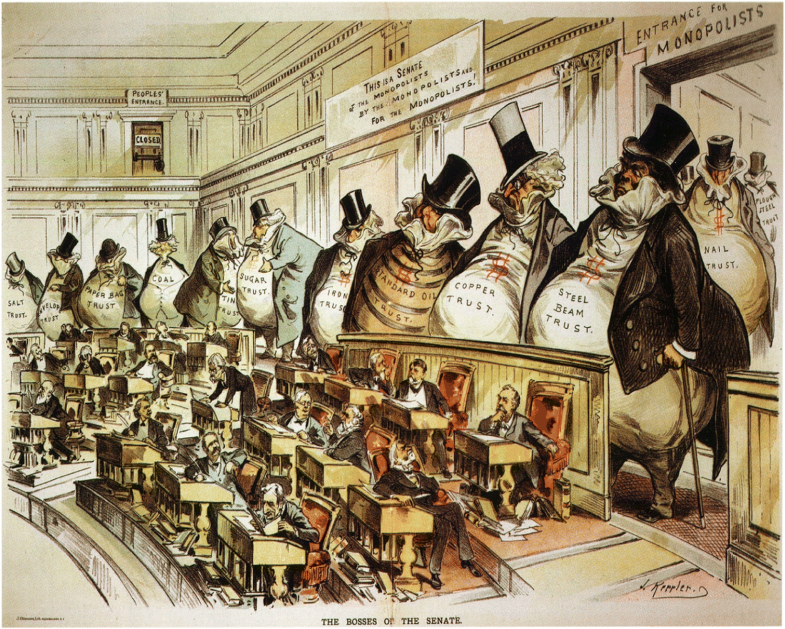
The study is actually a proper published peer-reviewed thingy by Robert J. Brulle in Climatic Change, and even for a journal devoted to the Description, Causes and Implications of Climatic Change it seems a teensy bit political rather than sciencey to me, but meh. In case you're in any doubt, though, the study includes a cartoon The lithograph “The Bosses of the Senate” by Joseph Keppler to make it's biases clear.

Lobbying, though it has a poor reputation, is part of the communication within any governmental system. There are two sorts of lobbying: good lobbying, which is done by people you like for causes you support (after all, as our source tells us, the Evil Fossil Fuel industry has outspent the Nice Environmentalists 10-to-1, but that does imply $200 million spent lobbying by the env folk1, all of it Good) and Bad Lobbying done by people you don't like for causes you oppose. Somewhat more seriously, the Good lobbying should be information feedback into the system, not buying the system. Alas, attempts to allow only Good lobbying are stymied by it being hard to tell from Bad by objective criteria, and by the desire of the political class to permit lots of opportunities for lobbying, for the obvious reasons. The solution, of course, is to have government Do Less, thereby lessening the potential for lobbying.

Quibbling the numbers


Just accepting the numbers is no fun; you'll expect me to quibble them so I will.

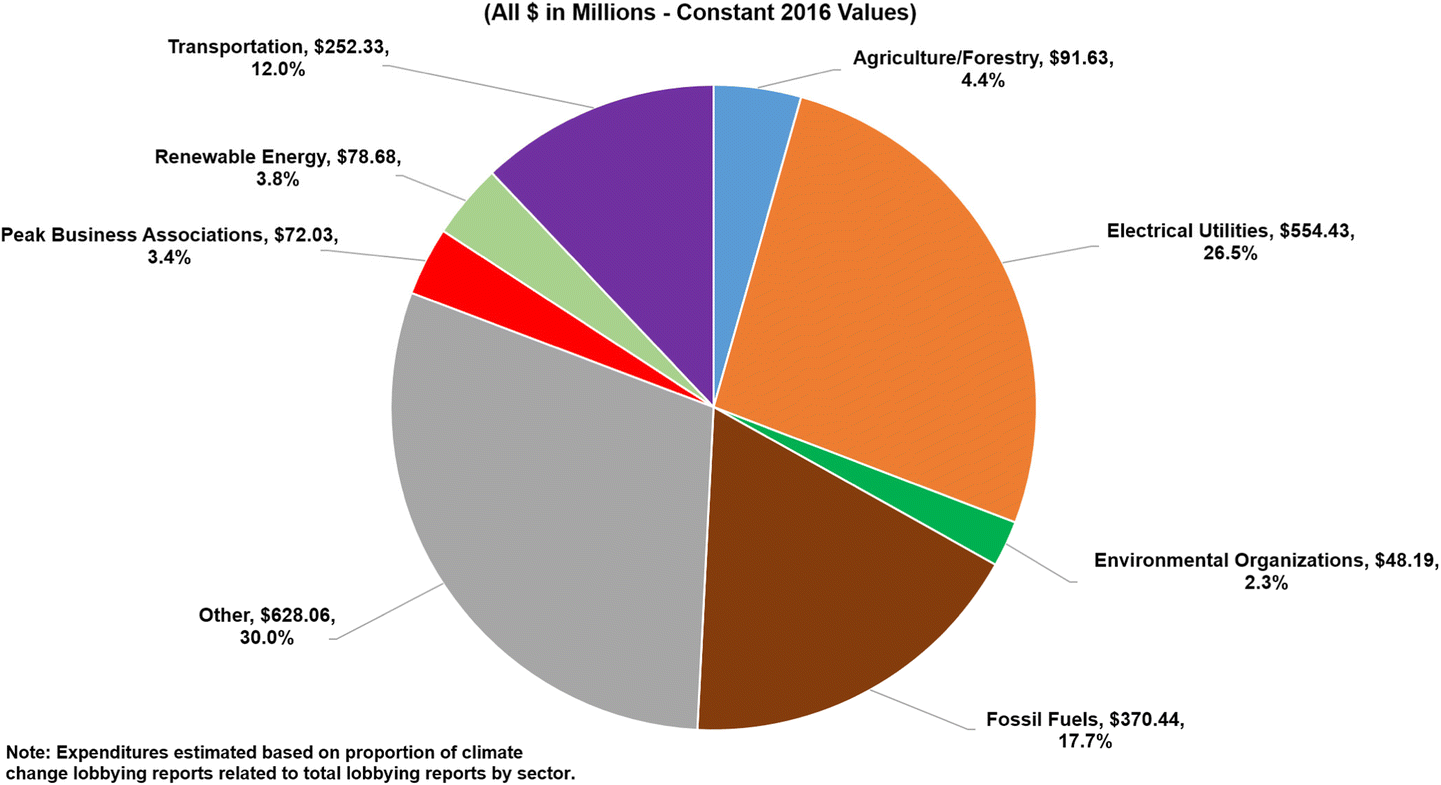
The total spend (2000 to 2016) was about $2 billion, which is about 4% of the total. The annual average is about $120 million.

Before we go on, allow me to tell you something that won't interest you: During the 2016 election cycle, organised labour spent $217m—88% of it going to Democrats, according to The Economist. Are you outraged by that? Probably not, since it is Good lobbying. The lobbying data seems to have come from Open Secrets, and they make it available per sector. Health is the biggest; there's loadsa dosh in healthcare in the US.

Aanyway, what of my quibbles? Well first of all $2 billion is all lobbying, so it includes the Good lobbying by the env folk. Rather more importantly though it includes a pile of other folk too: see the picture I've inlined from the study. So the FF spend is $370 million, the EO is $48 million. And so ThinkProgress's proud headline is a lie. Quite possibly not a deliberate lie; most likely they're just too lazy or too stupid to trouble themselves to read the paper. You'll also notice that the ratio of 370 to 48 is not ten-to-one, that's because the one in 10-to-1 is EO and the renewable sector, and I think they threw some other bits - maybe electrical utilities - into the "fossil" basket (does that mean EU doing solar are counted in the "fossil" basket?).

My second quibble is that they identify climate lobbying by keyword search within lobbying records. Each lobbying record is (I presume) likely to have a number of keywords in it, and (or so it seems to me) likely that if you did this analysis across a wide variety of topics, you'd discover that you'd counted more than 100% of the total lobbying expenditure. This is a point that I'd have expected the paper to address; but if it did, I missed it.

Other sources


My main quibble, though, is going to be suggesting that lobbying isn't necessarily the major source of influence. The paper doesn't consider this point; it's only interest is lobbying, nothing else. So if I were to look at my native UK, or indeed anywhere in Europe, I'd discover that "believing in global warming" or however you choose to phrase it is official government policy. I'd probably also discover that FF folk outspend the Env folk, but that both are outspent by Govt propaganda.

You'll riposte that isn't true in the good ol' US of A. But would you be right? We're talking 2016 and before, not the Trump era, so that includes 8 years of Obama presidency, which was actually rather GW-friendly, though admittedly not to the extent of managing to do anything useful.

Notes


1. Ah, no, it doesn't make $200 million: see the Quibbles section. I was dumb enough to beliave TP's headlines. Never mind, the principle remains.

Global warming and common law

New York City Climate Suit Dismissed by Federal Judge (U.S. District Judge John Keenan) says Climate Liability News (h/t WUWT; I'm afraid none of my other sources covered it; though it now turns out that the Smoggies did, h/t EFS).

2018/11 update: NYC is going to appeal (because they are pols).

The decision states unambiguously Climate science clearly demonstrates that the burning of fossil fuels is the primary cause of climate change, so once again the reality of GW science is not the issue. Indeed, it actually gets a teensy bit carried away IMO, continuing Global warming, or the gradual heating of the Earth’s surface and atmosphere caused by accumulation of greenhouse gas pollution in the atmosphere, has led to hotter temperatures, longer and more severe heat waves, extreme precipitation events including heavy downpours, rising sea levels, and other severe and irreversible harms. I think it is sourcing that from the complaint, which I haven't read.

The reasonning is essentially the same as in the Alsup case, and explicitly references it, which is a sensible thing to do. The headlines (and I did read the text in between) are Federal Common Law Displaces The City’s State Law Claims and The Clean Air Act Displaces the City’s Claims and The City’s Claims Interfere with Separation of Powers and Foreign Policy and the conclusion is the City's amended complaint is dismissed with prejudice in its entirety.

AFAIK, none of these rulings have addressed the cost benefit question, because they've been dismissed first. But "can you sue for damages from GW if you've been an enthusiastic burner of fossil fuels yourself?" is an obvious question, which will come into play if anyone gets any closer. And the other obvious question - who is responsible for fossil fuel CO2: those who burn it, or those who sold it - also remains.

But enough of that. It occurs to me that I've been a supporter of common law over legislation for a while now, so it would be natural to suppose me opposed to these arguments. But in this case I think the rulings are correct. Common law, as the name suggests, is there to deal with common problems, where similar situations have arisen before, and the judge's task is to discover what the law and custom says. Global warming has not occurred before within human judicial history, and attempts to relate it to previous claims under nuisance (or even less plausibly under trespass) are contrived.

So if you're feeling "disenfanchised" by the courts, what is your remedy under the legislative or executive branches? Well, obviously, to get them to pass legislation, or to act on existing legislation. "But Congress won't pass any GW legislation" you might reply, and you'd be correct, but that's rather the point, isn't it? If the will of the majority doesn't support it, you don't get it, no matter how fervently you the minority might believe in it2. And yes yes I know it is possible to argue that the public at large wants it but the evil Congress critters have been bought off by evil fossil fuel companies and so are acting against the will of the people but, whilst there is some limited truth to that, I don't think it's really the full story or even very much of it. The Joe Public is fat complacent unthinking and fond of his comforts. He is prepared to act on your minor campaigns like giving up plastic straws but inclined to regard his obligations as done once that trivia has gone by. As to the executive branch, you have Trump1, sadly.

[Update: another somewhat more parochial case by Plan B Earth (who, whilst very sweet, are probably idiots) comes my way: Environmental campaigners lose High Court battle over carbon target via a dodgy blog; or you may prefer The Graun's version. Again, I think the decision is correct: deciding the exact size of our CO2 reduction is within the "[]lawful exercise of [the secretary of state's] discretion". This may be a good place to remind you that I've come to think that carbon budgets are stupid, anyway.]

Notes


1. Sadly I can't find a posting by me as a good link to "Trump is a wazzock" so just take it as read: I think Trump is a wazzock.

2. Please don't interpret this as support by me for unfettered "majoritarianism", because as I've said before I'm not.

Refs

* Cleaning Out the Statutory Junk - Cato
* Supreme Court Rules on Kid's Climate Lawsuit - QS

2018-07-16

Unmasking the negative greenhouse effect over the Antarctic Plateau

It's "new", it's exciting, it's in Nature. Woo. Or at least that one is, by Sergio A. Sejas, Patrick C. Taylor & Ming Cai. But there's also Antarctic Specific Features of the Greenhouse Effect: A Radiative Analysis Using Measurements and Models by Holger Schmithüsen (via RR on Twatter). Are they related? I don't know. But this certainly isn't new; S had How increasing CO2 leads to an increased negative greenhouse effect in Antarctica in 2015.

CIP posted about this back in 2016 and we had a "discussion" there.

As you'd hope, the Watties have manged to mangle it: "it also implies that the EAIS is enormously stable with respect to higher CO2 levels". But that's not true. This only gets you an anti-GHE in midwinter, when it's too cold to melt anyway, and it wasn't about to melt in the interior anyway. For stability the edges, and summer, and the ocean are more interesting, as is polewards-advected heat.

Refs


* Town bumps starts tomorrow!

2018-07-12

Merchantilism and Denialism impartially consider'd

20180711_125916 Reading - as I do - the likes of Don Boudreaux railing against  the imbecility of Trump's merchantilist (aka non-free trade) policy, I can't help seeing the analogy with science-type folk railing against the idiocy of the denialists. Which is to say, being right, but talking to people who just don't care, because their ideology means they're not really thinking about the thing you're talking about. It's nominally the same subject - "global warming" in one case or "trade" in another - but since they're always thinking about different aspects there is no connection.

Amusingly, there's a further similarity: just as the science-type folk generally don't support free trade, so the economics-type folk don't generally support the GW science.

Refs


* The relativist can offer no cogent reason why we should not simply get on with it
* Hexapodia?
* Rejecting Climate Change: Not Science Denial, but Regulation Phobia?
* CIP on free trade
* NO MORE TIGER IN  KOCH THINK TANK: EXXON QUITS ALEC
* On the “National-Security Exception” to a Policy of Free Trade