2020-01-29

0.5°C makes a big difference for mitigation?

[Note: written rather a long time ago and finally published when I reviewed 2020.]

An interesting post from Glen Peters at Cicero. Keeping global warming below 2°C is hard, but 2.5°C is a walk in the park!; found via Twatter. Not everyone was happy with this, but I'm going to ignore The question is "when people argue 1.5/2C is not 'achievable' but 2.5/3C is a 'walk in the park', what are the unstated assumptions about policy, econ, and values being smuggled past scrutiny in that formulation?" because I don't think that is the interesting question, at least not to start with. The interesting question is, does changing target from 2 oC to 2.5 oC actually make things so much easier?

This had not previously occurred to me, and I had I thought about it I'd have said it didn't make all that much difference.

2020-01-24

Ignore the Fake Climate Debate

IMG_20200119_164755 Ignore the Fake Climate Debate says [Ted] Nordhaus. And he's right1. The second half of the sub-head of The deniers and alarmists may make headlines, but behind the scenes, an expert consensus is taking shape on how to respond to global warming is perhaps a bit more dubious. That almost everything you see in the Meeja, Twatter and indeed blogs is about the fake debate is all too true. That doesn't mean it's actually wrong, just not the real debate. But there's so much drivel in the public eye that anyone trying to be responsive ends up mostly talking about drivel, even if they're not actually talking drivel. I feel this to be so uncontroversial that I can't be bothered to demonstrate it; do tell me if you disagree.

Father2 Ted picks Greta Thunberg and Donald Trump as his archetypes of Alarmists and Deniers, and that seems reasonable enough. DT as denier seems uncontroversial so again I won't bother demonstrate; GT as alarmist may ruffle a few feathers but At Davos we will tell world leaders to abandon the fossil fuel economy? may do. And he says:
In the real climate debate, no one denies the relationship between human emissions of greenhouse gases and a warming climate. Instead, the disagreement comes down to different views of climate risk in the face of multiple, cascading uncertainties. On one side of the debate are optimists, who believe that, with improving technology and greater affluence, our societies will prove quite adaptable to a changing climate. On the other side are pessimists, who are more concerned about the risks associated with rapid, large-scale and poorly understood transformations of the climate system. But most pessimists do not believe that runaway climate change or a hothouse earth are plausible scenarios, much less that human extinction is imminent. And most optimists recognize a need for policies to address climate change, even if they don’t support the radical measures that Ms. Thunberg and others have demanded. In the fake climate debate, both sides agree that economic growth and reduced emissions vary inversely; it’s a zero-sum game. In the real debate, the relationship is much more complicated. Long-term economic growth is associated with both rising per capita energy consumption and slower population growth.
And so on. It wasn't quite all sensible; I don't quote everything. But for an Op-Ed in the WSJ it seems pretty good. He never really justifies "expert consensus is taking shape on how to respond to global warming"; the closest is somewhat different:
All of this suggests that continuing political, economic and technological modernization, not a radical remaking of society, is the key to both slowing climate change and adapting to it. And while the progress we’ve made has mostly not been due to climate policies that would cap, regulate or tax emissions, it has required government action.
That's probably his consensus; and it may be right. Somewhat like Brexit: we appear almost doomed to a rather pointless Brexit, when just remain would be more efficient. We could deal with GW more efficiently, but are doomed to muddle through.

Notes


1. But controversial; as he says, "This oped has stoked predictable outrage and ad hominem". Woo, such bravery.

2. Update: actually nephew (see comments).

Refs


Scientist Strike for Climate - Tamino
* The best way to help the climate is to increase the price of CO2 emissions - Jeffrey Frankel, in the Graun of all places.
Update day 2020! - RC
* Franta on Twatter reveals himself to be more pol than sci.

Pix


2020-01-18

End of the line for photogenic teens?

DSC_6095 Appeals Court Dismisses Landmark Youth Climate Lawsuit Vs. U.S. Government says ClimateLiabilityNews, or if you prefer the Dork Side, Climate Kidz case scuttled by 9th Circuit Court. And the reasons appear to be much as before. This is Juliana, if you haven't been paying attention; I say that so that Search will find it when I need it.

Read the judgement here; although for nominally sober judges is reads like they've been at the sherry: A substantial evidentiary record documents that the federal government has long promoted fossil fuel use despite knowing that it can cause catastrophic climate change, and that failure to change existing policy may hasten an environmental apocalypse. Probably, they're feeling a bit guilty about dismissing it, so have thrown them a bone1.

According to Vox, Andrea Rodgers, a senior attorney at Our Children’s Trust, the nonprofit backing the youth who filed the lawsuit, described the decision in an email as “unprecedented and contrary to American principles of justice.” This is of course a lie. It has several precedents, most obviously Alsup, as my previous post noted. Have these people no shame?2. And the reasonning here is similar: the panel held that it was beyond the power of an Article III court to order, design, supervise, or implement the plaintiffs’ requested remedial plan where any effective plan would necessarily require a host of complex policy decisions entrusted to the wisdom and discretion of the executive and legislative branches. In case you're tempted to argue "but that leaves us no recourse!" I point out that you are wrong: the forum for resolution of such disputes is the political process; if you reply "but we get nowhere with that!" then the reply is: well, yes, indeed. So, you need to think about why very carefully, rather than go forum-shopping.

The judgement is weak scientifically and factually; I'm actually rather surprised at some elementary mistakes they make; just possibly, they are repeated the Juliana errors. But in the 1990s, the EPA implored the government to act before it was too late. Nonetheless, by 2014, U.S. fossil fuel emissions had climbed to 5.4 billion metric tons, up substantially from 1965. This growth shows no signs of abating is drivel3.

So what of the plaintiffs claim that the government has violated their constitutional rights, including a claimed right under the Due Process Clause of the Fifth Amendment to a “climate system capable of sustaining human life.”? First, allow me to note that previous reasonning in the chain (particularised injury, and causation) that the court accepts seems weak to me; I'd expect that to get scrutinised more carefully if it goes to appeal. Then, we note the court's Reasonable jurists can disagree about whether the asserted constitutional right exists. Ah, but they don't decide it, because they don't need to: In analyzing redressability, however, we assume its existence and then go on to find lack of standing. So, the "right" will have to wait for it's day in court.

Wittily, one reason for the court deciding not to act is the plaintiffs’ experts make plain that reducing the global consequences of climate change demands much more than cessation of the government’s promotion of fossil fuels. Rather, these experts opine that such a result calls for no less than a fundamental transformation of this country’s energy system, if not that of the industrialized world, and much more text around the same ideas5.

Update 2023/06: Youth Climate Lawsuit Against Federal Government Headed for Trial sez Yale, though they may be wrong about that, but the important bit is that the Yoof have decided that when they said X they really meant Y: the plaintiffs asked to amend their suit, pushing not for a change in policy, but instead for a ruling declaring that the nation’s fossil-fuel-based energy system is unconstitutional. Meh.

2024/05: End of the line for the photogenic ex-teens.

Notes


1. Or, as they put it, "The plaintiffs have compiled an extensive record, which at this stage in the litigation we take in the light most favorable to their claims". So, even taking all their claims favourably, they still don't win.

2. Don't answer that.

3. Note that although it's drivel, it seems to be quite easy to pick up the wrong stats: per person, per $ of GDP, and just the electricity sector are the easiest stats to run across. Also "fossil fuel emissions" is an odd phrase; I presume they mean "CO2 from fossil fuels" or somesuch.

4. But again, There is at least a genuine factual dispute as to whether those policies were a “substantial factor” in causing the plaintiffs’ injuries suggests the court leaning towards the plaintiffs in order to make the dismissal.

5. And as if designed to wind up Progressives, another prong in their argument is analogy with Rucho v. Common Cause. You can tell the Dork Side is crap and can't read, because they don't even mention that.

Refs


Government Schooling and Supermarkets - CH
* Austerity for Liberty by Bryan Caplan
The Adverse Impact of Government Bureaucracy on Private Employment - AIER
Trump's Impeachment Trial Will Only Make Us Hate Washington Even More

2020-01-17

Citing Climate Change, BlackRock Will Start Moving Away from Fossil Fuels

81791977_1362043940658589_4321250782159568896_n Says the NYer (arch). But screw that - which wasn't what BR said, anyway - instead of their interpretation let's just read the source, A Fundamental Reshaping of Finance, by Larry Fink, Chairman and Chief Executive Officer. It's addressed to CEOs; there's also a letter to clients.
As an asset manager, BlackRock invests on behalf of others... to people in dozens of countries trying to finance long-term goals like retirement. And we have a deep responsibility... to promote long-term value. Climate change has become a defining factor in companies’ long-term prospects... a risk that markets to date have been slower to reflect. But awareness is rapidly changing, and I believe we are on the edge of a fundamental reshaping of finance. The evidence on climate risk is compelling investors to reassess core assumptions about modern finance. Research from a wide range of organizations – including the UN’s Intergovernmental Panel on Climate Change, the BlackRock Investment Institute, and many others, including new studies from McKinsey on the socioeconomic implications of physical climate risk – is deepening our understanding of how climate risk will impact both our physical world and the global system that finances economic growth... Investors are increasingly reckoning with these questions and recognizing that climate risk is investment risk. Indeed, climate change is almost invariably the top issue that clients around the world raise with BlackRock... They are seeking to understand both the physical risks associated with climate change as well as the ways that climate policy will impact prices, costs, and demand across the entire economy... These questions are driving a profound reassessment of risk and asset values. And because capital markets pull future risk forward, we will see changes in capital allocation more quickly than we see changes to the climate itself. In the near future – and sooner than most anticipate – there will be a significant reallocation of capital.
And so on. Read the thing yourself. Most of you will mostly be happy with it. Some of it, ter be 'onest, is just a touch strange: What happens to inflation, and in turn interest rates, if the cost of food climbs from drought and flooding? Well, it might. But food production in the real world continues to increase, and I expect core-cost-of-food to continue to decline as a proportion of total spend, so becoming less important into the future. How can we model economic growth if emerging markets see their productivity decline due to extreme heat and other climate impacts? Well, emerging market productivity compared to the West is so much lower it would be weird if catch-up didn't get them a lot; mostly, they need to fix their crap governance1.

But most of it is sensible, and some rather telling: From Europe to Australia, South America to China, Florida to Oregon, investors are asking how they should modify their portfolios. Yes, that's their major question. Not "how can we make the world better?" just "what should we shift our money into?" That's how things are; the job of govt ought to be guiding them towards "good" answers2.

Climate Risk Is Investment Risk


Govt will have to set frameworks, ideally wisely but there's faint hope of that so perhaps we can hope for not too unwisely:
Over the next few years, one of the most important questions we will face is the scale and scope of government action on climate change, which will generally define the speed with which we move to a low-carbon economy. This challenge cannot be solved without a coordinated, international response from governments, aligned with the goals of the Paris Agreement.

Accountable and Transparent Capitalism


Ah, glorious. Companies, investors, and governments must prepare for a significant reallocation of capital... Disclosure should be a means to achieving a more sustainable and inclusive capitalism. I find this a bit odd, too. This is all addressed at least nominally to CEOs, remember. So he's beating them up about how they are threatened that capital will shift, but then the major theme turns out to be transparency, which is largely a red herring (you really don't need to read their reports to know that Exxon is mostly oil). So is this just PR perhaps?

Letter to clients


There is also, as I noted, a letter to clients. It starts Since BlackRock’s founding in 1988, we have worked to anticipate our clients’ needs to help you manage risk and achieve your investment goals. This is something that I wish the govt employee non-biznis folk reading this would more clearly understand: biznis really does want to make it's customers happy; or at least, satisfy their needs. Not of course out of altruism; but because they want their money.

More words: Because sustainable investment options have the potential to offer clients better outcomes, we are making sustainability integral to the way BlackRock manages risk, constructs portfolios, designs products, and engages with companies. We believe that sustainability should be our new standard for investing... sustainability-integrated portfolios can provide better risk-adjusted returns to investors. And so on. But what of the actual concrete changes? Exiting Thermal Coal Producers  is one; that makes sense and by now is I think mainstream. Most of the rest is providing potential investors with more sustainable options and hoping they take them; Joining Climate Action 100+, but I can't say I'm keen on that.

Notes


1. Little else is requisite to carry a state to the highest degree of opulence from the lowest barbarism, but peace, easy taxes, and a tolerable administration of justice: all the rest being brought about by the natural course of things.

2. Re-reading, 2020/05/28: I wish I hadn't said that. What I meant to indicate was "the job of govt  is not to get involved in individual decisions". The "guidance" I'd like to see is of course a carbon tax.

2020-01-14

Germany Goes Greener With $95 Billion Push for Train Over Plane

This meeting is bollocks. Germany Goes Greener With $95 Billion Push for Train Over Plane proudly says Bloomberg.
Germany launched an 86 billion euro ($95 billion) plan to modernize and expand its creaky railway system, a move billed as an effort to make transportation greener. The 10-year plan is not only to upgrade rails, bridges and carriages but also build out capacity and electrify more routes so as to lure passengers from cars and planes. The federal government will finance 62 billion euros and state-owned Deutsche Bahn AG is to come up with 24 billion euros... DB, as the railway operator is also known, has been under pressure in recent years to improve punctuality and service standards as its fleet of aging trains failed to keep up with rising passenger numbers and its federal owner kept up pressure on the company to secure dividends. Currently only 58% of rails run on electricity and punctuality on long-distance trains was around 76% in 2019, up one point from a year earlier. Rail travel emits less CO2 pollution than air or road traffic. The company already slashed travel prices across the board by 10% on Jan. 1, after the government ordered a cut in value-added tax on tickets.
And so on. I like trains, really I do. Although I don't use them much any more (mostly, I'm happy to say, because I just don't travel that much any more). However, is what they've done a good idea? How would you even know? If your answer is "yes it's obviously a good idea" then my reply is "but would $195B be better?" Because if it would be, then they've made a distinctly sub-optimal choice, so calling it "good" is odd. If you believe that pols are generally not just wise and well advised, but also able to put aside lobbying pressures and party politics, then you might believe that they've picked the right number. Presumably you'll also believe that HS2 is also a great idea. And can I interest you in this fine bridge I have for sale?

How might we do it otherwise, and use something other than the undoubtedly unsurpassable wit and wisdom of pols? Well, if you don't like hairyplanes because they emit CO2, then you should tax CO2. Which would increase the costs of hairyplanes. If people still flew too much after that, then you'd know that Johannes Public doesn't agree with the pols.

Which brings me back to a rather short conversation with mt on Twatter recently. Well, less of a conversation and more him posting something and me replying. And my reply was to push the prices-as-information theory a-la Hayek. Of which DB's upgrade is not an example. People can signal how they wish to balance cost and convenience by whether they choose to buy plane tickets or train tickets. At the moment the Govt thinks they are buying too many plane tickets. Given that preference, you'd expect investment money to flow into hairyplanes, and that seems to be true. Deciding that you don't like that, and just dumping a wodge of money on DB, is likely to be inefficient. Because how will they know just what to spend it on?

Refs


The collection of resources for government financed or sponsored investment often has a substantial disincentive effect on saving, effort and enterprise...  Peter Bauer, Dissent on Development.
* Slow travel by ATTP

2020-01-11

At Davos we will tell world leaders to abandon the fossil fuel economy?

tour Greta Thunberg and others, in the Graun - where else? Time to update Skolstrejk för klimatet and see what the "No plan, let alone a plan B" looks like now.

But before that, my pic shows Cadel Evans (141, in red) on the Alp de Huez, on his way to winning the 2011 Tour de France. I thoroughly recommend it, if you like that kind of thing; that stage is here but it's worth stepping back a few to get into the flow.

But back to La Greta:
We demand that at this year’s forum, participants from all companies, banks, institutions and governments immediately halt all investments in fossil fuel exploration and extraction, immediately end all fossil fuel subsidies and immediately and completely divest from fossil fuels. We don’t want these things done by 2050, 2030 or even 2021, we want this done now – as in right now.
How to evaluate this? The idea that this can be done right now is of course absurd. I shall assume that it is but a rhetorical flourish and should not be criticised too harshly. end all fossil fuel subsidies sounds good, but without defining "subsidy" it is meaningless. Happily, GT implicitly defines "subsidy" with The IMF concluded that in 2017 alone, the world spent $5.2tn subsidising fossil fuels, because this can be recognised as IMF working paper 2019: Global Fossil Fuel Subsidies Remain Large: An Update Based on Country-Level Estimates. This means that GT doesn't know what a subsidy is, because that $5.2T represents all kind of things, mostly pollution - not CO2 - effects; which means that to talk of the world "spend"ing $5.2T is just wrong; and to think they could be ended - by just stopping paying out money - is also wrong. This is careless of GT because generally she is spoken of as someone who actually knows what she is talking about.

"Divesting" from FF generally means selling your shares: to someone else. That expresses your disgust quite neatly, but does mean that someone else now owns those shares. They don't just disappear. And, of course you've profited by the sale of a FF related asset, so are morally contaminated. Perhaps you should instead rip up your share certificate? That doesn't help either really: it's like ripping up a five pound note (in the days when notes were made of paper and were weak enough to tear); all that happens is a tiny amount of deflation. Lots of people selling shares will tend to decrease the price of those shares, and will signal to the markets to invest less in those companies; and that brings us naturally on to investment.

And, jolly good, I've managed to find a thread I was looking forHere's a THREAD about divestment (and why it's driven mostly by economics, not good citizenship), theories of change in climate / energy, and the power of tapping into self-interested economic motivations among corporates, banks, and investers. So that says, as I guess we all know, that coal is doomed; probably, it will collapse entirely quite soon. That will be good as it will remove a pile of people pushing for FF, as well as being good for the climate. GT says that since the 2015 Paris agreement, 33 major global banks have collectively poured $1.9tn (£1.5tn) into fossil fuels. That number may be correct, but again GT is making a mistake like she did with subsidies, and one I think Joe Public makes: that isn't the bank's money, cos they don't have money, they have deposits. It's clients money. Clients like, oh... pension funds. Sensibly, GT says it ought to be in every company and stakeholder’s interest to make sure the planet they live on will thrive. Alas, she cannot bring herself to add: and the correct way to do this is Carbon Taxes. I think because that would amount to compromise; and she cannot compromise.

Update: a more constructive view comes in From shtetl to Forum by Scott Aaronson.

2020-01-09

Plastic packaging ban 'could harm environment'?

Plastic packaging ban 'could harm environment' says Aunty:
Consumer pressure to end plastic packaging in shops could actually be harming the environment, a report says. Firms are swapping to other packaging materials which are potentially even worse for the environment, the cross-party Parliamentary group warns. Glass bottles, for instance, are much heavier than plastic so are far more polluting to transport. Paper bags tend to have higher carbon emissions than plastic bags – and are more difficult to re-use.
And so on. This is all tediously predictable; a simple knee-jerk "plastic is bad" is stupid; and the general public I think generally can't cope with subtlety.

But then again, neither can the Beeb. Because if you actually read the report1, you find:
There have been some minor changes, for the most part switching from one single use option to another. These include the use of new types of material to replace some plastic in the bottled water market and moves away from plastic straws and stirrers ahead of the forthcoming ban in England in 2020. But, overall, the proportion of plastic packaging seen on most supermarket shelves, and the amount collected as waste and reported to the Environment Agency, has not altered significantly.
Which I find somewhat cheerful. Supermarkets were using plastic packaging because it made sense, and it still continues to make sense.
another noted: “It’s been mostly complaints, saying that plastic is evil and has no place, regardless of any positives it might have in addressing food waste and what not… But this outrage is not necessarily translating into changes in purchasing habits... customers’ concerns over plastic pollution are not yet evident in what they are buying. One observed: “A lot more consumers are saying that they are already avoiding what they understand as single use plastics – that is a clear and consistent trend coming through our research. The challenge is that’s claimed behaviour and is not necessarily coming through as actual behaviours from consumers yet.” Another was far more blunt: “When it comes down to real consumer behaviour, they ain’t changing yet.”
As far as I can tell the entire "plastic pollution" scare is, in the West, nonsense. See e.g. Stemming the Plastic Tide: 10 Rivers Contribute Most of the Plastic in the Oceans; The Yangtze alone pours up to an estimated 1.5 million metric tons into the Yellow Sea.

Notes


1. Ignoring the boilerplate "Plastic pollution is one of the biggest environmental problems of our age" which is nonsense.

Refs


* Explain Your Extremists by Bryan Caplan
* The solution to the plastic waste crisis? It isn’t recycling; by John Vidal; There’s no way of making current levels of consumption ‘environmentally friendly’
The Perverse Panic over Plastic - John Tierney, City Journal

2020-01-02

Socrates, himself, is particularly missed; A lovely little thinker, but a bugger when he's pissed

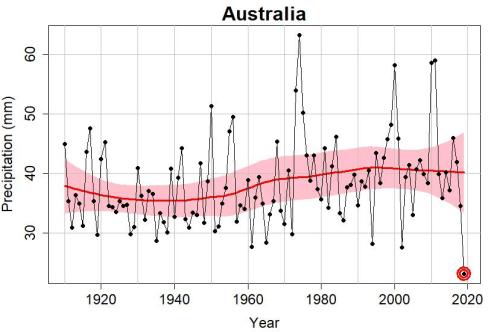
From Tamino, some nice graphs about the current situation in Australia. With all the wild excitement, it can be hard to see what's actually happening - after all, recall the Bazillion Rainforest fuss of not long ago.

As to ppn, as Tamino puts it, Australia has had dry years before, and will again. Although 2019 was the driest on record, there’s no trend detectable in rainfall amounts, at least not yet; it looks like an unfortunate but random occurrence. This isn’t climate change, it’s bad luck. And that seems a fair assessment.

As to temperature, clearly that is a record high, and part of a trend; though also clearly above the trendline.

Now I draw your attention to the correlations; wet years tend to be cold, and dry years tend to be hot. I'm doing that by eye; Tamino didn't leave his data lying around and I can't be bothered to look for it; but look at e.g. 2000 (and then 2002), and 2010/11; or 1974. 1994 is less convincing. Anyway, as you'd expect, there's a correlation: a dry year has less moisture to cool the earth by evaporating, so tends to be hot2.

And that then suggests that this year's disastrous fire season is unlikely to be replicated in the near future; if it's caused by the exceptional dryness, then it's bad luck. Anyone wanna bet, that 2020's ppn will be back at or above the bottom pink band; and next year's Temp will be at or below the pink; and next year's fire season will be unexciting?

Recall that we discussed this somewhat in the comments at Climate emergency? in November. At least my thoughts there suggest that yearly averages might not be fine enough1.

Notes


1. And now Tamino with prompting has done another post on more regional stuff, but still doesn't find much in the way of trends.

2. Although this isn't obvious when you scatter-plot it; see RR.

Refs


Hot enough to boil a monkey's bum!
* Australia’s Angry Summer: This Is What Climate Change Looks Like; by Nerilie Abram on December 31, 2019
* Australia, your country is burning – dangerous climate change is here with you now; by Michael Mann
‘Two hands are a lot’ — we’re hiring data scientists, project managers, policy experts, assorted weirdos… - Dominic Cummings
Climate change now detectable from any single day of weather at global scale - Sebastian Sippel, Nicolai Meinshausen, Erich M. Fischer, Enikő Székely & Reto Knutti; Nature Climate Change volume 10, pages35–41(2020)
Atlantic and Pacific oscillations lost in the noise; Absence of internal multidecadal and interdecadal oscillations in climate model simulations (arch); Michael E. Mann, Byron A. Steinman & Sonya K. Miller; Nature Communications volume 11, Article number: 49 (2020)
* A pre-hurricane climate change analysis gets major revision after the storm. Effort had predicted half of Hurricane Florence's rainfall was due to warming; Arstechnica (h/t VV).
Australia Rain: Seasonal by State - Tamino
Connections of climate change and variability to large and extreme forest fires in southeast Australia - Abram, N.J., Henley, B.J., Sen Gupta, A. et al. Connections of climate change and variability to large and extreme forest fires in southeast Australia. Commun Earth Environ 2, 8 (2021). https://doi.org/10.1038/s43247-020-00065-8.

2020-01-01

Book review: Homo Deus

80694470_3417507671654844_8495632808285306880_o CIP read Homo Deus but didn't really review it. I however am fearless. I was glad to get a chance to read this (it came as a Christmas present, welcomely as a second-hand book) because I'd heard good things about Sapiens. I haven't read that, so I don't know if much of this is recycled from that, but it somewhat feels like it is. However, I didn't get on with it: sorry.

The main point is that it is fat. Bloated. Obese. 100 pages in and he has barely said anything; a page or two would have sufficed. And the few things he has said are unexciting.

He's also careless. Planck is made to say "science advances one funeral at a time" on p 30. But he didn't say that. He said Eine neue wissenschaftliche Wahrheit pflegt sich nicht in der Weise durchzusetzen, daß ihre Gegner überzeugt werden und sich als belehrt erklären, sondern vielmehr dadurch, daß ihre Gegner allmählich aussterben und daß die heranwachsende Generation von vornherein mit der Wahrheit vertraut gemacht ist whose English equivalent is A new scientific truth does not triumph by convincing its opponents and making them see the light, but rather because its opponents eventually die, and a new generation grows up that is familiar with it. This is trivial but suggests that his scholarship, whilst wide, is shallow.

On p 106 he cites Numbers 28 for the statement that the old Jewish temples were swarming with black flies. Of course, that verse says nothing to that effect. And notice what a cheap reference that is; there are many many other statements he makes that should be reffed, in anything vaguely scholarly, but he doesn't. He only tosses off the odd cheap reference, presumably to look good.

Around p 119 there's a jejune1 discussion of why evolution tends to inflame the passions more than relativity, which (characteristically) he broad-brushes into the untrue "no-one gets angry about relativity". Evolution, he brilliantly deduces, inflames people because it is incompatible with having a soul. But of course it isn't (he knows this; on p 122 he comes close to admitting it; but when you're writing at the rate he is, and when you outrank your publisher's reviewer, you're not going to go back and correct your flow).

Part, perhaps much, of the bloat comes from our author being interested in many things, and insisting on weaving those things in, even when he has nothing to say. From p 123 we get a multi-page disquisition into consciousness, which amounts to little other than "we don't know how it works".

He isn't very interested in science, and shows it about as much respect as the Watties. We repeatedly hear about "current scientific dogma" (e.g. p 139). Or "classical economic theories maintain that humans are rational calculating machines" (p 163) - a regrettably unoriginal piece of drivel.

And so ends part 1. Part 2 starts by saying that humanism is the worship of mankind. This is stupid. Probably, he is just trolling. But he needs to do better; he hasn't got much more credit and I will be giving up soon... ah, his trick is becoming clearer. Perhaps it was worth reading: his defn of "religion"  is "to believe in a system of moral laws that wasn't invented by humans but that humans must nevertheless obey" (p 213). But this is a poor trick, and doesn't justify his use of the word "worship". I think... I "believe in" a system of moral laws that was "invented" by humans, though that might depend on how you define the word "invented". So even by his rather creative defn, I'm still not religious. Phew.

On p 222, he tells us confidently that the pope never makes a mistake. This is nonsense. As the good book sayethPapal infallibility is a dogma of the Catholic Church that states that, in virtue of the promise of Jesus to Peter, the Pope is preserved from the possibility of error "when, in the exercise of his office as shepherd and teacher of all Christians, in virtue of his supreme apostolic authority, he defines a doctrine concerning faith or morals to be held by the whole Church."[1] Infallibility is, according to the New Catholic Encyclopedia, "more than a simple, de facto absence of error. It is a positive perfection, ruling out the possibility of error".[2] 

At that point, I gave up. Looking for a review, I find the Economist:
Although there is plenty to admire in the ambitious scope of this book, ultimately it is a glib work, full of corner-cutting sleights of hand and unsatisfactory generalisations. Mr Harari has a tendency towards scientific name-dropping—words like biotech, nanotechnology and artificial intelligence abound—but he rarely engages with these topics in any serious way. Instead, he races along in a slick flow of TED-talk prose. Holes in his arguments blur like the spokes of a spinning wheel, giving an illusion of solidity but no more. When the reader stops to think, “Homo Deus” is suddenly less convincing, its air of super-confidence seductive but misleading.
Yup.

Notes


1. I like the word, and I've used "shallow" already.

2. Pic: New Year's Day 10k erg. I was trying.

Refs


* Ho ho ho: California Wanted to Protect Uber Drivers. Now It May Hurt Freelancers.
* 2026/06: Harari vs. Henrich doesn't rate Harari.

2019-12-31

You ain't ever gonna burn my heart out

MVIMG_20190725_132014 Aka the year in Stoats, 2019. Following last year's acclaimed tradition, I present posts by month selected by most comments; after all, it's the only objective measure.

* Jan: Aristotle's politics (38)
* Feb: A note on fossil fuel subsidies (30)
* Mar: Brexit schmexit (31)
* Apr: L'affaire Peter Ridd, part 2 (25)
* May: UK Parliament declares climate change emergency? (38)
* Jun: Does J R Oppenheimer ask: can science provide better models for democracy? (48)
* Jul: The One Viable Solution To Climate Change? (35)
* Aug: A dangerous new form of climate denialism is making the rounds? (22)
* Sep: Demons Tormenting St. Anthony (21)
* Oct: Economists greatly underestimate the price tag on harsher weather and higher seas. Why is that? (30)
* Nov: Pielke contra mundum (40)
* Dec: Sigh: DOE announces another lightbulb efficiency rollback (28)

Thanks to all my commentators for their contributions throughout the year. Rest assured that I read them all, and think about them all, and reply when it seems appropriate. To all you lurkers out there: welcome also.

Most of the posts I looked back at had typos; I've corrected some and in a couple of minor places clarified meanings that appeared unclear.

Refs


The lyf so short, the craft so longe to lerne (2018). Regrettably, I have failed in last year's resolve to insult more people this year.
* ATTP: 2019: A year in review.
* JEB: Review of the blogyear?

2019-12-30

The thing that hath been, it is that which shall be; and that which is done is that which shall be done: and there is no new thing under the sun

DSC_3744 A bit more Thucydides. This time from the "Mytilenian Debate". A quick precis of the background for those who have forgotten: war between Athens and Sparta is in its third year; the Mytilenians want to go over to the Spartan side1 and the Spartans promised aid; alas the revolt goes poorly, the Spartans prove fairly crap at sea and Mytilene and Lesbos are retaken. The ringleaders are taken to Athens, and the assembly there - no longer lead by Pericles - in anger and fear condemns all the men of Mytilene to death; but sleeping on it they come to be uneasy, and re-debate. The result - not to spoil the suspense - is a close run thing but is narrowly in favour of not killing everyone. Anyway, that's not my point here; what's interesting here is that Thucydides gives us the "demagogic" (Cleon) and "rationalist" (Diodotus) sides as speeches. This is one of his Dramatic Techniques and makes the whole thing more readable; after a catalogue of near-chaotic events and places which constitutes what happens, it's good to get the politics presented.

Aanyway, my real point was that on this my second reading - my first, several years ago, was mainly to get the story - I'm struck by bits of Cleon's speech I didn't notice before; perhaps I skimmed:
The most alarming feature in the case is the constant change of measures with which we appear to be threatened, and our seeming ignorance of the fact that bad laws which are never changed are better for a city than good ones that have no authority; that unlearned loyalty is more serviceable than quick-witted insubordination; and that ordinary men usually manage public affairs better than their more gifted fellows. The latter are always wanting to appear wiser than the laws, and to overrule every proposition brought forward, thinking that they cannot show their wit in more important matters, and by such behaviour too often ruin their country; while those who mistrust their own cleverness are content to be less learned than the laws, and less able to pick holes in the speech of a good speaker; and being fair judges rather than rival athletes, generally conduct affairs successfully. These we ought to imitate, instead of being led on by cleverness and intellectual rivalry to advise your people against our real opinions.
How Brexit is that? Don't trust experts. If you don't understand things, don't worry, just let your common sense guide you. Don't change your mind. It continues with proving that the M's were particularly evil, deserved punishment, and failure to do so would inevitably cause everyone else to revolt too.

Words had to change their ordinary meaning and to take that which was now given them


A well known passage, but worth quoting while I'm here.
Revolution thus ran its course from city to city, and the places which it arrived at last, from having heard what had been done before, carried to a still greater excess the refinement of their inventions, as manifested in the cunning of their enterprises and the atrocity of their reprisals. Words had to change their ordinary meaning and to take that which was now given them. Reckless audacity came to be considered the courage of a loyal ally; prudent hesitation, specious cowardice; moderation was held to be a cloak for unmanliness; ability to see all sides of a question, inaptness to act on any. Frantic violence became the attribute of manliness; cautious plotting, a justifiable means of self-defence.

Notes


1. Athens, though a democracy, wasn't terribly nice as an Empirical Power, the Delian League having decayed into hegemony.

2. If you're wondering about his wonderful memory capable of recording these speeches, be aware that as he puts it sometimes he made people say "what was called for in each situation". And from this distance, who are we to doubt this?

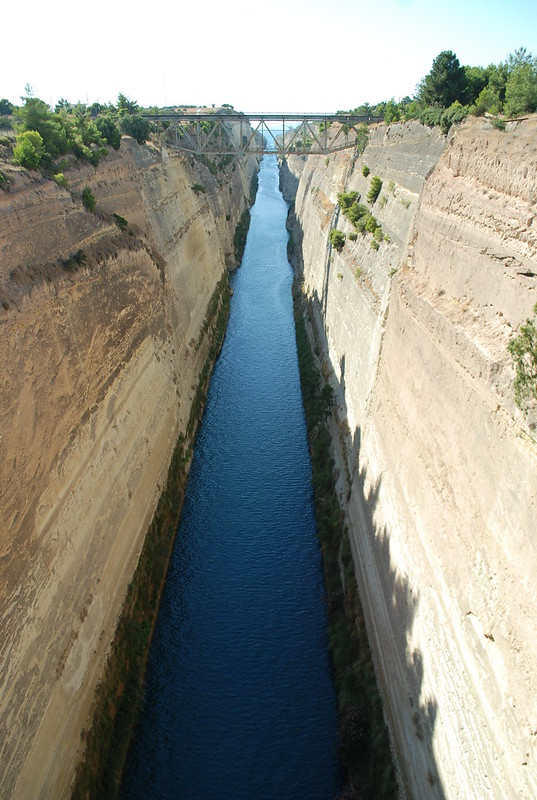
3. Pic: the Corinth canal. Somewhat beyond the strength of the Antients. But they did have a cut / road for dragging ships across.

Refs


* BBC Natural World: Weasels: Feisty and Fearless

2019-12-27

Close elections are bad elections; what we need is social consensus

Screenshot_20191223-225856 mt Twote:
Close elections are bad elections. What we need is social consensus. Anything important decided by a narrow fraction of the most disengaged voters is destabilizing.  Professionalization of politics is the problem, not the solution.
Complaining about something like politics becoming more professional, or more efficient, is about as much use as - and indeed, is very similar to - complaining about evolution. But I'm used to disagreeing with mt over politics, so skip that bit as a detail and come to the "close elections" thought.

About which, as I half said in a different context (oh, there are so many thoughts in the world to write down!) in Men spake from God being moved by the Holy Ghost / Every man in his own language, I feel I've said before but can't find, so will say again:

Politics tends to produce close results1, but not consensus2. Nominally, pols are supposed to seek and promote consensus, and mt is still yearning after that idea, but I see little evidence that it is a major part in practice. And politics is backed by coercion: at least in majoritarian states: if you win, you get the power to impose your - sorry, the people's - will; this tempts far too many people. This tends to leave the middle ground barren and dead, populated with the corpses of those attacked by both sides. The solution, of course, is to move as much as possible out of the purview of politics, since anything done there will inevitably be fought over as a zero sum game. And move it out into the free market, where individual decisions are indeed made by agreement.

Update


I should have reffed Aristotle's politics and the quote from Hayek: It is not democracy but unlimited government that is objectionable...

Refs


Does J R Oppenheimer ask: can science provide better models for democracy?

Notes


1. In an idealised society with a spectrum of opinion categorisable as from Left to Right, imagine two parties competing for votes, sure of all those on the side of the spectrum away from the other party; inevitably, they migrate to the centre. This was Tony Blair's chief idea, and lest you dismiss it too readily, notice that he was the only Labour to win an election for uncounted moons. I prefer conviction politicians - Blur IMO had no real ideas about what to do once he achieved power. The idealisation applies but in more blurred form in more complex scenarios.

2. Having commented on closeness, I feel the urge to comment on consensus too, since it is so strikingly absent. At least in the UK and USA; I'm rather less familiar with our Continental friends or those further abroad. But it is hard to know what to say. The UK is split by Brexit as one axis and by whether you dislike Corbyn or Bojo more on another, and that's not helpful. The USA is, apart from the perhaps-superficial Trump/Populist split, also divided between "free market" vs "progressive", but muddily, possibly leaving room for consensus in the details even if on principles there can be no meeting.

3. My picture shows Henry Worsley, who has nothing at all to do with this article. But I love the picture; I got it from the New Yorker. They shoved it into my fb feed for months on end and I finally got round to reading it. To my surprise, it doesn't show a USAnian: to me, he looks like one of the cowboy pilots from Catch-22, or the mad ones from Dr Strangelove. But no, just an Englishman.

Praise is due to all who respect justice more than their position compels them to do

DSC_3794 A fragment from The Peloponesian War. The Athenians are talking to the Spartans, trying to persuade them not to join the Corinthians; and so are defending their own actions and empire. They can't argue that they have been wholly good, and instead Thucydides1 reports them as saying:
praise is due to all who, if not so superior to human nature as to refuse dominion, yet respect justice more than their position compels them to do. We imagine that our moderation would be best demonstrated by the conduct of others who should be placed in our position; but even our equity has very unreasonably subjected us to condemnation instead of approval. Our abatement of our rights in the contract trials with our allies, and our causing them to be decided by impartial laws at Athens, have gained us the character of being litigious. And none care to inquire why this reproach is not brought against other imperial powers, who treat their subjects with less moderation than we do; the secret being that where force can be used, law is not needed. But our subjects are so habituated to associate with us as equals that any defeat whatever that clashes with their notions of justice, whether it proceeds from a legal judgment or from the power which our empire gives us, makes them forget to be grateful for being allowed to retain most of their possessions, and more vexed at a part being taken, than if we had from the first cast law aside and openly gratified our covetousness. If we had done so, not even would they have disputed that the weaker must give way to the stronger. Men's indignation, it seems, is more excited by legal wrong than by violent wrong; the first looks like being cheated by an equal, the second like being compelled by a superior. At all events they contrived to put up with much worse treatment than this from the Mede, yet they think our rule severe, and this is to be expected, for the present always weighs heavy on the conquered. This at least is certain. If you were to succeed in overthrowing us and in taking our place, you would speedily lose the popularity with which fear of us has invested you, if your policy of to-day is at all to tally with the sample that you gave of it during the brief period of your command against the Mede.
I think it fits the USAnian Empire well.

Notes


1. Crawley translation from Gutenberg. The Warner translation, which I'm reading, is somewhat different and appears to be more popular to quote. So you can key it if you want to, it starts "Those who really deserve praise are the people who, while human enough to enjoy power, nevertheless pay more attention to justice than they are compelled to do by their situation".

2. Yes I know: Mycenae predates this period by many years.


Refs


* Our holiday there some years back.
* Justice thus derived its importance from the need to preserve society – not society its raison d’être from a need to produce justice.

2019-12-26

Goe, and catche a falling starr

songAh, beautiful. The full - though alas modernised version - is available from e.g. here. I've used this before, though only incidentally so I think I'm allowed to use it as the headline now. The song is lovely though in my humble opinion runs out of steam and sheer madness in the third verse. While I'm on poetry I can also recommend So That's Who I Remind Me Of by Ogden Nash, h/t TF.

In other news, I managed my by-now-traditional Christmas day half, though not particularly quickly. And after some effort, we managed to set the Christmas pudding on fire. Boxing day will be quieter.

Refs


* The new spending bill is a disaster by Scott Sumner
* Economics as the Study of Peaceful Human Cooperation and Progress by Steven Horwitz
* Speaking of raving wackos: Trump on Wind (Oy Vey) - QS
* Christmas Trilogy 2019 Part I: Would the real Mr Newton please stand up? - RM
We need to make the labor force as flexible as the capital force - DMcC

2019-12-22

Happy Solstice

A re-tread from 2012. Doesn't time fly?

  DSC_1537-sunrise-w

A summer picture for the winter solstice. Which I'd forgotten until Amy reminded me.

This year's reminders from TPP and RM.

Refs


* Book of the New Sun. I still think Gene Wolfe does a better job of capturing the wonder of the Apollo programme with that brief paragraph that anyone else ever has.

2019-12-21

Sigh: DOE announces another lightbulb efficiency rollback

IMG_20191217_182721_122 More broken logic. Well, not really even an attempt at logic. The story from The Hill via Twatter:
In its latest move to roll back energy efficiency measures, the Department of Energy (DOE) announced Friday that it would block a measure designed to require more efficient lightbulbs, arguing the policy would be too expensive for consumers.  The announcement applies to widely-used, pear-shaped incandescent lightbulbs. Coupled with another controversial rule finalized in September, the move cements two remarkable decisions taken by the department this year to hamstring efficiency requirements for nearly every type of bulb used in America. The announcement follows earlier messaging from the department that market forces, and not the government, should guide consumer choices.
And so on. The lack of logic is:
consumer protection groups and environmentalists have widely panned the measures, saying consumers will be stuck with a higher electric bill spurred by inefficient bulbs... This law should have saved U.S. households more than $100 annually... You wouldn’t use a phone from the 1870s, so why use Edison’s 1870s light bulb?
But of course the change merely allows people to choose their own bulbs. If they value saving $100 per year, then they'll do that, and the law will have no effect. But they have the choice not to, if that's what they prefer. Those who think that the entire populace are feckless incompetents will argue that people should not have the choice, but I can't support that. As to phones, people migrate to modern phones with no coercion from the govt, so if that's your analogy, it argues against the regs.

Refs


* Ra ra: If you like your lightbulbs, you can keep your lightbulbs! The Obama Admin tried to limit Americans to buying more-expensive LED bulbs for their homes—but thanks to President
@realDonaldTrump, go ahead and decorate your house with whatever lights you want

2019-12-20

Historic Urgenda Climate Ruling Upheld by Dutch Supreme Court

80657110_1340083109521339_6781348271953543168_o I haven't written about Urgenda before. As they say themselves On 24 June 2015 the Urgenda Foundation, together with 900 citizens, won the Climate Case against the Dutch Government, forcing it to take more measures against climate change. On 9 October 2018 the judge in High Court again ruled in favour of Urgenda and the climate. The government appealed again. The final ruling of the Supreme Court will be on 20 December 2019. And Climate Liability News will tell you about the just-in victory: The HAGUE—The Netherlands’ Supreme Court upheld the landmark ruling in Urgenda v. the Netherlands, announcing its decision on Friday that governments have a human rights duty to protect their citizens from climate change. The strongly worded judgment orders the Dutch government to cut its greenhouse gas emissions by 25 percent by the end of 2020, compared with 1990 levels.

As I think I've said before, I don't like this version of "human rights". I like the version of the US constitution, most notably the First AmendmentCongress shall make no law respecting an establishment of religion, or prohibiting the free exercise thereof; or abridging the freedom of speech, or of the press; or the right of the people peaceably to assemble, and to petition the Government for a redress of grievances. This is "rights" as it should be done: by preventing govt f*ck*ng around with you. That way, you don't have to worry what the phrase "human right" even means. But when you end up deriving a "right to climate" from the state had clear obligations to protect the environment under Articles 2 and 8 of the European Convention of Human Rights involving the right to life and the right to a private and family life then things have, in my opinion, gone wrong. Read my insightful review of Ann Leckie's The Raven Tower for more.

And, of course, I think the whole targets idea is wrong.

On the overall concept, which is citizens suing their govt to do something, I think that is intrinsically weird. Holland is a democracy. They elect people to represent them. Attempting to manage govt through the courts is odd. The courts should be a check on the abuse of power by the govt; and on the govt over-stepping its authority; but I don't like them being used to prod the govt into action. In that case, your remedy is to get another govt. If you reply is "but a different govt wouldn't act either" then my reply is "that is telling you something rather important". The only counter argument to this is that it acts to prevent govt lying: if they've got in by saying they'll do X, then I have some sympathy with the courts forcing them to do X. But I don't think that applies in this case.

Refs


Reading of the Urgenda Verdict - QS

2019-12-19

Climatic Impacts of Wind Power

80620812_1339153616280955_2067261372671983616_o By Lee M. Miller and David W. Keith in Joule. In 2018, so I'm well behind the times; but so is RS. This is fundamentally the same idea as Zhou et al. in 20121: wind turbines mix the boundary layer and so tend to warm the surface when it is colder than aloft. The effects are significantly larger at night than daytime, as you'd expect (during the day gradients are small anyway due to solar mixing from the sfc; at night the sfc cools). There are two elements of confusion to address. The first is trivial: the turbines are not generating any significant amount of heat; they're just mixing it. This is obvious and I only mention this because people have otherwise got confused in the past. And secondly, that while you might want to therefore say "there is no contribution to rising global temperatures and their associated problems" (especially if you're the AEWA) that's not really true. Because as conventionally understood GW applies mostly to the sfc temperature, and wind farms do have the potential to change that.

This is but a humble regional model, and so can't give you global impacts. Possibly, warming locally might be mitigated by cooling elsewhere; but then again it might not be.

Comparing Climatic Impacts to Climatic Benefits


So does this have any bearing on the GW-related virtues of windfarms? If you're the AWEA the answer is of course no no good grief what were you thinking? The Science Media Centre has some reactions most of which are also keen to minimise the relevance of this; the only one worth reading is by Stephen Mobbs.

The paper says "We find that generating today’s US electricity demand (0.5 TWe) with wind power would warm Continental US surface temperatures by 0.24 oC... The warming effect is... large compared with the reduced warming achieved by decarbonizing US electricity with wind". But what is even the correct measure? You should compare the (global) changes, not just the changes over the US... they say "Assuming emissions cuts are implemented globally, then the climatic impacts of wind power affecting the US in 2100 are approximately equivalent to the avoided warming from reduced global emissions" which I think implies a sort of net loss until 2100.

It's also true that "the direct climatic impact of wind power is immediate but would disappear if the turbines were removed, while the climatic benefits of reducing emissions grows with the cumulative reduction in emissions and persists for millennia". However, in line with my std.policy that you shouldn't care too much past 100 years out, I don't think you should weigh the effects out to millenia highly. You might also attempt to assert that warming at night when it's colder anyway is better than warming during the daytime, perhaps.

What I said last time


To be honest, I should quote what I said last time, though of course you can read it all from the link. Most of the previous post was debunking misunderstandings, but as to the GW stuff I said: But if you’re silly, like the Torygraph, you find yourself obliged to headline your story Wind farms can cause climate change, finds new study. The actual article itself isn’t too bad – it correctly notes this is a local effect, largely night-time only, and it permits itself a little speculation that if done on a large enough scale this might just be noticeable regionally. And, being generous, you could call this “climate change” – though to most people, “climate change” will mean global climate change, which this isn’t. That was true in the old context, which was just about small - by comparison with the considerations of the current paper - wind farms. But is perhaps a little too dismissive of the potential GW impacts.

Notes


1. Except Zhou was real observations not models.

They are openly admitting they have no intention of trying to slow climate change?

79756170_1337096576486659_3664121601915355136_n More anguished twatting about oil companies: ExxonMobil’s 2019 Outlook for Energy predicts “no reductions in carbon dioxide emissions from the energy sector through 2040—and no date at which emissions reach net zero”. They are openly admitting they have no intention of trying to slow climate change.

This is just a dumb category error, confusing predictions with intentions. The obvious analogy is with IPCC / SRES (or whatever replaces SRES; see how out of date I am): just because the IPCC predicts / projects future CO2 emissions increasing doesn't imply they have no intention of helping reduce them.

Exxon's outlook for energy - which, obviously, I haven't read; see-also ExxonMobil: Positioning for a Lower-Carbon Energy Future? - is their best-guess at the future. It's them trying to read the tea-leaves, guess what will happen, what people will want, how the idiot pols will fuck things up, and so on. All of that occurs within a political and societal context, which they're trying to guess. But asking them to be in control of that context is ridiculous. And do people really want Evil Fossil Fuel Companies in control? Of course not.

Society is a big complex self-organising institution with some top-level control from govt, usually done badly. Within that various instituions like EFFCs operate in response to people's desires. If you want what they do to change you need to change your desires. Saying you want lower CO2 emissions and then flying off to COP25 is about as much use as a fat man saying he wants to be thin while still scoffing all the pies - see-also Climate chickenhawks. You should pay more attention to what people and pols do, rather than what they say. the key phrase is "revealed preferences". If you want EFFCs to count the SCC, then impose a carbon tax.

My appropriate picture shows the Angel of God chaining the demon of Lust. Jan Steen ~ ca.1660. Museum Bredius. See wiki for the full pic and full story, which is weird.

2019-12-12

Exxon Found Not Guilty of Deceiving Investors Over Climate Risks

79024836_1331247397071577_3374945770317807616_o This was the case that I commented on in L'affaire Schneiderman and noted briefly in refs a month ago. Broadly speaking though I thought the case silly and politically motivated and didn't much cover it. Summary: the City of New York decided to use some valuable taxpayer dollars suing Exxon for securities fraud and racketeering: their assertions were that Exxon had made misleading declarations to investors, and had committed deliberate fraud. The latter allegations were even less plausible than the former and NY dropped them a month back. Now Exxon has been found not guilty of the former.

The case was always stupid. In practical terms, NY was trying to show that Exxon had failed to tell investors that there were risks of "stranded assets" and that it's business could be seriously impeded by action on GW. And this is drivel because no sensible investor could possibly be unaware of those issues; there was no need at all for Exxon to tell anyone; and, anyway, they had. So the case was never about bad behaviour by Exxon; it was just an attempt to sue someone that NY didn't like on a technicality. And, deservedly, it failed.

Sadly CLN doesn't link to the judgement, so I have to go to the Dork Side for that. I've read / skimmed it all. I think that NY were hoping for a technical victory: that Exxon's words, though irrelevant to any investor's decision, nonetheless could be construed as misleading. But the judge doesn't even give them that, deciding that there must be "actual significance to the deliberations of the reasonable shareholder", and that's not going to fly. The allegations are mostly around a couple of reports from Exxon in March 2014, said to be misleading, but as the court notes "there was no evidence adduced at trial that the publication of the march 2014 reports had any market impact...". And just to grind it in, "evidence at the trial revealed that Exxon executives and employees were uniformly committed to rigourously discharging their duties in the most meticulous and comprehensive manner possible". Perhaps importantly, hizzoner notes that NY offered no testimony from any investor who claimed to have been mislead. There's also some stuff about Roger Reed, a market analyst, who didn't change anything due to the March reports, so that's pleasingly empirical. Also, NY's experts seem to have been a bit crap compared to Exxon's ("the testimony of the expert witnesses called by the Office of the Attorney General was eviscerated on cross examination").

If all this sounds like I'm gloating, I am. This was a stupid case that distracted attention from actual real world problems.

This may be a good place to link to my Exxon disclaimer, which I find I first noted in 2006 and certainly re-said in 2015.

Refs


* “Barking Cats” by Milton Friedman h/t TF