2020-04-30

What Do Donors Want? Heterogeneity by Party and Policy Domain

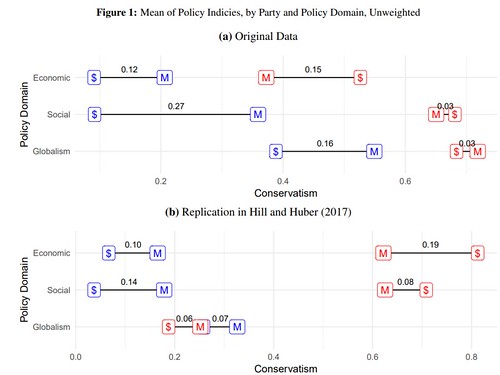
donors Via TF; see-also Twatter. It is fashionable, especially amongst the Left, to decry the influence of money in politics. This note, by David E. Broockman and Neil A. Malhotra, looks at how donors and public differ, by party. It considers them as blocs, so takes no account of how one may have influenced the other and come to alignment over time. The abstract:
Influential theories indicate concern that campaign donors exert outsized political influence. However, little data documents what donors actually want from government; and existing research largely neglects donors' views on individual issues. We argue there should be significant heterogeneity by party and policy domain in how donors' views diverge from citizens. We support this argument with the largest survey of U.S. partisan donors to date, including an oversample of the largest donors. We find that Republican donors are much more conservative than Republican citizens on economic issues, whereas their views are similar on social issues. By contrast, Democratic donors are much more liberal than Democratic citizens on social issues, whereas their views are more similar on economic issues. Both parties' donors are more pro-globalism than their citizen counterparts. We replicate these patterns in an independent dataset. These patterns can help inform significant debates about representation, inequality, and populism in American politics.
For the figure, you need to know The economic and social issues are coded to lie between 0 (most liberal) and 1 (most conservative). The globalism items are coded to lie between 0 (most pro-globalism) to 1 (most anti-globalism). Oh course, this is all written in USAnian, so when they say "liberal" on economic policy they don't mean liberal at all; they mean state-interentionist.

I wanted to trust their questions on the three issues, so I wouldn't have to bother read them, but grew suspicious and did. On social issues, their questions make sense (though they class The government should make sure that every American has health care coverage, even if it means raising taxes to pay for it as economic rather than social). Globalism is in some respects iffy (We should protect American jobs even if it means reducing the standard of living of people living overseas - this is protectionism, which is bad, including for Americans, so this question is hard to answer if you're economically sane). The Hill and Huber ones are worse: for globalism, only one question is about tariffs, and the other four are about sending troops abroad. This explains the massive differences between the two sets of results. Having said that... let's ignore all the caveats and just look at the graphs.

The Repubs are closely aligned with their electorate, except on globalisation; the Dems aren't very aligned - consistently further out - but are closest on economic.

Refs


What Tech Leaders Really Want - same authors, on Youtube. Irritating, as talking heads on Youtube usually are.
A Swedish Perspective on COVID19.
I CAN TOLERATE ANYTHING EXCEPT THE OUTGROUP - SSC.

2020-04-28

I used to think that climate change denial was built on some logical argument...

FB_IMG_1729280777064 [Note: published at end of year during review.]

I'm not sure I ever did; but my headline comes from AD. He continues But COVID reveals that these people are just crazy, but I don't think that's relevant to my discussion here. So, certainly, some people are just crazy; but those are a small minority and not interesting; we're interested in the rather larger group whose attitude to GW doesn't really rise to denial, but... well, I don't really know these people you understand, but I picture them as people ideologically opposed to "big govt", disinclined to actually read through all the science (possibly lacking the science background to follow much of it) and disinclined to trust experts (perhaps in the sense of having imbued the view that it is fine not to trust experts).

To quote from a quote from an earlier postCore values, not science, are what drive conservative opposition... and “free markets” are a core value for conservatives. They view climate policy as a threat to free markets, which is the real reason they reject climate science, so messaging should assuage those fears.

Some comments on that:

Free markets really are a core value. I think a lot of leftish folk don't understand that. They aren't a core value for them, and they see everywhere that free market principles are violated, so they think the rightish folk are lying. But they aren't. So, for example, that Trump is currently trying to prop up the oil price is certainly a violation of FM; but Trump is no free marketeer. And what of those nominally FM oil companies cheering this on? Meh, they'll take money if people throw it at them, most people will.

Science is a core value for a small set of people. Certainly not for the bulk of the populace. On GW you can argue that the leftish folk have got approximately the right answer, but this is only by accident; it happens to align or can be made to align with what they wanted anyway (the idiot Green New Deal, for example) and their allegiance is shallow. Expecting people to follow details is naive; instead, most people will just take on broad-brush; they expect to get their information processed by their usual interpreters of information.

2020-04-17

Coronavirus days: the IHME model is worthless

93486463_10158072109287350_8516462141245489152_o James half said this a bit ago in Dumb and dumber but on reflection he only half said it. But people keep on saying, effectively, "well the IHME model isn't very good is it" without ever bothering to look at exactly what it is. James said "some sort of fancy curve fitting that doesn't seem to make much use of what is known about disease dynamics" and I think that's true though I'm not sure how much it deserves the "fancy". I've been drifting along on the stream of all this modelling and not bothering to peer into the murky depths much, but I was very struck by this IHME "prediction" that James Twat; I've inlined it. If you look at it, there are - as James said - a number of obviously very strange things about it:

* the uncertainty range immeadiately leaps up on the first day of prediction to completely implausible levels (as well as having an implausible lower limit too);
* the model has an implausible level of certainty that the whole thing will be over by the end of the first week in May;
* it's all a bit Gaussian looking1.

That's taken from https://covid19.healthdata.org/united-kingdom, if you want to look for your self.

I finally dragged myself out of my lethargy to read their paper and discovered that they don't go out of their way to tell you what their methods are. But if you read it, it's fairly plain:  The cumulative death rate for each location is assumed to follow a parametrized Gaussian error function. So, that's their "modelling". But that's worthless, because epidemics don't follow a Gaussian, especially if they've got a lock-down in the middle of the data, whereupon fitting a Gaussian goes form being a bad idea to a cretinous one.

I'm guessing (though I haven't looked) that this explains their uncertainty bounds too: all they've done is taken the mean and fuzzed it, so the uncertainty is proportional to the value. Which is also worthless.

This also explains why the model goes to zero when it does: since we happen to look like we've got to the "top" of the Gaussian, it's simply predicting a mirror-image of itself as a decline. Also worthless.

But then we get people like Nate Silver Twitting "There are some good critiques of the IHME model in here IMO" and... it's all to wishy-washy. Yes there is in that one good point: According to a critique by researchers at the London School of Hygiene & Tropical Medicine and Imperial College London, published this week in Annals of Internal Medicine, the IHME projections are based “on a statistical model with no epidemiologic basis.” (my bold). And yet despite all this no-one can actually be bothered to read their paper and say what's wrong with it.

Notes


1. [2021/12] I may have been wrong to think this a flaw; see for example James "the natural infection profile of an uncontrolled epidemic".

Coronavirus days: Bluetooth based contact tracing

Contact tracing is going to save us all5, and, as my cartoon suggests, involves Bluetooth. VV reckons that a privacy respecting track and trace app to fight Corona is possible and effective; Ross Anderson and Bruce "who he?" Schneier are somewhat more doubtful. But never mind that; and never mind the Upper Layers gumpf about encryption and so on which is conveniently over my head: what of the lower layers?

There are apparently several suggestions; the one VV links to is distinctly light on radio protocol and looks like it has spent all its energy on privacy paranoia1, so instead I'll look at the Apple / Google one; the Bluetooth spec is over here (via more specs here). Wiki has an embryonic article which alas points out that the bureaucrats are keen to stick their sticky fingers in.

Which Bluetooth?


First of all, this is done via BLE (Bluetooth Low Energy) not Bluetooth Classic (aka BREDR). They don't (unless I missed it) explain why they use BLE not BREDR but it does make sense: BLE adverts were pretty well designed for this kind of use case; and perhaps BLE is I think less locked down in the phone's OS (not that last bit matters too much if you're Google or Apple...)4. As everyone else also points out it doesn't use GPS at all, so there's no actual location data involved, only "proximity".

Distance estimation?


Don't be confused by the name "Low Energy"2 BTW; it is generally about the same power as "normal" Bluetooth. The radio spec says nothing about estimating distance; it does note that RSSI (Received Signal Strength Indicator) should be captured. BLE has a potential range of ~100 m in open spaces so I'd expect some kind of filtering based on RSSI is going to be needed, but I don't see that in their spec (though the spec does say that RSSI should be in the info captured; perhaps they hope to work out what to do with it later).

Digression: I made a brief attempt to Google this stuff, and found confused things like this, so it's probably worth a discussion. So: people often want to do ranging via Bluetooth, it seems obvious: the louder the signal, the closer you are, and vice versa. But "normal" Bluetooth has power control on links: if a device can't hear its peer clearly, it asks it to speak up; and if its getting deafened, asks it to be quieter. That obviously gets in the way of ranging. But, (a) this is BLE so there is no power control3 and anyway (b) there's no link up so there's no power control.

But although Bluetooth can have a long range in open air it can have a short range when expected to go through squishy wet human bodies (is your phone in your back pocket away from the person you're very close to?); it can bounce off walls; and (as RA points out) it can go through thin walls and glass.

All of which comes down to: distance estimation is difficult.

Protocol


Your phone sends out BLE "adverts", which the other side receives. And, vice versa. But, each side is one-way, so to speak: there's no link, there's no two way exchange (the Verge seems confused on this, writing about a two-way code swap, even though their text is about a diagram that clearly shows one-way flow).

The adverts are non-connectable undirected (section 2.3.1.3 of 5.2 Core Spec if you want details; I only copy this here to show you the level of detail they are providing, for those interested). Non-connectable means they are outgoing adverts, and cannot be used to attempt to form a connection back again (this is one of the design functionalities of BLE: devices can be temperature or battery sensors, that put out little blobs of data ("adverts") and never know if anyone heard them).

The other side "scans" (aka listens) for these adverts, and will record those it hears.

Whenever you have this kind of TX-RX pattern, you need to arrange it so that the communication has a reasonable chance of working, whilst not using too much power. So if devA TXs an advert every second, but devB is only listening for a packet start in a 1 ms window every 5 minutes, you're very unlikely to get lucky and hear devA. In this case the protocol says TX about every 200 ms, i.e. 4-5 times a second, which is fair enough, but the words about scanning are somewhat vaguer: Scanning interval and window shall have sufficient coverage to discover nearby Contact Detection Service advertisers within 5 mins. Scanning strategy that works best is opportunistic (leveraging existing wakes and scan windows) and with minimum periodic sampling every 5 mins. So I think this is saying that if you're scanning already, as you may well be, just leverage that. Notice that although this appears to say "scan every 5 minutes" it doesn't actually say that; it says scan-to-detect-within-5-minutes which is rather different. Minor: note that BLE adverts can be on one of three channels (unless you deliberately restrict yourself to just one, and the spec doesn't say to do that) so the scanning needs to be across those three channels. Also, I'd have thought you want to distinguish people who you briefly passed as against people you've actually been next to for some time, for which scanning rather more frequently and keeping those you've seen quite a few of might be more helpful.

Refs


* Without Apple and Google, the UK’s contact-tracing app is in trouble - the Verge, 2020/05/05
UK virus-tracing app switches to Apple-Google model - Beeb, 2020/06/19 - aka "govt IT falls part into steaming heap of drivel shocker" surprises no-one.

Notes


1. And it talks about BLE "beacons", which I don't fully understand in this context. I think they mean just adverts with a 16-byte payload, for a 16-byte Contact Detection Service service (which Gapple tell me is 0xFD6F), leaving 1 byte for flags, which would be a 31-byte advertising payload, which is the largest you're allowed.

2. It went through a variety of names while the marketing folk tried to find a name than conveyed the idea of long battery life but didn't sound wimpy; so ULP ("Ultra Low Power") came and went.

3. OK, there is power control in the 5.2 spec, but most devices in the field aren't 5.2.

4. An article I read but cannot now find said that at least on Apple, Apps using Bluetooth need to be running in the foreground, i.e. to be the active App. And that this was some kind of security measure. This is all way up the stack from me, but this Apple article appears to support that. Maybe Apple would remove that requirement for Covid-tracking baked into its OS?

5. Or, if we're honest, probably not. Me on COVAD-19 Contact Tracing Apps is Bruce Schneier offering his opinion.

2020-04-12

Coronavirus days: endless summer

2020-04-12_08-58-34
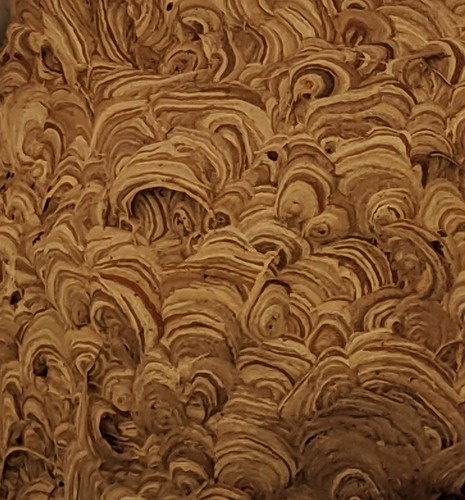
A wasps nest. Not new; I suspect from last summer; in which case
it's odd I haven't noticed it before. In other news, I've learnt how to
do image captions.
It has been a strange few weeks, and a strange last few days. This is the Easter - bank holiday here - weekend, so we have Friday and Monday off, and endless time in which to sit watching the garden, tidying the garden, reading books, web browsing, erging, playing Dominion, doing Sunday evening dinner over Zoom, and anything else. And all in near constant glorious sunshine, though I hear rumbles of distant thunder.

In virus news, James has called the peak, so it's all downhill from here. ATTP has a post I like on models, which almost but doesn't quite say what I've been thinking, which is that the epidemic modelling isn't really ready for the big time. Which brings me back to ...and global warming. Anything you do, and don't test, will be wrong.

Somewhat related, Interventions are likely to be fat-handed with incentive research as a case from TF. Which starts off with some cognitive-bias research which finds that even large incentives don't remove the bias; but then segues into the nice thought that this is only true if you leave the pool of those solving the problem untouched; but large incentives would of course attract those able to better solve the problem. Which is another way of expressing the advantage of the free market.

Contact tracing via smartphone is very much in vogue as an idea, so I'll point you at LBT's Contact Tracing in the Real World. If Google does it, it will be competent; but if (as the news appears to suggest) the NHS does it... we'll be perfectly safe from it for a couple of years. Incidentally, determining range from BT (certainly from BREDR; might be easier from LE) has a long history of being Difficult.

Refs


Will Fermi and Dirac Save Us All? Probably Not.
* A failure, but not of prediction - SlateStarCodex
* How to Win Friends and Influence People Book Club, Part 4 by Bryan Caplan
Why do human beings keep getting diseases from bats?
* Markets, Morality, and Mises by G. Patrick Lynch at EconLib

2020-04-07

Another one bites the dust

Well, there are only so many headlines in the world, ol' Folksy Fred will have to make do with a retread now he's pushing up the daisies. Which fits his schtick. I'm sure everyone will recognise him from the picture.

As to his quality, I think How to be wrong is about right. That's most of a decade old and he's done precious little since then.

If you'd like to read someone at least ostensibly sad, you can read Joseph Bast writing as if through a veil of tears although presumably not actually through a veil of tears. Or there's some gushing stuff at WUWT, as you'd expect.

But for anyone tempted to fall for the "nice old guy" bullshit, don't miss A Note About Roger Revelle, Justin Lancaster and Fred Singer from Eli.

Best Twatter response (now removed; see arch).

Take it away, Freddie...

Update


THE MANY GOOD WORKS OF S. FRED SINGER points out: Over four decades S. Fred Singer produced dozens of interesting, and stimulating, contributions to  astronomy and space physics, including seminal  and much cited work on cosmic rays and radiation in near Earth space (including one co-authored with  James Van Allen,) and his highly original, and still controversial theory of the formation of the Moon. However, none of these noteworthy scholarly papers had much to do with atmospheric science, and obituaries by partisan institutions like CFAC,  and the Heartland institute have accordingly ignored them. This indeed has strong similarities with the passing of Carter. Eli in similar vein offers Fred Singer the Good (there is lots of bad and ugly). Meanwhile, there are 49 comments on the WUWT post, which is rather low for them. Even Carter got more.

Refs


Interesting times (2008)
Eric Fnorrd and his Ouija Board? (2010)
Sea level rise in pictures (2018)
COLLEAGUES MOURN PASSING OF NOTED CLIMATE BORE
* Fred Singer Has Died - QS
* Fred Singer Has Passed. He Took Pleasure In Bullying Scientists. May He Rest - Paul Thacker doesn't like him either.
* Another giant of science has passed - go on, guess who. It is Dennis Avery, well known giant. How do we know he's a G-man? Because he is a coauthor of Unstoppable Global Warming – Every 1,500 Years.
* WUWT has another scratch at the wiki-scab: A New Year’s Look At WUWT. Of course, I appear, in the role you'd expect. Slightly interestingly, so does Stephen Philbrick.
* [2023/01] Jay Lehr is gone too. Cue RS. The Heartland folk go on about various, including his marathons and iron men. So I looked; they were some time ago so times are hard to find, but he did the Hawaii Ironman in 1982. He looks to be a decent swimmer and cyclist but a slow runner: 5:56 I think, though it is hard to read. Mind you, I've never done an Ironman.

2020-04-03

Coronavirus days: masks

MVIMG_20190908_153753 As I said about a week ago, wearing masks seems like a good idea. It doesn't have to be a real one, just anything that stops your breath travelling quite as far will reduce the risk of you infecting everyone if you're infected-but-asymptomatic.

Now, even the Graun has noticed the bleedin' obvious, and speculation mounts that even the thick-as-pigshit Mango Mussolini might get there eventually1. In which case that clown Bojo will doubtless slavishly follow suit. Some months later the WMO will issue guidance, apparently shielded by that old trick, "new research".

As far as I can tell the problem is that govts - ours in particular, but all of them really - are incapable of thinking or expressing any thought beyond the comprehension level of a six year old.

So the idea that Joe Public shouldn't buy quality facemasks because the govt, the NHS, and most medical practices were all too stupid to get in enough supplies in time and so need all the available ones has had to be expressed as "don't wear facemasks" because adding "but it would be a great idea to wear some homemade barrier" would make the thought too complex. And of course it would spoil our glorious pols dignity to appear with a facemask on.


Death


There's an interesting Twit from AukeHoekstra pointing to EuroMOMO, who publish weekly bulletins of the all-cause mortality levels in up to 24 European countries or regions of countries. Fascinating stuff. I've never heard of them but I'm going to trust their pix, because they say something I want to see. Firstly you can "nicely" see the spikes in winter deaths in previous years. This year seems to have been rather mild. "Week 13" is I think 23-30 March, so nominally includes lots of recent death, but they're not showing up clearly on the graphs, which is odd.

I think the deaths are per week, so I think that in the "bad" year of 2017 there was at worse 10k deaths/week, which by eye lasted for ~5 weeks, so 50k excess deaths. It is estimated by ECDC that at least 40,000 people die each year from influenza in the European Union (EU) so that about fits. So far the EU has about 34k deaths from Coronavirus. That number, alas, seems likely to increase; I'm still somewhat doubtful that the relative responses to the two situations are balanced.

Uupdate: a week later, EuroMomo is a bit more exciting, as James points out. Most countries are now up to previous peaks, but few exceed them (Italy does).

Winning!


It looks like the USA is winning at the moment: The focus of the coronavirus crisis has switched decisively from continental Europe to the US, with the country reporting the highest daily death toll of any nation so far, sez the Graun.

Update


To the extent practical, without significantly impacting mission, all individuals on Department of the Air Force property, installations and facilities are required to wear cloth face coverings when they cannot maintain six feet of physical distance in public areas or work centers. Meanwhile, The Economist is part of the giant supertanker slowly swinging over to recognise the bleedin' obvious. This is all so Overton-window-ish; what is acceptable to say sloooowly changes. Or the BMJThe suggestion that the public should not wear masks because healthcare workers need them more is valid up to a point, but it is surely an argument for manufacturing more masks, not for denying them to populations who could potentially benefit from them.

2020/04/28: Scotland advises face covering.

2020/05/01: even that dickhead Pence can be shamed into wearing a mask.

2020/05/22: Cloth Masks May Prevent Transmission of COVID-19: An Evidence-Based, Risk-Based Approach.

2020/06/04: Coronavirus: Face coverings to be mandatory on public transport.

2020/07/15: Masks offer much more protection against coronavirus than many think - LA Times.

Update: doctors


I don't see the medical establishment being keen on masks either. An analogy occurs to me: the reluctance of their earlier colleagues to wash their hands.

Refs


* James continues his heroic exploits with Lombardy Lockdown is working?!? and Are we achieving suppression in the UK?
* When you gotta go: Ghana's dancing pallbearers
* Our economy will likely reboot too slowly by Scott Sumner
* Economist: How covid-19 is driving public-sector innovation, aka "How an emergency reveals how stupid all your pointless regulation and bureaucracy was".
NHS worker quit when she was stopped from wearing face mask from the Graun; it could have been titled "NHS is a Stalinist bureaucracy".
* Face Masks Against COVID-19: An Evidence Review; Jeremy Howard et al.

Notes


1. The Trump administration announced Friday that the CDC is now recommending people consider wearing cloth face coverings in public settings sez NPR, but in a determined effort to retain that distinctive TaPS moniker, they note There's one big reason for the change: There is increasing evidence that the virus can be spread by presymptomatic and asymptomatic carriers. Which is of course a lie: that evidence has been there for rather a long time now. This is the familiar bureaucratic tactic of making things up in order to cover up earlier indecision. Colorado seems to be sensible too. Trump, who genuinely is a fuckwit, won't take this advice.

2020-03-31

WATN: John Brignell

90896053_1428597724003210_5764002353552293888_o Alas, poor John Brignell, he has suffered the sad fate of being declared NN. Cue paroxysms of faux outrage about censorship from the Dork Side, if they can still remember who he is: they have memories like goldfish. Even more humiliating for him, I don't appear to have bothered to diss him. He survived a previous debate in 2007, but only by "no consensus". As the closer of that debate said: it would be appreciated if the numerous sources and references provided in this discussion were to wander their way onto the article. This reflects the usual pattern: people show up at AFD, vote keep, and then can't be bothered to improve the article. That was back in the days when I cared a bit, and !voted weak delete, based on Brignell being certainly less notable than Lambert.

To establish his place in the world, here's WUWT approving of him; or his own Global Warming as Religion and not Science (arch).

I'm pretty sure he's now pushing up the daisies, but I can't find any actual source saying so, just absence.

Refs


* COVID-19, climate and the plague of preprints - by Richard Telford
Sometimes it’s never good enough - ATTP
Is R0 larger than people think? - JEB
* Speaking of WATN, Pielke appears to be back Twatting.
* Teaching Teaching by Bryan Caplan
* Climate Change: What is (Not) To Be Done by Pedro Schwartz - another in the regrettable series of "Libertarians" (well, EconLib) saying regrettable things about GW.

2020-03-26

Coronavirus days: and global warming?

90797873_10157993526827350_1355840889523535872_o ES makes two predictions:
1) Things are going to be okay if we follow the advice of actual experts and stay home for several weeks or more.
2) If things actually do turn out okay (because we stayed home), 1/2 the country will say this shows the experts were unnecessarily "alarmist".
Both of those sound reasonable, though 1 might be a touch optimistic. But suppose (1) is not only true but, to our joy, things are even more OK than we dare hope now. Then people connecting CV and GW, and saying things like planning for low probability, high impact, worst case scenarios1 is looking pretty smart right now are going to get the Dork Side saying "See! You told us to trust science, and we did, and we got all this lock down and economic damage for nothing; you think we'll ever trust you on GW? Ha!"2.

That happy event is unlikely, though.

In other news, I bought some US, on the grounds that the SP500 seems to have bottomed out. That doesn't mean things are getting better yet, just that the bad stuff has likely been (over)priced in. I could be wrong about that, too.

My photo shows the beginning of another day of hell in the office. See how green my lawn is; though not quite as smooth as it should be.

Update: Jem Bendell is an idiot


I don't think this is worth promoting to a full post, but his name comes up sometimes so I need Google to find what I've said about him. Up to now, nothing, for he is, after all, an idiot.

Here's some useless nonsense: Professor Sees Climate Mayhem Lurking Behind Covid-19 Outbreak
By Saijel Kishan at Bloomberg. Oreskes, also an idiot, Twats a mirror of it, because she is too dumb to link to the original. There's also This Is Not a Drill review – an Extinction Rebellion handbook from the ever-gullible Graun.

He has all the customary signs of idiocy, including puffing his CV: Bendell is a former consultant to the United Nations, has presented papers to the European Commission, co-authored reports for the World Economic Forum and advised Britain’s Labour Party.

Happily the Light Side is onto him: Michael Mann, a distinguished professor of atmospheric science at Pennsylvania State University, said that Bendell “gets the science wrong on just about everything.” I think that'll do.

Uupdate: the experts made mistakes


It now becomes ever clearer that some of the expert analysis was, errrm, poor; or "the supposed experts churning out dross on an industrial scale" as JA put it. And people inevitably are thinking about using that.

Notes


1. also now I come to re-read it, it's a slightly odd comment. We should indeed factor low-prob hi-impact scenarios into our calculation, but not really plan for them; the problem seems to be getting people to plan for the hi-prob cases.

2. Perhaps Delay is deadly: what Covid-19 tells us about tackling the climate crisis by Jonathan Watts in the Graun would be a fairer target.

Refs


Fitting the COVID-19 SEIR model to data, part 2 - JEB
Protect The NHS - Timmy

2020-03-24

Coronavirus days: policy?

90343127_10157291987478869_2697016565970239488_o Before you read on, consider Flatten the Curve of Armchair Epidemiology by  Noah Haber: Vet your sources or more people will be deluded. And also Noah Kaufman insightfully TwitsNew essay: "COVID Changes Everything Except 1 Thing" which impatiently explains why everyone must immediately drop their opposition to my long-held policy prescriptions. An example of wishful thinking is Coronavirus Will Change the World Permanently. Here’s How from Politico. Leaving aside the question of why so many Noahs, we come to... (trigger warning) Trump Twatting "we cannot let the cure be worse than the problem itself" (except he said it in shouty all-caps, because he's a shouty sort of person). Naturally he got flamed for saying that, and I'm all in favour of flaming Trump, because he is a wazzock, and only a nation of idiots would put him in charge1. Anyway, I'm disappointed by the lack of cost-benefit analysis; at least, I haven't seen one.

I shall attempt one. Recall that this sequence of posts is to some extent in the nature of a diary of the plague season, so I'm recording my thinking, and what I see around me. Let's suppose a life is worth £1 million (on the low end I know, but these are mostly elderly folk dying... let's hope my mother doesn't read this...) and we (in the UK) might end up with 500 k deaths if we do nothing, then that's a cost of £500 billion. Which sounds like a large number, but you have to be careful with things that look like large numbers. UK GDP is about 2 trillion, so if we lose 20% of GDP this year that would be... £400 billion. Did I get my numbers right? That suggests that at least in ballpark, costs and benefits about balance; in which case it doesn't seem unreasonable to err on the side of humanity. That's assuming no knock-on cost to GDP in future years, and on the other side, that 500 k mostly elderly deaths wouldn't affect much GDP.

Alternatives to lock down?


The current lock down looks like a very blunt instrument. You can argue, and probably will, that even that blunt instrument is misunderstood, and that the govt-to-public interface is incapable of transmitting anything but a blunt message. But that won't stop me thinking that it is all rather badly done and could be done better. Examples abound: I can't work-from-work, even though I'm about the only person on my floor, and the risk is negligible; certainly less that the risk from going into a supermarket. Speaking of which, at the local Sainsbury's, precautions seemed minimal: no hand-san on the way in, no staff wearing masks. It feels like everywhere is suffering policies that are more tuned to large cities.

Update: would wearing masks help?

There's almost no mask usage in the UK. And pols never wear them when gathered together. This Tweet points to the Czech's making their own; see this Google docAs more and more people took to the streets and social media with masks, on March 17 at the daily government press briefing, all members were wearing masks. It seems to me this is at least worth considering. The point being that you don't need medical-grade-certified masks to make it less likely to transmit.

I'm not the only one to think of the obvious... Scarves now, masks later; and Bring on the Masks and Gloves! And Lithuania starts producing reusable N100 face masks. It took just 4 days from idea to government contract of 1 million units. Costs 1.5 EUR per unit, production capacity 10,000 / day.

FACE MASKS: MUCH MORE THAN YOU WANTED TO KNOW: slatestarcodex.

Uupdate: I wrote a post about it.


News


UK now in "lock down" by which we mean don't leave your house unless necessary; but with a fairly broad definition of necessary, including a free pass for going out for a run. In a token of madness, even single sculling is now banned, presumably in order to prove that the world is insane. On a personal level, work has now bowed to the inevitable and sent me home. I'm anticipating that the garden will be at its best this spring, especially if the good weather continues.

Updates


I had some blogs by others queued up to comment on:

* Trump Murders Someone: The weapon: stupidity: DA/QS. Meh, more like suicide by stupidity. Anyone dumb enough to follow Trump's advice deserves a Darwin award.
* New York vs Italy - EarlyWarning: New York is in serious and, I would guess, irrecoverable containment failure; or you may prefer his We Are About to Lose New York City to Covid.
* Let Decadent Airlines Go Bankrupt by Pierre Lemieux at EconLib.
* Some thoughts about science advice - ATTP
* Uncertainty in the COVID-19 model - JEB: I think one thing that can probably be concluded is that the parametric uncertainty isn't hugely important for the broad policy advice. Rather like climate science, in fact :-).
That Oxford study, in full, in brief - JEB
Harsh But True - Timmy suggests Africa may show what happens without lockdown; though a commentator points out that they skew young, which helps.
* Open Borders: Now Do You See What We're Missing? by Bryan Caplan
* A battle fought on a million fronts by Scott Sumner
* J-value assessment of how best to combat Covid-19 by Philip Thomas
What About Economists’ Expertise?
* When Free-Market Prices Are Banned by Pierre Lemieux
* How long the lockdown lasts is not just a medical question – it's a democratic one; Richard Denniss - Graun
* Economic crash could cost more lives than coronavirus, says expert - The Times - Philip Thomas, Jvalue stuff.
* The UK lockdown and the economic value of human life by some bloke called Julian Jessop; a rather informal CBA.
* [2021/04] The apparently-reasonable idea that lockdown would increase suicides appears to be false: Surprisingly, suicide has become rarer during the pandemic - Economist

Notes


1. and only a party of utter morons would have put up a candidate he could beat. It looks like they have actually learnt something this time round; I'm astonished.

2020-03-21

Coronavirus Days: nice pix

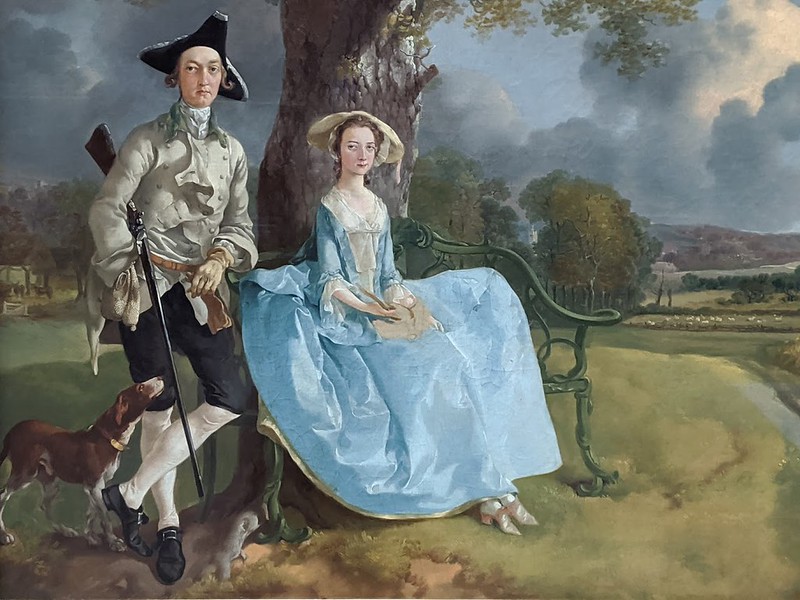
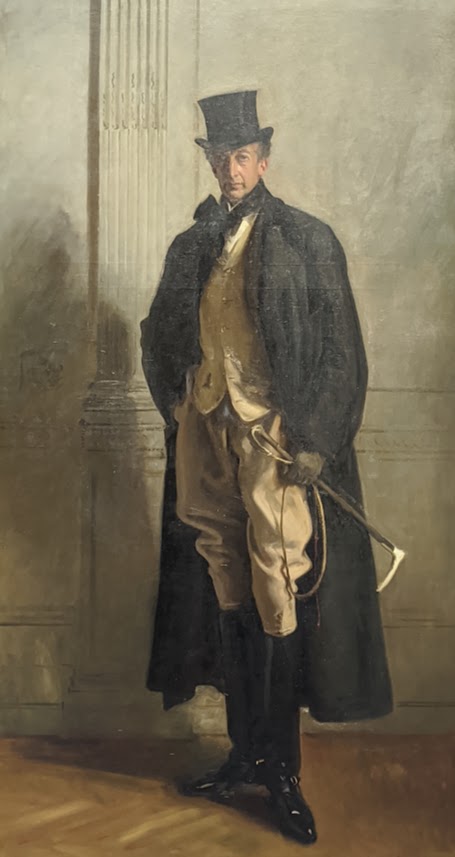
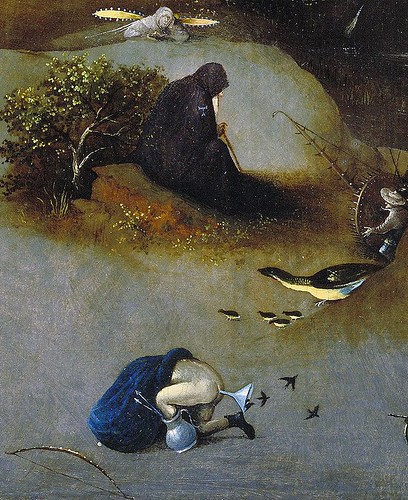
As I said, we visited the National Gallery. There's some nice stuff there. Here's some of it. These are in some kind of order... the order I saw them, which is roughly by age. They are all clipped, mostly not very much, cos I don't like to see the frame. Despite my best efforts, not all of these are perfectly lit (or, for the longer ones, perfectly flat) so you may prefer a better repro elsewhere.

As to COVID itself I have nothing new to say today; I found How much ‘normal’ risk does Covid represent? by David Spiegelhalter interesting.

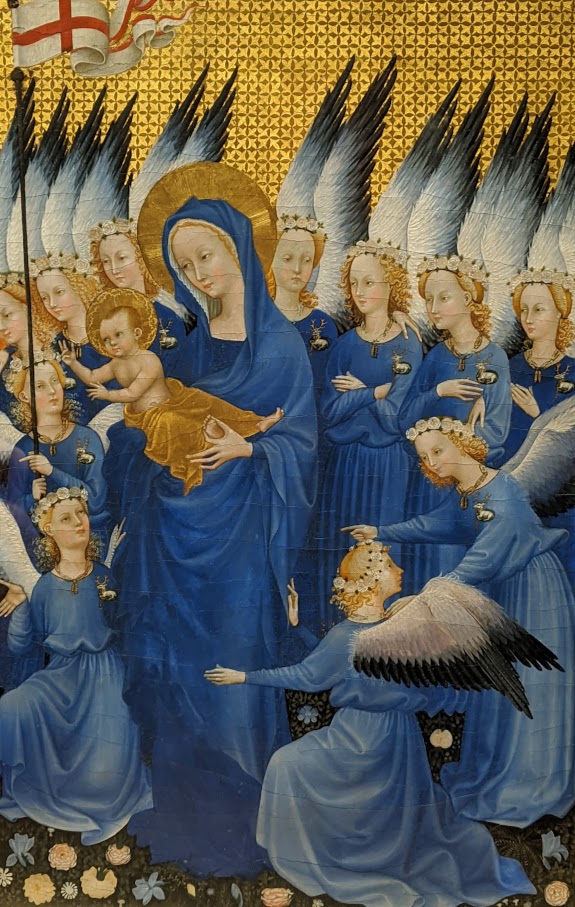
The Wilton Diptych (right hand panel). 139x. Gets a small room all to itself. Lovely, but I wish I could stop seeing the background as the fuzzy pegboard stuff.

IMG_20200315_113241

Christ showing his wounds. Weirdly modern-looking in structure and colour - to me - but about the same age as the diptych above. If you look at it from a distance you may not notice that his robe is rent and there's a gash in his side. The apostles coyly hide behind him in their haloes.

IMG_20200315_122623

A fairly typical scene of St Michael defeating the devil, but a gorgeous example. The armour! The serene face! The fearsome devil! The gorgeously folded cloak! And the benefactor, unfazed, kneeling. Bartolomé Bermejo, the most important fifteenth-century Spanish painting in Britain.

IMG_20200315_120621

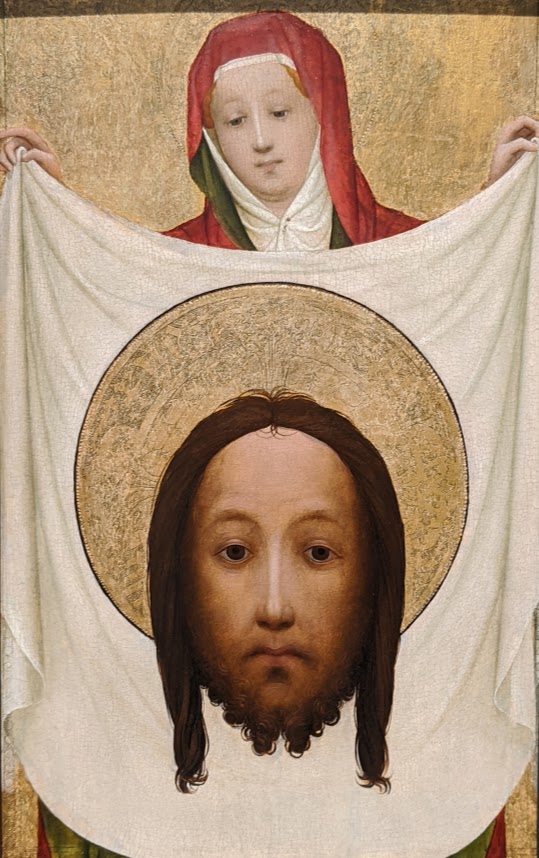
Saint Veronica with the Sudarium: According to her legend, Saint Veronica saw Christ fall as he carried his Cross to the site of his crucifixion. Taking pity on him, she offered her linen handkerchief (called a sudarium) to wipe the sweat from his face. When he returned it, an image of his face was imprinted upon it. One of the many many weird ones in there; well, St Michael and the devil is pretty weird, too.

IMG_20200315_115630

Christ being taken down from the cross. A nimble boy at the very top of the painting attempts to support Christ’s weight while clinging on to the arm of the Cross, hooking one ankle over it to prevent himself from falling headlong. Which is the bit I liked: his contorted spidery appearance and, because of his colouring, his visual identification with Christ, is good. As is the odd gilded niche in which the action is placed.

IMG_20200315_115404

Mr and Mrs Andrews. This one is famous because it was in my school history textbook about the changing face of England in the 18th century.

IMG_20200315_131451

The Fighting Temeraire. 1839. Massively famous, a good painting, well worth a look.

IMG_20200315_131642

Lord Ribblesdale. 1902. Just to prove I can like things other than intricately detailed pain. Lifesize or more, hung on the wall of the mail hall.

IMG_20200315_131335

Refs


Landscape with the Fall of Icarus (Uffizi)

2020-03-18

Coronavirus Days, part two: drivel

90252544_10157958933532350_9084115092445855744_o (1) The opening shot in today's drivel wars is fired by doughty campaigner John Vidal in the Graun, with 'Tip of the iceberg': is our destruction of nature responsible for Covid-19?3;The answer is of course No, as Michael Mann should have known. But I told him anyway. To make it more explicit, We cut the trees; we kill the animals or cage them and send them to markets. We disrupt ecosystems, and we shake viruses loose from their natural hosts. When that happens, they need a new host is wacko. Viruses or any other kind of disease are not happy little things secure in their environment, and only "trying" to look for a new host(s) if their existing host(s) get offed. This is a mistake of teleological proportions. They have no will or desire; they just blat about randomly; if you keep on eating bushmeat or whatever you increase your chances of catching something regrettable; and that's true whether you also cut down the trees or not. The rest of the article is anodyne, merely noting that Research suggests that outbreaks of animal-borne and other infectious diseases such as Ebola, Sars, bird flu and now Covid-19, caused by a novel coronavirus, are on the rise and The disruption of pristine forests driven by logging, mining, road building through remote places, rapid urbanisation and population growth is bringing people into closer contact with animal species they may never have been near before. Destroying nature doesn't cause these diseases; it's just the getting closer that does it1, coupled with our new-fangled ability to spread them across the world quickly.

Moving right along we come to Jim "back to Plato" Al-Khalili with A Physicist for President?, part of a long tradition2 of "people more like me should be in charge". Jim is a bit thin on any examples where his Physicist-President would break out the pencil and solve problems, but that hardly matters, because really he's just trolling; or perhaps more generously, trying to make you think about the different ways things could be handled. Pushing the obvious aside, his philosopher-physicist would never get nominated, much less elected. Because PP's on the whole tend to be not really people people. And on the whole they don't have a good grasp of history or politics which would allow them to function usefully in a political role. More fundamentally, they probably think like Jim in terms of "we must also find solutions to the climate crisis... to our energy needs" as though the state, or the President, needs to solve those problems. But it doesn't. It needs to impose a carbon tax and mostly get out of the way. Jim's PP would I fear be all too hands-on, getting in the way. [See-also: ATTP's view].

Lastly - and only at best ambiguously drivel - we have Scientists have been sounding the alarm on coronavirus for months. Why did Britain fail to act? by Richard "is editor of the Lancet medical journal" Horton, as Twat by James. And my only complaint is, as I said, is "What does Horton's own record on sounding the alarm look like?". Because although the piece is unflinching in its criticism of everyone else in not raising the alarm, it is notably short of "look, here, at what I said months ago, why didn't you listen". Perhaps he is just too modest to link to his own wise words of warning.

Closer to home, Waterstones Cafe on the second floor is now closed, and the ground floor one is takeaway only; how can I be expected to finish The Mirror And The Light under those conditions? School will go virtual from Friday, and what will happen next term is a mystery; ditto for D's 4th term at Cambridge. The shops are out of bread flour; all the yummy mummies desperate to fill their child-enriched hours with baking, no doubt.

Notes


1. Perhaps something the back-to-nature folk might like to think about.

2. I'm sure that's true but can I justify it? Well, there's Plato of course. And now Al-Khalili. And Heilein's vets in Starship Troopers. Oh go on, you can fill in your own examples.

3. Of course, the logic of the piece is clear: environmental destruction is not just bad, it is a sin, desecration; and so like any sin it must invoke punishment from the Gods; and is not a plague a punishment from the Gods?

Refs


How they got it so wrong - a theory - JEB
Coronavirus – getting angry - Bronte Capital
* Covid-19 and Conservative Liberalism - by Dan Klein
IF YOU WERE ALIVE IN 2005, YOU READ IT HERE FIRST

2020-03-17

Coronavirus Days

89982123_10157965695152350_6353842693486936064_o In these days of people at home dying of boredom my contribution should be blog posts; so here's one.

Life is steadily moving from dim-and-distant problems-of-other-people to closer-to-home. Last weekend I rowed in the third leg of the Winter League, and watched the lightweight races; but now all rowing is cancelled on the Cam and The Boatrace is off; even more horrifying, Mays will probably not happen; at least we had Lents. We went up to London to see Hamilton; though my mother sensibly didn't come because she is Old; now all the West End is shut. We looked round a rather quiet British Museum and National Gallery; now they are shut. I got to run in the Cambridge Half, but the Paris Marathon is, oddly enough, not going to happen. E sneaked in her grade 8 clarinet exam on Monday; from today, all that is off; what will happen to A-levels1 can only be conjectured. My work has decided all-but-essential folk should work from home; M's cannot be far off. For those who sit at desks this is not too much hardship.

As you see I have some fine-quality literature lined up to last me for... at least a couple of days, when the apocalypse comes. After that I guess it will be back to Marcel and his ilk.

Of the Dread Lurgi itself I have nothing useful to say; I read people like James Annan with interest but no doubt you will find many more similar.

But - and you understand that I write this more in the spirit of writing something to read in the future and be amazed at my lack of perspicacity - what of the future? Civilisation collapsing seems unlikely. We have shortages in the shops of bogroll and handsan (fortunately E still has some supplies from her expedition to Bolivia last summer) but other stuff seems to be there for now; and probably will continue to be, if the evil capitalist supply chains are allowed to continue without too much help from the pols3. The markets aren't looking too healthy2 but I think the same thing applies. The govt apparently promises £330B in loans and holidays and the US and Frogs too are talking of throwing money around. The hospitals are not yet full of the dead, but these are early days.

Refs


'Tip of the iceberg': is our destruction of nature responsible for Covid-19? - John Vidal in the Graun. Answer (of course): No. Bonus answer: you're an idiot.

Notes


1. Actually Pre-U.

2. Excellent news for those who decided to buy the first drop...

3. Boris's amusing-but-incompetent schtick is starting to wear thin even to his own people; Trump looks ever less competent; maybe some good will come of this. Mind you it's not just them; the whole structure doesn't look good when obliged to actually do something rather than just negotiate with other drones.

2020-03-09

Red team goes up

87937686_1406827916180191_2092134331442003968_o A follow-up to Red team goes down; but this is Lents, not Mays. In an inversion of last year, Maggie were now about 30 seconds faster than Caius over 2 km - as revealed by Newnham regatta - and Pembroke regatta had fallen victim to Wind, familiar to all those who lived through this winter. Indeed Torpids had to be cancelled; excess stream I think; and WeHorr too.

And so on Wednesday. Maggie caught Caius, and yet I cannot write "predictably enough" because it happened unpredictably: Caius 5 seat had seat troubles, and Caius didn't last past First Post; which was regrettable, it would have been good to see the proper fight. Meanwhile Pembroke caught Downing to go third. Thursday saw puzzlement at the Plough as Pembroke and Downing failed to show up for the practice starts; eventually the truth came out: Pembroke, in a fit of careless coxing during warm-up on the Reach, had smashed into the back of Downing causing much damage, and had been awarded a technical bump against1. So 'binson, at 5, didn't get to try themselves against Downing and instead went down to FaT. On Friday, predictably enough, Pembroke re-bumped Downing; and on Saturday got Caius; but didn't get a chance against Maggie - but while that would have been good to see, I don't think they'd have done it.

For the women, Newnham - to my surprise; so certain was I that they would row over that I didn't bother follow it - went down to Jesus and then fell two more in subsequent days, before redeeming themselves by bumping Emma back on Saturday; in the wings, Downing started rising, and on their second go, on Saturday, went head; so congratulations to them.

Charts to help you through this maze at various places but I used CamFM. And you can re-live the full bumps experience with the Youtube playlist.

Wattmageddon


I'd been doing some longer pieces on the erg, partly because 10 k had come to seem too short, and partly as a way of getting distance in this wet-feeling winter. So friend Tom invited me to his marathon-on-the-erg at City's glorious new boathouse on February the 29th. I was the weakest of the four; the others all got sub-3; Tom in 2:51 which is 2:01.x. I did 3:04:39 which is 2:11.2. It's a somewhat weird experience. I found the last 8 k the easiest; I'd kinda settled in by then. My arse was fine (I had a seat pad); I got a small blister on my left hand early on but put on my fleecy cycling glove and was then fine. No food or drink during it, though I had bananas, gels and a water bottle standing by. My back was also fine. A few times I started to feel stiff in the shoulders and solved this by weird-looking wriggles as I came forwards. And the ?tendons? above my knees started to feel a bit odd around half-way, but came back to normal after a bit.

2009: Ergathon. My first, in 3:20:58.4. 2023: YAME: 3:01:58.4.

Cambridge half


Another year, another Cambridge half marathon. This year a glorious new course that went through Kings. I was a bit weaker than last year - somewhat speculatively, perhaps not fully recovered from the previous week's ergathon - and got 1:43, which was my target (1:45 is my limit of respectability, and I wanted to do better than that). I should note that my watch - like last year - thought the course was a bit short, at 20.9, but another 200 m would have been less than a minute so definitely under 1:45 any way you look at it. There was something of a headwind on the way out, and as my pace dropped I found I was telling myself how 1:45...or perhaps 1:46... would be perfectly acceptable; but either I bucked up or the tailwind coming back helped, but all the excuses weren't needed. Gels at 8 and 13 k, somewhat early, and then a race-provided one at about 17 k. Miranda also ran this year, her first, in 2:10.

Paris, postponed


I entered the Paris marathon, for the start of April. Sadly, it is postponed to October due to Coronavirus. I may just go and run anyway.

Notes


1. Downing cox had to go to hospital as a precaution but was unharmed; Pembroke cox was banned for the remainder of the bumps; Downing's boat will require extensive repairs.

Refs


* Lents 2019.
* The Leiter-Caplan Socialism Debate by Bryan Caplan

2020-03-07

The Trials of the State

89511586_10157933757712350_3351801376970637312_oA slim volume by Sumpers, who I've disagreed with, though only mildly, before. I picked it up on New Year's Eve fully expecting to dislike it but was increasingly enchanted and instantly resolved to blog it; now it is nearly the end of February well into March.

Before reading my ill-informed opinions you'll want to read others. keepcalmtalklaw says it argues that law, and its modern fixation on rights and due process, has now largely filled the space previously occupied by politics and political debate - for better or for worse3. Or you can read Stephen Sedley in the LRB,  who seems to disagree with Sumpers a lot; perhaps professional enmity or just the desire to have something to say, I don't know, I got a bit bored reading him5. Anyway, enough of these other people, "what of me?" I hear you cry.

Chapter 1: Law's expanding empire


The law used to regulate religion, and ban homosexuality. Now it regulates neither, and indeed bans discrimination. Animal welfare legislation, by banning fur farming on moral grounds, has enforced a common morality: what could have been an entirely personal moral decision, to purchase and wear fur or not, has been made common (he declines to argue the rights and wrongs of fur; as he does for other things; this is correct; his discussion is not over the rights and wrong of these choices, but whether they should be covered by law). This leads me to reconsider his point re non-discrimination: the law could have simply withdrawn from the area, but did not; it chose to ban discrimination. Per Gay Cakes I think the answer is that the law should ban discrimination by the govt (ideally in the glorious words of the US constitution: shall make no law concerning...), but not by individuals, leaving the question of large companies somewhat unclear but my inclination would be to have the law by default stay out when it can. JS's opinion is that we are afraid to allow people to make their own moral judgements, in case they disagree with our own.

A little later he asserts that the advance of law into ever more areas is simply a fact, which we shall have to get used to. It is certainly an observed fact of recent times, but not quite the fact-of-nature that he appears to consider it; perhaps it is not an area he wishes to discuss so closes it as quickly as possible.

After morality, he considers risk, and notes that we become ever more risk averse and insist on the law protecting us, at the inevitable cost to our liberty.

Chapter 2: In Praise of Politics


By constantly disparaging pols I may have given the impression that I disparage the concept of the political process, but this is not true; see for example Aristotle's Politics. JS, while aware of political failings and the public's opinion of pols, nonetheless notes the importance and elusiveness of the concept of "legitimacy": people will accept decisions they disagree with as long as they accept the legitimacy of the decision-making process.

But it is necessary to counter the tyranny of the majority; JS asserts two parts to this: representative democracy, and law.

JS's defence of RD is not convincing to me. Chiefly, it is that it is superior to direct democracy (which is just-about-now just-about-possible1) because pols are less likely to sacrifice the long-term good of the country to short-term interests. In asserting that we use RD as a matter of principle, he ignores the obvious, that current pols would fight tooth and nail to keep their jobs and power, and that any change would have to come through them, the most opposed to change. SJ acknowledges this view as perhaps "elitist", but not his own bias for it as a member of the elite. He then goes on to defend political parties, on the grounds that they are flexible and balance interests. Since this is all in the context of Brexit, he has to bring that in, and finds himself obliged to say that "Europe has become the defining issue which determines party allegiance". This is nonsense. Brexit cuts across party allegiances.

We move on to law; but almost immeadiately return to the prior theme, of increasing, umm, activity of law in the political process, or "law as the continuation of politics by other means" (a familiar idea from the USAnian climate change cases). As far as I can tell nowhere does Sumpers admit the obvious conflict of interest here: judges are awarding themselves more power. Briefly, he touches on the appointment of judges in the UK. They are nominally nominated by an independent panel. But actually this just means they are nominated out of public sight by an opaque process. JS appears opposed to something similar to the USAnian political appointment process, but admits that with judges becoming more political, this may be inevitable2. But then we get to the more interesting point: that judges are intrinsically unable to mediate; that it is a zero-sum game; and cannot accommodate diverse opinions the way politics can (if it works well). This point is a good one, but only quasi-true. Reading the deliberations of the SCOTUS (I recommend Scotusblog) I think it becomes clear that in many cases the judges are trying to strike a balance, and will only come down hard on one side if given no choice.

Chapter 3: Human Rights and Wrongs


Human rights have a long common-law foundation, but there is an awkward problem of definition; what exactly are they? I like Hobbes's view (see wiki; and I dislike rights-based language) which I assert the USAnian constitution largely subscribes to: that "rights" are things you have naturally, that laws constrain those rights by imposing obligations, and that the constitution imposes restrictions on the state as to what constraints it may impose. Thus the first amendment says Congress shall make no law respecting an establishment of religion, or prohibiting the free exercise thereof; or abridging the freedom of speech, or of the press; and does not state that people have the right to freedom of religion or a right to freedom of speech; and I strongly criticise the European approach, which is to award people rights by writing them down on pieces of paper. Anyone with any knowledge of the USAnian constitution will of course object that they do not everywhere follow the wise model of the above words; and I can only reply that no-one is perfect.

JS's issue is the public concern that HR law is independent of democratic choice, and protected against amendment by a democratic legislature; or equivalently that HR law has exceeded it's proper sphere and trespasses on politics.

Shifting over to the ideal domain, JS notes that democracies can enact what rights they want; if there is to be some over-arching HR, then that requires some legitimacy; otherwise, HR are just whatever your law currently defines. Once, religious authority might have supplied that legitimacy; no more. Some rights can be considered fundamental, because without them society as we desire it cannot exist; equality before the law, freedom of speech.

What he doesn't say explicitly is something I've said before: that there's a problem in the gap between "rights" which sound excellent when considered in their prime formulation, and the consequences that flow from them4. He does however implicitly consider this, because we move onto...

We then get a lot of technical stuff about the structure of HR legislation, which I think you should read from him not my poor paraphrase; but cutting to the chase we end up with extensions of the text which rest on the sole authority of the judges of the Strasbourg court. This is, in  reality, a form of non-consensual legislation... most of the rights which the S court has added to our law are quite unsuitable for inclusion in any HR instrument. We're back to legitimacy, and the problem of taking difficult and disputed decisions out of the political (i.e. public) sphere and "privatising" them (that's my phrase, not his) by calling them matters of law. This is correct, and accounts for much of the public discussion; which discussion is not, of course, on these rarefied terms; and part of the public anger is I think at its inability to articulate its unease.

Chapter 4: Lessons from America


The primary lesson is that he isn't too keen on a constitution, for reasons I find unconvincing. He does note that the SCOTUS has made some rather broad and arguably bad decisions: finding a right to privacy (which underlies Roe vs Wade; although that has since been "corrected") and Dred Scott. Otherwise, we're left with judges not being able to save society single-handed, which is or should be uncontroversial.

Chapter 5: Constitutions, New and Old


Spends most of its time arguing against changing to a written constitution, which is pointless, because that's not going to happen. Does the familiar bemoaning the decline in citizen participation in politics, but finds nothing new to say on the subject. Argues against PR, pointlessly; and of course I disagree. So I'm glad to be able to some extent to regain my prejudices against him in this last chapter.

Update: on reflection


On reflection, prehaps I was close to the truth when I said "enchanted" and perhaps I should have said "bedazzled". I feel there is somehow less ot this than meets the eye, as exemplified by my failure to find any "key points" to pull out. Except I still like his point re legitimacy.

Notes


1. Note, this doesn't mean clumsy referenda. It would mean internet-based voting on a far more regular basis. It is not going to happen, so carefully considering the exact details is pointless.

2.See-also the timely Boris Johnson takes on the judges, and Why pruning the British judiciary’s powers will prove tricky from the Economist.

3. And this is wrong, because the thinks it is for worse.

4. I'd suggest some kind of "back flow": if you can reason from your universal rights to a decision that is wrong, then (assuming your reasoning survives scrutiny) you have to reconsider what you think of as rights. "wrong" here might be slippery. JS makes a good point in that if it is a question of morality, and you assert universal rights, then significant rational disagreement amounts to it being in error.

See-also: Book review: the Raven Tower.

5. Re-reading SS I retain the same antipathy; for example, in 2011... attacking the judiciary of which he was now a member for methodically invading the territory of politics... he has returned to the theme of the deference owed by law to politics. It is his bad luck to have done so at a moment when the UK’s political process, both in and outside Parliament, has been in functional meltdown and moral decline, while both his own court and the lower courts have remained a source of constitutional principle and political stability. I think this misses the point; that adverse-to-politics judicial decisions are part of the political problem.

Refs

2020-03-05

Zharkova is a tosser

87025852_1397434010452915_1819510646673244160_o At last, a female winner of the prestigious Tosser award for behaviour above and beyond the call of stupidity. Z gets it not for writing crappy papers that everyone can see are wrong and even Nature eventually realises have to be retracted. No, she gets this for writing silly review comments on someone else's paper. From the comments on Prediction of the strength and timing of sunspot cycle 25 reveal decadal-scale space environmental conditions by Prantika Bhowmik and Dibyendu Nandy (a perfectly sensible paper as far as I know, though I haven't read it)
the authors did not cite a single paper, which predict an imminent Maunder-like grand minimum (GM) that can lead to cooling of global climate. This is a violation of the intellectual property rights for the authors who did such the predictions...
Wonderful stuff. The other comments, on a quick scan, don't really live up to this opening, sadly.

Other views:

Zharkova et al. – retracted - ATTP
Sunblock Applied - DailyKos
Why are so many solar-climate papers flawed? - Gavin at RC

Freeman Dyson is dead


Read about him from many people, including David Appell. I don't know much about him; from what I gather, he was a respectable physicist who went somewhat emeritus in his later years, as so many do. I don't bear him any ill will; his forays into talking nonsense were few and, I think, rather half-hearted. He gets Freeman Dyson on global warming in 2006; and then a by-blow in On its hundredth birthday in 1959, Edward Teller warned the oil industry about global warming?; meh.

On the Dems


So, it's down to Sanders versus Biden. An uninspiring choice but I would choose Biden without hesitation, both to be the candidate - as having a better chance of beating Trump - and as Prez - as not being an over-enthusiastic socialist. I'd have preferred Bloomberg, but you can't always get what you want. Side note: it was weird the way all the other Dems like Warren attacked Bloomberg at the last debate, when Sanders was ahead. It was like they weren't playing to win, just to prevent someone else winning; like they weren't even serious or not really thinking.

Update: Of the women


Well, Warren. I paid no attention to the others. As the NYT sez, Warren had an avalanche of policy plans and I thought she was bad for that reason. That same article describes Sanders as "liberal" which is odd to me; he is far from a classical liberal but apparently "liberal" is one of those words that means different things in the US of A. Presumably Warren now gets to decide who to sell her endorsement to.


Other views:

* Campaign postmortems - magical thinking edition - TF
Bernie Sanders is more electable than Joe Biden and will win - VV
Elizabeth Warren, Once a Front-Runner, Drops Out of Presidential Race - NYT
Nicholas Kristof: Why Biden is the change candidate - SLT

2020-02-29

Why Should the U.S. Be the Leader in Numerical Weather Prediction?

86806960_1396690180527298_2007980331382079488_n A question asked by Cliff Mass (arch); you may recall him from my acclaimed L'affaire Cliff Mass post. All his answers are wrong; there's no particular reason why the US should be a leader, but it's kinda nice that they're trying, cos it helps to push everyone else along. CM calls ECMWF and UKMET the current world leaders, which is I think correct. The UK has cared about weather for a long time, and ECMWF are leet, so it's not surprising they are ahead. Both, as far as I can tell, have managed to get one central organisation and largely put competent people in charge.

CM reckons that the huge resources of the US could produce better forecasts. But actually, the resources of the USofA aren't actually much bigger than Europe, so that's a rather dumb argument. He also asserts that the US is far ahead in computer sci+tech, which I think is drivel. They're much bigger than the UK, though. He also notes that The U.S. has the largest weather research community in the world, which may be true, but adds Unfortunately, we are currently wasting huge amounts of resource with large number of redundant efforts, which alas I think is also true and is the core of the matter (note: I'm basing that on what I knew when I was in the game, more than a decade ago).

Inevitably, we run into the problem that what, say, the top levels of USAnian govt might well want is a world-leading NWP capability, but what individuals want is their career (or, more politely put, interesting work to do), and what individual senators want is Pork, huge big barrels of it. The Chinese might manage a central organisation, though :-)

But all that duplication is probably inevitable in a country like the US, and in terms of the world getting forecasts, who cares, ECMWF do them. If you had a central org like NASA, you might end up with NWP like the SLS, and who wants a giant orange non-reusable NWP?

2020-02-18

Tasting the whole worm

86697897_1395874010608915_5526347119981494272_oOr; "Pielke shumps the jark?". Stoat is the blog of record, so I feel obliged to record the strange disappearance of Roger Pielke Jr, at least in his Twotter incarnation. Some might say that this sad tale deserves to be passed over in silence, and indeed most people do seem to be doing that, but it is so easy to forget, so that seems wrong. Speaking of memory I'm re-reading Proust again; I thought you'd like to know that.

Over at Curry's I discover what I think is the best / only extant account of the endgame: I was watching in real time as Roger Jr. melted down on Twitter. First he “doxxed” a load of folks and got his account suspended for violating Twitter’s terms and conditions. Once his account was reinstated he announced he was taking a leave of absence, then apparently closed his account voluntarily. If you know of a better one, do tell1. That the account is now gone appears to be true.

On the 5th of Feb RP was engaging in bizarre puffery of Curry to which I brilliantly replied "I don't think that's true. She didn't reach the top; middling, perhaps. And I doubt the "many important papers" bit; care to name any? And more recently, some trash e.g. https://wmconnolley.wordpress.com/2013/10/17/wyatt-and-curry-part-ii-not-waving-but-drowning/. Strangely, no-one did care to name any of her epoch-making papers.

On the 7th he was laying into Skeptical Science; to which I made the brilliant reply Oh, FFS: sharpen your reading skilz. No, that isn't what they say. My recollection was that I was replying to his misinterpretation of the SkS "misinformer" page2; you still get to see his misinterpretation because it's on Forbes. Seeing that, I couldn't decide (Feb 9th): Weird. Is RP jumping the shark, falling off the deep end or just trolling?. My best guess was going to be "just trolling" but it seems he was rather more serious than that3. I think this then segued into meltdown, from insisting rather too insistently that of course he was entirely right about all this.

Prof. Matthew Nisbet is a twat


Well come on, who puts their prof-ism in their Twatter handle?4 Also, he's a Professor of Communication; case closed. Not only is he a twat, he's also an idiot, in evidence of which I put forward "as wealth continues to concentrate among a few politically active billionaires, philanthropists are likely to surpass national govts" in defining the climate agenda. But that wasn't my point; my point was that he appears to have taken on the role of annoyer-in-chief for ATTP and AD with Twits like ...@rogerpielkejr has played a valuable service in committing his career to this role, inspiring & informing the types of innovative, self-reflective thinking needed to identify new solutions + new alliances. See for example this recent piece. I quite like RP's pieces, but self-reflective is the last thing I'd call them; PMN doesn't seem the sort of person who would recognise SR if it hit him in the face with a haddock. "New alliances" is also odd, unless it's referring to the RP article posted "by request" over at the Dork Side. Or you may prefer the GWPF version.

Update: deliberately misleading?


AukeHoekstra thinks RP has "has now been shut out of twitter for reasons I find questionable". That's based on RP's Forbes column (the one that, ironically, ends "Follow me on Twitter"). I think AH has misinterpreted RP's words, but now I look again, I think RP's words are deliberately ambiguous and designed to support the misinterpretation AH has made.

But if RP was just locked out, his account would still be there. I don't think Twitter would have deleted it.

Uupdate: it appears I have convinced AH :-).
Uuupdate: here's an example of what a suspended account looks like.

Update: the Return of the Native?


He seems to be back. The profile says "Joined February 2012" and he has zillions of followers, so it's probably the same account. But his first Twat seems to be from March 22nd 2020.

Update: 2021/11


Bad news for the Pielkemeister: he is being defended by the GWPF and Laframboise. With friends like that...

Refs


Trump and science: malice or indifference?
Curry jumps the shark
My Unhappy Life as a Climate Heretic
* RP in Bloomberg: Good News And Bad News As Carbon Dioxide Emissions Grow More Slowly Than Models Predict - 2020/02/18 - so he's deffo not completely gone. Ironically, the piece ends "Follow me on Twitter"; someone is using an out of date template.
‘Eugenics is possible’ is not the same as ‘eugenics is good’
* Moral Approximates by Bryan Caplan
How to Write Usefully - Paul Graham

Notes


1. See-also Sou: "He appears to be having a meltdown".

2. Ironic, no?

3. Notice that Curry pops up with her malign Mann obsession in the middle of this stuff.

4. Also, he looks terribly young... and, he isn't a prof. He is an ass prof, which is rather different.