2021-10-31

There should be a law to the People besides its own will

DSCN1031-rip A quote from Lord Acton. It is a good quote, found via CH, but what does it mean?

If you rewrite it for individuals, "there should be a law to a person besides their own will", then it becomes rather obvious. Or the phrase But to live outside the law, you must be honest comes in (note: that linked post contains nothing to the point).

For a society - and I think we're considering a society in isolation - it is somewhat different. This is most easily considered as a warning against majoritarianism, to which all good constitutionalists will happily nod along (see also Russell on Aristotle's Politics). It could also be a reflection on the need for a constraining morality, or even a religion, but I'm not going to consider that.

It is most naturally considered as a need for a constitution, or some other form of slowly-changing law or meta-law, to constrain passing (perhaps decades-long) whims of the majority. But in that case, instead of being constrained by its own will, society is constrained by the dead will of the past; why is this better? If you're rigidly constrained by the dead will of the past, as Plato desired, because you fear change, then this is bad, not good. Because no matter how wise those past folk might have been, they cannot forsee everything. But if you are constrained, but not rigidly; if you can change those constraints if enough people agree; then I think that it is good.

That was somewhat abstract. Let's consider an example: gunz is the obvious one. The USAnians arguably have too many, and many folk there would like tighter laws on who can own them and where they can carry them. But they are bound by the 2nd amendment, if anyone can work out what it means. But the fight is in the courts: no-one significant wants to change the 2nd amendment because everyone knows that would be hopeless, because not enough people agree. So they are in the position of non-rigid constraint. Not everyone gets what they want, and some people get death who didn't want it, but there is no perfection in politics.

Refs

The Problem Is These Numbers Are Wrong - Trains, Planes and Automobiles

2021-10-28

Fueling the Climate Crisis: Exposing Big Oil’s Disinformation Campaign to Prevent Climate Action?

1635279188500-0ff470b4-77ce-4788-a4c9-85685a07b987_ Some kind of hearings off in the colonies. Mostly I think grandstanding by pols, but did anything come out of it?1 There's the usual bullshit like "The fossil fuel industry has had scientific evidence about the dangers of climate change since at least 1977" but I've debunked that to death. The people making a career out of lies and disinformation are "on our side" but no-one calls them out. Anyway, Oreskes & Cie have been Twatting about the hearings, so I thought I'd browse their feed for killer titbits. Here's what she's got:

Summary of what we heard  @OversightDems hearings: A lot of tap industry dancing [shurely "industry tap dancing" - ed.] and & (at least) two lies.1) Fossil fuels ARE subsidized. $20 billion pa direct in US alone. 2) ExxonMobil statements were NOT consistent with the science at the time.  Anyone want to add to this?

Which is nothing. And the $20B in subsidies is dubious; the dubious bit is the word "direct"; try looking at the breakdown; they're accounting stuff, tax offsets; not direct xfers of cash from govt to EFFs (and now I look in more detail, her Twit was OK now a CEO has flat out lied.  "Our products are taxed, not subsidized.". Which is false; their products most definitely are taxed). Point 2 is rather vague. I'll give her it (see-also what I've said in the past) but I think EFFs have been fairly careful recently - well, since Lee Raymond retired with a stonking payoff.

Is there anything more? Apparently they are refusing to say what carbon price they would accept; meh. Now @shell is trying to deny any responsibility for @APIenergy's anti-methane fee, and anti-EV advertisements. I think that's a bit better, but still thin. From someone elseExxon's Darren Woods: "As science has evolved and developed our understanding has evolved and developed" on climate change. Efforts by Maloney to have him respond to Exxon memos and ads over the year that show otherwise have not yet knocked him off talking points. Which points to how useless these kinds of hearings are, if the attackees stay cool and the attackers don't have much. I'm not sure what the memos are; probably the usual dox that the usual over-excited folk misread.

Anyway, that seems to be about all for now. If there's a transcript, I might read it, but I'm not going to watch the vidz.

Robert Brulle

I couldn't help looking at the train wreck a bit more. Robert Brulle Twots Exxon maintains their public statements on climate change were in line with the scientific consensus.   This is historically untrue. After the 1995 IPCC report that stated there was a “discernible impact” on climate by anthropogenic emissions, Lee Raymond still said the link was unclear. But... this is dodgy. IPCC '95 was rather more tentative than Our Hero suggests; see here. Or just read the thing yourself, of course. They said Our ability to quantify the human influence on global climate is currently limited because the expected signal is still emerging from the noise of natural variability, and because there are uncertainties in key factors... Nevertheless, the balance of evidence suggests that there is a discernible human influence on global climate. So, he is wrong (or, in hysterical-Oreskes-speak, HE LIED) because IPCC '95 did not "state" a discernable influence it "suggest"ed same. We don't have a direct quote from The Evil Lee Raymond (before your time, children) but if he said "the link was unclear" then, in 1995, that was defensible (denying any link would not be, of course). Mind you, TELR said plenty of other things that weren't defensible; but it's weird how hard a time these people have in finding it.

[Update: even Rahmstorf, who really should know better, is buying this shit.]

[2025/01 update: re-reading this, I see I was too kind (how like me): Brulle's "discernible impact", which is a direct quote, is as far as I know wrong; it should be as I quote ""discernible human influence"; no it is not acceptable to modify direct quotes. I wonder if Brulle has even read '95 at all, or is just relying on careless re-hashes from e.g. Exeter.]

Refs

* Wikipedia and the Representation of Reality by Ian Ramjohn

* GLOBAL REBRANDING CRISIS: ZUCKERBERG THREATENS TO DROP ATEMIC BOMB ON METACLIMATE CHANGE

Exxon CEO accused of lying about climate science to congressional panel says the Graun, but they're just parrotting the (Dem) pols - there's no information content. Speaking of lobbying, you might want to see me here. FWIW, I believe that pols have a strong interest in there being as much lobbying as possible, and act to make this so.

* We want environmental action, but don’t want to make the lifestyle changes, Cambridge-led poll finds - truely astonishing.

* More bollox from Supran; the same tired old stuff.

* SCOTUSblog: Justices agree to review EPA’s authority to regulate greenhouse gases.

* What should have happened in 2008-09 by Scott Sumner

Episode IV: The Evil Empire strikes back (2015)

* 2022/01: Graun: How Exxon is leveraging Texas courts to silence its climate critics.

Notes

1. No. From the point of view of 2022/03, it instantly vanished without trace.

2021-10-27

Study shows shocking impact of 'photo-hoarding' on carbon footprint?

n_photos Found via an IET press release. They're trying to convince you that the CO2 costs of storing pix online are substantial, and larger than a couple of other randomly selected things: flying, for example. About 3.7%, because flying isn't that bad really. I'm not sure I trust their numbers - this is nominally the press release for a study, but doesn't link to the study, and the one ref to the actual costs of data storage is actually a ref to vehicle emissions. But never mind; take their numbers as read. So what is the solution?

With Brits admitting to taking an average of five pictures for everyone they post online – and 10% taking ten or more – a life lived through social media with endless selfies, scenic snaps, and ‘food porn’ needs to be managed. Producing a carbon footprint over a lifetime equivalent to driving from Lands’ End to John O’Groats, happy snappers are today being urged to simply ditch the dupes to slash their carbon footprint.

But... this is unrealistic. Anyone taking large numbers of photos knows: deleting duplicates is hard work, and most people simply won't do it1. Urging people to "ditch the dupes" is classic eensy-teensy-steps stuff, which is more of a distraction from real solutions than any useful solution in itself.

The solution, obvs, is twofold: improvements in cloud infrastructure to use less power; and decarbonising the cloud via renewable energy2. Since it already runs on electricity, this is "merely" a matter of finding more renewable power; unlike rather harder problems like aircraft.


Notes

1. I make this worse because my pix go onto Flickr - via autouploader - and also onto Google Pix, because I have a Pixel phone.

2. Google, to take a random example, alreaady does this. There's an ever-so-slightly weaselly "matched 100 percent of its global electricity use with purchases of renewable energy" in there, but I think it is good enough.

Refs

Epistemic Minor Leagues - ACX

2021-10-21

COP26: Document leak reveals nations lobbying to change key climate report?

PXL_20211019_214048473 Well, no. If you already know what this is about, you can just about unpick the Beeb's shit reporting to understand the rather mundane truth. The IPCC AR reports go through drafts, and - strangely enough - they invite comments on the drafts, and - strangely enough - people and govt representatives comment. And sometimes the comments are sane, and sometimes they aren't. But they aren't ever "lobbying" - that bit hass been done earlier when the SPMs are approved by govts.

Calling it a "huge leak of documents" is wanky too: it is just an enormous amount of - assuing it fits the pattern of previous ARs - mostly deeply tedious comments. All this is presumably just a desperate attempt to stir up interest in the upcoming COP; which looks increasingly like a party that no-one will bother to attend1.

Notes

1. No-one that matters, that is. The usual pile of waste-of-time freeloaders will show up by jet and moan about CO2 emissions, of course.

2021-10-20

Fossil fuel production set to soar over next decade?

PXL_20210818_173430033 Says Auntie; parrotting the UNEP production gap report. They are worried that some of the biggest oil, gas and coal producers have not set out plans for the rapid reductions in fossil fuels that scientists say are necessary to limit temperatures in coming years. Which doesn't really make any sense; why would you expect companies to set out plans to suiicide themselves, if people remain keen to buy their products? And if people don't want to buy, well, where's the problem? The problem of course is the plan-loving bureaucracy.

Continuing, I'm struck by According to our assessment of recent national energy plans and projections, governments are in aggregate planning to produce around 110% more fossil fuels in 2030 than would be consistent with... whatever arbitrary targets are fashionable at the moment. What's odd about this is that, apart from banana republics like Saudi or Venezuela, sane govts don't plan fossil fuel production because they don't produce fossil fuels; companies do1. But I guess that's not the sort of thing the UN bureaucracy wants to think, because it wants govts to negotiate with and make plans with.

The sane answer is of course a carbon tax, as any fule kno.

Notes

1. Yes, I know about 50% is produced by SOEs.

Refs

The Distorted Market for Woke Capitalism


2021-10-13

Please Don't Give Up On Having Kids Because Of Climate Change?

PXL_20211009_151129246 As A notes, a recent post at ACX was "Please Don't Give Up On Having Kids Because Of Climate Change". It rather touches on various things I think I know, but perhaps haven't written down. So to start at the top, I agree with the overall conclusion if not the exact reasons for reaching it. 

Not having children because the climate will get worse is wrong, if you're in the First World: as ASX points out, conditions are so much better than in the Third World, and will stay that way; so if you genuinely believed the idea, you'd have to believe in no-one in the Third World having children.

Not having children because they'll emit CO2 is I think wrong, too. After all, we're expecting to get to carbon neutral at some point, like 2050 perhaps, so they're free after that.

And then some notes on some specific points.

The current scientific consensus, as per leading scientific organizations like the United Nations’ Intergovernmental Panel on Climate Change, is that climate change will be very bad, but not world-endingly bad. And the link is to a Vox article Is climate change an “existential threat” — or just a catastrophic one? Vox isn't really an RS for this stuff; the reason that ACX doesn't link to the IPCC itself is of course because the IPCC says no such thing.

Climate change will cause worse hurricanes, fires, and other disasters. It will lead to increased spread of invasive species and diseases. It will hit subsistence farmers in poor agricultural countries very hard, and some of them will starve or become refugees. But it won’t cause the collapse of civilization. It won’t kill everyone. Life in the First World will continue, with worse weather and maybe a weaker economy, but more or less the same as always. This is all a bit funky. Hurricanes, well, there are plenty of people to tell you about that. Invasive species are I think rather more spread by global transport and travel, not GW. The best hope for subsistence farmers in poor countries is that they stop being subsistence farmers, and that their countries stop being poor. Refer to Adam Smith for a short - but, it would seem, quite hard to achieve - set of conditions. The collapse of civilisation seems vanishingly unlikely. Life in the FW will not continue "more or less the same as always" because, errm, things will change; technology and politics and society will progress. GW will probably decrease GDP from the value it would have had with no GW, but GDP will continue to increase anyway, just by a bit less.

focus on sea level rise because it’s easy to quantify and display. People often choose SLR because it is unambiguously bad; but it is hard to get any significant damages by 2100 because the expected rise just isn't big enough.

* let’s say there’s still a 1% chance that everyone’s wrong and [a runaway greenhouse effect] can happen. 1% is clearly not exact; it's a proxy for "unlikely, but not negligible". But this is wrong; the real assessment is more like virtually impossible, though as with all these things you never can tell. However, using a lower probability wouldn't affect his argument.

* What we actually need is concerted government action... But your choice not to have children makes that government action less likely to happen. Suppose 1-2% of Democrats stop having children because they’re worried about climate change. Meanwhile, Republicans don’t care about this and have just as many children as ever. Since children tend to share their parents’ political beliefs, this skews elections in favor of the Republicans, who will prevent strong government action. I don't think this makes any sense. Because politics simply doesn't work that way, with fixed party boundaries; instead, the parties shift to pick up voters.

Update: Chilling Effects

See-also his In what sense do 10% of people die of the cold? And why is heat-related death most common in Greenland? Note the Epistemic status: Extremely confused! Low confidence in all of this. But also the I’m not really impressed with the people working in this field.

Refs

Climate crisis to shrink G7 economies twice as much as Covid-19, says research?

* Authoritarian Left, Authoritarian Right by Pierre Lemieux

* CPI Bias vs. the Penn Effect by Bryan Caplan

* Highlights from the Nobel Committee Report by David Henderson, which I mention so I'll be able to find his criticism of the Card/Krueger minimum wage stuff that everyone is so keen to spout.

An Honest Appraisal of the Global Temperature Trend - Tamino.

There must be a spirit of tolerance in the entire population - TF.


2021-10-05

The Nobel Prize in Physics 2021?

PXL_20211005_115952391 Bit of a weird one this. First of all, if you'd rather read something other than my bitter and twisted ramblings, you can read DA or SE or indeed a zillion others. So, I'll spare myself the trouble of saying nice things - it doesn't come naturally - and pick at the nits. Chad Orzel is grumpy cos the Nobellers have mixed up climate with spin glasses thereby ensuring that all the luvverly press coverage goes to climate, because who has a clue what spin glasses are, but that's a different matter. Mind you, I'm listening to R4 garbling it all right now, so I don't think he should care too much. Other idiots whinge about gender balance.

Probably, this is a quasi-political thing: recognise GW type stuff in the run up to COP<n>. As several people have said on Twatter, "why these two"? Amongst climatologists they are worthy, but you could find others equally so. Perhaps that's how Nobels work: "we're going to award in area X, now pick two big ones at random (without replacement)".

The citation (or is this just the headline) is for the physical modelling of Earth’s climate, quantifying variability and reliably predicting global warming. But the "reliably predicting1 GW" bit is weird. Some idiots will even tell you he got his 1970 prediction spot-on and that is to his credit. But of course it isn't. It was just luck. He could easily have been out by a factor of two or more. Had he been, absolutely no-one sane would be saying "oh dear his original prediction was wrong, that's a problem". And if being wrong wouldn't be a problem, then being right is no big thing either. Shades of obsessing over Hansen's predictions.

My other - actually my main - nit is that Manabe's stuff at least is all rather engineering. Which is a worthy thing, I speak as a (software) engineer myself - but it isn't really the stuff of Nobel prizes, at least to my thinking. Or is this just a prophet shall have no honour in his own land? The idea of taking CFD equations and stuffing them into a computer is not exactly genius, and he wasn't even the first.

Lastly - that's not a promise, mind - I dislike Complex systems are characterised by randomness and disorder and are difficult to understand. This year’s Prize recognises new methods for describing them and predicting their long-term behaviour. Because this appears to be a rather thin attempt to link disparate subjects in a not-very-convincing attempt to pretend that the two halves of the prize have any connection. Weather is chaotic but climate isn't2 - which is obvious, if you think that Manabe made reliable climate predictions, duh. Klaus Hasselmann almost links climate and QM, but perhaps not really - I can't quite tell. Note that there's been a massive burst of editing on his wiki page just recently (surprise!) so it may not be stable. I removed Hasselmann was the first to demonstrate human influence on the climate because I think it either isn't true, or is too vague as stated. Do feel free to correct me. Hasselman's stuff isn't really about chaos either - it is about integrating noise, which is different. Unless I've mis-guessed what they meant.

Notes

1. And let's leave out the IPCC's habit of avoiding the word "prediction".

2. See my Climate is stable in the absence of external perturbation, which will obviously convince you.

Refs

Quotation of the Day… "Even though talent, circumstance, and luck play a role in human behavior, we all are spared an enormous administrative burden if we mutually renounce any claim to these assets of others...".

Quotation of the Day… "To develop one’s judgment properly, one first needs the freedom to make decisions for oneself, because judgment, like other skills, must be practiced to develop. But one must also be held responsible for one’s decisions, because it is through feedback – negative or positive, as the case may be – that one learns to correct, hone, and develop one’s judgment".

* Gavin at RC.

* Gavin in SciAm.

2021-10-01

Yet more Exxonknew drivel

evil Only this time it is #humbleknew, not such a popular tag. But, addd to the Wiki Exxon page, because people like their drivel to be in visited places. And the drivel was:

Prior to its purchase by Exxon, Humble Oil had conducted a study titled "Radiocarbon Evidence on the Dilution of Atmospheric and Oceanic Carbon by Carbon from Fossil Fuels" in 1957.  The report warned that rising carbon dioxide levels as a result of the combustion of fossil fuels would result in increases in temperature at the Earth’s surface and that significant increases in temperature could have numerous consequences, including causing ice caps to melt, sea levels to rise and oceans to warm. Unfortunately for humanity, this report was consequently hidden from the government or public, so that Humble Oil, and later Exxon could increase their profits.<ref>https://www.ucsusa.org/about/news/new-evidence-reveals-fossil-fuel-industry-funded-cutting-edge-climate-science-research</ref>

The "Unfortunately for humanity..." obviously fails NPOV and got removed; but the rest was left, because poeple tend to trust people; and who can actually be bothered to read sources nowadays? But if you look at the UCS report, none of the text is justified, apart from the title of the report. And if you read back a little, the title of the 1957 doc gives you a hint why. I've removed it now, BTW.

The text of the report is available from https://www.smokeandfumes.org/documents/7. If you go there, S+F will "helpfully" put up a popup telling you that This 1957 study conclusively demonstrates that, by no later than the 1950s, Humble Oil (now ExxonMobil) was aware of climate risks and actively engaging in climate science, just in case you're not able to think for yourself. But if you the report itself, it is dull (well, to me). It is about exactly what the title says: Radiocarbon Evidence on the Dilution of Atmospheric and Oceanic Carbon by Carbon from Fossil Fuels. And... it is in Transactions of the AGU; i.e., fully public. So once again, there were no secrets, and the correct hashtag is #everyoneknew. The UCS doesn't actually say the dox were sekrit, but it does do its best to imply so, breathlessly: A trove of documents released today by the Center for International Environmental Law (CIEL) reveals that..insideclimatenews does lie to us, asserting it shows that the risks of climate change were being discussed in the inner circles of the oil industry earlier than previously documented but that is bollox: just because they did some research does not show that anyone at the top much cared.

Update 2021/11: I find The state of the science at the time (say, the mid 1970’s), based on reading the papers is, in summary: “…we do not have a good quantitative understanding of our climate machine and what determines its course. Without the fundamental understanding, it does not seem possible to predict climate…” (which is taken directly from NAS, 1975). In a bit more detail, people were aware of various forcing mechanisms – the ice age cycle; CO2 warming; aerosol cooling – but didn’t know which would be dominant in the near future. By the end of the 1970’s, though, it had become clear that CO2 warming would probably be dominant; that conclusion has subsequently strengthened at https://www.realclimate.org/index.php/archives/2005/01/the-global-cooling-myth/

Refs

If you’re a climate or energy researcher, chances are the fossil fuel industry owns you?

Early oil industry knowledge of CO2 and global warming?

* Exclusive: GM, Ford knew about climate change 50 years ago?

What Exxon Knew and When, round three?

Yet more Exxon drivel (includes more people lying about the 1957 report)

What’s the Least Bad Way to Cool the Planet?

2021-09-25

Book review: Climate Shlock

PXL_20210922_092023032 By that nice Gernot Wagner2. And some bloke called Weitzman. I now notice that I've discussed GW's work before, and that work reffed Schlock, which dates from 2015. The subtitle is "The Economic Consequences of a Hotter Planet".

Who is supposed to read this stuff? A general audience. Will they, and should they? Probably not: or at least, if they read the words, I doubt they'll be understood. There's nothing too complex, if you're familiar with the ideas, but there's enough that's hard on the surface that people who want to not hear will just bounce off.

Chapter 1 starts with the Chelyabinsk meteor and is edging towards the idea of taking sensible precautions in the face of unknown potential disasters. We learn that "many observers" regards GW of more than 2 oC as potentially leading to "catastrophe" but that economists struggle to understand that term, without a dollar value: 10% of GDP? 50%? What? Then we segue onto the familiar-to-us-all problems of dealing with GW: it is global; slow; irreversible; and plagued by uncertainties. Fat tails get a mention, but we'll come back to them later. Time to quibble: Fourier didn't discover the GHG effects of CO2 at any time let alone in 1824 as any fule kno. The book has references, but they're all tucked away into the back to avoid scaring the horses, so you have to keep flipping around to find out what is well reffed and what isn't. They correctly point out that the solution to GW is Pigouvian taxes4; and discuss why we can and can't actually do anything.

Chapter 2 is a series of definitions, sort of, or perhaps very brief discussions of relevant points; but e.g. reducing the history of climate science to 4 bullet points is too brief; this is part of the awkwardness of the book's target-audience-point.

Chapter 3 is about "fat tails" and is I think... hmmm, well, let's say "overly pessimistic". We're arguing about the value of Climate Sensitivity, and hence the expected warming for 2x CO21. Certainly the values they choose are higher than AR6 gives. I think they'd like to be talking about Weitzman's Dismal Theorem but they back away from it. Tol has stuff to say, too. [Aside: they use the familiar idea that people insure against large improbable risks. But I don't think this analogy helps them, quite the reverse: the point is, that people do choose to run these risks: they don't do absolutely everything possible to avoid them; instead they insure. We now return you to...] There's familiar stuff about DICE damage functions and related matters. There's discussion of whether damage functions should affect rates rather than levels, and so on. What there isn't is (as Tol notes) is any discussion as to whether flailing around with climate policy might leave us overall poorer. In the end, they go for "it is all too complex; let's use $40/ton" which is fine by me7. On discount rates, I think I'm going to rely on my A review of a Review of The Stern Review on the Economics of Climate Change which I think is very much the same stuff. There's a brief (and erroneous) discussion of the analogy of an asteroid-heading-towards-Earth-in-a-century3. Some bits have got slightly out of date: he bemoans - well, as I did - the ETS because the carbon price is too low - but it isn't any more.

Chapter 4: willful blindness. The debate about whether to act on GW should be over, they say, and even on how to act; the question is how high should the price be? While I would love to believe that, it is not true5. A majority of economists would accept it, but not a majority of pols, and not even a majority of scientists - as for the general public, they haven't even thought of the question. Just read the bloody comments on any of my posts on carbon taxes. They return to $40/t, but are then forced to confront a problem: according their analysis, the risk-of-catastrophe is quite high, let us say 10%, and for that $40 is a paltry price... should it not be $400, or $4000, to prevent catastrophe? This analysis spirals out of control as JA noted and fundamentally goes nowhere, and we move on to the next chapter, geoengineering.

Chapter 5: geoengineering, or rather, not (see-also my Reflecting Sunlight). Anyone talking about GW has to talk themselves out of geoengineering, because it is cheap. They point out all the obvious problems - not a full solution, what if we suddenly stop, winners and losers, governance, ocean acidifcation, blah blah the usual stuff. I think their conclusion insofar as they have one is weakly in favour of research8; I'm rather more strongly so although TBH I think it is likely doomed because of the screachers. Notice that some of their objections (geoeng will cool; some people might like it warmer) are dumb, because exactly the same objections exist to halting CO2 increases or CO2 capture; and their distinction between active and passive is I think spurious.

Chapter 6: for no obvious reason they have another chapter on geoeng, but don't really say anything else. Also, they're desperately focussed on reflecting sunlight and barely a word and no detail on ocean iron fertilisation. Are they embarassed because as economists they're unable to recommend the cheap solution?

Chapter 7: what to do? This is all worthily sensible and makes all the obvious suggestions. Except... they're all, like everyone else's, somewhat superficial. Suggesting that we help educate our citizenry to have better ideas is perhaps too slow. Given that most of the solution is likely better solar, better wind, electric cars, perhaps they could encourage people to help this effort? Or, they could adopt my solution6.

Notes

1. Yes, 2x is arbitrary and CO2 doesn't stop at 2x if you keep emitting; but we have to concretise the discussion somehow, and we shouldn't care too much about post 2100.

2. What are GW's real credentials? He calls himself a climate economist; Tol calls him a climate activist. You be the judge. MW's credentials are of course impeccable.

3. What should you do if your observations and calculations suggest that a large asteroid will hit the Earth in a century or so? Not much. Improve your observations; re-check your calculations; perhaps boost research into rockets. But instituting a crash programme of rocket building would be dumb. To make that more obvious, consider what if, a century ago, people had discovered an asteroid heading our way in two centuries.

4. Or should be. Increasingly, though, it is looking more and more likely that we'll get a somewhat less efficient transition: wind and solar will just become cheaper, we'll swap to that, and there will be a tremenous froth of pointless nonsense on top.

5. Thus their chapter title is self-referential, tee hee.

6. Which is using my native intellect and high quality education to... write software. And, of course, helpful blogs: if only anyone would listen. This of course is nothing to do with my desire for money but because I'm inclined to trust the market to find the most useful use for me; but happy co-incidence, that's whoever will pay me most.

7. Most people in favour of carbon taxes end up about there; like most people interested in CS end up at 3 oC or thereabouts; that doesn't mean that all the words wrapped around it are worthless, but I think if I was a general reader I'd be disappointed: so many quibbles, ideas, qualifications, and we just shrug and pick a number.

8. To be fair to GW, he is still Twitting in favour of research into solar geoeng.

Refs

* Climate Shock Bet by Bryan Caplan

The Cost of Insuring Expensive Waterfront Homes Is About to Skyrocket - if only. If we (well, OK, not me, those funny USAnians and their disfucntional govt) can't even get simple things like this right, what hope for harder stuff?

‘Greenflation’ threatens to derail climate change action - FT

What does "local control" actually mean? by Scott Sumner

Whither Tartaria? - ACX

* Rational Irrationality in High Places by Bryan Caplan; on Pinker: It’s really only with I think the Enlightenment more or less that the idea that all of our beliefs should be put in the reality zone, should be scrutinized for whether they’re true or false. It’s actually in human history a pretty exotic belief. I think it’s a good belief, a good commitment, but it doesn’t come naturally to us. See-also Review – Enlightenment Now by Steven Pinker by CIP.

Alito blasts media for portraying shadow docket in “sinister” terms.

* [2021/11] I Win My Climate Shock Bet by Bryan Caplan - no great surprise. Worth reading though for how the Other Half reacts; see esp Social Desireability Bias: "Frankly, it looks like Wagner and Weitzman want to impoverish the world by many extra trillions of dollars to ensure that humanity’s savior is the United Nations instead of the United States or (horrors!) Elon Musk... sound like typical smart people under the spell of Social Desirability Bias.  They care [m]uch more about solving climate change inoffensively than solving it cheaply." And a response; to which I commented.

2021-09-24

Leaving Afghanistan

EnGAIWVW4AMOWdq[I wrote this in April, but didn't quite get round to publishing it. But now it is of historical interest, so I'll publish it. Apart from this notice, I haven't updated it at all. See-also Afghanistan.]

It looks like the Yanquis are leaving Afghanistan, having trashed the place. The Economist thinks that Joe Biden is wrong to withdraw American troops from Afghanistan. And so of course my pic is unfair. Obama, in a post characteristically full of long complete but somehow rather empty sentences that don't quite get round to explaining why he didn't do it, agrees with Biden.

The backstory, for those who didn't pay attention at the time: after the Soviets fucked off, people paid little attention to Afghanistan until they had the unwisdom to host Osama bin Laden, who twatted the Yanquis, who in righteous wrath twatted Afghanistan. Unfortunately, no-one in the USA even knew where Afghanistan was, so this proved insufficiently cathartic, so they flailed around for someone else in the public eye to twat, and took out Iraq. Militarily that went well, but politically the aftermath was disastrously badly done, and alas the same applies to Afghanistan. My favourite story from those days is We don't even know how many legs he's got.

But I only rehash history to get me to the point of asking: should the Yanquis indeed Go Home? I find myself with Sheryl Crow: I'm standing in the middle of the desert / Waiting for my ship to come in / But now no joker, no jack, no king / Can take this loser hand / And make it win. Or, if you prefer something more formal, sunk costs fallacy. Or more explicitly, yes they should leave.

If they do, terrible things will happen when the current incompetent corrupt regime falls. But terrible things are happening now. And terrible things might happen if the bloody Commies step in (see-also Syria). But overall, civil war is the worst of all evils: so if you're not prepared to win, you should step back and let someone else win.

More generally - and this is why I bothered write this - there's a more general failing nowadays. Once upon a time, terrible things happened, but at least eventually the various sides fought to exhaustion and stopped. We seemed to have contrived a world order where that doesn't happen: Afghanistam, Iraq, Syria1, Yemen, Somalia, Libya: outside powers do just enough to stop their side losing, but not enough to win. They lose a few of their own folk in the process, but the main losers are the civilians on the ground.

Refs


1. In late 2024 that stopped being true in Syria, because the Commies fucked off, since they were busy in Ukraine. There's a lesson there: perhaps this stupidity isn't eternal and inevitable,

2021-09-14

The ETS again

1631562763665-29e8c8df-701e-4f59-945b-47f08a7f683c As noted in February, the ETS price is going up; from E30 then to E60 now; and this is causing problems for some people. Which is in general a good thing: the ETS was long stupid for having too many permits and too low a price; if it isn't causing problems for someone, it isn't much use. However, when we're at the stage of A senior European Commission official insisted on delivering “a message of calm”, perhaps things aren't working quite as desired.

Refs


* UK Department for
Business, Energy
& Industrial Strategy
* Myths we teach our children by Scott Sumner
by Bryan Caplan
* Average is over by Scott Sumner
* Timmy on pigs and CO2 prices, with a comment by me.
* Timmy says the obvious that the meeja and pols can't think, on electricity prices in the UK.
* Record EU carbon price boosts clean fuel economics - Rise in cost of polluting to more than €90 makes green energy technology more attractive - FT (arch): There are CCS opportunities available to the market at less than €75 a tonne... you need prices sustained at these levels for a period of at least two to three years in order to see real investment... The gas supply crunch has provided an incentive to energy producers to switch to cheaper but more polluting coal, increasing demand for allowances.

2021-09-12

Gray agonistes

1631460182580-84fc2c97-395c-4782-8cb4-7f401a9c7bd4_ Or, Enlightenment's Woke. More philosophy of government. Rawls refers, as does The Enlightenment Project; this post begun in Wales quite some time ago and now hastily finished; I hope you can't see the join. This is from Enlightenment's Wake by that nice John Gray, in particular essay 6, "Agonistic liberalism". You'll immeadiately wonder what he means by that phrase but, because he is a ponce, he won't immeadiately tell you. Indeed he never does, explicitly, but explains how it differs from other liberalism. Despite this what he has to say is valuable.

We start from an observation that Gray makes on Rawls: effectively, that Rawls assumes too much; that he claims to deduce too much from his principles. Since I said exactly the same, I agree with this. But Gray then takes this as a fundamental problem, asserting In all of its varieties, traditional liberalism is a universalist political theory. Its content is a set of principles which prescribe the best regime, the ideally best institutions, for all mankind. I think this is wrong (why would you take Rawls to represent Traditional Liberalism? TL doesn't obviously prescribe), but it isn't quite clear if Gray is merely setting up a strawman, the better to contrast his nuanced theory.

TL1 does not go to the detail of prescribing the best regime or the institutions. Instead it sets out abstract rules that such regimes and institutions must satisfy. There is no implication that this would lead to a standard set of rules; there are random choices made along the way that will inevitably be part of the final product... insofar as there even is a final product; I'm not sure there is. Gray not only expects this, but he also believes that the EP implies the evanescence of nationalistic alliegances, and marginalisation or levelling down of cultural differences. I don't think that's true; certainly not on the scale of a century or so. Instead, he is distressed by the dominance of nationalistic and ethnic and fundamentalist - religious, I suppose - forces in current affairs. But I think his time scales are too short.

He prefers what he defines (as a by-blow: my notes to the page say "FFS you stupid bastard introduce terms by definition, not incidentally") "agonistic liberalism", but alas for him wiki hasn't adoped the idea, and it only appears as a sub-section of his own page. Quite what he means by AL is not precisely defined - which is fair enough - but gets a sort of set of definitions, sometimes by what it isn't. But value-pluralism seems to be at his heart: the idea that people have, errm, not the same values and desires as each other. Which seems fine to me. Most of the discussion is rather abstract, but he does mention abortion in roughly the way I did: by noting the USAnian's way of trying to decide it legally (in JG's somewhat dubious terms, "the liberal legalist project of abolishing politics") as opposed to most other country's way of dealing with it politically3. He spends some time opposing Rawls, but Rawls is wrong, so who cares?

He - correctly I think - asserts that what he is arguing for is not relativism, but under-determinedness. Invoking Isiah Berlin, I hope I don't have to read him too.

I belatedly realise I didn't finish the book. Perhaps just as well: in chapter 7 - the undoing of conservatisim - he's foaming at the mouth2. Most unedifying.

And lastly - I hope - Gray ironically for one who respects tradition seems to me to fall into the sin of despair, and shows why the Church regards is as a sin: having overthrown one's beliefs, one becomes prone to any alternative, without considering it carefully, merely because it does not suffer quite the same faults as the position one has abandoned.

Refs

Gray the sinner.

Notes

1. I'm not too familiar with Traditional Liberalism so I may need to refine who I'm referring to. I'm thinking of Smith and Hayek, and even Hobbes though he is not a liberal.

2. I hate this: whilst raving (The denial of the primacy of cultural forms is, of course, an implication of any neo-liberal view that makes a fetish of consumer choice, and of any more developed liberal philosophy which accords an intrinsic value to choice-making independently of the goodness of that which is chosen. And it is a necessary presupposition of the knee jerk response of economic liberals which regards all political intervention in economic life as an evil that stands in need of justification.) he does nonetheless continus to have valuable things to say. But what are they? Meh, I can't be bothered to synthesise his "argument", that should have been his job. There's a difference between practical politics and theoretical politics; I'm not much interested in the former, except insofar as it is intrinsically part of the latter.

But, he also has non-valuable things to say. Such as ...unlikely to be successful so long as public policy and indeed the public culture are animated by the idea of the insatiability of ever-expanding human wants. I have argued elsewhere that a conception of satiable human needs has a central role in reasoned discourse about public policy. The idea of a satiable human need will be workable in public discourse, however, only if the ruling ideal of the unending proliferation of human wants is relinquished and replaced by a conception of sufficiency in which it is the quality of social life, rather than the quantity of goods and services, that is the central objective of public policy. Personally I want a govt that does less, and one of the elements of "less" should be not having an objective of public policy, other than "stay out of the way as much as possible". But there are two obvious objects to his idea: that he could have said much the same one hundred, or two hundred, years ago; and yet few today would be content with the level-of-stuff available then; and that if any one nation does so limit itself, it will be left behind. There's also a problem that this is all very broad brush and he has worked out no details.

3. I wrote this before Dobbs of course; see Church and State.

2021-09-06

Bad beekeeping, autumn 2021

Sunday was sunny, and I've cleared the weeds over the last week or so, and so time for some beekeeping. Plus, I had a new brood box to install.

The left hive, Old Faithful, was first, because that one didn't need its brood box redoing. Inside, things are fairly clean but also a little thin; so I took out just four frames and put in the Apistan. The autumn recolte is always less than the spring. I did wonder whether it was worth doing anything. But, I'd left them quite enough to over-winter with, I hope.

PXL_20210905_111001144

The right, Copper-Top, is on three supers and a rather old brood box, for which I have a replacement, that has been acting as a useful occasional table in the living room for a while now. When I came to swap them over I realised I should have got a new floor too, as that would have made thing rather easier. Anyway, first the honey: from the top two boxes I took out five frames to make nine total, which is worth spinning. I could perhaps have taken a few more, but there's no need. Then I remove the queen excluder, and for a mercy the bees are behaving very well: perhaps they have re-queened themselves happy. And so I transfer brood frames one-by-one from old to new (noticing as I do that one of them is a super frame, which the girls have extended, presumably because I was short of brood frames (or wax?) a few years back) and all goes well. When done, I'm left with a few bees on the walls and floor of the old brood

PXL_20210905_113557303

I take off the old brood, and then scrape off the remains of rotten wood that adhere, and then scrape off all the junk that is adhering to the floor, and the girls are still well behaved; amazing. And then I put the new brood onto the floor, shovel some left-behind bees in, and hope I haven't lost or killed the queen in the process; there are a few left outside. And then reconstruct the hive. The old brood frame is getting bendy and rotten.

PXL_20210905_115103257

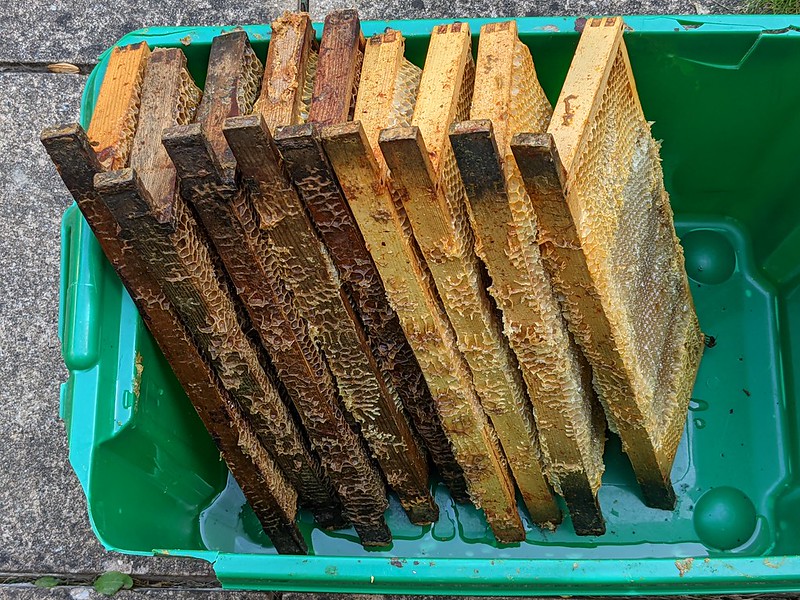
Inside, I (with Miranda's help) spin the frames fairly painlessly - they are mostly good frames, without much accreted junk - and put them back into their respective hives, again without annoying the bees much. Below, processed frames before re-insertion.

PXL_20210905_161256961

Refs


* People are realizing that degrowth is bad The mad schemes degrowthers advocate are a fantasy that distracts us from real efforts to save the planet by Noah Smith.
* ...or so you'd like to think. But the fuckwits are in Nurture in 2022.

2021-09-05

Whole Woman's Health v. Jackson

241204464_10157984249526020_2132393950904762802_n Whole Woman's Health v. Jackson was a decision by the United States Supreme Court not to issue an injunction against Texas Heartbeat Act1; read it in full here; it generated a vast amount of anguished reaction from the usual suspects. The decision was difficult but reasonable people could and did argue different sides; personally, I'd have decided the other way.

Majoritarianism vs Constitutionalism


In most politics, the progressives tend to favour majoritarianism: if enough people want it, they should get it. Most obviously on gunz. And the conservatives tend to favour the other side: that the constitution binds the tyranny of the majority. But on abortion it is the other way round: the progressives want what they consider their constitutional right to abortion, and the conservatives think that if Texas passes a law, then it should be fine. This just shows that both sides attachment to abstract rules and principle is shallow; this is of course bad.

I tend to favour constitutionalism, but that doesn't in itself make me a supporter of RvW, because (as I've said before) RvW's basis in the constitution is thin at best; wiki has a reasonable discussion of the points in the Opposition and Legal sections. RvW's main basis at the moment is that it has been established law for decades, and enjoys broad support amongst the populace (but suffers fanatical opposition from a significant minority). In particular, the argument (made by folk such as the sainted RBG) that moving the argument from the political to the legal sphere cut short debate and de-legitamatised the result is I think real; see-also Sumpers again; elsewhere the change has tended to be political (e.g. the Irish referendum).

On the fundamental principle


There is some balance to be struck between individuals and the state; this is the fundamental basis of society. Problems arise when people have very different ideas of morality. In general, imposing your morality via law is only appropriate if there is overwhelming support for it (thou shalt not murder). Sumpers offers the example of fur farming, which progressives are keen to ban. And yet the liberal approach would appear to be to leave other people's morality alone, if you can. And that appears to be the correct rule for abortion: the state has no need to make any laws in this area, and so should not. All the wurble about state interests is just spurious. It should be possible to find a principle like this in the constitution, or write one in.

Smoke and mirrors


The Texas las has a novel enforcement mechanism, in that it empowers private individuals to sue those who aid abortions, rather than the usual mechanism of getting the state to do its stuff. I think this is fluff; it does not change the underlying substance, regardless of the decision's their application also presents complex and novel antecedent procedural questions on which they have not carried their burden. For example, federal courts enjoy the power to enjoin individuals tasked with enforcing laws, not the laws themselves. But the constitution is vague about the powers of the court; and precedent certainly says they can declare laws unconstitutional.

In the mean time


Eventually, the full case will come to court and likely be declared unconstitutional, with RvW as precedent (I am doubtful that today's court would make RvW, but I think it likely they will uphold the precedent). But I think it has to wait in line; there's the Missisippi case Dobbs v. Jackson Women's Health Organization to hear first. So what should the court have done re temporary injunctions? It gets to either block the law, or (implicitly or explicitly) allow it; they chose the latter; as I said at the start, I'd have chosen the former, on the grounds of stability.

[Note: DvJ was decided in June 2022; I didn't write a separate post about it; discussion happens in a comment thread at Church vs State where, generally speaking, everyone says what you'd expect them to say.]

I think the Supremes have a (laudable) tendency to not-do-things rather than do-things; and certainly, they reject or ignore the vast majority of petitions to them, as they must. Then again, there's the "principle" of irreparable-harm-in-the-interim, which justifies emergency injunctions. Thinking through that: (a) suppose they had emergency-blocked the law but the law is, eventually, found constitutional. In that case the irreparable-harm would be the deaths of foetuses. Conversely, (b) if they don't block it but do eventually strike it down, the irreparable harm is people being forced to drive 300 km out-of-state2. The balance there seems to me to favour (a).

The other argument in favour of not-block is to see how it works out. If they block the law, we never get to see what would happen. As it is, we'll presumably find out if the apocalyptic predictions turn out to be true or not.

Elect someone else


As noted above, these laws that everyone hates are made by democratically elected pols, so if you don't like the laws they make, the obvious solution is to elect someone else, or leave. Obvs, if all Texan women hated the laws and considered it their top electoral priority, the Repubs would be voted out. But that doesn't happen. Partly because not all Texan women hate the laws, but partly because of a sort of moral hazard: since people are fairly sure the Supremes are going to strike the laws down, they can vote for these clowns in the fairly-sure knowledge they won't suffer from them.

As to leaving, this brings me to my cartoon, which was put up on fb by the normally-sensible Bart V. When I replied with the Houston Chronicle's Texas continues to lead US in raw population growth, Census Bureau estimates he had no answer, of course. Cartoons have to reflect reality to be funny; otherwise, they just point up the lack of understanding of the promoter.

Unconstitutional in so many different ways?


A lot of people who really ought to know better are saying that the Texas law is clearly unconstitutional, but I don't think it is. As noted above, the constitution is at best vague and at worst silent on the issue (and for fans of reading the framers's intent, I very much dubt they intended any such). What it is, is clearly against precedent; but that's different. Stare decisis is part of the common law, not the constitution.

That same article continues Second, the Texas statute is unconstitutional in that it allocates to ordinary citizens who have no connection to the woman seeking an abortion the power to sue anyone who provides any help to the female. And I sense deep unease amongst progressives against the idea of citizens enforcing the law. But, why? Citizens having a deep connection to the law seems rather USAnian to me; these funny people elect some sherrifs and judges, after all.

Wiki


As a side note, wiki has several articles on this area, and to my surprise, they are not a hotbed of edit warring; indeed, they are snoozy.

Notes


1. Actually, I'm unsure if it is the name of just that decision; or if it will be the name of the full case when it comes to court, and that decision will be just the opening skirmish.

2. I know, I know. This is harder for poor folk. But so is everything. Certainly, it will be no great hardship for the wives and daughters of Texan politicians.

Refs


By and large, those schemes (like Texas’s SB 8 liability for abortion providers) must be fought by raising the Constitution as a defense in a civil lawsuit—not through preenforcement challenges; by Eugene Volokh.
2021-08-29

The Problem with Nordhaus?

IMG_20210811_165348_742 Time to stop bashing those who are nominally on my side, and bash people on the other side, errm, well sort of. The offender today is David R. Henderson of Econlib, although really at Hoover. DH isn't one of the better Econlib folk, though he's generally sensible on economic matters (I've reffed him e.g. here, tangentially) but on GW he goes a bit mad; perhaps this is a good place to drag out my newly-discovered Proverbs 21:16: The man that wandereth out of the way of understanding shall remain in the congregation of the dead.

Let's begin by establishing to our own satisfaction that DH is on the clueless-septic fringe: he says Nordhaus challenged a Wall Street Journal article by sixteen scientists who were/are global warming skeptics. There's an arch of the WSJ thing here; it features the usual suspects like Happer and Lindzen, as well as somewhat more surprising nutters like Armstrong, who knows fuck all about GW. DH's problem of course is that he too knows so little about GW that he takes their self-description as sixteen scientists who, implicitly, has some clue as to what they're talking about at face value. He is also so bad at updating that he even approvingly quotes their dumb Perhaps the most inconvenient fact is the lack of global warming for well over ten years now. FFS, I thought everyone had given up on the "hiatus" ages ago. I don't think I bothered talk about the WSJ drivel at the time; if you want more detail, try RC.

OTOH, back on the basic econ, he makes several (ex?-)commentators here look like nutters: "innovation generally has contributed to economic growth and economic well-being. But how is the growth from innovation split between the innovators and the consumers who benefit from innovation? In a 2004 study published by the National Bureau of Economic Research, Nordhaus wrote: Only a minuscule fraction of the social returns from technological advances over the 1948-2001 period was captured by producers, indicating that most of the benefits of technological change are passed on to consumers rather than captured by producers. How minuscule? Nordhaus estimated the innovators’ gain to be only 2.2 percent of the overall value they create. The rest is competed away". It is so hard to find people competent at both GW and Econ.

And in other places DH is simply mixed: [Nordhaus] claims that the company suppressed the science of climate change and funded “climate deniers.”. So the suppression claim is of course nonsense (and remains nonsense, even when people who should know better like Rahmstorf twit it), but the funding of denial is I think true.

Incidentally, DH is kicked off by Nordhaus's The Spirit of Green: The Economics of Collisions and Contagions in a Crowded World. And he sez in a 355-page book, Nordhaus hardly discusses the science at all, apparently expecting that an argument from authority is sufficient. Which is to misunderstand; more, I think, signs that DH hasn't been keeping up to date. The point is that the science is now generally agreed (see, e.g., the Alsup case; even the oil companies agreed to take the IPCC as given); why would Nordhaus discuss it, other than to give the general conclusions?

What should DH do? The obvious: write about things he understands: economics, and perhaps the related governance issues. And where he wants to talk about things whose science he doesn't understand, like GW, he should accept authority (which in this case is obviously the IPCC), because this is the only thing you can plausibly do. His mistake is to cherry pick some "experts" with opinions that suit his leanings; per Feynmann, the easiest person to fool is yourself.


2021-08-26

Yet more bollox from Supran

Who knew what when? refers, obvs. But today's lesson is taken from a twat by Geoffrey Supran, pushing an amicus brief wot he has writ in conjunction with a pile of the usual suspects. As is traditional, it is badly written, starting with At least 50 years ago, Defendants [the usual Evil Fossil Fuel Interests] had information from their own internal research, as well as from the international scientific community, that the unabated extraction, production, promotion, and sale of their fossil-fuel products would endanger the public. Defendants failed to disclose this information... yes, that's right: the EFFI are being accused of failing to disclose info from the international scientific community. This makes no sense at all. Being slightly less literal, they knew nothing that the ISC didn't know, so accusing them of failing to disclose duplicate info makes no sense either.

And now I look, FFS, this is just recycled drivel - or perhaps my use of the word "traditional" was more approriate than I thought - so you'll have to forgive me the picture, it too is traditional - from Yet more bollox from Oreskes. It is the same junk they wrote then. Give me strength.

But I shall struggle on a bit further because I can recycle one of my own posts. They continue, "In 1959, physicist Edward Teller delivered the earliest known warning of the dangers of global warming to the petroleum industry, at a symposium held at Columbia University. Teller described the need to find energy sources other than fossil fuels to mitigate these dangers, stating a temperature rise corresponding to a 10 per cent increase in carbon dioxide will be sufficient to melt the icecap and submerge New York....". But the point is that Teller was hopelessly wrong, as I said before. No-one should, or did, act on Teller's warning, because at that point, no-one knew. As Teller so helpfully demonstrates.

Note that this is all orthogonal to the question of "was there a PR campaign to delay and obfusticate", to which the answer is Yes.

Notes

1. I briefly covered the suit in Yet moah climate suing.

Refs

TALIBAN PROMISES FIRST CARBON NEGATIVE JIHAD

Book review: Colonialism, the Golden Years

Book review: Labyrinths

Book review: Euthyphro

2021-08-18

Afghanistan

PXL_20210815_100741012 So, Afghanistan has "collapsed"3. This is hardly surprising, since we've1 spent two decades propping up corrupt incompetents; without the prop, they cannot stand.

I'm with Hobbes: the worst thing is civil war. Our prop sustained eternal civil war, as we didn't have the resolution required to end it, so leaving was the best thing to do2.

The speed of collapse surprised me, as well as people who should have known better. So the system was even more rotten than we thought. OTOH, we had warning of this, in the sense of an example, ISIS in Iraq, had we thought to think of it. However, that the system would collapse was obvious; sadly, I neglected to write that down in advance.

This is distinctly Hard Luck for a variety of Afghans who would prefer a more Western lifestyle, aka freedom and the Great Society rather than Tribalism. OTOH, such people don't seem prepared to fight for what they want; they seem to have acquired our fatness and rather forgotten the blood-of-patriots bit alongside the tree-of-liberty bit; preferring (I extrapolate from very limited information) to leave the fighting to the proles.

I've seen various saying that it is sad that it comes to this, after we "gave them freedom"; but I don't think you can really "give" people freedom; they have to take it.

Updates


The Economist: America's shambolic withdrawal from Afghanistan has left the country on its knees. How can America and its allies rectify such a dire mistake? But this is wrongthink: firstly, it wasn't a mistake, and secondly the USA and friends can do little to "rectify" it other than get out of the way.

As to the shambolicity: meh. Possibly it could have been done well, but I think that was asking too much. So much of USA-in-Afghanistan (and Iraq) has been done appallingly badly - indeed, everything other than the initial inevitable military victory - that expecting something better than bad is unreasonable.

2021/08/20 The chaos on the runway contrasted with the Taliban’s nearly bloodless capture of Kabul a day earlier sez The Economist. And... who was in charge of the runway? Yes, that's right: the West. Not the Taliban. I wonder how long they will tolerate those troops? They may perhaps be quite happy to see a pile of "troublemakers" leave. Or All Afghanistan is secure, but the airport which is managed by the Americans has anarchy, as the Taliban put it.

2021/09/18: in a final burst of incompetence: Afghanistan: US admits Kabul drone strike killed civilians.

Predictions


Words are cheap, predictions are hard. So these will be wrong, but they might be in the right direction. I think all the current panic - which effectively says that anyone who ever talked to a Westerner needs to leave now to avoid being strung up or worse - will turn out to be just so much panic. The Taliban will string up few if any, at least for past "crimes", because: why should they? They have won, at least for now. They don't have a long-term strategy (do they want to remain a local tribal theocracy, or join the league of nations? They don't know). Women's rights... are unlikely to get better quickly and are likely to get somewhat worse (but my suspicion is that WR were only ever improved in urban areas and remained poor in most of the country) but if the country can have peace, will improve in the long-term. Peace will also improve everyone's right not to get blown up or be otherwise killed or be poor (recall Smith). If the West avoids meddling - as it should - then the Panjshir valley stuff will fizzle out to overall Taliban control.

From the West, we seem to be tying ourselves into knots: we've classified the Taliban as terrorists (even though, as far as I can tell, they aren't (they have blown people up in Afghanistan, of course, but that was in the course of a civil war)) and have blocked their money, and somehow we're going to have to unwind that position. Doubtless we will, in time. We will continue to pontificate pointlessly about Rights.

Other people's bad takes


Kissinger (is he really still alive?) has a go in the Economist. Let's look:
We entered Afghanistan amid wide public support in response to the al-Qaeda attack on America launched from Taliban-controlled Afghanistan: this isn't true. The USA got twatted, and the public wanted to twat someone back, so they did. But that was the extent of public support. It was easy for aggressive pols to parlay that into boots-on-the-ground, and doubtless a poll at the time would have seen Joe Public thumbs up, but really support was ignorant and shallow.
We convinced ourselves that ultimately the re-establishment of terrorist bases could only be prevented by transforming Afghanistan into a modern state with democratic institutions and a government that ruled constitutionally: which is what they always do. Because (as big K fails to think through) they have no other plan. Having twatted the govt, they needed to replace it. They could not replace it with a structure that would have reflected the actual tribal power structure (waves hands: don't mistake me for an expert on Afghanistan) because that would be undemocratic; they have nothing else to fall back on. K refs himself in 2010 saying the attainable outcome is likely to be a confederation of semi-autonomous, feudal regions configured largely on an ethnic basis, dealing with one another by tacit or explicit understandings but his only idea towards that is regional diplomacy rather than national: thin stuff, and no longer mentioned in 2021.

Weirdly, the Afghan army doesn't blame itself, if a three-star general in the Afghan Army writing in the NYT can be believed. But of course it is the same old excuses all over again: It’s true that the Afghan Army lost its will to fight. But that’s because of the growing sense of abandonment by our American partners and the disrespect and disloyalty reflected in Mr. Biden’s tone and words over the past few months. The Afghan Army is not without blame. It had its problems — cronyism, bureaucracy — but we ultimately stopped fighting because our partners already had. This fails to understand that the Afghan army had to be the primary in all this; not (what it actually was) some dangling appendage of the USA that gave up when the USA "disrespect"ed it. But, he gets some points for mentioning corruption.

Economist: After Afghanistan, where next for global jihad? The biggest danger is in poor, unstable states where insurgents already control territory. But as they themselves say: Bad government creates an opening for jihadism. When a state is unjust, its citizens may imagine that one run by jihadists might be better. Even if they do not take up arms, they may quietly support those who do. Many rural Afghans decided that Taliban justice, though harsh, was quicker and less corrupt than government courts, and that Taliban checkpoints were less plunderous... The long-term solution is to build less awful, less exclusive states... Donors can offer advice and cash, but ultimately it is up to locals to build institutions that work. I think that last bit is wrong: that all the West should offer is advice and cash. The advice is ignored, the cash is stolen. Something better, more forceful, is required. But the force must be to build good govt, not to prop up bad.

Other people's good takes


From Hazlitt (p 72): It has been observed again and again how the morality of savage tribes decays and disintegrates when they are confronted by the utterly alien moral code of their "civilized" conquerors. They lose respect for their old moral code before they acquire respect for the new one. They acquire only the vices of civilization. The moral philosophers who have preached root-and-branch substitution, in accordance with some "new" ill-digested and oversimplified principle, have had the effect of undermining existing morality, of creating skepticism and indifference, and of making the rules by which the individual acts "a matter of personal taste."

Premature Imitation and India’s Flailing State (and Econ 101, the Drug War, and Afghanistan) are good on the issue of corruption, and the thorny issue of why.

Update 2021/12: they are clearly short of stuff so I gave the British Red Cross £100 to spend there. 2022/12: and another £100.

Refs


History is not a master but a teacher. It is full of evil. It is addressed to free men who choose among its examples. Like experimental science – in which many unsuccessful experiments prepare the way to discovery.
* A Taliban-run Afghanistan will be less isolated than the West may hope. But no country will feel comfortable with it - Economist.
* The Afghanistan occupation and the Japan occupation: We learned the wrong lessons from our post-WW2 success by Noah Smith
* The shocking reality of Afghanistan today (via Sky). I know, I know, there's far worse.
Al Jazeera English: The West is getting Afghanistan wrong – again.
Afghanistan: Social media users delete profiles over fear of attack - is the Beeb getting short of real news?
* No Forgiveness for People Like You - Executions and Enforced Disappearances in Afghanistan under the Taliban - HRW
* [2023/04] Taliban ban on women has forced UN into ‘appalling choice’ - the UN chooses rules over helping people.
* [2023/05] Life under the rule of the Taliban 2.0: For half of Afghans the mullahs’ regime is less bad than feared - Economist: The Taliban have improved economic-law enforcement across the board... “The core competency of the Taliban government is the enforcement of laws and orders... If we find you are doing corruption and we implement Sharia laws on you, you will not do corruption again.” To acknowledge such progress is less a tribute to the Taliban’s harsh methods than an indictment of the corrupt, nato-backed governments the Islamists replaced.

Notes


1. "We" means the Cold West, but of course mostly the USA.

2. "best" but not good. One might perhaps attempt to argue that only now two decades have passed is it obvious how useless the Afghan elite are; but I think it was obvious at least a decade ago.

3. Far in arrears (2025/10) I realise that of course A has not collapsed; what has collapsed is the corrupt incompetents we tried to impose; instead, it has phase-transitioned to a stable-looking although not very pleasant-looking native govt.