2018-11-23

Was an imminent Ice Age predicted in the '70's? No

DSC_3261-w-ma-great-aunt-jess With the recent drivel in "Metro" making the news, it may be time for another anti-ice-age-myth post; the last from me that I can see is from 2015, when the Squareheads went mad. To remind you, the "proper" scientific source for all this is Now out in BAMS: The myth of the 1970s global cooling scientific consensus, which is my wild-eyed enthusiasm, Thomas Peterson's careful scholarship, and John Fleck's journalistic flair. My1 RC post from 2005 is also worth a look.

But what I wanted to link to here, for those young 'uns who don't know the history, is http://www.wmconnolley.org.uk/sci/iceage/. Which is hosted on my web site (remember when people had personal web sites?) and will probably one day disappear when I forget to pay the bills; happily there's an archive of it. As you can tell, it is a page that Just Grew; I even felt moved to add a note to new readers at one point. So all this started in the sci.env days, let us say around the year 1995-2000. In those days GW "skepticism" was a little bit more respectable, the evidence wasn't all in the way it is now, and one of the themes was the familiar "but you were all predicting ice ages in the 70's", and what I discovered was that when you actually read the papers that people were putting forward, you discovered that no, people weren't predicting ice ages (with a few exceptions).

Some flavour of sci.env comes from Re: control the climate by Michael Tobis in 1995, or Cooling vs. Warming by Robert Parson in 1993. In some ways the best summary is by Dick "Mad Dog" Lindzen:
Many studies from the nineteenth century on suggested that industrial and other contributions to increasing carbon dioxide might lead to global warming. Problems with such predictions were also long noted, and the general failure of such predictions to explain the observed record caused the field of climatology as a whole to regard the suggested mechanisms as suspect. Indeed, the global cooling trend of the 1950s and 1960s led to a minor global cooling hysteria in the 1970s. All that was more or less normal scientific debate, although the cooling hysteria had certain striking analogues to the present warming hysteria including books such as The Genesis Strategy by Stephen Schneider and Climate Change and World Affairs by Crispin Tickell--both authors are prominent in support of the present concerns as well--"explaining'' the problem and promoting international regulation. There was also a book by the prominent science writer Lowell Ponte (The Cooling) that derided the skeptics and noted the importance of acting in the absence of firm, scientific foundation. There was even a report by the National Research Council of the U.S. National Academy of Sciences reaching its usual ambiguous conclusions. But the scientific community never took the issue to heart, governments ignored it, and with rising global temperatures in the late 1970s the issue more or less died. In the meantime, model calculations--especially at the Geophysical Fluid Dynamics Laboratory at Princeton--continued to predict substantial warming due to increasing carbon dioxide. Those predictions were considered interesting, but largely academic, exercises--even by the scientists involved.
though of course you can't trust everything that article says. The 1975 US National Academy of Sciences/National Research Council Report is also worth a look; and since Big D mentions it, here's my read of The Cooling.

Refs


* 2012: Carbon Dioxide: Our Salvation from a Future Ice Age?

Notes


1. Now assigned to "group" but as the archive shows, it's mine.
2. The pic is me - I'm the little one - my mother, and Scary Great Aunt Jess. at their house in Leighton Buzzard, in 1964 I'd imagine.
3. A point that VV makes in hist comment elsewhere is that even if the meme were true - if the consensus had been for cooling then - it still wouldn't affect the quality of today's science. That is logically true, but I suspect it wouldn't play well politically, so it isn't my lead argument. I prefer to go with the argument that the entire meme is broken, which it is.

2018-11-21

What made solar panels so cheap? Thank government policy?

It's by that nice Dave Roberts, in Vox (arch). Naturally, he omits the second question mark. His text is Evaluating the causes of cost reduction in photovoltaic modules by Goksin Kavlak, James McNerney and Jessika E.Trancik. I'd feel guilty for not reading it but it's paywalled so I'll rely on DR's paraphrase.
 

Anyway, the paper takes the observed steep decline in solar PV price, and tries to work out what caused this: things like building bigger plants, efficiency (of the panels) and R+D. This is a sensible thing to do, and nicely they do it over two decade-length times, so you can see to some extent how the drivers change over time. Read Vox, I won't re-say it here.

DR's point is that it were the gummint that dunnit, and naturally I'm a bit dubious about that. If you break down the drivers into "low level" and "high level", then each contributes about 100% (by a quick by-eye addition), and the largest single factor is a high level one, public and private R+D, which is ~60%. Unfortunately it then starts to get blurred: DR doesn't split R+D up into the obvious categories of public and private. Then "market-stimulating policies" come in from the left field, and are policies "which create legal or economic incentives for private actors to research, develop, and invest in technologies"; and apparently "do the bulk of the work". So it was mostly private R+D, stimulated by govt policies? This is believable.

While I'm here, I should link to Auke Hoekstra's update of his "solar PV is doing much better than the projections" that I blogged as Photovoltaic growth: reality versus projections of the International Energy Agency – the 2017 update.

Refs


* Extinction rebellion - ATTP. Well, someone had to write it. I notice he isn't brave enough to venture an opinion. Having written that, I suppose I ought to. Reading Rupert Read, philosophe, it would seem that they're fine because they're "righteous"; I'm dubious.
Transportation is the Biggest Source of U.S. Emissions - from 2017, but the point is interesting: with large-scale solar supplying more power, and coal less, there will come a point where addressing (electric) transportation becomes more important. Fortunately, that's already happening to some extent.
* Thanksgiving in Little Hill Village - Scott Sumner
* Astonishingly, Timmy has a different answer: It’s Capitalism That Made Solar Panels Cheap. Capitalism And Markets, Not Public Policy. Although actually he mainly points out that the paper doesn't answer the question he is interested in.
* Nice cartoon.

2018-11-19

Early oil industry knowledge of CO2 and global warming?

evil The world is clearly desperate for information on this topic, because a minor and rather unimportant letter on the subject makes Nurture (to me via Twitter; actually maybe it's only NatureClimateChange, possibly in lower case, I find it hard to keep up). The author, one Franta, came to my attention with similar stuff earlier: On its hundredth birthday in 1959, Edward Teller warned the oil industry about global warming? I find this disturbing, because I think people are jumping on this rather foolish bandwagon under a kind of group illusion that because other people publish drivel, they should too (and this isn't free; it distracts from reality); see-also The oil industry knew about climate change long before the American public did? You can hear the salivating in These archival discoveries add to the growing body of information regarding  fossil fuel producers’ knowledge of climate science over time12. Such information  may assist in understanding the history of climate policy efforts and assessing  the responsibilities of fossil fuel  producers today. FFS, that ref 12 is not to any scholarly article, it's to Exxon: the road not taken by InsideClimateNews. Terribly nice people I'm sure, but their entire series was broken, as I may have mentioned more than once before.

Refs


* DID THE WHALE OIL INDUSTRY KNOW ABOUT GLOBAL WARMING BEFORE THE GENERAL PUBLIC?
UN environment chief Erik Solheim quits amid expenses row.

2018-11-10

The Carbon Tax Is Dead, Long Live the Carbon Tax?

vie Or; alas poor I-1631, I knew you well. Tyler Cowen ventures to hope that its failure on the ballot in Washington state will inspire economists to come up with better arguments. TC doesn't address the rather messy nature of 1631. I noted that parts of it appeared to have been written by children, and no-one disagreed. In comments elsewhere, I said to PH that
You have a bind: there are two versions of the "carbon tax initiative": the "pure" one, which can attract thinking Repubs, and ought to have the support of Dems; but which offers no pork-barrelling, which people have come to expect as a right, so struggles to get enough support. As you found, this version doesn't get 100% Dem support, because they want the moon on a stick, so it fails. The other version is the distinctly impure one, where revenues are used to buy off a pile of special interests. Now you can get all the Dems on board, but you repel a lot of Repubs. There isn't an easy answer to this, other than to slap the over-fussy Dems around and get them to vote for the "pure" version.
Joe Romm at ThinkProgress roundly blames Big Bad Oil for the defeat; but that's just excuse-making and infantilising the electorate. Doubtless money has some influence; but telling how much is impossible, and in the end the electorate are responsible for the little marks that they put on the little pieces of paper. TC says
Like many economists, I have long supported the idea of a carbon tax, and still do. Government has to tax something. So why not tax those activities which generate social costs, in this case through disruptive climate change? It is a very intuitive argument that has persuaded many economists on both sides of the political spectrum.
So far so obvious. But also
The doomsday wing of the carbon-tax movement has long faced a tension in its proclamations. On one hand, it argues that relatively modest carbon-tax proposals will bring significant gains for the global climate. On the other, some of the more extreme advocates argue that without such taxes, the climate will take a disastrous turn. The reality is that carbon taxes would simply be accelerating the natural course of technological progress — electric cars in five years rather than 15. That’s a net social benefit, but it is unlikely to make the difference between environmental balance and doom.
which I rather like. How can sane people - like him and me - convince anyone that carbon taxes are a good and useful idea, if other people are loudly shouting that doom is just around the corner? Clearly, a modest (say, $20 / tonne) carbon tax cannot be the difference between Doom and Not-Doom; it is easy enough to morph that into "oh well in that case let's not bother".

TC doesn't have any geat ideas for how to address this problem, and neither do I. We could just hope it will solve itself; Lazards Levelized Cost of Energy and Levelized Cost of Storage 2018 looks good (and see-also Storage will replace 3 California gas plants as PG&E nabs approval for world's largest batteries).

Brian has a go, at Eli's.

Refs


What is the revenue generation model for DuckDuckGo?
* Legal Responses to Regulatory Capture SENATOR SHELDON WHITEHOUSE United States Senator from Rhode Island; aka "drop Chevron deference if the agencies make decisions I disagree with".
* Elon Musk weights in.
U.S. Coal Plant Retirements Near All-Time High.
The E15 Mandate is Poor Environmental Policy - USA corn ethanol boondoggling.
Will Trump Join the "Fight for $15?.
There are No Natural Resources… - CafeHayek
Yes, a carbon tax - Timmy
Low-skilled Immigrants are Productive, Too - CafeHayek
* Markets fail, use markets - EconLib
It is impossible, however, to guarantee that force will be limited to maintaining good civil order.
* What Would Milton Friedman Do About Climate Change? Tax Carbon - Jeff McMahon, Forbes.
Why the world needs a carbon tax - Tim Harford
* A Carbon Tax Is Not A Slam Dunk by David R. Henderson - not I think a very good article (we shouldn't have a carbon tax because there are three alternatives: 1) tackle cow farts first; 2) geoengineering; 3) plant trees. Duh).

von Neumann on climate, in 1955

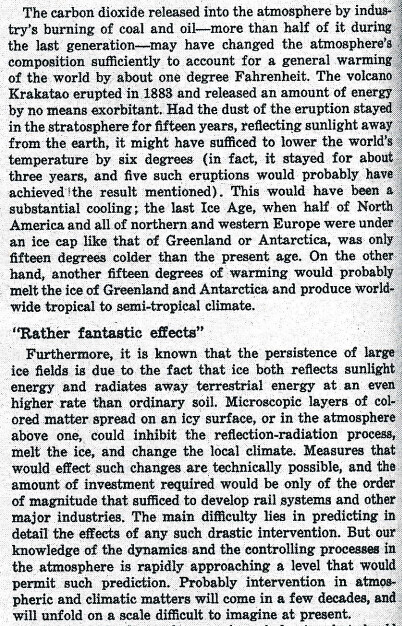
vonn Via Twatter, I discover that Every president since JFK was warned about climate change. That doesn't seem especially plausible to me - at least, in the conventional sense of the phrase "climate change", which is used to mean "global warming" - and the sense of the word "warn". Since I suspect attacking this would be more shooting fish in a barrel, I won't bother; instead I'll look at the source of JFK's warning, which was apparently from the great von N, no relation to von S. If you look, you'll easily find Can we survive technology? (Fortune, 1955) which purports to be a reprint from the archives. Alas, you'll search in vain for climate there, and you may be rather confused by the somewhat abrupt ending of the piece, without even the dignity of a final full stop. And then it becomes clear that whoever was tasked with transcribing this stuff just got bored after a bit and stopped.

Happily, there's a copy at http://activistpost.net/Can-We-Survive-Technology.pdf1

I don't have a great deal to say about it, though. He knows about CO2 causing warming; he knows about aerosols causing cooling. However, he doesn't seem to be concerned, as we are now, with inadvertent warming from CO2 emissions; rather, his interest is in deliberate modification.

At this point I need some text to fill out the blank space before the next image comes in. I could read more of the article itself, but don't feel inclined to. Instead, I'll tell you about my sculling outing today. I didn't get out until 2:30, by which time the early sun had gone; and I had to fight my way past endless novice VIIIs tangled up with each other, and the moored boats; but once on the Reach it was lovely. Then it began to rain, and on the way back it absolutely hammered down so that it was hard to see. Ah, I see I've hit my quota. Excellent, on with the show.

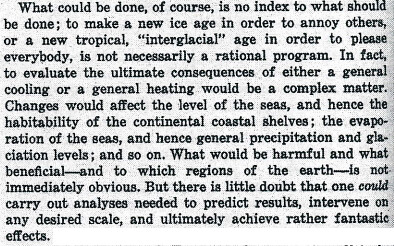
vonn1 He realises that trying to change the climate might not please everyone; he is bizarrely confident of our ability to do it, however.

Perhaps not unreasonably, Senator Clinton Anderson chose to bring this to the Prez's attention, but under the rather weak rubric of "I mean only to suggest to you that this is an interesting subject and one which should not be put entirely on the shelf.

For my general opinions about "early warnings", see In the decade that ran from 1979 to 1989, we had an excellent opportunity to solve the climate crisis? and indeed Who knew what when? not forgetting The oil industry knew about climate change long before the American public did?

Notes


1.  Warning; that nice PDF came via this, which begins In the course of exposing chemtrails... and then ...is the most potent evidence yet in support of the assertion that the theory of man-made global warming is a cover story for the biggest scientific effort in history. However, that does have a plain-text copy of some of the von N text, which I'll paste in here for convenience: The carbon dioxide released into the atmosphere by industry’s burning of coal and oil – more than half of it during the last generation – may have changed the atmosphere’s composition sufficiently to account for a general warming of the world by about one degree Fahrenheit. The volcano Krakatao[sic] erupted in 1883 and released an amount of energy by no means exorbitant. Had the dust of the eruption stayed in the stratosphere for fifteen years, reflecting sunlight away from the earth, it might have sufficed to lower the world’s temperature by six degrees (in fact, it stayed for about three years, and five such eruptions would probably have achieved the result mentioned). This would have been a substantial cooling; the last Ice Age, when half of North America and all of northern and western Europe were under an ice cap like that of Greenland or Antarctica, was only fifteen degrees colder than the present age. On the other hand, another fifteen degrees of warming would probably melt the ice of Greenland and Antarctica and produce worldwide tropical to semi-tropical climate.

Refs


A study of climatological research as it pertains to intelligence problems
Trump cancels US cemetery visit amid diplomatic embarrassment

2018-11-09

Jordan Peterson is a tosser

#1 in a series of "my friends have taken this idiot seriously so I paid some slight attention"1. ATTP has discussed him and his a few times and it wasn't very interesting. But now JP has chosen to say things about global warming which makes it obvious that he's a fuckwit, so I can conclude my opinion-forming process with "tosser". There's a convenient transcript of some of his words by CliSep, who I think are dodgy, but ATTP Twitted their link, so I guess that's OK.

We start off with Well, I don’t really have beliefs about climate change, I wouldn’t say. I think the climate is probably warming, but it’s been warming since the last ice age, so... This is a bit shit, taken together. There's nothing wrong with "Well, I don’t really have beliefs about climate change, so I'd rather not answer your question" or some other such deflecting formula; but having professed no knowledge, there's no justification for going on and pushing out your beliefs2. There's a get-out-card available for him, perhaps, if he wishes to distinguish "beliefs" and "knowledge": perhaps he knows a lot, but doesn't "believe" in it? But if so, he should be clearly distinguishing the two; otherwise he's just guilty of muddled talking, and probably muddled thinking.

In answer to "But It’s dramatically accelerated in the last couple of decades" we have Yeah, maybe, possibly, it’s not so obvious, I spent quite a bit of time going through the relevant literature, I read about 200 books on ecology and economy. Again, there's the contradiction between his original assertion of lack-of-belief, and his apparent vague but firm knowledge that "it's not so obvious". This is then followed up by a claim to have looked at the "relevant literature", which then turns out to be ecology and economy.

These are obvious points the interviewer should have picked up on. But the interviewer is as thick as pigshit and totally fails to notice, so JP gets a free pass in the interview. But not from me. Is he genuinely so muddled that he doesn't know that he needs to look at physical climatology, if he is interested in the temperature record? That the IPCC is the obvious source; and that there's a convenient summary available? Of course, if you're a provocative public intellectual, then simply agreeing with the relevant authorities is uninteresting and might diminish your aura of controversiality.

But actually the answer is that he's even more muddled, because he segues straight into I find it very difficult to distinguish valid environmental claims from environmental claims that are made as a secondary anti-capitalist front. And indeed, that's a separate muddle one can get into, but it is nothing to do with temperature rise.

So, far from a clear-thinking intellectual, he's just a rather confused talking head.

Update: 2022/01: "there's no such thing as climate" and "climate and everything are the same word" - Jordan again demonstrating he's a useless talking head who doesn't know what he is talking about. And it's nice of Timmy to let us know that he is clueless on the science too (Timmy's usual approach is "let's take the IPCC as given, and do the econ"; this makes sense. In this case, unwisely, he has decided to throw his idiot commentators a bit of what they fancy; but he has an audience to sustain).


Notes


1. Number 2 actually happened first and is over here, deliberately obscure, but I link it for completeness. This one was a-friend-down-the-pub, and to be fair they were only going to listen to him speak.

2. Unless you're a talking-head public intellectual too dumb to realise that you're not obliged to have an opinion or know things about all subjects.

Refs


What the Word Liberalism Means, If Anything.
* The 'debate of the century': what happened when Jordan Peterson debated Slavoj Žižek by
Stephen Marche

2018-11-02

More bad news for photogenic teens

DSC_6095 Via ClimateLiabilityNews, Alaska Judge Dismisses Youth Climate Suit Vs. State Government. Looks to be very similar to a Washington case, which itself was similar to the Alsup one. Meanwhile the original photogenic teens have their case stayed (update: and now unstayed... now more, see update #2). On what bizarre grounds was the current one dismissed, you will wonder?
If this court were to bypass the executive or legislative branch and make a policy judgment, it would violate the separation of powers.
So there's a pattern emerging, because that's essentially the same reasoning used in the other cases. That dealing with this problem is one for the legislative and executive branches. I agree with that, as I've said before. It would be a case for relief-by-law in the normal courts if there was a clear law being broken; but there isn't. And it would be one for the constitutional courts of there was some clear violation of the constitution or your rights. But despite the rather implausible stretches in the cases, there isn't.

That leaves you with the unpalatable problem that the L+E branches won't do what you want them to do. So that's the problem you need to address, rather than wasting your energy in the courts. I offer my wise advice about What to DO about big problems? over there.

Just as I'm writing this, Previously Unrecognized Rights: Climate Change Lawsuits and the Rule of Law comes my way. I seem to largely agree with it. Notice also that my view of "rights" as expressed in Equal rights for others does not mean fewer rights for you? also largely agrees with that link's disdain for over-creative claims of "rights".

Update: from CleanTechnicaIf the political process is hijacked by rabid climate change deniers at a time when an environment suitable for human existence is threatened, the courts have no choice but to put aside legal niceties and force the hand of the Congress and the president. That’s what the Juliana case is really all about, although the plaintiffs can’t say that openly. But of course, the courts will not put aside legal niceties.

Update #2: The case was stayed, by Roberts, and then unstayed, by the full court, but when you read the reasoning carefully, it was less due to lack of merit and more because if that's what was wanted, the appeal court could have done it instead. So the govt applied to the appeal court ({{cn}}) and now have got a temporary stay while they think about it.

Refs


* A eulogy to Guardian's Climate Consensus - the 97%
* Is Kids Climate Case Coming to an End? - Volokh: The "trial of the century" may not happen after all; Jonathan H. Adler

2018-11-01

Portrait of Adele Bloch-Bauer I

Continuing my art series, wherein I offer you plebs advice about which pictures are worth your attention, from the heights of my cultured elegance. It also serves as a partial answer to CIP's "eh it were better in t' old days", first popularised by Plato. But then so does Heart of Darkness.


Path: Gustave Moreau: The Apparition, via fb; to Musée d'Orsay; to Gustav Klimt.

Refs


* The ParkBuchenwald I.

2018-10-27

Death of an Onion

deathDie KlimaZweibel pegged out some time in early 2017 (arch from now; it's last post was mostly in German). You'll have to forgive me for not noticing earlier; I'd rather stopped visiting after his hit post on me, which I thought careless. People kinda just got bored or ran out of things to say, which happens.

But I shouldn't allow it to pass un-noticed. Other hits from down the years include Junk from von S (about the Lovelock affair in which von S deletes some of my comments, the cad; but can a squarehead be a cad?) and Werner Krauss is a tosser in which I delicately express my opinions. On a lighter note, there's von S’s testimony.

This may a good place to lament the death of blogs in general. People with short thoughts seem to Tweet them; and those with slightly longer ones, ridiculously, break them into a sequence of Tweets. Young folk nowadays, they have no respect.

Refs


Well Done – Entirely, And Totally, Misunderstanding Canada’s Carbon Tax - Timmy
* Reducing Your Carbon Footprint Still Matters; In fact, getting politicians and industry to address climate change may start at home - Slate; the idea that your actions will influence others; ah, yes: that's my Climate chickenhawks.
THE PRESS RELEASE THAT LEAVES YOU BREATHLESS - RS.
The crisis as reported is just the crisis of a few.

2018-10-26

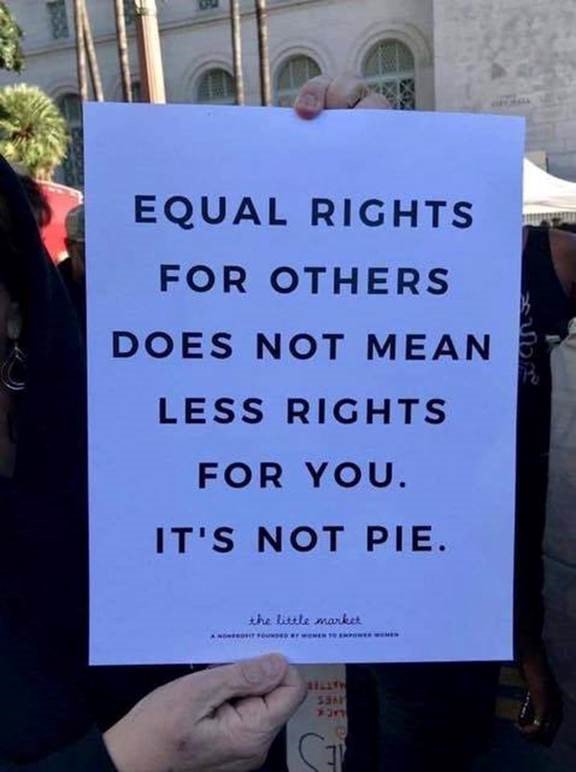
Equal rights for others does not mean fewer rights for you?

The idea that "it's not pie" and that "equal rights for others does not mean fewer rights for you" is such a commonplace that you can get it on a tee shirt.

But is it true?

In Hobbes' world, in the State of Nature we all have equal rights to all things; but we agree to give up some of those rights in order to allow Civil Society to form. And in exchange for, for example, the right to settle our own disputes by force if needed, we agree to submit to a Sovereign's adjudication of disputes: in practice, a court system.

That system inevitably involves balancing some rights against others. For example, does a baker's right to "free speech" in the form of no-forced-speech trump a gay person's right to have a cake baked for them by the bakery of their choice? The answer turned out to be in the baker's favour. Can you call the Prophet a "paedophile" because of his child marriage? Not in Austria; it would seem that religion's freedom from having unpleasant things said about it trumps free speech1. I don't think it would in the US of A. Contrariwise, the "right" to an abortion doesn't obviously involve others losing anything that could be called a right2.

Part of the answer is going to turn on what-are-(human)-rights, anyway? As I've said before, or perhaps edged towards, or avoided, I rather like Hobbes' version: rights are what you have naturally, the aim is to lose as little as possible3. That fits with the Declaration of Independence's famous We hold these truths to be self-evident, that all men are created equal, that they are endowed by their Creator with certain unalienable Rights, that among these are Life, Liberty and the pursuit of Happiness. That to secure these rights... Which says that the rights are prior; the govt does not create any more, it helps secure pre-existing rights.

[Update 2019/04: so for example the Equal Rights Amendment is bad, because it declares the existence of equality of rights. Had it, instead, declared that the state should pass no law depending on sex, it would have been good. And yes, that would permit single-sex toilets to continue, but no it wouldn't permit blanket prohibitions against women in, say, the military.

Notes


1. Religious beliefs must be subject to criticism and denial, the ECHR observed, but when statements about religions went beyond critical denial and were likely to incite religious intolerance, states could take proportionate restrictive measures, it seems. Hobbes would thoroughly approve: the sovereign may judge what opinions and doctrines are averse, who shall be allowed to speak to multitudes, and who shall examine the doctrines of all books before they are published.

2. At least, not without contortions. As I understand it (I'm talking US law here) the "right" to an abortion is founded on the "right" to privacy, which itself is founded rather weakly on the Due Process Clause. So again, there's a balance between an individual's right to privacy and personal life, against the Sovereign's "right" to maintain society. 2024 update: RvW is now toast, following Dobbs, so the "right" to an abortion vanishes, and this example disappears.

3. An example again from the USA: your right to freedom of religion is protected by the constitution forbidding the state to make any laws about it; not by any positive legislation.

Refs


CLIMAT DE LA PEUR.
A Brazilian in Canada - When one person’s right is another’s obligation. How transgender rights sometimes lead to conflict - the Economist.
UN Urged to Recognize Healthy Climate As a Human Right; or, "people who get paid loads to globetrot about human rights and the environment advocate for more gravy".
* But where do rights come from? An opinion, from CafeHayek.
* Immigration as a Civil Right by Bryan Caplan.

2018-10-24

Global Warming of 1.5°C, an IPCC special report on the impacts of global warming of 1.5°C above pre-industrial levels and related global greenhouse gas emission pathways, in the context of strengthening the global response to the threat of climate change, sustainable development, and efforts to eradicate poverty

44519460_2151550924897512_776482657792950272_n The IPCC "1.5 °C" report's full title is Global Warming of 1.5°C, an IPCC special report on the impacts of global warming of 1.5°C above pre-industrial levels and related global greenhouse gas emission pathways, in the context of strengthening the global response to the threat of climate change, sustainable development, and efforts to eradicate poverty. I'm not making this up; their press release says so. Wisely, RC doesn't tell you the full title, because unless you're a bureaucrat, you can immeadiately tell that for something to end up with a title like that, something must have gone badly wrong.

One of the things that is going wrong is that people are misinterpreting it. For example, the wiki article says in the lede Its broad findings are reported as being that drastic action must be taken in limited time to avoid severe and worsening consequences. But the report doesn't actually recommend any action at all, still less use the word drastic. The press release does it's best to hide this, saying:
Limiting global warming to 1.5ºC would require rapid, far reaching and unprecedented changes in all aspects of society, the IPCC said in a new assessment. With clear benefits to people and natural ecosystems, limiting global warming to 1.5ºC compared to 2ºC could go hand in hand with ensuring a more sustainable and equitable society, the Intergovernmental Panel on Climate Change (IPCC) said on Monday.
But as the background saysthe Conference of Parties (COP) to the United Nations Framework Convention on Climate Change (UNFCCC) at its 21st Session in Paris, France (30 November to 11 December 2015), invited the IPCC to provide a special report in 2018 on the impacts of global warming of 1.5 °C above pre-industrial levels and related global greenhouse gas emission pathways (my bold). And so that's primarily what it is: a report on the impacts.

Refs


* Having finally done what I'd promised not to do, i.e. write this post, I guess I should link to James' version.
* WHEN BUTTERFLIES START HURRICANES BE VERY AFRAID OF BATS
Eli sat in on an interesting conversation last week at the Brookings Institution involving Chris Crane the Excelon CEO.
Climate science identifies the problem – it can’t tell us what to do in response? - me in 2015.
* Don't miss: (Move log); 23:10:54 . . Brandt Luke Zorn (talk | contribs) moved page Special Report on Global Warming of 1.5 ºC to Special Report on Global Warming of 1.5 °C over redirect ‎(as pointed out on talk page, the page title incorrectly used an ordinal indicator (º) instead of the degree symbol (°)).

2018-10-20

A large part of the planet will become unlivable: either too hot or too dry?

americanpieVia Twatter, I discover to my alarm1 that A large part of the planet will become unlivable (either too hot or too dry). It's in Salon, which isn't where you'd normally go for scientific accuracy. But it's by that nice Michael Mann, who you'd rather hope wouldn't talk drivel4. To complete the quote, he also says And more and more of the available land surface will be used for agriculture and farming to feed a growing global population. That means more concentrated human settlement—and probably a lot more conflict.

He also says We will need to adapt to a world where damaging extreme weather events are far more common. If we don’t act, these events will become both more extreme and more common. Whilst a touch repetitive, it is at least defensible. But let us return to my headline quote. It isn't clear exactly when he imagines this will occur; perhaps 2050 (a date mentioned later in the article, by Trenberth) or perhaps 2100. Never mind; sometime in the future. For the sake of argument, let's pick Trenberth's 2050, when the world is 2 oC above pre-industrial, so (picking numbers rather out of the air) perhaps northernish land areas are +4 oC, since land warms faster than sea and so on.

Heat and Dust


I find it hard to see how just getting warmer will make the world unliveable, at least for humans. People already live in places that are significantly warmer than where I live. Unprotected humans definitely feel uncomfortable if they get too hot, but that's a rather different matter. And air conditioning makes a huge difference, as Florida shows. Naturally, you'll say that air conditioning takes energy and making it hotter just to cool it down is a bit mad, but there it is. You'll also say that poor people don't have a/c2,, but part of GW is increased CO2 emissions is from the world getting richer, per SRES and so on3.

This doesn't mean there wouldn't be a fair bit of adaption needed, but if we have 30+ years to do it, it will be possible. To point out the hopefully obvious I'm not suggesting that just because we can adapt all is fine; but suggesting areas will become unliveable requires some evidence. Perhaps Mann is on a dial-up line and unable to transmit many bytes.

Dryness and drought is a more plausible problem, but it won't make places unliveable. Because (I hope you guessed this) people already live in areas that are far dryer already. For people, greater dryness isn't a problem, though it may be bad for their lawns. But lawns aren't a good idea anyway.

More of the available land surface will be used for agriculture and farming


Agriculture and farming as well? My, the land will get crowded if they have to do both in the same place. This is a more serious concern, at least when linked to the dryness, because obviously enough droughts are bad for crops. And yet, much of the world's agriculture is dreadfully inefficient, and many of the world's food chains are very badly run, with a large proportion of crops wasted. The answer, of course, is more efficient western style farming and supermarkets, and fewer happy peasants and charming but inefficient mom-and-pop stores. We could feed a growing global population off less land, and return some back to wild, if only the world was better run. Though improving the world's government is not a trivial task.

If the climate changes, the optimal crops for various areas will inevitably change. In Ye Olde Dayes, this would have been a problem, because people didn't have instant access to information and predictions, and didn't have ready access to advice on what other crops they might plant. Happily, now they do.

Wild Thing


You make my heart sing. But this doesn't address the non-human-sphere component, which IMO is where the problems are most likely to lie. But nor do I know much about it, so I won't say much.

More concentrated human settlement


Is a fairly safe prediction. But is it a bad thing? Probably not; probably it's a good thing. Let's concentrate the people and leave the wild alone. Most of the settlement patterns, at least in the West, are a fossil of the days when mot people spent most of their time grubbing in the soil. Most people don't do that any more, so most villages are functionally redundant, other than to cater to tourists coming to look at nice villages.

What should be done?


Bizarrely, having asked two physical climatologists about the likely consequences of GW - an entirely reasonable thing to do - Salon then goes on to ask them about what should be done; an area in which neither Mann nor Trenberth have any particular expertise. Naturally, they have nothing particularly interesting to say.

Science advances one doctorate at a time


I briefly considered writing a post taking the piss out of John McLean's shit PhD thesis, but ATTP has said that it's rubbish, with his habitual disappointing lack of rudeness, and really it's better to leave it to die quietly in a ditch than talk about it.

Notes


1. Don't worry. Whilst I take GW seriously, as you'd expect, I don't find this particular story very alarming. Or at least not in it's original sense. I do find it quite alarming that respectable people will say this stuff, though.

2. Unless they're poor USAnians, of course.

3. Which I haven't looked at in yonks, of course; hopefully my fallible memory isn't misleading me or you.

4. Mann says sane things, for example, here. He's also getting rather political; e.g. Brick by brick, Trump and his enablers are dismantling the incredibly fragile geopolitical and societal infrastructure... But (whilst agreeing that Trump is a twat, and probably a dangerous one) "incredibly fragile" is wrong. It must be. If it was so fragile, it would no longer exist.

Refs


Credit where it's due - JEB
Wages Reflect Underlying Economic Realities - CafeHayek
* Is Quantum Mechanics a Probabilistic Theory? - NotEvenWrong
Politicians say nothing, but US farmers are increasingly terrified by it – climate change - Graun
* The space race is dominated by new contenders; Private businesses and rising powers are replacing the cold-war duopoly - the Economist

2018-10-17

The producers of hydrocarbons have made astonishing returns over decades?

DSC_7960 The Carbon Majors Report, linked by the Graun (under the Just 100 companies have been the source of more than 70% of the world’s greenhouse gas emissions since 1988, which I was so rude about), sez
‘Carbon Majors’ offers insight into responsibility from the perspective of the producers of hydrocarbons; those companies that have made astonishing returns over decades through the extraction and production of greenhouse gas emitting products. 
Normally one's eyes pass straight over that kind of stuff as boilerplate, but just for once I read it, and thought "huh? Really?". It is fine rhetoric, but how does it compare to reality. This matters, of course, in two ways: for one, part of "the people's" anger at FF companies is them making vast unjustified profits; and the second of course is that luvverly idea that there are oceans of profits just waiting to be taxed to pay for damages.

Quora from 2017 offers me about 4.5% for Exxon. Forbes, in 2011, says on average, between 2006 and 2010, the largest oil companies averaged a profit margin of around 6.5%. This pales in comparison to profit margins in just about every other industry. The pharmaceutical industry, for example, routinely averages a profit margin of about 16%. The soft drink market is even more lucrative... And so on.

So it is hard to see their profits as "astonishing", or even much out of the ordinary. Which is what you'd expect: oil is a competitive industry, there isn't much room to make extraordinary profits.

Related to this is The big lie we’re told about climate change is that it’s our own fault over at Vox. It's the usual anguished stuff and rather carelessly written. It's also rather vapid: stripped of the emotionalism, there's almost nothing there, apart from the assertion that it isn't our fault, oh dearie me no not at all, it is all the Evil Oil Companies to blame. Weirdly, having got that bit wrong, it then gets we can’t pretend that some unnamed cavalry is coming to save us. We are the adults in this room. We have to save ourselves right, which is a nice surprise. At least, the words are fine (apart from the dubious assertion that such people are the adults). Is the hyperlinked list of "10 ways to accelerate progress against climate change" any good?

#1 is "Price carbon emissions" which is a good start. They spoil it a bit by offering DR's quibbling at the end, which is all a recipe for special interests. #2 is "Subsidize clean energy, and end subsidies for dirty energy". Meh. And, so on. I think I'll not go through them in detail here; I'd rather have a separate post on "what to do".

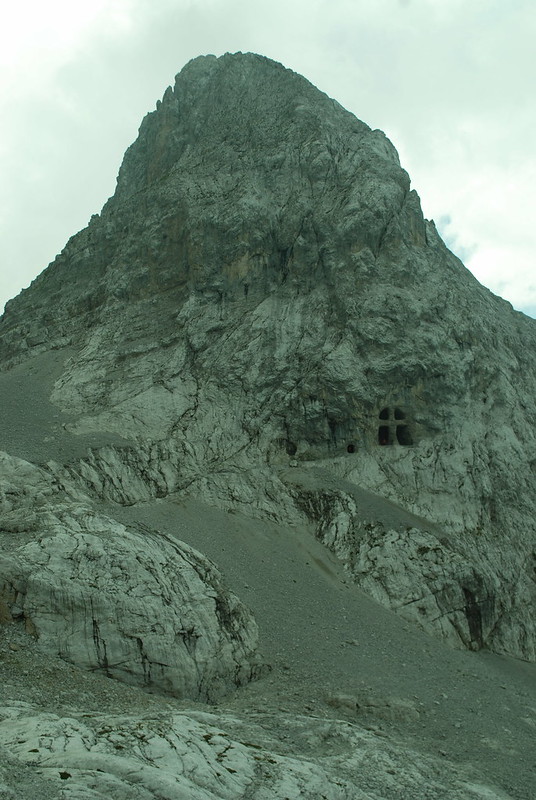
[Pic: Dolomites, chapel carved into the rock, at the Apostoli hut.]

Refs


Fixing the tomato: CRISPR edits correct plant-breeding snafu.
* More on the Long Run - CafeHayek.

2018-10-13

The Fall of the Rebel Angels


I don't have much to say at the moment - except it would seem in the comments - but I've had this up in a tab for a week now. Isn't it gorgeous? I find it wonderful that something most of 500 years old can be so good; and it is hardly alone.

In other news we came third in the IM3 IV+ in Robs's Autumn Head today; but only by 1.6 seconds. Despite a strong headwind, and a rain shower while marshalling, it was a lovely day, unseasonably warm.

2018-10-06

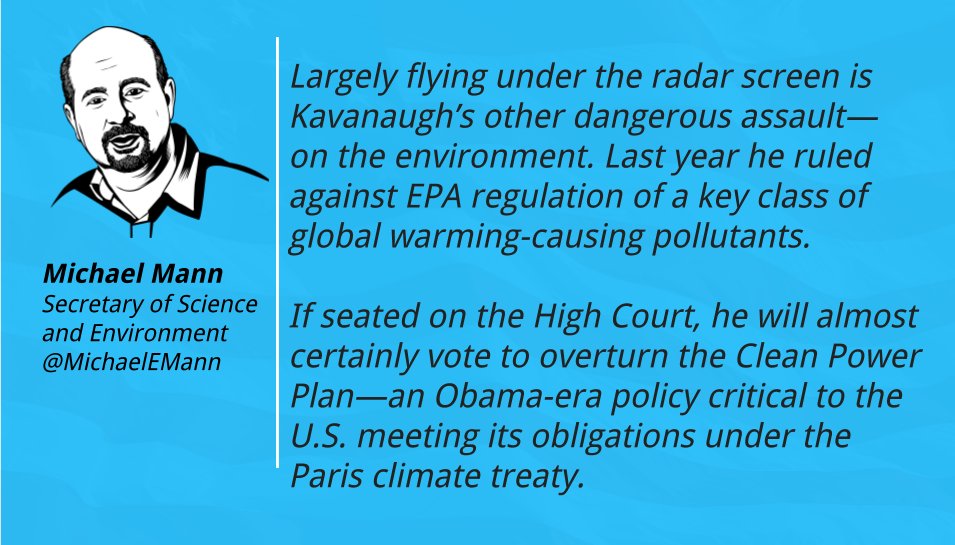
Kavanaugh's other dangerous assault - on the environment?

So says Michael Mann. Although that link is only to someone else reposting something Mann said, and annoying only "said" in the form of an image1.

Aanyway, the relevant case is I believe Mexichem Fluor, Inc. v. EPA. And since I took the trouble to find that out, and read some of the decision, I shall blog about it. You'll be unsurprised to learn that while MM's soundbite is mostly true, it elides a great deal of important detail. For example, just like the recent Alsup case, K was entirely happy to take all the GW science at it's word.

The actual judgement is here (or here). The argument, as in so many of these cases, is arcane and complex, hinging (sort of) on the meaning of the word "replace". It's worth pausing for a moment to think about this point: the higher courts don't hear simple cases where the answer is obvious to the lower courts; or indeed so obvious that it never comes to court. This kinda returns us to a point I was trying to make before: that if the legislature wanted to make these points beyond doubt it could. It could either explicitly give the EPA authority, or withhold it.

Background


Quite some time ago, in 1990, section 612 of the Clean Air Act was passed, and requires manufacturers to replace ozone-depleting substances with safe substitutes. In fact that - although a quote from the judgement - is a slightly dodgy paraphrase; the exact rule is quoted later: To the maximum extent practicable, class I and class II substances shall be replaced by chemicals, product substitutes, or alternative manufacturing processes that reduce overall risks to human health and the environment. What that adds to the paraphrase is "to the maximum extent practicable" - but that's not important, because no-one tried to contest that point - and using "reduce overall risks to human health and the environment" instead of the hard-to-interpret "safe". But as it happens, that didn't matter either, because K was entirely happy that HFCs could be called, colloquially, "unsafe", because they cause GW. Indeed, K was quite happy for the EPA to move HFCs from the "safe" list, where they had previously been (because they didn't deplete ozone) to the "unsafe" list (because further research had revealed they cause GW). Indeed, he's even happy that the EPA, in doing that, may prohibit anyone from replacing an ozone-depleting substance with HFCs2.

Foreground


So what does that leave as a problem? The problem was that the EPA wanted to use that authority to oblige people using HFCs to replace them with something that doesn't deplete ozone, and doesn't cause GW; or at least not so much. However, the act appears to only give the EPA authority to force people to replace ozone-depleting substances; and HFCs aren't. Is this a bit Jesuitical? Yes, but that's the law for you. Is it a reasonable reading of the law? I think so; and of course on of the other two judges on the case concurred. Could one make a reasonable case for the opposite? Yeees, probably. Indeed the dissent (Wilkins) does so (page 26). Is this an example of K clearly being unreasonable? No.

Hobbes


As Hobbes puts it, concerning ambiguity in the law,
In all Courts of Justice, the Soveraign (which is the Person of the Common-wealth,) is he that Judgeth: The subordinate Judge, ought to have regard to the reason, which moved his Soveraign to make such Law, that his Sentence may be according thereunto; which then is his Soveraigns Sentence; otherwise it is his own, and an unjust one.
So it is pleasing to see K address this by referring to what the Senate considered, when writing the law:
The Senate’s version of the safe alternatives policy would have required the replacement not just of ozone-depleting substances, but also of substances that contribute to climate change. Id. sec. 702, §§ 503(8), 514(a). In other words, the Senate bill would have granted EPA authority to require the replacement of non-ozone depleting substances such as HFCs. But the Conference Committee did not accept the Senate’s version of Title VI. See H.R. Rep. No. 101-952, at 262 (1990) (Conf. Rep.). Instead, the Conference Committee adopted the House’s narrower focus on ozone-depleting substances. Id.; see S. 1630, 101st Cong. sec. 711, § 156(b) (as passed by House, May 23, 1990). In short, although Congress contemplated giving EPA broad authority under Title VI to regulate the replacement of substances that contribute to climate change, Congress ultimately declined.

Etc.


There was a petition for a rehearing en banc4, that was simply denied; so it is appealed to the supreme court.

Notes


1. I can't find the quote via Google. Reverse image search says the image appeared in Mann's Twitter feed some time in 2017, and I have no reason to doubt it is his. The slightly odd "Secretary of Science and Environment" bit is from the Shadow Cabinet.

2. Although, as the judgement notes, this is probably unimportant, as it is unlikely if there is anyone left still using ozone-depleting substances. Update: ah no, That's not quite what it says: footnote 2 is: The parties disagree over whether, as a factual matter, any manufacturers still make products that use ozone-depleting substances. EPA says yes. Mexichem and Arkema say no. We need not resolve that factual dispute here, as it has no bearing on our legal analysis of the meaning of Section 612(c). 

3. Also note that "flying under the radar screen" is an odd way of putting it. The analogy is with a plane, flying underneath the radar beams. The "screen" is just the read-out from such a radar; a plane would not meaningfully fly under the operator's screen.

4. Which I'm guessing means "with a wider panel of judges", perhaps the "full court".

5. laws, when good, should be supreme; and that the magistrate or magistrates should regulate those matters only on which the laws are unable to speak with precision owing to the difficulty of any general principle embracing all particulars - Aristotle, Politics.

Refs


What Brett Kavanaugh on Supreme Court Could Mean for Climate Regulations
Schumpeterian Profits in the American Economy: Theory and Measurement – Yale economist William Nordhaus
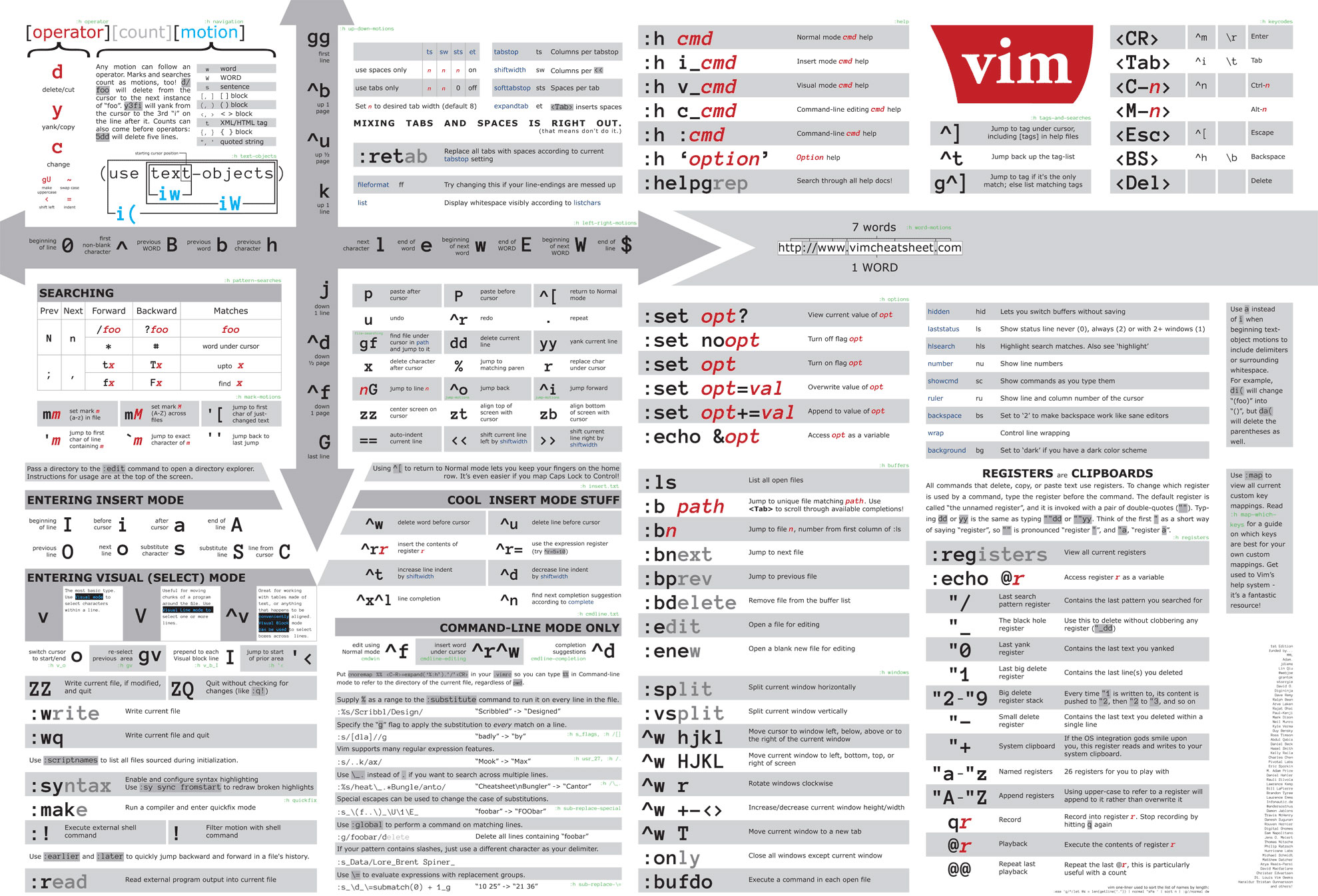
* VIM cheatsheet; thanks Paul.
* Salon thinks we're about to exist under an oxymoron: Neoliberal fascism by Tim Worstall.
Climate change and compassion fatigue - ClimateSight.

Der Prozess

Someone must have traduced Joseph K., for without having done anything wrong he was arrested one fine morning. Not entirely applicable to the current fuss, but an arresting start to a book, which I read when I was far too young: about sixteen. I really should re-read it some time. And - before you get carried away - no, I am not making and would indeed deny any analogy between the bizarre processes described in The Trial and the current situation; I just like the text. So, we turn to Brett K and his travails.

TL;DR: he should not be confirmed6, on balance of evidence.

I'm kinda tempted to leave it at there, but can't quite bear not to write down my brilliant and insightful reasoning. In brief, the sexual assault allegations against him are - at this point - too thin to carry sufficient weight; but his own recent testimony is, on balance of evidence, enough to convict him of lying.

I'd like to rely on someone else's analysis. Unfortunately the matter has become so partisan that almost everyone's words are near worthless. Unlike mine, of course. So if we think back the the now-almost-unimaginably-distant time after the first hearing but before the sexual assault allegations, we can categorise people into for and against. If we then step forward to now, we find the same people in the same camps, some of whom admit that they simply hold the same views more firmly and believe of deny the allegations accordingly, and others who pretend that the allegations have tipped them over1.

The Economist (I generally like to be able to agree with them, Pinko-Crypto-Lefties though they are) sez Brett Kavanaugh’s testimony disqualifies him from the Supreme Court and I largely agree with them, except in some matters of tone. There are too many lies, though I also find myself disagreeing with people of what exactly are the lies. So I won't commit myself to exactly what are, and what aren't4.

On the question of whether this has all become so partisan, and K has - in part, simply in defending himself - come to attack the Dems in a partisan fashion, I'm rather less sympathetic. The Dems I think did go all-out to attack him. An ideal candidate would have remained above such a fray but failure to do so is too understandably human to disqualify him. CIP asserts that K will seek revenge; that would certainly be human; the Dems have made it quite clear that they regard K as their sworn enemy. But CIP also assert that There was every reason to expect him to be an utterly partisan justice from the get go, so it isn't clear what margin for "revenge" CIP thinks there is. But on yet another hand, I don't think CIP is right in that last, so the "revenge" question, not as far as I can see addressed in mainstream analysis, is interesting. And calls into question the Dems strategy: if you're going to lose, why lose in such a way as to antagonise the winner? Unless you're going to gain something precious by dying in the ditch.

The other side lied too


Lest I be misunderstood3, I think the other side has lied too2. This initially confused my thinking, because people were bandying around terms like "due process", and so it was natural to think of it as a "trial" in some sense, and so there was some balance to be struck, and their lying some defence on his part. But it isn't; so the "other side" lying is irrelevant to his fitness to serve; and anyway there isn't "another side" on the supreme court.

Strategy


That the Dems are really pissed off is not strange, but being pissed off is not a strategy. On balance of evidence (and not on beyond-reasonable-doubt) I think the use of the sexual assault allegations was a tactic, and the delay deliberate; but that doesn't make it wise; nor indeed the strength of their previous opposition. Were they, perhaps, trapped in what their fanbase insisted on getting?

The solution


I like Brian's solution: regain Prez and Senate, and appoint two more judges5. This has the advantage of being about as outrageous as the Repubs antics over Merrick Garland, but equally legal. It might also set a precedent, that might help prevent similar antics in future. At least it might, if both sides have the sense to step back from the obvious tit-for-tat war that could ensue.

Historical context


Everything was better in the Olde Dayes, of course. Politics was conducted with decorum, by dead white men wearing wigs. Or was it? Who said:
And these discussions, whether relating to men, measures, or opinions, were conducted by the parties with an animosity, a bitterness, and an indecency, which had never been exceeded. All the resources of reason, and of wrath, were exhausted by each party in support of it’s own, and to prostrate the adversary opinions.

Notes


1. Arguably the American Bar Association has sort-of changed it's mind, in that it argued for a careful examination of the accusations and facts by the FBI. Well it has had an investigation, and we don't know if the ABA considers it careful; one might hope not. Perhaps their current opinion is the hard-to-read New information of a material nature regarding temperament during the September 27th hearing... has prompted a reopening... does not expect to complete a process and re-vote prior to the scheduled Senate vote. Our original report must be read in conjunction with the foregoing. Our original rating stands. If they'd left out the last sentence it would make sense.

2. For example, the sainted Christine Blasey Ford's purported Fear of Flying.

3. Obviously, simply writing that will prevent me being misunderstood.

4. For example, for fans of the "Devil's Triangle" being obviously sex and definitely not a game, note that the current wiki page carries neither; there's currently a discussion of whether the sex version should be included, which appears to be leaning towards "no".

5. [2021/11] I now regret saying that. Thank goodness no-one reads this stuff and holds me to account. Well, I like it in the sense of it being outrageous; but I don't think it would be a good idea. Too much tearing-at-the-fabric-of-society type stuff.

6. [2025/10] How has my assessment held up? Badly I think. As a Supreme, he is fine; I have no complaints; I could have written this note several years ago. I think the whole court is being somewhat soft on Trump, but the situation is delicate; the tariff case may make things clearer.

Refs


At least Americans choose top judges in public - Samizdata via TF.

2018-10-04

No-one understands wiki, part n+1

As I've said before, no-one from the outside ever understands how wikipedia works, but that doesn't stop them writing about it for their own partisan political gain (arch). In this case, it's the social justice warriors on the Graun. The offending text is:
When the Royal Swedish Academy of Sciences in Stockholm announced the Nobel prize for physics this week, anyone wanting to find out more about one of the three winners would have drawn a blank on Wikipedia... Until around an hour and a half after the award was announced on Tuesday, the Canadian physicist Donna Strickland was not deemed significant enough to merit her own page on the user-edited encyclopedia. The oversight has once again highlighted the marginalization of women in science and gender bias at Wikipedia... when a Wikipedia user attempted to create a profile for her in March, the page was denied by a moderator. “This submission’s references do not show that the subject qualifies for a Wikipedia article,” said the moderator.
Problem number one, as you'll discover if you try to follow the "said the moderator" link, is that the link is broken. It is missing a "y". What they presumably intended to link to was https://en.wikipedia.org/w/index.php?title=Donna_Strickland&offset=&limit=500&action=history. Which brings up problem number two, which is that link is not in the least informative. If you scroll down to the bottom you see some crossed-out stuff from 2014 that looks interesting (but you can't see the contents, and neither can the Graun, cos you'd need at least admin priv) but actually is I think irrelevant. What they intended to point you at was somewhere around Draft:Donna Strickland from May this year, and in particular this edit, which carries the edit comment Declining submission: bio - Submission is about a person not yet shown to meet notability guidelines (AFCH 0.9), and whose (templated) textbox begins This submission's references do not show that the subject qualifies for a Wikipedia article—that is, they do not show significant coverage (not just passing mentions) about the subject in published, reliable, secondary sources that are independent of the subject (see the guidelines on the notability of people). I've bolded the start of the textbox addition, because it looks to be the source of the Graun's quote.

But notice that what was said was not "marginalization of women in science [or] gender bias". It was pointing out either that the subject was "not yet shown to meet notability guidelines". It didn't of course say "doesn't meet the notability guidelines" - just "not yet shown".

This being wiki, there is a long and (if you like such things) interesting discussion of how this was assessed at https://en.wikipedia.org/wiki/Talk:Donna_Strickland#Notability. The Graun could have referenced that, but didn't. The talk page also contains some fascinating facts that the Graun could have used, but wouldn't, since they undermine it's case: since Wikipedia's Jan. 2001 launch:

  • of 212 Nobel laureates, 69 (33%) had no Wikipedia bio when prize was announced;
  • of 48 laureates in physics, 17 (35%) had no WP page when award was announced—all except Donna Strickland being male, including one each in 2014 & 2015.
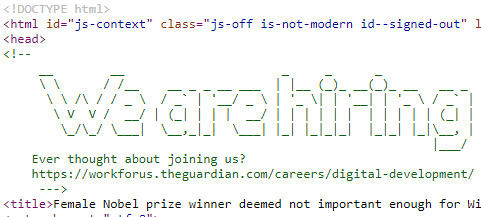
Meh. A bit later, I noticed that "said the moderator" is actually two links and was sad enough to bother look up the page HTML to see why. The answer is dull; it just is two links, for no good reason. But that showed me the top of their page source, which is:

hire

Which is an image not "pre" text, because blogger doesn't seem to handle pre properly.

Forbes


It isn't just the Graun that gets this wrong, of course. Forbes totally stuffs it up too, writing: only to have their proposed entry deleted. What's wrong with that? Well, the link they provide is to the proposed entry (the draft). If it had been deleted, they wouldn't be able to point to it.

2018-09-29

Climate and Economics, again

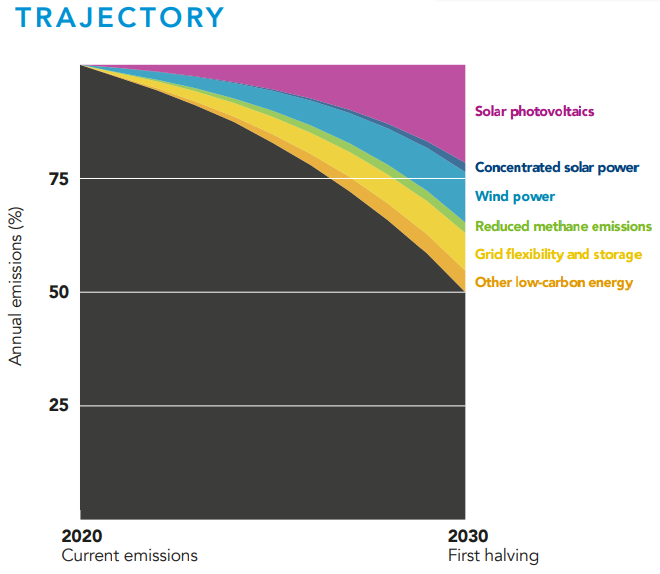
power The Exponential Climate Action Roadmap was published 13 September at the Global Climate Action Summit in San Francisco, says SR on fb. So, fairly sure what I'd find, I decided to take a look. It fully lived up to my low expectations. Let's begin with
The Paris Agreement’s goal to reduce the risk of dangerous climate change can be achieved if greenhouse gas emissions peak by 2020, halve by 2030 and then halve again by 2040 and 2050. This is now technologically feasible and economically attractive but the world is not on this path...
What should you do if you read, and indeed if you write, this kind of stuff? That's right: you should wonder "if this is economically attractive, why isn't it just happening of itself? Why do people feel the need to write reports pushing it, and trying to make it happen faster?" So you'd expect a substantial portion of the report to be dedicated to this puzzle, because it is obviously rather important. And note that this isn't some minor element tucked away in an appendix; it is literally the first words in the report, the overall most-important-thing that they want you to see.

When I say "expect", I don't mean expect-in-the-real-world of course. I mean expect in a mythical "sensible" world. What you'd expect-in-the-real-world is that they'd totally ignore the point I mention, and that's exactly what they do.

One possibility is that they are simply lying, or being somewhat more polite, being a little economical with the truth. "economically attractive" is a vague phrase as it has to be to cover such a wide area. Another is that they're just being over optimistic, or rather bad at evaluating things: of their eight or so talking heads, only one - CEO of Ericsson - is actually in bizniz. Another is that if it really was economically attractive, and just going to happen anyway, well, where's the fun in that? Who would need nice reports like this if the evil capitalists were going to do it anyway just to make money?

My image, from the report, illustrates another problem. There's a nice graph, projecting "energy use" sources. We see solar increasing nicely. What problem could there possibly be here? The answer is "we estimate that solar needs to continue growing exponentially at a pace of 23% per year... less than half of historical growth rates". Less that half of historical rates should be easy to achieve, yes? But suppose instead you assume historical growth rates. In which case, more than 100% of power will be solar by 2030. That's even better, you can stop pratting around with wind. Oops, but that would make the wind people very unhappy indeed, so assuming that would be a Bad Idea. My point, which my sarcasm badly obscures, is that the projections are quasi-arbitrary, and it isn't obvious that's its a good idea to try to "manage" them.

Refs


Economics, Law and Ethics
Hothouse tipping elements of no return
The Great Persuasion: Reinventing Free Markets since the Depression
FT: The Big Green Bang: how renewable energy became unstoppable

2018-09-28

Craig Loehle speaks

Famous1 people editing their wiki pages, part two. Part one was Ross McKitrick speaks. And so, with the comment I do not want to list my employer who does not want to be associated with my climate change research. The citations to "climate change denier" are vandalism and defamatory and so I removed them. Craig Loehle (arch), he removed
Craig Loehle is an American ecologist, a principal scientist at the National Council for Air and Stream Improvement, a forest industry-funded research institution and is listed as a policy expert for The Heartland Institute, a think tank famous for sponsoring climate change denial.[1][2][3][4]
Not perhaps the sort of thing you want to see written about yourself. To rub gall into the wound (do you rub gall into wounds? No, you rub salt. And yet it seems to fit; I shall leave it) reference 3 is one M. Mann, The Hockey Stick and the Climate Wars: Dispatches from the Front Lines. Tee hee.

Is it really CL speaking? Probably. Firstly, who else would care. Secondly, that IP geolocates to Illinois, and (so an old version tells me), CL is the chief scientist at the National Council for Air and Stream Improvement, a forest industry-funded institution based in Naperville, IL. Not conclusive proof, but good enough for these purposes to make it rather likely it is indeed CL speaking2. Possibly interestingly, that address was removed in 2017 by Ascientistxx.

[Credit for pointer to carton to S]

Notes


1. Ish. I did mention him once.
2. I say this not just to demonstrate how clever I am but to point out to anyone editing wiki that editing without logging in leaks your IP. Perhaps surprisingly, you're far more anonymous if you use an account, in which case your IP is only visible to those with Special Powers (not ordinary admins). Note that if you do use an account, it is an excellent idea to not accidentally fail to log in; see e.g. User:Obsidi's edits around the 11th of September to Talk:List of scientists who disagree with the scientific consensus on global warming, alas since revdel'd, but which link the account to the CEI. Update: and Obsidi ended sadly.

Refs


 * The goal of science communication - ATTP; persuasion or information

2018-09-27

Total meets Twitter

Corps aren't always good at social meeja. Take those nice Frogs at Total:
Well... OK. You're trying to show willing I suppose. But not providing a link to some kind of webpage giving a bit more details is a fail from the start.

Oh, but wait. They weren't finished:

Well, all right, but this is the internet and my attention span is low. Could you come to the point?
Meh. That's a bit dull. However, it gets more amusing, because (surprise!) people start replying:
and

If you manage to get past all of that (actually I didn't; I had to go to them direectly) you can find the exciting conclusion somewhere off in Tweet 6:


That, in turn, will lead you to https://www.total.com/en/sites/default/files/atoms/files/total_climate_2018.pdf, which (gloriously) is a 404.