2023-06-22

Mayflies

Another year another splendid Mays. How the years roll by. This year's playlist is here featuring the usual mix of high-quality hot bumping action and other stuff. See-also rowing photos; and 2022. I continue my indefensibly biased tradition of picturing Caius M2, for their elan1,2.

Caius M2

Notes


1. Yes, this is at Xpress Head, I know. But during Mays I'm mostly videoing. If you'd like to see M1, they are available from Andy, with the bonus of being able to see the distance to Maggie.

2. As a counter-example, I was struck by Münchener R.C. at Henley in their race against Nines. Nines are full of passion, the commentators even note it, whereas the Germans are completely controlled

Refs


2023-06-20

The world’s nations could switch to 100% renewable energy in a few years?

PXL_20230619_064644366 Just a quickie, since I seem to be on a roll. Via Twatter, cleantechnica says "Mark Jacobson and his colleagues at Stanford University have published a new study in the journal Energy & Environmental Science that claims 145 of the world’s nations could switch to 100% renewable energy in a few years using renewable energy technologies available today... The cost of making the changeover to 100% renewable energy would be... $62 trillion".

Can you see the problem? Hmm, well: this past year, total world investments in clean energy were about $1.7t. To spend $62t at 1.6t/y would take 34 years; and anyway only ~$600b of that was renewable power. Of course that £1.7t per year is likely to go up; were you to assume it doubles every year then it would take ~5 years; but that isn't going to happen.

So this is a familiar problem: yes, we can transition to renewables, but no it won't happen in just a few years, we simply lack the industrial and other capacity to do so. Can I have my John McCarthy badge now?

Having written that, I can now try skimming the study itself. I see it makes the usual "it generates jobs" error; it tells you that these people are not economists but it also warns you to be cautious, which is nice.

Refs

Measured by the ratio of billionaire wealth to GDP, the US has less inequality than Sweden or France

* Perhaps you'd like to read AH being enthusiastic about the prospects for solar?

UK installations of heat pumps 10 times lower than in France, report finds

Vattenfall says it is stopping British Norfolk Boreas offshore wind farm

2023-06-19

Bandit Hoekstra

IMG_20230617_065650_758 AukeHoekstra, a useful source for renewal energy factz, laments that we can't bankrupt [oil companies] before we have weaned ourselves off oil. And this is part of a mish-mash of the usual leftist economic confusions.

BH is sad that oil & gas companies are giving windfall profits to shareholders instead of re-aligning towards clean energy. But why? What else should they do with their profts, except give them to the people that own the companies, or invest them in their business. Only in some bizarre statist fantasy would they direct them towards whatever BH deems most worthy. And he thinks that governments should aim to starve and bankrupt them a.s.a.p. which is distinctly "nice company you've got there, be a shame is something happened to it" type language. It doesn't occur to him that if people stop buying their products the oil companies would be starved without any need for govt muscle.

But that's not all, oh no, that is not all: he also objects to giving subsidies and windfall profits to the oil companies. But this too is bollox: he isn't. The subsidies stuff is largely drivel; and no-one is "giving" windfall profits, other than the people buying the product. That people continue to buy the product despite its price increasing demonstrates how much they value it. If govts care to provide an alternative that is better and cheaper then that would be one solution; although just letting the market do it would be better.

Refs

Degrowth and the monkey's paw.

The Case Against (Most) Books - contains some words I'll want to reference one day. Though it weirdly and uncritically refs this piece which gets the Galileo story completely wrong, sigh.

2023-06-16

Subsidies, reprise

PXL_20230616_064425965 Via Twatter, yet more subsidies stuff. This time they've decided to consider fossil fuels, agriculture, and fisheries together, presumably so as to get a bigger number. And so they do; about $1.25t direct, compared to ~$500m when thinking only of fossil fuels. Unfortunately - even though this is at least nominally a World Bank report - they are distinctly sloppy in their language: Governments spend a large percentage of their budget on subsidies that exacerbate air pollution and affect the agriculture and fisheries sectors. The magnitude of subsidies for fossil fuels, agriculture, and fisheries is vast and likely exceeds US$7 trillion per year in explicit and implicit subsidies — or approximately 8 percent of global GDP. So here they give the impression that govt spend on subsidies is ~8% of GDP. But of course that's bollox, because that $7t includes "implicit" subsidies, which aren't seen in GDP. If you include only direct, you'd get a rather less impressive 1.4%. Note that explicit Ag subsidies are bigger than FF, and fisheries ones are significantly smaller; implicit Ag subsidies appear to be wildly uncertain, ranging from ~$500b to $5t (but I think much of that in turn comes from GHG effects, so there may be double-counting with the FF subsidies). We get stuff like For fisheries, the largest implicit subsidy is the lack of effective regulations to reduce overcapacity and prevent overfishing, which shows you how far away from the usual meaning of the word "subsidy" we have drifted.

Another amusing point is that when looking at Ag subsidies, they are easily able to see - it's their first point - that Richer countries spend more on agricultural subsidies than poorer countries, even when seen relative to total agricultural production. But when looking at FF direct subsidies, they are unable to say anything about what kind of countries subsidise more. Could that be because when you look, the answer is that its the banana republics, not the West, doing the subsidising? There is a sliver of good news though: Implicit subsidies for fossil fuels... the local impacts of air pollution and global climate change constituting more than 75 percent of the total: so the banana republics are damaging themselves mostly, rather than us. This means that recommendations like Policy makers must fully reflect the health and societal costs of air pollution in the price of fossil fuels are dubious; because most of the damage / implicit subsidy occurs in what you burn and how you burn it, not how much you burn (see e.g. box 2.3). Indeed I'm somewhat dubious that their focus on FF is correct; they need to include "dung".

Perhaps I should note that I'm all for removing harmful subsidies. But I'm doubtful that a somewhat meally-mouthed report that can't bring itself to be honest about who is doing the subsidising, and which sez stuff like Subsidies are important tools that governments can use, is going to help.

Incidentally: I don't think they include negative subsidies (e.g. the EU's ETS) in their totals, and probably should.

Refs

In Debate Over Railway Safety Bill, J.D. Vance and Donald Trump Are Leaning to the Left

‘Power and Progress’ Review: Technology and the New Leviathan: Deirdre N. McCloskey on Daron Acemoglu and Simon Johnson.

Not only will Hollandse Kust Zuid become the world’s largest offshore wind farm it’s also the world’s first offshore wind farm to be built without subsidy.

Orwell’s Falsified Prediction on Empire.

Diversity Really is Our Strength.

OECD: Fossil fuel subsidies added up to at least $373bn in 2015?

* BBC More or Less: Behind the Stats: Do fossil fuels get $7 trillion in subsidies? The answer of course is no.

2023-06-15

Meet the Money Behind The Climate Denial Movement: Reprise

Screenshot_20230615-122749In Meet the Money Behind The Climate Denial Movement? I queried the assertion that Nearly a billion dollars a year is flowing into the organized climate change counter-movement, discovering that it was unsubstantiated: from the info given it was simply impossible to tell. Weirdly, I was not the only one object to such; I discover that persons with whom I probably don't wish to be associated say things like Climate activists often repeat the myth that Big Oil is pouring millions into climate scepticism. The reality is that Big Green's billions are driving climate alarmism worldwide. Although that's not quite the text I want; I want, firstly, In 2019 the climate activist and UCL Geography Professor Mark Maslin wrote that oil companies were spending $200 million a year promoting something he termed “climate change denial”. The ‘dark forces’ claim has been in regular use ever since. That's $200m/y not $1b/y, which is something of a disparity. But it's only oil.

But (via a source I'll get back to in a moment) that at least provides a ref, which is How the oil majors have spent $1Bn since Paris on narrative capture and lobbying on climate by influencemap. Somewhat weirdly, that quotes the five supermajors as spending over $1b in 3 years, or ~300m/y; and refers to a 2022 update which bumps that up to $750m/y. But I doubt there's any real hope for consistency in these numbers. Having now skimmed the report, I don't think they provide enough detail to know if they've done it well or not. I'm doubtful; I think I can leave it at that.

Back to my source, which is I'm afraid to say Ben Pile, and his topic is The monolith of climate smear-mongering. He too (after a few preliminary flings) takes issue with influencemap's methodology; I leave you to judge his prose. But he then continues on to How big is the green blob, compared to big oil? which might be interesting. If he's done it well. Picking those that have funded influencemap, and then adding their total spend, he comes to 1.275b/y, or in his words In total, InfluenceMap’s funders are making grants of roughly $1.2 billion per year to climate change lobbying. Can we rely on his arithmetic? Given that he is trying to criticise "the other side" for sloppy accounting, we'd hope that he would in return strive for precision.

He estimates $478m/y for the climateworks foundation, wot I've never heard of. But they have financial information. Which allows us to see their form 990s, year by year. They've had a good 2021: income has more than doubled over 2020, as have grants. But their total expenses for the year is only $180m which is waay smaller than $478m, and not all of that can be lobbying anyway. Number 2 is the IKEA foundation, for which BP claims $334m/y; from their own report I find USD 118.7 million (62%) to climate action (SDG 13). But I think from the context that much of the money is double-counted in the sense that any one grant can count towards a number of different areas. So that's two strikes for BP and I can't be bothered to go to the third.

My overall conclusion is that no-one is producing any reliable numbers in this area.


2023-06-05

Scientists warned about climate change in 1965. Nothing was done?

PXL_20230602_130259904 More of the same, of course, so I won't waste too much of your time. knowablemagazine saysA report to the US president sounded an alarm — humankind was ‘conducting a vast geophysical experiment’ by burning fossil fuels and filling the atmosphere with an ‘invisible pollutant.’ But a slick campaign by Big Oil led to confusion, politicization and dire consequences for the planet. But as usual, we should pause and wonder if this is actually true. And, as usual, it isn't. The report to the Prez is truthy - and that was in 1965. The mag then asks So why weren’t climate scientists listened to earlier? Why did this warning direct to the president of the United States not lead to any significant efforts to change course for decades thereafter? And Oreskes (for it is her, as I'm sure you guessed) replies But by the 1980s... the science becomes more specific, more quantitative. And in 1988, the IPCC, the Intergovernmental Panel on Climate Change, is created specifically to summarize and assess the scientific evidence on this problem, in order to report to governments, who would then act upon it... that’s when the fossil fuel industry changes course. And that’s when they make what I consider to be a fatal and, in my opinion, tragic choice: Rather than accepting the science and beginning to think how they could change their business model to address the problem, they go down the path of disinformation and obstruction. And that is true too, or true enough for our purposes.

So what is false: the idea that we knew what was going on in 1965, and Evil Oil Companies somehow derailed this. Because that is drivel: by their own timeline, there was more than two decades between their precious report of 1965 and the disinfo. The truth, of course, is that we didn't know what was going on as early as 1965.

Note that the report-to-the-Prez in 1965 is only truthy, because they fail to note that the bits dealing with CO2 are shuffled off into an appendix; see Retread: Just 90 companies caused two-thirds of man-made global warming emissions?

Refs

How an Early Oil Industry Study Became Key in Climate Lawsuits?

A Wealth Tax Reality Check

* Truth Serum: The Other Ehrlich Bets: Desroches/Geloso/Szurmak's Analysis

Heterodox vs. mainstream macroeconomics

2023-05-31

Heat pumps: more than 80% of households in Great Britain ‘satisfied with system’?

PXL_20230526_182634779 So claims the Graun, h/t Twatter. What the Graun won't do, because they are clown journos who don't understand the concept of sourcing, is link to the study they are relying on. But I digress.

Speaking of digressions: while induction stoves are nice and I personally prefer them to gas, only idiots write things like "Cooking with a gas stove is like smoking indoors". Let's try to retain some connection to reality folks.

So, back to the study (pdf). And we care, because heat pumps are a nice and probably efficient way to electrify us, and reduce our dependence on evil Putingaz. So we'd like people to like them, if possible. But reading the Graun, our radar should be triggered by the phrase "broadly similar levels of satisfaction" compared to conventional heating; and then you notice that the Graun provides no way to compare; well, they don't want you to think for yourself; they'd rather do the thinking for you. So, oh yes as I was saying, back to the study.

You'll immeadiately think of a lot of reasons why this survey can't really be that much use, and you'll be right: those with heat pumps are likely a different demographic to those without; those who have deliberately decided to try this new-fangled tech, ditto; and so on. Interestingly, one problem - that there are more gas boilers - isn't a problem here; they have ~2k heat pump responses and ~1k gas. But if we ignore all those caveats for the moment, and ignore their words, we can look at figs 11 and 12 to compare. Following them (I think) I'll pick the percentage of "very satisfied" + "fairly satisfied" as my Key Metric.

For gas, for the category "hot water", that gets you 94% and for heat pump, 88%. For "space heating", 85% vs 83% (I'm reading these by eye of course so don't complain if I'm a percentage point off). For running costs, 59% vs 67% (Higher levels of satisfaction with running costs are likely to reflect the high efficiency of heat pumps and the high cost of gas during the 2022-2023 cost of living crisis. It may also reflect that heat pump users are on average likely to be more affluent, meaning that costs are less of a concern.). There are other categories; my impression is that gas wins, by a little, more often than not. The report says that Nearly three-quarters (73%) of heat pump users had the same or higher levels of satisfaction with their heat pump compared to their previous heating system but I would place little reliance on that, since anyone who has bothered to switch over is likely motivated. This is supported by fig 14, which shows that people who moved into a property whose previous owner had installed a heat pump where, marginally, net less satisfied than with gas.

So, overall, this is reasonable support for heat pumps not being a disaster area, and generally being about as good as gas.

2023-05-17

Bad beekeeping, spring 2023

Another year another spring and I wonders, yes I does, if my bees have made it through the winter. The answer appears to be yes, at least one of two hives has, we quietly forget the other one which had died out last autumn. And so on a sunny Sunday afternoon just after Champs Head I went out to Coton; from a distance all is well:

PXL_20230514_154657304

From closer up things are not bad, there is honey in all five supers

PXL_20230514_155728225

but perhaps the pattern is not all that could be desired.

PXL_20230514_155947489

I predict pain and effort when I come back in a week or two to take some honey off.

PXL_20230514_160230827

We'll see.

PXL_20230514_160245674

Update: recolte

I ended up taking off three supers, saving my poor old back by trundling them into the car with the aid of N's wheelbarrow. I wanted to do them at my leisure at home, foreseeing (per the above) some pain. However, things turned out surprisingly well: very little had set, and much of that was probably from a previous year. I could have taken off more I suppose, but some of it wasn't very capped, and I like to leave them something, and three fairly full supers is quite enough to manage in one go.

PXL_20230603_155559615

Here's the "spinning zone" in the Newe Place, the old BAS mahogany bench is coming in useful at last.

PXL_20230604_164213882

And if you like to watch honey folding, there's a video here.

Update: return

On a warm sunny Sunday a week later I took the spun supers back

PXL_20230611_132416985

The hive was fine before; they were happy during; and fine after. Note the woodpecker damage in the top super in the wheelbarrow. I ended up (by happy chance) swapping that for one of N's supers, and took that home to repair in due course.

Uupdate: autumn.

Refs

My apiary.

2023-05-15

How an Early Oil Industry Study Became Key in Climate Lawsuits?

doc16_p110 Another in the who-knew-what-when games, from the Yale Environment 360. I think it is yet more proof that people are lying to themselves and are going to get badly disappointed when this hits a competent court1; but in the meantime people are presumably getting paid for this trash, and making reputations out of it.

Aanyway, what they're getting over-excited by now is a 1968 paper commissioned by the American Petroleum Institute, the powerful fossil fuel trade group, and written by Elmer Robinson and Bob Robbins, scientists at the Stanford Research Institute. The claim made is that it shows that the science around climate change was clear. Of course, it does no such thing, which anyone vaguely sane could tell without reading it, because we all know that the science wasn't clear in 1968.

They provide a link to excepts (though as far as I can tell not to the whole thing) helpfully highlit to guide your eye. But if you allow your eye to slip away from their guidance (yellow) to my guidance (green) you find "Whether one chooses the CO2 warming theory as described in detail by Revelle and others or the newer cooling prospect indicated by McCormick and Ludwig, the prospect for the future must be of serious concern".

So far from the science being clear, they weren't even sure what direction the temperature trend would be. Which is unsurprising, because we all know that in 1975 the NAS wrote we do not have a good quantitative understanding of our climate machine and what determines its course. Without the fundamental understanding, it does not seem possible to predict climate.

Notes

1. That the Supremes recently denied oil companies moves to get some cases moved from state to federal courts doens't help anyone very much, I think. A whole pile of lawyers get lucky, because they get to make a pile of money. The state courts will decide whatever, and the decisions will get appealled to the Supremes, which will throw them out if they've been stupid.

Refs

Who knew what when?

* ACX: Galton, Ehrlich, Buck.

Hard to Sue: A Feature Not a Bug.

The moral costs of markets: Testing the deterioration hypothesis.

Distribution versus Growth.

* NIMBY Is Economic Illiteracy: Denial of the obvious, not self-interest, is what strangles construction; or NIMBYism and Economic Ignorance.

All Medications Are Insignificant In The Eyes Of God And Traditional Effect Size Criteria: interesting in itself, but also in that it really has taken this long to think of using synthetic data.

How much money can electricity storage earn with power price arbitrage? (or: "where should you build your battery?")

2023-05-09

What’s behind the dangerous new notion that democracy should be left to the well-educated?

Screenshot_20230503-140157 Asks Democracy, a Journal of Ideas. They are less than complimentary about that nice Bryan Caplan, but it is his twat that alerts me to the article. But then again, they haven't understood what Bryan, or the Libertarians or the Free-Marketeers are saying; so their attempts to have a conversation are doomed to failure.

To give the overall answer first, Bryan's view - well, and mine, but he is rather more famous, and for all I know I got it from him - is that democracy doesn't work very well in a number of respects1, that free markets are to be preferred when possible, and so the ideal direction to aim in is to push more decision-making into FM and out of D. This is of course entirely against the tenor of the times - so much so that the authors of our piece aren't even able to read it.

I continue with some quibbles: railing that Donald Trump was elected against the wishes of the majority of American voters is foolish. He was validly elected, get over it, stop whinging. Worse, this is an unreasoned attack on anything-but-simple-majoritarian-D and that is bad, because of the amount of unreason in that area is already too large. My view is that you have bigger problems; and especially if you're trying to start a conversation, leading off with partisanship is foolish.

The main bugbears of the article are Some right-wing intellectuals... argue that democracy should be shrunk down or even replaced by new systems of rule, where the intelligent and knowledgeable (i.e., those who believe in neoclassical economics and efficient markets) would be privileged over those too foolish and uninformed to understand their own best interests. Firstly, the "i.e. those who" is wrong; but that barely matters because while there are those arguing for limited francise (or so I assume; I don't read them) there are few and they aren't important, because - duh - it just isn't going to happen. There are far too many dumb schmucks out there who know very little, but they know that getting their pork off the state depends on them having a vote - in some obscure way that they don't understand and don't need to - and so are not going to give up that token-entitlement.

The solution to D's woes? Fixing democracy will require a myriad of reforms. Just in the United States, this includes preventing gerrymandering, getting rid of the filibuster, guaranteeing voting rights, and constraining the power of an anti-democratic Supreme Court. This is nonsense of course: the Supremes aren't anti-democratic, indeed technically they come to their decisions by voting; they just aren't elected by the bulk of the population, thank goodness. Putting them under democractic control would be a bad idea. As to the rest of the wish-list, I would be happy to see less gerrymandering; hating the filibuster just smacks of impatience; and you have all your voting rights already2. Further down he posits the brilliant idea that we should start experimenting with new institutions that might better harness disagreement; but this works rather better unconstrained by govt.

Penultimately, our authors have got the std critique wrong: it isn't that pols and voters are stupid and that clever people could do better; it is that pols are human beings; voters rationally put little thought into their voting; and people do better looking after their own affairs than other people's; that the right answer is seldom obvious and will rarely be found by something imposed top-down but is more likely found by experiment.

Anyway, that's enough ripping up their stuff. To return to what I'm pushing: coercion is bad, monopoly is bad, therefore govt is bad. And yet, some govt is needed. And yet, that doesn't mean that all the govt we have is needed; indeed, most of it isn't, and we would be better off served by people acting freely.

Oh, and lastly, I forgot to throw out the usual: D is a means to an end - flourishing society - not an end in itself; it has no intrinsic virtue, unlike freedom which has. See-also Meritocracy, democracy and competition.


Refs

Two views of democracy.

* What to DO about big problems?

Aristotle's politics.

* The Tyranny of Merit?

In Defense of Merit in Science twat Dawkins.

Political Capitalism: How Economic and Political Power is Made and Maintained.

Comparing Physician and Artificial Intelligence Chatbot Responses to Patient Questions Posted to a Public Social Media Forum.

Book review: Saving the Appearances - Owen Barfield.

Book review: Eversion.

All the arguments against EVs are wrong.

* The Volokh Conspiracy: A Flawed Attack on "Libertarian Elitism" About Voter Ignorance: ILYA SOMIN.

* And just so I can maybe find this one day in the future: delegitimising the Supremes / SCOTUS for your own political benefit because "the other guys" are in control is bad / reckless / foolish; e.g. see Michael Shellenberger (for it is he) criticising Pelosi.

Notes

1. Anyone mindlessly quoting Churchill in response will be spammed, as a sort-of Godwinning. Incidentally, in a jibe that I've only just thought of: that politics works badly is shown rather well by the sort of people you see at the top.

2. Recently, the UK has introduced photo-ID for voting. This is a shameless attempt by the Tories to disenfranchise some Labour folk but I don't care; voting is taken entirely too much for granted; anyone who can't be bothered to get themselves one of the many valid forms of ID doesn't deserve to vote.

2023-04-28

The alternative to Atlas Shrugged

PXL_20230422_140540760~3I exepct most of my readers are eagerly awaiting some alternative to accepting the conclusions of AS, so I thought I'd provide mine.

Re-reading my review of AS I find myself again struck by "The image the book conjures up - of a fading darkening America crumbling under the weight of an unproductive, uncomprehending and eventually almost unwittingly hostile bureaucracy or parasitic class...". That AR felt like that more than half a century ago reminds me not to believe in the Age of Gold but also perhaps to ponder if, as I partially do, think some of her fears were correct, what went right? Because clearly despite problems, America has not crumbled. But note that the twin industrial foci of her book - steel, and railways - have strongly diminished in importance as a proportion of the economy.

And so my1 thesis is that what saves us is innovation escaping the control of the government; or perhaps of any large bureaucracy. Old things grow schlerotic, but the overall economy survives that. And thus her solution - all the innovative people disappearing off West to rebuild - isn't necessary, and is instead translated into the innovative people leaving, or rather not joining, but not physically.

Notes

1. My brilliant thesis is of course not original but right now I can't find someone else saying the same thing.

2. My pic shows the Queens' crew of 1963, which post-dates the publication of AS, but pre-dates my birth by a year. It may not resonate with you, but in this era when any Cambridge college getting to the Friday is considered a major achievement, actually winning is from a different age of the world. Although that's only the Thames; go back another half century and they would be winning the Grand.

Refs

* Following on from the comments, SA's A THRIVE/SURVIVE THEORY OF THE POLITICAL SPECTRUM seems relevant. I quite like the underlying concept, but have reservations about the conclusions. Or perhaps you prefer Liberals Read, Conservatives Watch TV?

2023-04-24

Meet the Money Behind The Climate Denial Movement?

PXL_20230421_172602343 Spring is in the air and my irises are out, so you get to share the joy. But joy is not what you come here for so I rapidly continue onto...

Meet the Money Behind The Climate Denial Movement, in that reliable source The Smithsonian, and twat to me by Peter "who he" Strachan. Subtitled Nearly a billion dollars a year is flowing into the organized climate change counter-movement. But, it isn't true. As they immeadiately back off in the text: According to Brulle's research, the 91 think tanks and advocacy organizations and trade associations that make up the American climate denial industry pull down just shy of a billion dollars each year, money used to lobby or sway public opinion on climate change and other issues. (The grand total also includes funds used to support initiatives unrelated to climate change denial, as explained in a quote Brulle gave to The Guardian: “Since the majority of the organizations are multiple focus organizations, not all of this income was devoted to climate change activities.”) (my bold).

So what fraction of that ~$1B is dedicated to GW? 100%, 10%, 1%? They have literally no idea at all - or if they have ideas they aren't sharing them. But that's a great step forward from Brulle's paper, which doesn't mention this bijou problemette at all. How did that pass peer review?

Refs


2023-04-23

Lost Decade: How Shell Downplayed Early Warnings Over Climate Change?

evil Gosh, it is nearly the end of April and I haven't written anything for the month yet. So as cheap post I'll throw in this from the Smoggies, thoughtfully subheaded  Newly discovered documents from the 1970s and early ’80s show that Shell knew more about the “greenhouse effect” than it let on in public, and pushed by Michael "the GOP are pure evil" Mann. This is of course yet more of the #exxonknew bollox, so if you're not a fan of mindless drivel you should look away now. Note that I'm not claiming that Shell or other Evil Fossil Fuel companies emphasised the same things in publicity material as it did in scientific reports or conference proceedings; but I am claiming that they had no secret or hidden knowledge; and that all the court cases that claim otherwise are stupid. The Smoggies thrive on ambiguity: most or perhaps all of their article isn't untrue, just misleading: after all, what does "let on in public" mean? Hidden knowledge? Or just things you don't tell the public, but which the public can certainly find from your public publications or those of others, should they choose to?

If this stuff is unfamiliar, I recommend my Who knew what when?

Actually, the Smoggies do get some credit for writing the truth, which is what Shell helpfully tells them: Shell said that it had no unique knowledge about climate change, and that its position on the issue had been publicly documented for more than 30 years in its annual report and other publications. “The issue of climate change and how to tackle it has long been part of public discussion and scientific research that has evolved over many decades,” a Shell spokesperson said. “It has been widely discussed and debated, in public view, among scientists, media, governments, business and society as a whole.” It's just a bit of a shame they don't want to hear it.

Anyway, we read down the article looking for substance. There's a promising thing about a report in 1986, but alas that isn't new, and 1986 isn't 70's or early 80's, so we read on. Unspecified reports from "mid- to late-’70s" apparently warn about “drastic economic consequences”, so I may be forced to source those, since the Smoggies don't seem to bother. Continuing, we get Shell’s knowledge of the risks posed by the build-up of atmospheric carbon dioxide (CO2) from burning fossil fuels can be traced to at least the early 1960s. In 1962, Shell’s chief geologist, Houston-based Marion King Hubbert, produced a book-length report on energy for the U.S. National Academy of Sciences that explicitly warned of... Oh dear. Can you help the Smoggies? That's right, the klew is in the "for the U.S. National Academy of Sciences": it was public.

Next up is Meanwhile, Shell would commission British scientist James Lovelock... to investigate the possible global consequences of pollution from fossil fuels... Lovelock’s report, dated June 1966, concluded that it was an “almost certain fact” that the climate was deteriorating, and that burning fossil fuels was probably responsible. Lovelock’s main concern was not warming caused by the greenhouse effect, however, but the prospect of a precipitous drop in temperatures caused by the localised cooling influence of atmospheric pollution. In a separate essay for Shell, Lovelock warned that there was a good chance of a “brush with an ice age” within the next decade or so. So, just as well Shell didn't publicise that, because it was wrong. It is however a fascinating vignette in the ice-age wars, and one I didn't know about before. Unfortunately the Lovelock report doesn't appear to be available (do tell me if I'm wrong).

Then we come to the Club of Rome's broken report of 1972, which the Smoggies lovingly quote and include graphs from. They do this in order to add "In a critique published in Nature in August 1972, three Shell employees argued that it was “too early” to draw policy conclusions from The Limits To Growth". But Shell were partially correct: it was too early (only partial credit; for full credit you have to point out that the report is fundamentally broken). Then we come to the (again, public) IIASA report of 1975.

I gave up at that point. I would kinda like to know which report from the 70's warned of “drastic economic consequences” but I can see no good way of finding out and I'm pretty sure if I did find out it would be dull; if it was any good the Smoggies would have linked it.

Note that it is no lucky chance or strange coincidence that none of these early documents show any hidden science: instead, it is exactly what would be expected; it could not have been any different. The scientific work the EFFs did was fairly minor, and strongly meshed into the stuff that everyone else - universities and govt labs - was doing. There was no space for anything secret of any importance.

Update: The IPCC’s calls for emissions cuts have gone unheeded for too long – should it change the way it reports on climate change?

Well, this is probably a good place to slot in a piece from The Conversation touted by Rahmstorf (see if you can spot SR's misquote). They're sad that no-one listened, so to speak. But actually people did listen; if you read the report, you find they asked, very sensibly, for more research. Which was duly done. But pretending that they were asking for action then is another matter. TC, and SR, do their best to spin "Long-lived gases would require immediate reductions in emissions from human activities of over 60% to stabilise their concentrations at today’s levels" into "calls for emissions cuts" but it is no such thing: all the IPCC is doing is telling you what would have to happen in order for a certain other thing to happen. Deciding that the other-thing is a good idea well worth the effort to do it, is quite a different matter.

Update: more of the same, but from the Eyeties

Italian oil firm Eni faces lawsuit alleging early knowledge of climate crisis reveals the Graun. But really they're copying from The Smoggies homework. It's the same kinda stuff - old reports that were talking about publically available things (the Eni 1970 report, as the Smoggies own article states but does not think about, was based on a UN report). But as usual the state of the science then was not up to making good predictions. For example the Smoggies tell us that the Eni report says "[C]arbon dioxide in the atmosphere, according to a recent report by the U.N. Secretary, given the increased use of [fossil fuels], has increased over the last century by an average of 10 percent worldwide; around the year 2000 this increase could reach 25 percent, with ‘catastrophic’ consequences on climate". The Graun / Smoggies are keen to say "aha so they knew it would be catastrophic way back then" but this is bollox: because there were no catastrophic consequences by 2000; the report was wrong (or rather, the simplistic reading the Smogiad wants to foist upon it is wrong; doubtless the report itself was more cautious).

Poking around, I find the UN report (Problems of the human environment : report of the Secretary-General, 1969). And it gets funnier: the text they rely on is, in context, from the introduction, "During the d i scus s Lons (li the Gel"1l:,ral Ass embLy at the tHenty-tllird session, it vas pointed outt1:lut the reliance of mcdern technology upon the combustion of fossil fuels hac' brought a 10 per c errt Lnc r-eas e in atimospherLc carbon dioxide over the past cerrt.ury , Hith Lncr eased rates of c ombustton, this could rise to 25 per cent by the ::,"eCil" ,'::COO J\.D. The cons equcnce of such an Lncr-eaae upon wor-Ld "Ieather and cli!::nte are unc e.rbaLn, "cut could eventually be catastrophic" (sorry, couldn't be bothered to fixup the OCR, I'm sure you understand). So the source of this "catastrophic" is actually a public debate at the UN, and the complaint is... that Eni kept it secret?

Anyway, apart from that random "catastropic" in the intro, the main body of the report is more sober and indeed boring, which is why no-one reads it. I don't see anything interesting to quote; I don't see any interesting conclusions or indeed suggestions for action.


2023-03-31

Guns are now the leading cause of death for children in the US?

PXL_20230319_092927490 Another in the Gunz Warz. From the sainted Obama, no less: "We are failing our children. Guns are now the leading cause of death for children in the U.S.". But is it true?

You'd hope it was true. Big O is a high-profile saint, with the best advice available to him, and certainly no fool. And yet, he appears to be wrong. He appears to be so badly wrong that I suspect I've made some obvious mistake; if so, please point it out to me1.

My source is the CDC.

Here's a picture (the one below, not the one to the right...) from the CDC site. As expected, the wrinklies die of disease, but for the moment we don't care about them, we care about the young folk.

As sort-of expected, homicide peaks for late-teens / early adult, presumably amongst young men who make regrettable life choices. If I split by sex, we'd probably se something different for the rather more sensible female types <tries it> Ah yes, the sensible women are more likely to kill themselves: H+S = 27% for 15-24, vs 44% for males.

I don't think switching attention to the 10-14 group would help the argument. I wonder if you adjusted the breakdown, you could get something that looked like Gunz-are-Number-One: for 1-14, UI leads, but contains 27 "firearms"; Suicide (#2) has 189 F; Motor Vehicles leads UI as 294... ah, but if you broke MV down into all its constituents, the leading number would be 87, which is less than F. I think that's cheating, though.

You'll be wondering, of course, if "Unintentional Injury" hides some Gunz Deathz.

stiffs

But no. UI is mostly Carz, with somewhat oddly "Poisoning" coming a very close second. But that's because P includes Drugz. For 10-14, F-in-UI comes up, but only to 5%.

stiff1

Update

chart (2)

P et al. point me at Current Causes of Death in Children and Adolescents in the United States in defence of O's claim. For the purposes of a pol, that's good enough: for the single year 2020 (though if I painfully search by year, 2021 looks similar to 2020 at least for X95), O's claim is "true". Although you'll notice that is "children and adolescents", not the "children" that O claimed. That's because rather than the what-looks-like-default age binning, that study uses 1-19.

Apart from the age issue, there's another, which is that is all death-by-gun; in the context of school shootings, that's misleading.

But to return to the age issue: why would you use "children and adolescents", if you mean "children"? The obvious reason is that death-by-violence goes up a lot into the 15-24 age group, and including older folk lets you tap into that.

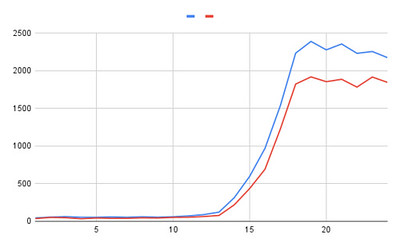
Can I face quantifying that? Oh go on... and so (from the kindly provided https://wonder.cdc.gov/ucd-icd10-expanded.html) I managed to drag out that graph (which if I've got it right is for X95 - which is most of the death-by-firearms-violence, but doesn't include suicide I think, for 2018-2021 (blue) and then I updated it to add just 2018-2019 in red; and remembered to multiply those latter by two to make them comparable, since they are numbers-of-the-fallen. Data in disorganised form here). This rather clearly shows why mixing up "children" and "those old enough to go out and get into trouble" isn't a good idea. Unless you have propaganda in mind, obvs (PF notices the same problem but is more forgiving than me). It is also rather clear that 2020-21 are anomalous; or at least, not like 2018-2019. The "obvious" "explanation" for that is Covid, but YMMV.

Notes

0. The gravestone is from SEH.

1. There was no shortage of kind volunteers. See the comments. And see my update.

Refs

I’m not sure people fully appreciate how dire the US life expectancy / mortality situation has got.

War and subsidies have turbocharged the green transition.

On the Rise of the "Economic Style of Reasoning".

WILL CLIMATE MITIGATION END UP IN A REAL PICKLE?

* Hourly modelling of conversion of USA48 to wind/solar, with costing and optimisation - Moyhu.

* The Dominion lawsuit showed the limits of Fox’s influence over its audience

2023-03-25

IPCC AR6 SYN goes woo?

stop The just released IPCC AR6 synthesis report seems a bit woo to me; the woke folk have got carried away. I don't think that's a good idea6.

I was going to whinge about António Guterres saying dumb IPCC-related things but I discover that he is indeed just a pol so I think I'll have to learn to ignore him2.

Science of Doom has been looking at the AR6 WG1 report and isn't quite happy3; but I want to look at the synthesis report. And life being short, I'll only read the so-called Summary for Policymakers. Some of it is perfectly unexceptionable4: for example, Human activities, principally through emissions of greenhouse gases, have unequivocally caused global warming, with global surface temperature reaching 1.1°C above 1850–1900 in 2011–2020. But then it veers off into "unequal historical and ongoing contributions". This is undoubtedly true, but being the bleedin' fuckin' obvious, doesn't belong here. Later on, we are astonished to discover that poor people emit less CO2 than rich people5.

We also have "Vulnerable communities who have historically contributed the least to current climate change are disproportionately affected" which is true, but dull. Being poor makes you vulnerable; part of being rich is not being vulnerable; this is what being rich is all about. It would be nice to see the report endorsing the obvious solution: people become richer. But that piece of the bleedin' obvious is beyond them7.

Not something I'm going to rant about, but something I'm dubious about: Climate change has caused substantial damages, and increasingly irreversible losses, in terrestrial, freshwater, cryospheric, and coastal and open ocean ecosystems. My suspicion is that far far more ecosystem damage is at present done by overfishing, deforestation, farming and the like than is done by GW.

I read that "Increasing weather and climate extreme events have exposed millions of people to acute food insecurity and reduced water security". How many is millions? Let us imagine, seven millions: had they meant tens of millions, they would have said so. So that's 0.1% of the world population: a pretty good result, I think you'll agree. 99.9% have not been exposed climatically to food insecurity. Of course there is no space to say that crap government has exposed rather more to insecurity and worse.

Anyway, meh, it confirms my impression that WG1 is the best part of the IPCC. If you'd like to read someone being nice about Syn instead, big G retwat ZH pointing to CarbonBrief.

We also have "From a physical science perspective, limiting human-caused global warming to a specific level requires...". I think I've said before that I don't like the "a specific level"; I realise that the report is constrained by their policy, but I'd prefer to have them admit that as an explicit constraint: we would have discussed other stuff, but they won't let us. But I'm not surprised they don't get to say that.


Refs

* WHY DIDN'T NATURE ENDORSE PRESIDENT GRANT IN 1869?

* The 1619 Project on Hulu Vindicates Capitalism

Carbon budgets and carbon taxes

* Conservatives Win All the Time: Understanding one of the founding myths of the New Right

* "Climate change is a bit like a policy inkblot on which people map their hopes and values associated with their vision for what a better world would look like... it should not be a surprise that scientific information cannot lead to political consensus" - RP Jr.

* Book Review: Anaximander By Carlo Rovelli; CIP.

Yellen: Sanctions Kill Iranians and Don't Work So Let's Impose More

* But Judith Curry goes too far, IMO.

Prosecuting Donald Trump over Stormy Daniels looks like a mistake. Ref: Orange Man Bad. The problem is that if the crime is trying to overthrow an election, then prosecuting him for mislabelling expenses is wrong. The Rule of Law and the Proliferation of Laws by Pierre Lemieux sounds like it is arguing the reverse, but probably isn't: Trump is certainly wrong to feel some wealth-and-importance-given right not to be arrested,; PL counters with "The danger for the rule of law comes from the proliferation of legal obligations and bans" which is about right: the problem is that Joe Public would get a fine for what Trump is accused of, as many have pointed out; the contorted elevation to a felony is perhaps legally possible but doesn't look like equal justice. Why do Democrats keep helping Trump? continues the Economist, including the regrettable-because-plausible they do want to help him, cos they think he is the most beatable.

* The IPCC Report on the Impacts of Climate Change is Depressing: But not for the reasons you might think; Richard Betts isn't interested in responding... no I'm wrong; he's just a bit slow; see here.

* From the same author: Human Deaths from Hot and Cold Temperatures and Implications for Climate Change.

Notes 

1. Image in honour of Tom's fine comment.

2. Increasingly I write my posts in arrears, instead of with the white heat of anger burning inside me, which makes this easier. Or you may prefer RP Jr's take.

3. You might prefer RP Jr's take. Although notice that he says "WG1 on extremes was particularly good". More from him: Misinformation in the IPCC.

4. Well, nearly. What are we to make of "unequivocally"? It would be natural to expect this to be part of the "IPCC calibrated language" but it isn't; so it would be better to simply omit the word and say "caused", without qualification. To be fair, WG1 does the same.

5. I scorn, but it is possible to imagine, just as today rich people are on the whole thinner than poor people, a day in which the rich thanks to their rooftop solar and electric cars, emit less than the poor. But we're not there yet.

6. See-also Political endorsement by Nature and trust in scientific expertise during COVID-19.

7. Instead, we discover that maladaption can be cured by long-term planning, which seems unlikely.

2023-03-21

Shell rules out more ambitious goal for end-user emissions

PXL_20230319_113549256 Shell rules out more ambitious goal for end-user emissions reports Reuters (arch), and this is sensible on Shell's part. These are non-Shell end-user emissions of course: Shell (SHEL.L) has ruled out setting targets to cut emissions in absolute terms from customers' use of its products, its chair said in a report published on Thursday as the energy company faces increased activist and investor pressure over climate. End-user emissions, referred to as Scope 3, account for about 95% of the energy company's greenhouse gas pollution and some investors have urged Shell to introduce medium-term targets to reduce them in absolute terms.

Shell's business is making and selling things that people want to buy. Making them simultaneously responsible for not-selling those same things is as sensible as putting a heater and an airconn in the same room and letting them fight. The usual idiots aren't happy, of course, which is one way of knowing that the decision makes sense.

If you want less CO2 emissions, tax them more. Trying to micro-manage the entire economy is stupid.

Refs


* The Malthusians Are Back: Climate activists who worry that the world has too many people are joining an ugly tradition.

2023-03-14

Red team rows over

334109032_742575820756470_7391586374405360439_n Another in the Red Team series, although I seem to have skipped 2020 and 2022; 2021 was Covid. You can have 2022's Mays. This year the Reds weren't troubled by the Minty Blues and all was serene at the top. It's nice to see the strokeman staring at his hands; I thoroughly approve.

I have various vidz which meant I have no good pix; fortunately Giorgio does, and here is one from him.

Thursday was miserably wet, so much so that Friday was cancelled due to high stream; cue much gnashing of teeth on Rowbridge. Saturday went ahead in tolerable weather but the stream still high and the river over the hards, so W/M3 and below didn't row. Jesus are up to three; Clare did well, as did Queens' and Emma; and Red2 and Minty2 both went up, the latter into M1. On the women's side, which I follow with reduced interest, Jesus are now head and Emma two, at the expense of Newnham.

Refs


2023-02-27

WTF Google?

332243680_2599889713484752_8802687058343301616_n In which I whinge at Google for getting their core business of search badly wrong.

I am (as so often) looking for my post "I dislike rights-based language". But I can't remember exactly what I called it (when I started this process...). If I search for site:mustelid.blogspot.com "I dislike rights-based language" I get a link to 2021/06 which is, to be fair, Rawls, continued and does (now) refer into the then-future post. But it fails to find the post with that title. And a search for site:mustelid.blogspot.com "language" doesn't pull up anything relevant; nor does site:mustelid.blogspot.com "rights". FFS.

Update 2024/02: Bing finds my posts. I have taken to using it by default for this kind of search.

Another: I wanted my "Malthus" post. It turns out to be Why did Malthus assume linear increase in food? But site:https://wmconnolley.wordpress.com/ malthus doesn't find it. Interestingly, Bing does find it. Has it really come to this? Should I dump my Google stock? Happily, Bing still screws up the "rights" search.

Incidentally, I have "solved" this problem by Google Takeout of all my posts, and using good old reliable grep.

Another: Godwin's law.

Refs

* Torpids 2023

Extreme Weather #2 – Trends in Frequency and Intensity of Tropical Cyclones out over the Ocean

Income and emotional well-being: A conflict resolved

On Jobs and Economic Dynamism

The Myth of American Inequality: How Government Biases Policy Debate

This is Why We Can’t Have Nice Things: Directionalists vs. Destinationists

Give Up Seventy Percent Of The Way Through The Hyperstitious Slur Cascade - ACX

* Mixed Feelings About My First Fieldwork Project - Aardvarchaeology


2023-02-21

Bad beliefs: Misinformation is factually wrong – but is it ethically wrong, too?

Screenshot_20230218-201035 More wank - but I shouldn't spoil the plot - by Lawrence Torcello, who has form. Naively, he wonders whether people are ethically accountable for not just what they do, but what they believe – and how they consume, analyze or ignore information to arrive at their beliefs. If so, we have him bang to rights, because he continues about Plato’s “Republic,” in which Plato depicts Socrates’ endeavors to uncover the nature of justice and goodness. But this is bollox; The Republic is essentially a work of propaganda; "Socrates" is not S but P, and he does not endeavour to uncover the nature of justice, instead he presents a shamelessly biased account of Plato's tribalist ideas. TOSAIE refers, as ever, and I still haven't written it up properly. And to answer his question, yes you are accountable for what you believe, and no putting the blame on Evil Oil Companies is not an answer fit for an adult.

Refs


* Pembroke regatta, pix and vidz
* Torpids 2023: a few vidz.

2023-02-06

Advancing the estimation of future climate impacts within the United States?

PXL_20230205_150255141 Roger Pielke has a Twit complaining bitterly about Advancing the estimation of future climate impacts within the United States. He appears to be correct. I don't have much to add to what he said: it is so badly broken as to be useless. The paper itself begins

Evidence of the physical and economic impacts of climate change is a critical input to policy development and decision making. The potential magnitude of climate change damages, where, when, and to whom those damages may occur across the country, the types of impacts that will be most damaging, and the ability of adaptation to reduce potential risks are all important and interconnected. This study utilizes the reduced-complexity model, Framework for Evaluating Damages and Impacts (FrEDI), to rapidly assess economic and physical impacts of climate change in the contiguous United States (U.S.). Results from FrEDI show that net national damages increase 20 overtime, with mean climate-driven damages estimated to reach $2.9 trillion USD (95% CI: $510 billion to $12 trillion) annually by 2090.

So I think it is intended to be taken seriously; this isn't supposed to be wild, useless speculation. But, oh dear: the CI is so wide as to be utterly useless; RP says this is because they have averaged across all scenarios which looks rather likely; but it makes the answer useless. Furthermore, essentially all the damage is from Heath due to Extreme Temperatures. Ecosystem damages are by contrast trivial. This seems quite likely to be the wrong way round. But 2090, if it is needed, air conditioning will be universal, for people but not for plants.

Quite how this can be reconciled to 4th National Climate Assessment report: Extreme Temperature Mortality I don't know.

While I'm here: notice that RP isn't happy with Alex Epstein; as you'd hope.

Refs

If I'm Old During the Next Pandemic by Bryan Caplan

* Unity at Last! by VERONIQUE DE RUGY

* The 1619 Project on Hulu Vindicates Capitalism by David Henderson