2017-12-28

Book review: Atlas shrugged

[This is a direct copy of my Book review: Atlas shrugged from 2013 over at LiveJournal (I blame Paul). I'm copying it here because I want to refer to it and keep not being able to find it (but you can still comment if you want to). In order to forestall some of the inevitable criticism, here's a link to CIP who presents the case for the opposition. Note that everything (including the edited-to-add) below this was in the "original".]

Quick summary: (too) long, interesting, enjoyable (as long as you skip stuff), but ultimately unacceptable.

A famous work here's its wiki entry. I'm not going to bother attack its many faults too strongly, because they are too obvious. If you want to read someone disliking it, try CIP. As a token: the many long dense passages of philosophy - Rand's "Objectivism" - that lard the book get increasingly boring as they repeat. This culminates in John Galt's 70-page 2-3 hour speech on the radio, which is more like something you'd get in Cuba or communist Russia than in the cold West (so long it even makes a joke at Volokh). Some of the characters - the dashing pirate - are laughably implausible. But enough criticism (errm, I won't keep to that. Sorry).

The image the book conjures up - of a fading darkening America crumbling under the weight of an unproductive, uncomprehending and eventually almost unwittingly hostile bureaucracy or parasitic class is well done, and will strike a chord with anyone who actually makes things. Those who work for the govt may be less impressed (token: I find her hatred of all govt funded research ridiculous. But hey, I was a govt-funded scientist for years). But Rand's solution - that all the able folk withdraw their labour and their physical selves and rebuild society in a quiet corner before, presumably, walking into the territory emptied by starvation, cold and strife is hard to see as acceptable. As an aside, at the present day, the central core of the hardened capitalist struggling to keep a railroad - yes, a railroad - going seems very quaint and 50s.

A veil is drawn over most of the deaths, but she helpfully provides one example: the wood burning transcontinental sleeper train taken through the long tunnel. It gets stuck inside, and everyone dies. Rand is at pains to set up the incident as an example of bureaucratic stubbornness and buck-passing (someone at the top decrees the train must get through, but all the way down officials area at pains to ensure that the disastrous orders they give can't be traced back to them) and does her best to make it seem as though all the passengers deserve death; but they don't.

You'll have to forgive me some vagueness here: I started reading the book on the way back from the Amsterdam marathon last October, and finished it a few weeks later, so my memory is fading.

And yet the two key intermingled ideas are worth thinking about: that there is a parasitic class leaching off the productive, and that this class is actively harmful (in Darwinian terms, they are bad parasites). In the book, as things go wrong, the parasites use fear of the problems to gain more power and control, and they use that power to throw patronage at their friends, but they also make genuine (to them; at least the book doesn't try to say otherwise) attempts to fix things, but because they are incompetent things just get worse. The attempt-to-fix-but-fail stuff is very true to life for anyone watching politics ever. The Tobin Tax propsed for the EU is a possible example. The stupid carbon trading schemes are another. These are examples where pols motivated by - well, we cant see into their minds, so we have to guess - a combination of shallow and wishful thinking, carelessness and stupidity, and a desire for patronage, act to make the world worse.

201016491_3540709362695152_2568655642094953640_n Since I've mentioned Darwin I need to complete the thought: which is, that parasites are universal, unless you make great efforts to remove them. Rand's idea is for a parasite-free society. Like many others she has no patience for fixing the old - its a tired toy, she will throw it away and make a new shiny one; lives don't matter to her; or at least, not the lives of small people. Inevitably, her new world would acquire parasites, but that's for the future. Our world is infested by parasites; what keeps them down is partly Democracy and blah; partly that anywhere that becomes too uncompetitive gets out-competed. That's not a careful analysis, but what I mean is that we accept a balance as we must: as long as society functions, and produces enough wealth for all or most, we tolerate some parasites. And at least at the moment it is working: the share captured by the unproductive isn't too high. In Atlas Shrugged Rand has had to produce a less capable society that succumbs to the weight of parasites - though even there it isn't really clear that it would do, if it wasn't for the "strike". Rand's various protagonists have decided - amongst themselves - that all the invisible deaths are worth it, to them. It is a very individualistic philosophy, and to support its plausibility all the lead characters are implausibly capable.

If you agree that Rand's apparent solution - restrict, retreat and rebuild - isn't very plausible, what lesson does the book teach? Just, resistance to stupid bureaucracy I suppose. Put like that, its not profound. And I do sense that many of the book's admirers are motivated more by some savage uncomprehending hatred of The System rather than by a desire, themselves, to try to build something better. Nonetheless there is something there.

[Edited to add: if I'm not mis-remembering, another important element to Rand was the coercive power of the State: its structure and authority is based ultimately on force. She doesn't like this; it doesn't fit with her individualistic world. Nonetheless in the book the state is rather uncoercive: only at the end is there a carefully contrived torture-John-Galt scene, which is inserted only to fulfil her own prophecy, that the state will ultimately resort to force. In this, I'm firmly with Thomas Hobbes and against Rand: without the Civil Sword, no compacts and hence no civil society is possible. Rand's insistence otherwise places her with the hippies and flower children, who she would despise.]

Refs


* Ayn Rand’s 1957 philosophical novel Atlas Shrugged may not be a literary masterpiece or the last word in political theory, but it does hold some lessons - even Pierre Lemieux, good libertarian that he is, can't bring himself to be very complimentary.

2017-12-19

B.H.P. Billiton, Acknowledging Climate Change, to Quit Coal Group?

25446008_795530077309981_4883035578440317314_n From the NYT: B.H.P. Billiton, Acknowledging Climate Change, to Quit Coal Group: B.H.P. Billiton, the British-Australian mining company, said in a report Tuesday that it planned to withdraw from the World Coal Association, an international lobbying group, because of differences in climate and energy policies. The report also noted that B.H.P. would review its relationship with the U.S. Chamber of Commerce in light of the Trump administration’s decision to withdraw from the Paris climate accord. The FT's take is essentially the same. You can read BHP's own report on the release of the report. The report is apparently  In accordance with the commitments given on 18 September 2017, but I couldn't find what those commitments were.

The interesting bit to me is withdrawl from the World Coal Association, but before I come to that, an oddity: Twenty-one industry associations were assessed as holding an active position on climate and energy policy, and were included within the scope of the review. The review focused on 10 climate and energy policies identified as being of key importance to BHP, with seven material differences in position identified across three associations: The Minerals Council of Australia (MCA); The United States Chamber of Commerce; The World Coal Association (WCA). So of 21 industry associations they only found something to worry about in 3 of them? Odd. But, never mind that for now. Onto the WCA.

BHP's report considers "Material differences". They find quite a few with the US chambers of commerce, but with the WCA all they can find is "Technology neutrality", which BHP likes (We believe energy markets should be both fuel and technology neutral, and should not artificially favour one type of technology over another. We also believe governments should focus on setting policies to facilitate efficient markets. Government intervention in resources and energy markets should only be in response to a demonstrated market failure, and informed by cost-benefit analysis) and the WCA sort-of likes (The World Coal Association (WCA) has expressed support for technology neutrality in climate and energy policy frameworks11. The WCA, however, has also called for policy changes that are more technology-specific. For instance, the WCA supported abandoning the proposed Australian Clean Energy Target because in their view abandoning the Clean Energy Target would improve the investment climate for HELE generation).

So as a stated reason to withdraw from the WCA, this looks a little thin. A bit later on we see possibly a bit more explanation: BHP derives benefits from its membership of the WCA, though the scope of these benefits is narrow... the role of the WCA is primarily focused on information provision, it generally does not manage initiatives aimed at improving the performance of member companies... This is largely because such initiatives are driven by national associations and/or the International Council on Mining and Metals. Which might be code for "the WCA only does lobbying", other Real Organisations do the hard stuff.

They conclude In relation to the WCA, BHP has reached a preliminary view that, in light of the nature of the material difference, and the narrower activities of benefit to BHP from membership, it will exit as a member but they'll give the WCA a chance to respond before making up their minds. So it almost seems like the main reason for leaving is that the WCA is a bit useless. Or at least the official reason. Perhaps they are also an embarrassment, too.

2017-12-17

Should we care about the world after 2100?

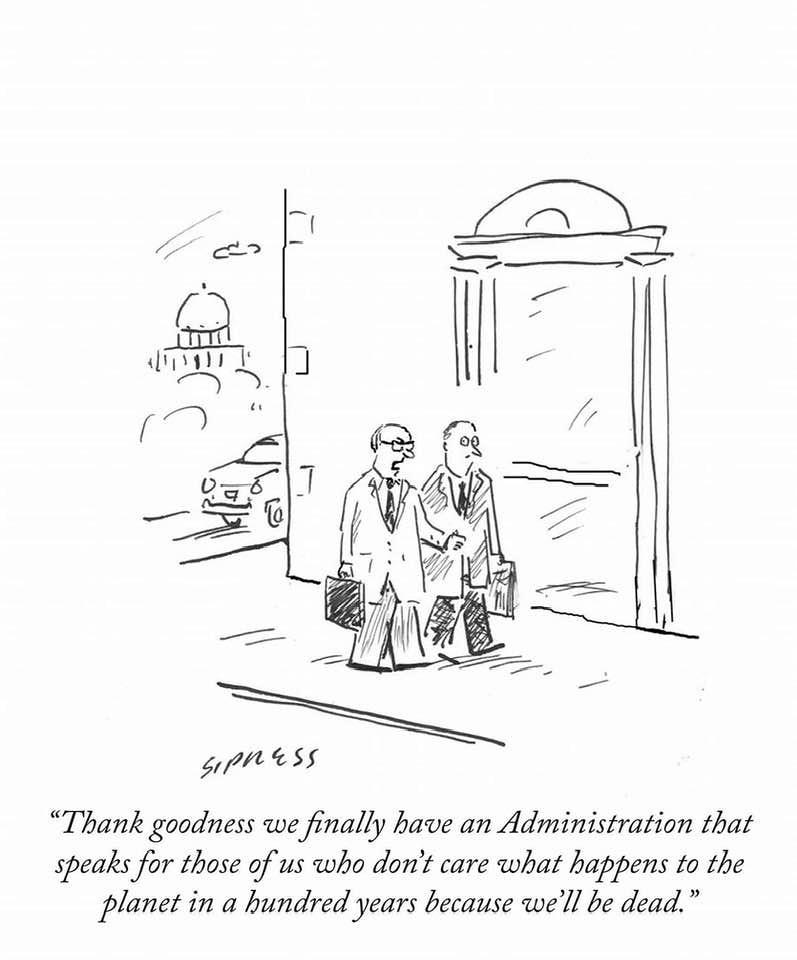
25438869_1662238943841032_1081912425639291177_o I think it is obvious we should care, in the sense of being benignly interested; but should we care in the sense of changing our actions in order to design changes in the world post 2100? I don't think I've written on this directly (as I say in reply to DB). Morality and economics discusses mt's The Seventieth Generation, which would be relevant, but sadly I'm looking at a different perspective. I say don't think more than 100 years ahead in reply to NB in 2014 in Meesc, and the discussion continues for a while there.

Update: 2021/02: I find an early post from 2007: World Doesn’t End in 2100.

There are two valid reasons why you might not care about post-2100 (or post-2117; or some other arbitrary but distant time. But not a time as close as 2050). One is that you like to use a conventional-economic discount rate of X% and that reduces future concerns so that mathematically and economically you're convinced those concerns are so deflated by discounting as to be uninteresting. And two is that you think our ignorance of those far-off times is so deep that we cannot possibly usefully design our behaviour to helpfully shape their world. Those two reasons aren't totally separate, but for various reasons I'll talk explicitly only about the second.

Not to ruin the tension, but my answer is a qualified no; we should not care-as-change.

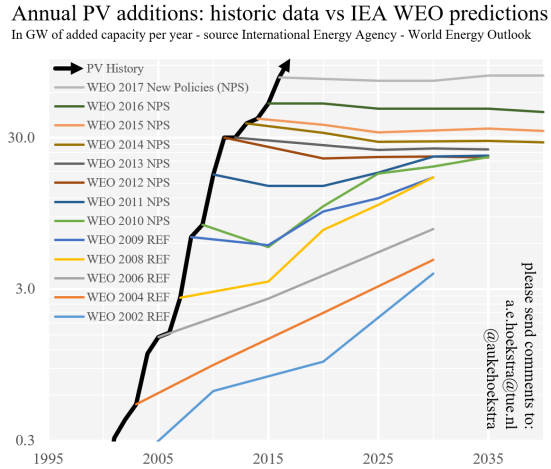
And why would I think a thing so manifestly absurd? Because our ability to foresee the future is so weak. An easy recent example that comes to hand is the IEA (and everyone else's) inability to predict solar PV growth even a year ahead, let alone a decade or a century. You could plausibly say that case is hard, and that broader trends are easier to forseee, but meh. Would we have thanked people in the past for trying to see 100 years ahead? When I asked that before, Gavin replied "Central Park" but I wasn't convinced; and I'd add that on the scale of GW, that's trivia. Dunc did better with "the London sewer system" but again; it's a small thing.

And secondly, too much striving to foresee and manage the future leads to too much managing, which is bad, in my opinion. This of course leads back to Hayek, but I see I've failed in my duty to provide the promised posts on him; Hayek and Climate provides a reasonable sample. I don't mean the comparatively minor parasitic class that flies off to the various political climate conferences around the world. I mean more the encouragement of the very concept that it would be a good idea if the state did more planning, when it should be doing less.

"Not caring" doesn't include not doing sensible and obvious things. One of which is to Do Science, which apart from anything else is cheap. The science we've done so far leads us to conclude that Sea Level Rise will be about +1m by 2100. You can make a case for only 50 cm and you can make a case for 2m. But - barring some major revision - it won't be as much as 10m (which would be disastrous) and it won't be as little 10cm (which would be too little to notice). So that's a happy co-incidence in a way; there's no obvious reason why SLR out to "about as far as we can usefully look" should sit just around the "irritating but manageable" level. You'll notice I've spoken only of SLR, because it kinda fits my narrative. But I could spin similar words around temperature change I suspect. Ecological response as usual I leave to others. To get with certainty to clearly disastrous levels of SLR you have to go out ~500 years; and that's too long. Can you help the case by replacing certainty by "at least Y% probability of"? Doubtful.

Long-term-ism

   
Fresh in December 2022 I come across Long-term-ism, "What We Owe the Future", and William MacAskill (who went to SEH). Wiki identifies the Key Flaw, which is the same as my objection. ACX points to a review by KP which isn't terrible; SA's own review doesn't really go anywhere.

See-also: Utilitarianism, impartially consider'd.
49766506_10156107493561009_3403688799564201984_n

Refs


* So What Climate Change Stories Would Sir Philip Sidney Tell asks Eli. Somewhat disappointingly, it isn't about predictions from that era. I prefer the Python version.
* Freeman Essays #4: “Capitalism: Who Are Its Friends and Who Are Its Foes?” - old stuff from CH
* Dangers Lurk in Timid Defenses of Free Trade - sort of more old stuff, from CH

2017-12-15

Techno-optimism

I'm feeling quite techno-optimistic at the moment. Don't worry, I'll fall back into cynical despair before too much longer. Just recently I've thought it implausible that we'll starve, and noted how well solar PV is doing.

f9

And of course there's watching SpaceX launches; another one today, from which my pic is taken. It is just after second stage separation. Stage 1 has turned and has begun its "boost-back burn". What I find cute is that you can see any of this; the pic is a screen capture of video from the ground, and the Falcon 9 is 80 km up. Other cuteness: they've stopped scrubbing the soot off the sides before reuse. What's also cute is to compare the landing with a recent Blue Origin effort: notice how BO pretty well stops well clear of the ground, has a think, and gently descents. Whereas SpaceX have calibrated themselves rather more carefully and simply slow to zero at the ground. BTW, I noticed that they were very careful to be very nice to NASA this time.

But just being optimistic is dull. Happily, there's a recent James Hansen post I can take mild exception to. The offending text is I believe that the legal approach will become increasingly important in the future, because the judiciary is relatively independent of fossil fuel interests. The Guardian did an article on this. I've expressed my doubts about solving GW through the courts before - funnily enough, also in the Hansen context - although with my characteristic lack of clarity. But I've also said more clearly - though I can't now find it - that approaching GW through the courts just seems like a bad idea to me, doomed to fail, doomed to polarise further an already far too polarised situation.

Refs


* Whats wrong with the world
* adventofcode.com
* FOAAS: Roy Moore
* Lazard Levelized Cost of Energy 2017

2017-12-11

Mass starvation is humanity’s fate if we keep flogging the land to death?

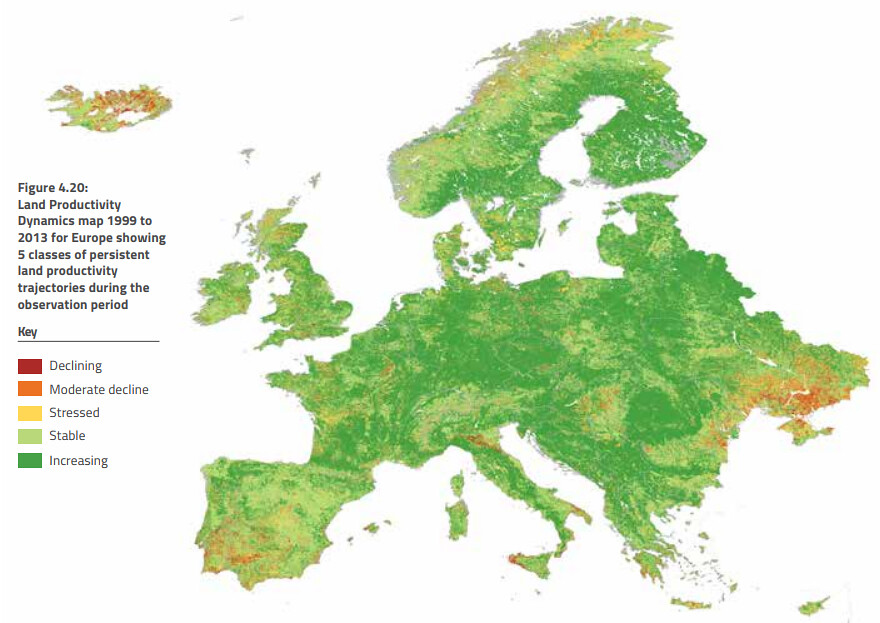
europe George Monbiot, in the Graun, with a lead pipe. By which I mean it is the usual bludgeoning. He has various points, many of them semi-valid, including the superior efficiency of a non-beef diet, to which I feel a great deal of sympathy. But I don't want to talk about that, I want to look at a thing he points at for his cropland doom, the United Nations Convention to Combat Desertification's Global Land Outlook. I went expecting to be disappointed and they didn't disappoint me about being disappointing. You can skip the next couple of paragraphs if you don't care about that stuff but only want the yields are already declining on 20% of the world’s croplands stuff. I find some interesting discussion of vaguely similar points from a 2008 post of mine. In 2009 I looked at Could Food Shortages Bring Down Civilization? but failed to say "Betteridge".

As you'd expect, the report isn't friendly to agribiz; their solutions are about "managing" things. Bureaucrats good, never markets. And we get stuff like Small-scale farmers, the backbone of rural livelihoods and food production for millennia, are under immense strain from land degradation, insecure tenure, and a globalized food system that favors concentrated, large-scale, and highly mechanized agribusiness. No, that's not the right way to think about that kind of problem; this is more longing for the Merrie England Happy Peasant type stuff that no-one who can possibly avoid it will actually choose to live with. People abandon peasant agriculture when they can, for the obvious reasons. Their Happy Peasant culture of dancing around maypoles will be lost, just like ours has been.

Much of the early sections reads like boilerplate; things that other people have written, and they've copied, without even thinking about. Take, for instance, The widening gulf between production and consumption, and ensuing levels of food loss / waste, further accelerates the rate of land use change, land degradation and deforestation. What does that even mean? There can't be a large excess of consumption over production, the gulf can't be that way round, otherwise we'd run out of things to consume, which is physically impossible. So they must mean that production now greatly exceeds consumption. If true, that would be mad, but it would also be a cause for hope: because if you could then cut down on the waste - presumably, the "gulf" in that case comes from waste, I think even the EU has stopped just throwing food away, though even that is indeed waste - you could feed more people from the same land, which would be good. Is that what they mean? I don't know. I get the feeling they've been told to bang out a report, lots of references, at least 1" thick 2" would be good, never mind about the actual words too much.

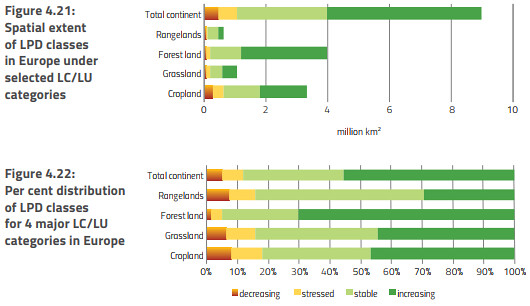
Anyway, so much for intro, the bit I wanted was A significant proportion of managed and natural ecosystems are degrading and at further risk from climate change and biodiversity loss. From 1998 to 2013, approximately 20 per cent of the Earth’s vegetated land surface showed persistent declining trends in productivity, apparent in 20 per cent of cropland, 16 per cent of forest land, 19 per cent of grassland, and 27 per cent of rangeland. These trends are especially alarming in the face of the increased demand for land-intensive crops and livestock.

But we also learn, from the start of Chapter 4, that Over the last 20 years the extent of land area harvested has increased by 16 per cent, the area under irrigation has doubled, and agricultural production has grown nearly threefold. These two ideas aren't incompatible of course. We can be increasing productivity in some places while losing it in others. We could be grabbing good new land while throwing wrung-out old land away. Maybe.

key But as Chapter 4 says, Measuring the extent of land degradation is difficult, so we didn't try to do it we just nicked The World Atlas of Desertification (WAD) instead. It appears to be an EU product. For an example pic, see Europe inlined above. I've cheated; Europe is the greenest. But is that cheating? Europe is intensively inhabited and intensively farmed; why isn't it desertifying, if that's the problem we're worried about? The answer is obvious: Europe is also run by wealthy people who look after the land, in general. Perhaps that's the solution?

The report is keen to guide your eye, and will tell you for example that Indications of decreasing productivity can be observed globally, with up to 22 million km2 affected, i.e., approximately 20 per cent of the Earth’s vegetated land surface shows persistent declining trends or stress on land productivity. But if you look at Europe, you'll see that more than 50% is deep-green, which is to say "increasing". That doesn't get a mention (they can't avoid mentioning Europe entirely of course, so they say Local farming practices often result in water and wind erosion and other degradation phenomena that, however, cannot be captured universally at the scale of analysis with the current datasets available; they know there's a problem, even if they can't see it). Even globally, the "deep green" total is bigger than the red-plus-yellow bits. That doesn't mean all is well, but it does deserve noticing; I can't think that a report that doesn't notice that is balanced.

I'd better stop before I channel any more of the spirit of Bjorn Lomborg. Global warming is bound to bring shifts to rainfall patterns that are bound to disrupt our agriculture and natural ecosystems in ways that are hard to predict in any kind of detail. I do caution against lack of caution.

Refs


* Does Eating Meat Contribute to Global Warming?

2017-12-10

Photovoltaic growth: reality versus projections of the International Energy Agency – the 2017 update


A fascinating picture, and blog post, comes my way, ht CR. There are various ways of looking at the same numbers; I've picked solar PV additions on a log scale, but you can also look on a linear scale, or look at total installations; see the post for more.

What we're seeing is that "official" forecasts of solar PV have lagged waay behind actual installations, and have done so with remarkable consistency. Despite repeated failure they have learnt nothing year on year. There's some discussion of just why the forecasts have been so bad, up to and including capture by Evil Fossil Fuel Barons, even though it isn't clear how that would make sense. Greenpeace also don't do a very good job, as the post notes. I tried to trawl back through GP's reports. But I got stuck because the 2005 report has ~70,000 PJ/a total energy baseline for 2000, whereas the 2010 one has 400,000; and that's illogical, captain. Also unpresciently, 2005 lumps solar PV, hydra and wind together; and the 2010 report is lead by pix of shiny mirrors.

The blog post quotes the IEA as pointing out that its reports are not supposed to be forecasts; this is probably about as useful as the IPCC saying the same about its projections. The IEA claims not to take into account new policies or "major new technologies" and that second point gets closest to the problem. Which I take to be not, really, any major new technologies but just steady technological improvements. Wiki has a nice pic showing growth by region; you can see the overall exponential growth continues, but Europe has clearly tailed off.

Although this is somehow news to me - clearly I've been asleep - others have noticed. The linked blog post provides examples, one of which is David Roberts at Vox. And, delightfully, I find myself able once again to disagree with him. He quotes GP saying Everything beyond projections for the next 10 years is simply a political statement from us, indicating what we want to see happen. This also becomes a work plan for us. If we see a renewable energy market isn’t performing as we want it to, we’ll try to jump in with campaigns—against fossil and nuclear fuels and in favor of renewables. And he likes this; because, effectively, he's a campaigner; and campaigners need something to campaign for. And I disagree because I wonder...

What are the consequences of this mis-forecast? Off in the real world, as opposed to scenario-land, solar PV keeps getting cheaper and people keep installing more of it. We can assume this is likely to continue, regardless of who campaigns for what and, probably, by this stage, largely regardless of government policies. Carbon taxes would help it, of course, but carbon taxes (or anything vaguely equivalent) are moving so sloowly that it seems solar PV will likely leap straight past that hurdle. I'm speculating here, of course. So a possible consequence of all this is that CO2 becomes less of a problem than we thought. Could it be that John McCarthy's semi-magical techno-optimism was actually right?

Refs


* US carbon emissions
* How self driving cars will lead to small, shared, electric vehicles that will save our cities and climate (by Auke Hoekstra)

2017-12-08

Temptation of Saint Anthony in visual arts

sta The Gods Themselves is a novel by Asimov. One of the few - perhaps the only one of his - to feature aliens; and quite decent aliens too. Whereas the picture, as you'll instantly recognise, is one of the Temptation of St Antony, a theme that appealed to the more psychedelic (psychotic?) painters. Temptation is rather an odd word, because although he is tempted by Lust and all the usual, rather more of the story seems to involve him being beaten, perhaps to death, by demons.

But its also totally irrelevant, because I wanted to talk about the lesson from TGT. I've just re-read it for the first time in many years. I remembered the outline of the story, but not the details. Let me tell you the outline.

Aliens (it later emerges) are sending (from their universe, in which the strong nuclear force is stronger than ours) blobs of Pu-186 into ours, in exchange for W-186. As the laws of physics leak into the new material it becomes radioactive; a source (when developed) of limitless free unpolluting energy for both sides. Alas, there is a catch: as the alien law of stronger nuclear force leaks in, our sun risks exploding; but scientists disagree whether the laws dissipate at the speed of light, or more slowly (and hence more dangerously). Eventually, rebel (so to speak) scientists on the moon find a way to pull mass from an even-weaker-nuclear-force universe, and we end up happily in the middle, law balanced.

Naturally, to make a decent story the tension must be maintained, so there is a fair bit of academic rivalry, but also the book does a decent job of making it entirely plausible that people will risk destroying the world in exchange for free energy, and will overlook evidence to the contrary if it is at all marginal; and that to convince them, you must offer a solution. Hmmm, make you think of anything? It also features - well, the title comes from - the famous Against stupidity the gods themselves contend in vain, which I'm sure we've all used uselessly in our time. The book is 1972, so it is a bit early for the moral I've drawn to be intended to be present. I haven't found any reviews that say it is.

[Update: don't you hate it when you forget to give a post a title and then see what Feedly makes of it?]

2017-12-04

The moral and intellectual bankruptcy of the Republican Party?

23669069_1631029183628675_3247074209637407602_o Well maybe. But I'm not sure I agree with the logic. Tis Dana Nuccitelli, in the Graun. Specificailly, DN is comparing the scientific consensus on GW ("97%") with economists attitudes to the GOP tax plan. And look! Among the experts who took a position either way, there was a 96% consensus that the plan would not substantially grow the economy more than the status quo, and a 100% consensus that it would substantially increase the national debt. See; there's the number 96%, that's almost 97%, so it is practically the same thing! Well, no.

The 97% for GW is the consensus on the underlying science. If you asked instead for consensus on policy responses to GW, you'd get a much lower degree of agreement. An appropriate concept to try to compare 97% to would be "are protectionist tariffs a bad idea?" To which "all" economists would agree; but of course no significant politicians are prepared to sign up to, much less any political party. On those grounds, I could just as well compare the Democrats1 to denialists. But please don't think that I'm defending the GOP tax plan; as I've said elsewhere it isn't good.

But "not good" isn't the standard; to make DN correct it has to be "economic denialism", and I don't think he gets close to that. Increasing the national debt is one of those things that everyone decries, perhaps the GOP most vigourously, but time after time pols cave in order to buy whatever trinkets their current electorate demand2; at the moment, that's tax cuts. So if that's denialism, practically all pols are guilty. As to "would not substantially grow the economy more than the status quo", by many standards, that's a success; at least it won't shrink the economy. Or would it? We don't know, because the survey doesn't tell us. But again, a tax plan that simply doesn't make anything better is hardly a failure; plenty do worse.

Why do I care: there are lots of wrong things in the world, why pick this one to write about? Pfft, maybe I shouldn't. But it is a part of my long doomed campaign to help people get out more.

[Update: this (from George Will! Boo hiss!) more directly addresses the plan itself (or, in a sense, any plan):  The top 1 percent of earners supply 39 percent of income tax revenue, the top 10 percent supply 70 percent, the bottom 50 percent supply 3 percent, 60 percent of households pay either no income taxes (45 percent) or less than 5 percent of their income, and 62 percent of Americans pay more in payroll taxes than in income taxes. So, any tax cut significant to macroeconomic policy — any that might change incentives sufficiently to substantially change businesses’ and individuals’ behaviors — must be primarily a cut for the affluent.]

Notes


1. Or, I strongly suspect, a fair fraction of my commentators. Nothing new there, then:-)
2. Tell me I'm wrong. Point to Hillary campaigning for tax rises to reduce the national debt.

Refs


* Our greatest responsibility is to be good ancestors via mt.
* Is the GOP tax plan an unprecedented windfall for the wealthy? We look at 50 years of data to find out - WaPo
* Utopias in the Anthropocene - mt criticises progressives and Historicism, but doesn't reach the obvious conclusion.
* Observing for the long haul
* The Economist isn't keen on the budget, but even more on the manner of its passing.
* American Democracy Is in Crisis - Hillary Clinton in The Atlantic. Her analysis can be faulted.
* If the Popular Vote Had Been What Mattered, Would Hillary Have Won? by David Henderson

2017-12-03

Electric cars already cheaper to own and run than petrol or diesel?

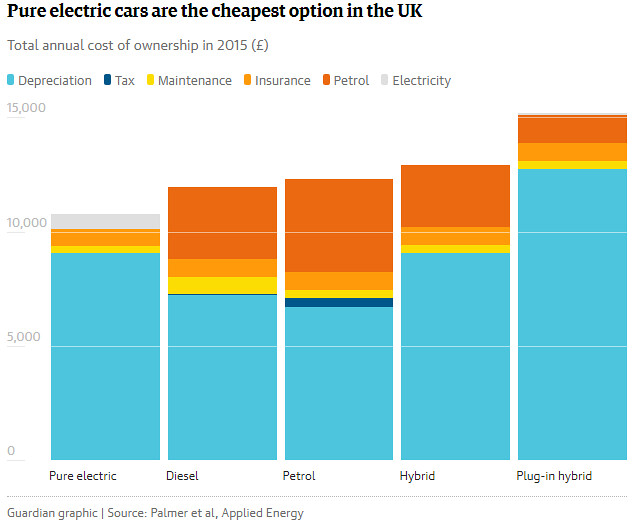
cars So says the Graun. Indeed it claims an Exclusive: Pure electric cars cost less over four years than petrol or diesel cars in the UK, US and Japan, researchers say, but China is set to lead the market. Quite how it can claim an exclusive when this is based on published research (Total cost of ownership and market share for hybrid and electric vehicles in the UK, US and Japan by KatePalmer, James E.Tate, Zia Wadud and John Nellthorp) is a mystery to me; and anyway I'm pretty sure I've seen similar elsewhere. It is a nice headline and points the way to the future but you won't be shocked to learn that there are a few little details in there to be careful of.

The details are all around the fact that while we're all very interested in money, only evil capitalist scum regard money as the bottom line; we of course care about ecological cost. So we need to notice that Pure electric cars receive a sales subsidy of about £5,000 in the UK and Japan and £6,500 in the US. “The subsidies are reasonably expensive at the moment but they are expected to tail off,” said Tate. He estimates that an electric car such as the Nissan Leaf will become as cheap to own and run as a petrol car without subsidy by 2025. Renault expects this to happen in the early 2020s. Unfortunately it isn't easy to add the £5k onto the chart above; but since they use a depreciation rate of a little under 20%, for a simple approximation, add £1k to the Pure Electric, which still (by eye) leaves it a shade under the Diesel.

Further, its kinda odd that the fuel cost for electric is so much lower than for diesel or petrol. If you ignore nuclear and renewables, then electricity is produced by burning things; burning oil is expensive and falling out of fashion but the cost should be comparable to diesel (within a factor of two, perhaps, in some handy-wavy expectation, mixing in the higher efficiency of large-scale combustion with the losses in power lines). And of course it is; the difference is tax: petrol and diesel in the UK are taxed at about 66% whereas electric is essentially tax free (there's a small carbon tax but I think it is significantly smaller than for diesel) so the diesel cost should shrink for comparability. Of course that's true now. In the glorious future when all our electricity is produced fossil-free the electric regains it's pure advantage; so in a sense this is a pointer to the future.

And the big pale blue elephant in the room is depreciation, which is by far the largest part of the cost for any of the types. This is a real financial cost and a real ecological cost, since it represents the cost of the raw materials to make the car, and the cost of the labour etc. to make it. It is reasonable to suggest that electric will come down in the future, since it is a newer thing; and reasonable to hope that electric cars are fundamentally simpler.

Lastly, there's the things we'd need to add onto the diesel (and to a lesser extent petrol) to be fair: costs of particulates and so on. I don't know what those are, numerically.

Prior art from Brian in 2015: EV costs at a tipping point for un-American countries.


2017-11-29

Study discovers why global warming will accelerate as CO2 levels rise?

Or, ZOMG! We're all doomed, part N. Via fb (but not so far Twitter), phys.org tells me "Global warming is likely to speed up as the Earth becomes increasingly more sensitive to atmospheric CO₂ concentrations, scientists from the University of Reading have warned. In a new study, published this week in the prestigious journal PNAS, the scientists explain that the influence of increasing levels of atmospheric CO2 on global warming will become more severe over time because the patterns of warming of the Earth's surface will lead to reduced cloud cover in some sensitive regions and less heat being able to escape into space." And so on. However, if you read the article you'll notice one thing missing: any form of quantification. Also, if you miss the "why" in the headline, the article will give you the impression that the paper is reporting the idea of warming speeding up. But it isn't; the paper in PNAS (Relationship of tropospheric stability to climate sensitivity and Earth’s observed radiation budget by Paulo Ceppia and Jonathan M. Gregory) whilst undoubtedly perfectly sensible (or so I assume; I haven't sullied myself by reading it, of course) is actually about explaining the pre-existing observation from modelling studies.
Which rings a bell; and indeed the answer is Beyond equilibrium climate sensitivity by JA, whose picture I have shamelessly stolen; after all, he did too. C+G's abstract reads in part:

The change in climate feedback is mainly associated with a decrease in marine tropical low cloud... and with a less negative lapse-rate feedback, as expected from a decrease in stability... Relationships qualitatively similar to those in the models among sea-surface temperature pattern, stability, and radiative budget are also found in observations...

That gets written up by phys.org as "The findings are supported by observations, suggesting that forecasts made by climate models evaluated by the Intergovernmental Panel on Climate Change are realistic." I think that is literally true, but very easy to misinterpret as "observations say that warming will speed up", which is not what I think they are saying.

Notice also that while the "speed up" is rather noticeable if you start from year 1, if you compare years 50-100 to 1000-3000, you get a rather small ~10% difference, which is well within the margin of error ECS is "known" to (although that's sort-of not relevant; what this is saying is that whatever the "real" value is, it is a bit bigger than you think. On yet another hand, I'm dubious about worrying about more than a century into the future anyway).

I think my conclusion is that the original "speed-up" idea is interesting but relatively minor; the new paper is scientifically interesting but not of any great interest to the general public (because it simply provides a plausible explanation for an existing observation) and so the PR for it is hype.

I mentioned this came from fb so I'll quote what I saw there, while sparing the blushes of the quotee: "A paper published in the prestigious "Proceedings of the National Academy of Sciences" this week reports that, climate sensitivity, the amount of near-surface planetary mean temperature rise per increase of greenhouse gas concentrations, is increasing. Our planet sees more warming for less CO2. This is a precursor to a "Runaway Greenhouse" condition." This is wrong, obviously; but not too hard to read into the phys.org article.

Refs

* There once was a polar bear – science vs the blogosphere - Bart Verheggen

2017-11-28

UK emissions

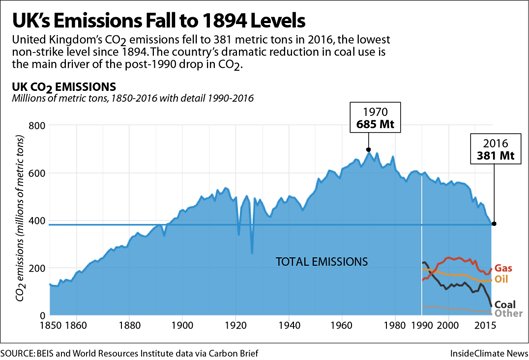
Via Twatter comes this interesting graph. We're back to pre-1900. At first I was deeply suspicious, but I think it holds up. The claimed source is "BEIS and World Resources Institute" via Carbon Brief. And that leads me to UK Carbon Emissions Fall to 19th Century Levels as Government Phases Out Coal (from March, so I'm hardly up to the moment). Which is I think wrong; the UK govt doesn't burn coal, it leaves that up to the electricity generating companies, as you'd expect. If we're attributing most of the drop to the loss of coal, then we can expect progress to plateau soon, because as the detail shows, we're almost out of coal to stop burning.

They say (apropos of this discussion) "Carbon Brief also attributes the precipitous drop in emissions from coal to the country's carbon tax, which doubled in 2015 to £18 ($22) per metric ton of CO2" (so perhaps we can credit the government to some extent :-). Of course, $22 per ton (per C? Per CO2? I can never remember) isn't large by ~$50 type standards which are what I tend to think of as "about the right value". But if that's big enough to have the "desired" effect, then fair enough.

Refs


* WATTS  SIDEKICK COPS A PLEA  ON THE 2nd  LAW OF  THERMODYNAMICS - RS

2017-11-22

Politics over science

There's a report on a survey in the NYT just recently ("The More Education Republicans Have, the Less They Tend to Believe in Climate Change"), though the survey itself ("College-Educated Republicans Most Skeptical of Global Warming") is reported in 2015. h/t PH.

The NYT chooses to highlight the answer to Percent saying they worry about climate change “a great deal” but that wouldn't be the question I'd choose: what if Republicans are generally happy-go-lucky people, whereas Democrats are worry-warts? The NYT avers that This relationship persists even when pollsters pose different kinds of questions about climate change, and that's sorta true, though just-by-chance they happen to have picked the question with most divergence. The divergence, as you'll see from the pix, is that more educated Repubs tend to believe in GW less than their less educated fellows, whereas the reverse is true for Dems. That's not what you expect if you think that the problem with GW "skeptics" is lack of knowledge; sadly, experience teaches us that isn't actually the problem.

Before you get too carried away, notice that they diverge on other issues too; for example, "Trust and confidence in mass media": Dems agree more with this the more educated they are, with about 80% agreeing; Repubs go the other way, and end with about 10% agreeing. And on this one, the Repubs are clearly correct, as you'd be mad to trust the mass media.

Anyway, let's look at a somewhat better question also in the survey, "GW is mainly caused by natural changes". Demoplebs go for that 35%, Collocrats 13%. Whereas Replebs are 54%, and Collegicans are 66%. Which indeed has the same pattern. Which is explained by, errm, what? I'm not sure the NYT's explanation - people get their ideas on GW from elites - is particularly explanatory.

There's another article, which may or may not include the same poll, I can't quite tell (but is probably this one instead), When Don’t the Highly Educated Believe in Evolution? The Bible Believers Effect (Skeptical Inquirer Volume 39.2, March/April 2015). That includes another explanation that I quite like, which oddly enough is from Chris Mooney and they've translated it from GW to Bible and I'll translate it back: "Compared to less well educated,  more highly educated better understand arguments used to deny and are, therefore, better able to justify their beliefs in the face of scientific evidence to the contrary". I quite like that, at least in part because it fits in with my prejudices. It isn't too difficult, with a little education and or reading, to learn enough about GW to upset the easy explanations you'll find on popular websites or in the meeja. Indeed, I suspect, it is easy enough to come up with arguments that people who "believe" in GW will find hard to refute, or even understand. None of them stand up to proper scrutiny, of course, but I suspect that it's enough to (a) give a feeling of intellectual superiority; (b) make it plain that the "believers" are often just believing: they don't actually know (as discussed before, this is inevitable; you are going to rely on scientific authority; perhaps disingenuously people have a tendency to under-emphasise this). Being surrounded by idiots who believe something strongly but who obviously don't understand the reasons why is quite likely a force towards believing the reverse.

Pic: early viewers of this post will have got a disturbing image from 2015 Christmas Head. But then I remembered I wanted to put this lovely B+W pic somewhere, and this is a good post for it.

Refs

* What Are ‘Theoretical Reasons’? - CH on protectionism

2017-11-18

Nuclear winter?

23593387_10212802514451021_6937348403898754147_o One for RS (via a tweet that Mann liked). The Smithsonian tells us about When Carl Sagan Warned the World About Nuclear Winter. And the Smithsonian links it to the treatment of global warming today. I feel uncomfortable with that: the science of GW is good; the science of NW has not aged well.

I've always felt NW was a bit weird. The effects of the bombs themselves would be catastrophic; I really couldn't understand why people would want to make it "worse". Yes, I know that people were talking about "survivable" nuclear wars but these are the same sorts of people who deny GW nowadays; you don't win arguments with such people by telling them that GW or nuclear war will be worse than they think, because... they aren't thinking anyway.

Looking back, I find I've said very little about NW. Probably because while I felt vaguely sympathetic to the idea, I wasn't comfortable with the science so kept quiet. In 2010 I'm snarky about the Economist, and could be read as defending NW along with some other stuff. But the main point at issue there is the Economist evading GW; they wouldn't do that any more. A quick search on sci.env didn't throw up anything there either. I've edited the wiki article; unfortunately it doesn't seem to be possible to get a good link to this, but if you go to the history and put "William M. Connolley" into the rightmost box and press "Isolate history" you see all my edits. I've definitely removed some material critical of it - e.g. this in 2006 - but that was unsourced and OTT. In 2009 I removed the assertion that NW ended the arms race and the Cold War, because that was bollox. This talk page archive is interesting; in 2008 I say I[']m not happy with the Seitz section "A 1986 article by Russell Seitz ...". Basically, Seitz fabricated various quotes. We shouldn't be giving them countenance. Oh dear, I hope he'll forgive me. That links to Nuclear winter: science and politics (Science and Public Policy, Vol. 15, No. 5, October 1988, pp. 321-334) by Brian Martin which I think is worth reading.

The wiki article is ambivalent. The opening para reads:
Nuclear winter is the severe and prolonged global climatic cooling effect hypothesized[1][2] to occur after widespread firestorms following a nuclear war.[3] The hypothesis is based on the fact that such fires can inject soot into the stratosphere, where it can block some direct sunlight from reaching the surface of the Earth. Historically, firestorms have occurred in a number of forests and cities. In developing computer models of nuclear-winter scenarios, researchers use both Hamburg and the Hiroshima firestorms as example cases where soot might have been injected into the stratosphere,[4] as well as modern observations of natural, large-area wildfires.[3][5][6]
and from that you can't tell much about whether it is considered plausible or not. Lower down there's a long "Criticism and debate" section and in the end, my reaction is just to back away from the whole thing as being something like Cold fusion.

Robert Jastrow


One weird bit in the Smithsonian is
In the case of nuclear winter, the consequences of this backlash would be profound. In 1984, a small group of hawkish physicists and astronomers formed the George C. Marshall Institute, a conservative think-tank that supported SDI. Their leader was Robert Jastrow, a bestselling author and occasional TV personality whose politics were nearly opposite Sagan’s.
That is, I assume this Robert Jastrow. But wiki describes him as Robert Jastrow (September 7, 1925 – February 8, 2008) was an American astronomer and planetary physicist. He was a NASA scientist, populist author and futurist. Why would you describe him as a "bestselling author and occasional TV personality" - unless you were trying to diss him? That rather makes me doubt the article.

Whither NW?


The article concludes with "Thus, nuclear winter is still an important area of research, forming much of TTAPS author Brian Toon’s subsequent research". It might well form a large part of BT's work; I don't know. But it clearly isn't an important area of research in general. Hardly anyone bothers.

And as for "Both nuclear winter and global climate change are fairly abstract phenomena that occur on a scale beyond our immediate sensory experience" - WTF? GW is a long slow process, yes. NW isn't; it would be - if it's real - quick. It would also follow a major nuclear exchange, and calling that "fairly abstract" is just off with the fairies.

Rowing


It was the Cantabs Winter Head today. Sadly the Powers that Be failed to enter the "Four of Whi(ne)" so I ran alongside div 3, and cycled alongside div 4. Div 3 was absolutely appalling; some terrible quality rowing by the first few (college) crews. Division 4 was much better, the highlight being the guests from Heidelberg RuderKlub who were powerful, controlled and relaxed at 33. Perhaps slightly too relaxed; they were 5 seconds behind Downing. And yes, they had an on-Cam cox so they did make it round the corners. But I'm delighted to say that our IV of Steve (with guest star Conor) won the S1 category.

Refs


Some links from RS:
 * history-of-climate-science-lessons
 * nuclear-winter-wages-of-hype

Recently tweeted: Let’s End the Peril of a Nuclear Winter By ALAN ROBOCK and OWEN BRIAN TOONFEB. 11, 2016

2017-11-17

Noises off

dick Not much going on is there? ATTP is talking about Mertonian Norms but really, I cannot raise the energy to care so he's welcome to it, and to Warren Peace. Some minor comments on wiki reminded me of my Cogito ergo Stoat, which shows how seriously people take bollox if it comes from famous people. Speaking of which, James Annan is being cwuel to Pat Frank, but someone has to do it.

RS reminds me that reports of my death have been somewhat exaggerated; but it is nice to be noticed. He also notes a bizarre plan to put advertising on an iceberg.

In my own little world I've now written up the first two days of my trip to the Ecrins last summer; more of that anon.

On the politics front, there seems to be some faint hope that Zimbabwe has a chance for sanity. That depends on a lot of things going right, but it seems faintly promising so far. Unlike Brexit, which remains unpromising.

A friend of mine makes the Economist - well, he works for Cambridge Medical Robotics.

And lastly, a US Navy pilot drew a giant cock in the sky. If I was a pilot, it's the sort of thing I'd do, which is one of the many reasons I'm not a pilot. It's not a bad effort but needs some hairs as well as something extra at the other end.

2017-11-11

Hexapodia?

23333947_10155828187957350_1525222338592911454_o Via ATTP on Twatter comes Conservatives probably can’t be persuaded on climate change. So now what? (arch). Since it's by David Roberts, you won't be surprised to find that I disagree with it. Or rather, I disagree with some of it and will therefore violently object to its very right to exist. His tagline of "One more round of “messaging” won’t do it" is true, though hardly rises to the rank of a Key Insight. Anyway, DR writes:
Dixon’s team found that, in surveys, conservative opinion on climate solutions could not be moved by scientific or religious messages, but it could be nudged in a positive direction by messages that stressed “free market solutions.” Core values, not science, are what drive conservative opposition, Dixon tells Grossman, and “free markets” are a core value for conservatives. They view climate policy as a threat to free markets, which is the real reason they reject climate science, so messaging should assuage those fears. This is wrong. First, the idea that free markets are a core value of today’s US conservatives should provoke only laughter...
and so on. Notice DR is being offered the truth but is blinded to it by his prejudices; we're back at Rejecting Climate Change: Not Science Denial, but Regulation Phobia? Or alternatively, we're back at the New Yorker: what Democrats have learned [sic] in the year since they lost to Donald Trump. And if you judge by that article the answer is nothing: they are still pissing around trying to magic demographics instead of finding sane policies, candidates and messages. DR continues:
Most importantly of all, we must note that it’s not true that climate solutions necessarily involve violence to free market principles.
And that is correct; see for example Carbon Tax Now! But DR then asks if it’s not true that climate solutions necessarily violate the allegedly core conservative principle of free markets ... who told them that? (which is slightly oddly phrased; he is of course asking who told the Cons that Clim Sols do violate FMs). To which the answer is: most of the people pushing GW solutions via regulation are saying that very thing.

Well, I wrote the above yesterday and then re-read it and thought meh; I've said much the same before. And then today I find that ATTP has posted on the same DR post, so I decided maybe it was thrilling enough to throw out the door. Per all my previous, I think DR is wrong to be giving up on persuasion; he just needs to trying thinking, instead of trying to ram the same wrong-shaped "facts" down unwilling throats. ATTP is of course correct to conclude that there is some core of people who will never be convinced and trying to find clever messaging strategies that might do so, is... a waste of time. I assert that the core is smaller than you think.

But does accepting what ATTP thinks imply those who want to actively promote change will probably have to – at times – approach this more as a fight than as some kind of polite debate? This I find somewhat dubious. If those who wanted meaningful action on GW in the USA had a majority - or the strength in other ways - to act, they would have done so. If the facts and the science are on your side but you're not strong enough to win a brawl then it is foolish to start one.

Refs


* Victory for Journalist as Accuracy Complaint by ‘Contrarian’ Climate Scientist Thrown Out (Professor Ray Bates and the Village Magazine)
* Today's contribution to the tariffs debate from CH
* 'I'm not a bigot' Meet the U of T prof who refuses to use genderless pronouns

2017-11-08

No nation should be allowed to exit

DSC_6220 Anyone who has read my previous comments on Hansen will know that I find him somewhat over-excitable, and this one - Global Climate Justice: Making the Carbon Majors Pay for Climate Action - is no exception. It is I think a speech at COP-23. My title quote - that I find rather hard to parse - comes from
I have come to note that greenhouse gas climate forcings are accelerating, not decelerating, and sea level rise and ocean acidification are accelerating. We confront a mortal threat, now endangering, only at first, the very existence of island and low-lying nations in the Pacific and around the planet. Accordingly, ambition must be increased and enforced. No nation should be allowed to exit. Moreover, the unrequited provisions of the SUVA Declaration, Article 19, must be revived. Effective action must be undertaken not only to keep temperature rise below 1.5° C but, in my view, to return it to below 1° C to preserve island nations and global shorelines.
All fine sentiments, but what does "No nation should be allowed to exit" mean? It might mean that no nation should be allowed to exit the Paris agreement. Which would be a splendid sentiment until you came to think of how a recalcitrant state - perhaps a powerful one, like the USA - might be "persuaded" against it's well. Never mind; that's the dull interpretation. The more interesting interpretation is "No nation should be allowed to [cease to] exi[s]t". That's interesting, and I'll talk around it lower down; but first I need to fly off the handle about various crapness from Hansen.

The main of which is "Funding is required. As a matter of justice it should be extracted from those who benefitted most from fossil fuel burning -- the so-called Carbon Majors". This isn't true, as previously discussed. We had some debate about whether consumers deserved all or just most of the blame; but I don't think anyone believed that oil companies deserved all of the blame. But Hansen does. Why? Is he... totally economically illiterate? Or just propagandising? It's hard to know. He also appears to believe that the Carbon Majors have somehow extracted all this profit and piled it up in a big heap somewhere untouched, all ready for Hansen to expropriate. But of course it isn't sitting around. The carbon companies have paid it out to their shareholders. Sue all the carbon companies to death if you like and you can; you still won't get the money; it isn't there.

But Hansen wants Moah Litigation - how very Libertarian of him :-):  more effective legal action is needed... Legislators around the world could clarify the law related to liability for climate change, but courts are able now to assert jurisdiction to require fossil fuel polluters to pay their fair share. Legal scholars have outlined the path forward, and one of them is with me here today. And links to Atmospheric recovery litigation: making the fossil fuel industry pay to restore a viable climate system; Wood and Galpern. That feels somehow familiar but I find no references in my past. However, that purportedly scholarly article says "the primary responsible parties are the major fossil fuel corporations", which is clearly just more of the same drivel (and, incidentally, name-checks Hansen, so this is all going round in circles).

Hansen ends with The period of consequence requires honesty and courage. Nothing less will do. These are stirring words! But is (self-assessed) honesty and courage enough? No. It also necessary to be correct, and to have a clue what you're talking about.

No nation should be allowed to [cease to] exi[s]t


A fine sentiment: but is it true? I'm sure we'd all be happy to agree that no individual person should be killed (absent suitable exclusions for those who like the death penalty, and wars, and whatever else you need to find exclusions for). But should nations have similar rights to life? Obviously it is no defence to say that this or that nation has been killed in the past; that wouldn't establish it was all right to kill them. And nor would saying that the international order has decided it would be politically expedient to not extinguish nations make it not-right now. Somewhat belatedly bothering to look for prior art I find Right to Exist on wiki. As that says, that tends to get wrapped up in Palestine-Israel wars, so (invoking an analogue of Godwin's law) I'm not going to talk about it in that context and any comments that do so will get deleted. Meh, but apart from that there is little there, so I'll go back to making things up.

My point is that - in moral terms - we don't apply cost-benefit to individual lives; it is considered reasonable to regard them as infinitely precious. Obviously in the real world governments don't actually do that, they use value-of-life in cost-benefit all the time; but that's not morality.

Should we regard nations as also, individually, infinitely precious? I don't see why we should. One island nation (we're talking about nation-death-risk from SLR, so it's an obvious example) is much like the next island nation. Many of them are smaller than English counties, and English counties are not regarded as worthy of special protection against individual extinction.

Hansen kinda sources himself to "the SUVA Declaration, Article 19". Article one notes "existential threats to our very survival". It isn't clear what "our" means. It might mean "the nation"; that would be consistent with Hansen. Or it might mean the individual people; in which case it is somewhat dubious - they could move.

I'm expecting a certain measure of disagreement to my view from readers. If you comment, it would be nice if you could distinguish moral outrage from facts or logic or theory.

2017-11-06

The sun in your eyes made some of the lies worth believing

TheAlanParsonsProject-EyeintheSky I am the eye in the sky, Looking at you-o-oooh I can read your mind.
I am the maker of rules, Dealing with foo-o-oools, I can cheat you blind.

At least, that's what Alan Parsons thought. But today we have Donald Trump accused of obstructing satellite research into climate change by the Graun (via, for example, See No Evil: Trump/GOP Trashing our Eyes in the Sky, which is my excuse for invoking the sainted Alan); well, it's on their website but it's actually the Observer, specifically Robin McKie and I'm a bit dubious about him.

The article sayeth President Trump has been accused of deliberately obstructing research on global warming after it emerged that a critically important technique for investigating sea-ice cover at the poles faces being blocked, but articles often say that kind of thing, and in this case it undermines itself by quoting no source for these accusations. It's possible that the fling at Trump is mere ritual, because the substance, as far as I can determine it, is Republican-controlled Congress ordered destruction of vital sea-ice probe.

That does appear to be true, though exact details are murky. What is not-being-launched is DMSP-20, a replacement for DMSP-19. The wiki page on DMSP is useful, if you don't even know what they are, but of DMSP-20 it says "The failure [of DMSP-19] only left F16, F17 and F18 – all significantly past their expected 3–5 year lifespan – operational. F19's planned replacement was not carried out because in 2017 the Republican-controlled Congress ordered the destruction of the already constructed F20 probe to save money by not having to pay its storage costs." Spacenews (from March 2016) tells me "...the Air Force’s Space and Missile Systems Center, said... that while the Defense Department still expects to complete the termination of the DMSP program by Dec. 20, DMSP-20 remains properly stored in Sunnyvale... study, completed in September 2014, recommended against launching the satellite. But the Air Force said in April 2015 that it intended to launch the satellite in 2018... opted not to fund the program in a massive spending bill in December, kicking off plans to dispose of the satellite."

Inside Defence tells me that the "tear down" of DMSP-20 started in November 2016, "Based on the deputy secretary of defense and Air Force decisions and in accordance with congressional direction". So blaming that on Trump seems hard to justify (and Trump isn't responsible for all the world's evil  just because we all agree he's a bozo). https://directory.eoportal.org/web/eoportal/satellite-missions/d/dmsp-block-5d looks like it ought to be definitive but clearly isn't, since it hasn't noticed the sad deaths of either DMSP-19 or 20.

So does anyone have the real story? Or is there no real story, other than someone having kicked McKie?

rmg says "...Comparable (better) instruments are on the JAXA-NASA AMSR-2. But it, too, is past its design life".

Update: RC now has a post which substantially says what I said above, but with more detail. Gavin is more politic, of course, writing that the "headline is not really correct", but I think it is now clear that the headline is the usual drivel you expect from headlines. RC also points at a Nature article, Ageing satellites put crucial sea-ice climate record at risk (arch), which I inexplicably missed.

Meanwhile...


Experts Ponder Why Administration Released Tough Climate Report, says EOS. Quite possibly because it would be too much trouble to censor. But that's just another way of saying they couldn't be bothered to censor it. So another spin is because the report just says what all the other reports have said - after all, it would be rather odd if it differed substantially. Obviously the Trump administration is trusted by no-one other than fools, so pretty well everything it does will meet with this kind of response: if you hate it, you'll whinge; if you like it, you'll wonder what the hidden reasons were.

Trump is the current La-Di-Di?


What is it with all this Trump-is-the-cause-of-everything stuff? Now we have the New Yorker saying With the tacit support of President Trump, King Salman of Saudi Arabia and his powerful son launched an unprecedented purge of their own family over the weekend. C'mon, bullshit. The Saudi dictatorship continued to act like a dictatorship and they're quite capable of doing that all by themselves. You're wondering what "la-di-di" is, aren't you, but somewhat afraid to ask. Come on... person who sells lots of newspapers... sadly deceased... try pronouncing it as though French... that's right, it's a frog trying to say "Lady Di(ana)".

For NPR's take, you get With Saudi Arrests, Crown Prince Shows He Can Force Change. But It's Not Democracy. Um, yes. The clue is in the words "Crown" and "Prince".

Refs

Trump Wrongly Blamed for Destroying Sea Ice Satellite: November 6th, 2017 by Roy W. Spencer, Ph. D.

2017-11-04

Anti-fb drivel

23157071_768966359966353_3134902088891222076_o I finally got sick of all the anti-fb drivel coming out. But perhaps your experience isn't like mine. Here's what I see (PF(S|B)F = post-from-(scientific|blogging-)friend:

* PFF
* "Publication suggérée" (IBM flash storage)
* PFSF (in foreign)
* PFBF (about Ian McKellen)
* PFSF (about a concent)
* PFF (about dance)
* New Yorker (about some silly Sean Hannity film)
* New Yorker (Things to secretly love about NYC)
* God about Jesus Memes
* World Rowing about Teaser Aegon European Rowing Indoor Championships 2018
* "Publication suggérée" about some cycling thing
* New Yorker (again!) about Gordon Ramsay
* God: a fun cartoon about cycling in America
* Friend suggestions
* Unfunny New Yorker cartoon
* Rowing: Cantabs advert for the Winter Head
* Discarding images: Ants
* Rowing: Concept2: inspirational picture
* Running: Parkrun pic
* Teddy Hall: upcoming events
* Artfinder advert (I must stop seeing that stuff... I can't recall why I decided to follow them. Unfollowed)
* "Publication suggérée": BFI player

That's a little atypical; normally I have more posts from friends, mostly about rowing. At this point I got bored, so let's skip everything non-political.

* SR: about his http://www.realclimate.org/index.php/archives/2017/11/el-nino-and-the-record-years-1998-and-2016/
* NY Times: Did the World Get Aung San Suu Kyi Wrong?
* New Yorker: Mueller's indictements, Ryan's tax plans.
* SR: Das CO2-Budget ist fast verbraucht
* MM: Humans 'dominant cause' of climate change, government report says
* "Publication suggérée" by Jacobin Magazine

22424347_1608398379230566_5482377878423454436_o And now I've scrolled deep into my feed, where it is generally admitted people just don't go. It's probably fitting to end with this tasteful tee-shirt.

So my conclusion is that if people are trying to feed my stuff, they aren't doing a good job. Maybe I'm not their target demographic. But anyway: that's what I see. Now let's consider two other views:

An opinion piece, Beware: this Russian cyber warfare threatens every democracy by Natalie Nougayrède in the Graun (aside: increasingly I've grown dubious about the virtue of "columnists" in the papers. Just like financial advisers (if you were any good, why aren't you too rich to bother advising me?), if a columnist was any good, why wouldn't they be in policy?) Notably, it has no solutions, other than that scary-faced women should tell fb what to do, in the name of course of Democracy. The closest she comes is
Interestingly, the Facebook representative was then asked whether the platform would suppress specific content in a geographical area to abide by local laws including, for example, taking down a Chinese dissident’s postings. He partly deflected the question by answering that Facebook did so already in Germany, where legislation bans Holocaust denial. That moment, if anything, brought a small glimpse into the many complex aspects of a debate that will define much about whether democratic principles can be upheld in a technologically interconnected world.
Which is kinda cute, and rather analogous (I know, this is well over the top) to Jesus's answer to the Pharisees. Early on she admits
We don’t yet know the full picture. In particular, we don’t know if Russian-promoted bots, trolls and online ads had an impact that in any way altered the outcome of the US election.
but only immeadiately after quoting with approval the scary-faced woman:
says sternly to the Facebook, Twitter and Google representatives (whose evasive answers have exasperated her): “You don’t get it! This is a very big deal. What we’re talking about is cataclysmic. It is cyber warfare. A major foreign power with sophistication and ability got involved in our presidential election.”
So there you have it: we don't know these ads had any impact, but nonetheless it is cataclysmic. Can you say America is facing an epistemic crisis, children? These people are clearly not capable of thinking; not capable of forming logical connections between related sentences. Because their aim is propaganda for their favoured solution which is (you knew this was coming, didn't you?) moah regulation. That's also The Economist's solution (arch); their reasoning is better although their tagline (Facebook, Google and Twitter were supposed to save politics as good information drove out prejudice and falsehood. Something has gone very wrong) is drivel.

Refs


* Two Basic Foundations - Science of Doom
* Timmy finds another example
* A World of Ingratitude - Bryan Caplan, EconLib
* We Analysed the 527,350 Facebook Ads placed by the US Presidential Candidates. Here Are The Results [2019]

2017-11-03

An epistemic crisis

America is facing an epistemic crisis says David Roberts at Vox. I'm used to disagreeing with DR, though everyone else seems to lurve him, so it's no surprise that I disagree this time, too.

The first thing wrong with it is that it's yet more stuff about Trump and Mueller, and the world already has far too much of that. In a sense it isn't really about Trump though - he's just the peg to hang off "thoughts" about the Evil Right Wing (DR's Left Wing is much nicer) and then a tiny bit of climate at the end.

I imagine that you (well, except for RS) like me can never remember what all the wanky Philosophy words like Ontological and Epistemology actually mean. DR thoughtfully explains that Epistemology is the branch of philosophy having to do with how we know things and what it means for something to be true or false, accurate or inaccurate. And further notes that The US is experiencing a deep epistemic breach, a split not just in what we value or want, but in who we trust, how we come to know things, and what we believe we know — what we believe exists, is true, has happened and is happening. And that I think is reasonably fair, though I think if you probed it more deeply you'd find extensive areas of shared agreement. I'm pretty dubious about The primary source of this breach, to make a long story short, is the US conservative movement’s rejection of the mainstream institutions devoted to gathering and disseminating knowledge though. DR's free pass for the left wing doesn't seem terribly plausible to me.

But anyway, what this all ends up meaning is that you can't win arguments on the internet. Which those of us who've been arguing on the internet for a while have already noticed. It isn't particularly new; that there are partisans for causes who cannot meaningfully be reasoned with is familiar to anyone who has commented at WUWT and elsewhere. There are many many problems but one of them is that any given issue can (and must be, if you want to nail down anything) be hair split into so many parts and chased down into so much detail that if you've wasted vast time finally nailing down the most carefully hair-split detail, then (a) all the audience has got bored and left, and (b) you've only settled the tiniest fingernail of uninteresting detail. And of course "winning" on that one point of detail does you no good, because no-one has any honour; "losing" a point means nothing; it establishes no precedent for trustworthiness or otherwise.

Mind you, I also think he is wrong about his case: US institutions are stronger than he gives them credit for. But I'm not at all sure this kind of hand-wringing is useful; helping strengthen those institutions would be better. Perhaps that's what he thinks he is doing?

Of course, if you don't like disliking DR, you can always dislike the American Enterprise Institute instead; the post and comments there provide a nice example of the problem. You'll wonder (I hope) how I got there; the answer is via Cafe Hayek who, whilst a nice economist, is rather naive about GW and the truthiness of Patrick Michaels.

Refs


* Mark Jacobson Abandons Science, Takes Up Barratry - mt
* A  Mind Böggling Development In Energy Storage & Zeppelin Parking - RS
* ATTP joins the epistemic bandwagon: Jordan Peterson speaks the truth.
* ATTP again with The Black Knight.