2019-04-09

Can Law Save Us From Climate Change?

DSC_0125_crop No. Because it isn't against the law. However calltothebar.org would have it otherwise, writing:
On April 18, 2019, a group of leading lawyers and law professors will convene in person at locations across the United States to discuss the problem of climate change and the role of lawyers in advancing solutions. The locations will all be linked by live video/audio feeds. This is the third year in a row for this national conference on this important subject. This year’s conference will feature leading experts addressing the most important aspects of the climate crisis from a legal perspective. The conference will also address ways in which lawyers can work to make a difference on this subject of grave concern to our well-being and future.
Much of their petition is sane: recognition of GW-as-science1 and calling for carbon pricing. Their arguments for why lawyers-in-particular should be involved are weak, but never mind, they're a bunch of lawyers and can be expected to think that they're important. The bit that I'm less happy with is
Protecting society from harm is the most fundamental purpose of law and government. Faced with clear evidence of impending harm, we as citizens and lawyers have a duty to speak out on the need for effective government action to protect humans now alive and those to be born. We have no right to knowingly continue to inflict severe damage to the planetary ecosystem that sustains all life. To the contrary, we have a duty to protect it.
Why would anyone object to that motherhood-and-apple-pie type stuff? Because as usual, as ever, as always when people talk about this stuff there's the dangerous sliding of words. GW does indeed risk harm to society. But then again, burning fossil fuels provides good to society. That's why people do it, after all. How do you balance the harm and the good? Ah, now we're back to the real problem.

And the problem of balancing harm and good isn't obviously one that is well suited to the all-or-nothing of a courtroom. Lawyers can be rather one-sided. To quote a well-known Alsup:
The benefits of fossil fuels are worldwide. The problem deserves a solution on a more vast scale than can be supplied by a district judge or jury in a public nuisance case. While it remains true that our federal courts have authority to fashion common law remedies for claims based on global warming, courts must also respect and defer to the other co-equal branches of government when the problem at hand clearly deserves a solution best addressed by those branches. The Court will stay its hand in favor of solutions by the legislative and executive branches.

Notes


1. And they get credit for using videoconferencing, too.

Refs


* Economics, Law and Ethics
* Skolstrejk för klimatet
* The Climate Wars Can Get Rough At Times
* Global warming and common law
* And stuff like The destruction of the Earth is a crime. It should be prosecuted by George Monbiot doesn't work

2019-03-22

Top oil firms spending millions lobbying to block climate change policies?

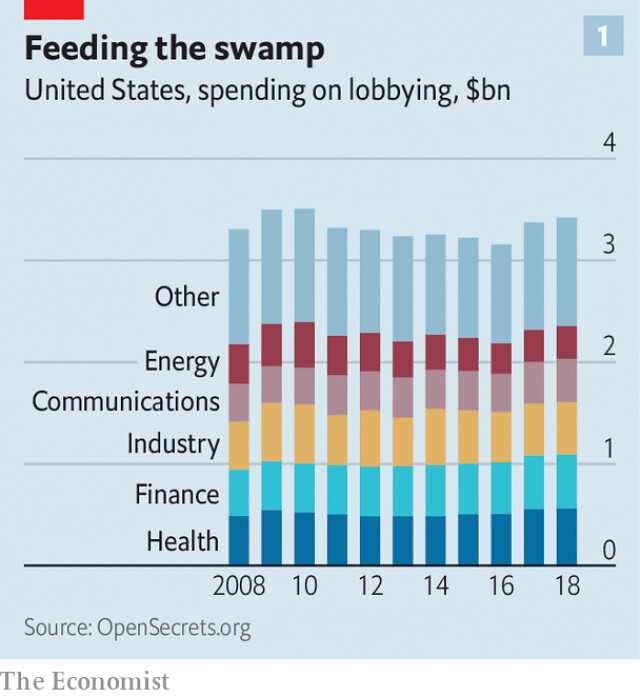
brexit The largest five stock market listed oil and gas companies spend nearly $200m (£153m) a year lobbying to delay, control or block policies to tackle climate change, according to a new report, the Graun breathlessly tells us. Can it be true? Exxon is pegged at $40+M, and yet Exxon total lobbying spend per year is around $11M, according to OpenSecrets. How do we reconcile these numbers?

I think that The five publicly listed oil majors – ExxonMobil, Shell, Chevron, BP and Total – now spend about $195m a year on branding campaigns suggesting they support action against climate change doesn't help. That's not the same spending as above. However, any just accounting would have to count it towards the "good" side, since it's essentially a positive message re GW. Naturally, the report doesn't count it as such.

To find out more we're going to have to download the bloody report, which creepily requires you to register, these people are friends of the surveillance state. And then, worse, we're going to have to read it. And you know what? It's some kind of shit-for-brains cut-n-paste protected thing too, the scum. Well, don't expect too many quotes then.

20190413_WBC689 Page 10 tells us Exxon's climate lobbying is ~$41M per year, again making no effort to reconcile that to the total $11M figure. But they may be counting social media and advertising as "lobbying". Lots of the report is the traditional I-don't-like-oil-companies stuff; by which I mean the authors struggle - or rather, don't struggle - to stay on topic, and wander off.

So by the time we get to the end of the conclusions, no details of the composition of the numbers have emerged. We need to go into the depths of the Appendix, it seems. But no, that doesn't help either. The appendix has no real data, just a methodology. So it's impossible to tell quite where they've gone wrong, or what they've made up.

[Late addition: pic from the Economist, Lobbying in Donald Trump’s Washington.]

Refs


* Banks Funneled $1.9 Trillion Into Fossil Fuels Since Paris Agreement - endorsed by the sainted Greta no less.
* Paasche Says Progress by Bryan Caplan
* There are some more numbers at https://climateinvestigations.org/trade-association-pr-spending/

2019-03-19

Skolstrejk för klimatet

DSC_8439[1] Trigger warning: negativity. If you want to think happy thoughts, go elsewhere. Continued at: At Davos we will tell world leaders to abandon the fossil fuel economy?

People say things like "Yesterday, I went to witness the local #ClimateStrike. I found the energy and enthusiasm of these young people very encouraging.  It gives me hope for the future". And that's charming. It's always lovely to talk to nice positive people, rather than unlovely old curmudgeons. And yet the absence of any real idea is becoming glaringly obvious.

No plan, let alone a plan B


I should establish that GT has no plan, since this is important to my argument. She says
People keep asking me ”what is the solution to the climate crisis.” And how do we ”fix this problem”. They expect me to know the answer. That is beyond absurd as there are no ”solutions” within our current systems. No one ”knows” exactly what to do. That’s the whole point. We can’t just lower or heighten some taxes or invest in some ”green” funds and go on like before... We are just passing on the words of the science. Our only demand is that you start listening to it. And then start acting. So please stop asking your children for the answers to your own mess.
I think that serves; she advertises it as a reply to those who keep on lying, spreading hate and knowingly leave out facts but perhaps I can forgive her in time.

We are just passing on the words of the science


Another of those things that people say, but which aren't true. People trumpet Greta Thunberg has done her science homework, but this is to miss the point: as the Alsup trial proved, the science isn't in question, to first order1. Almost everyone - even the Evil Bjorn Lomborg - claims to be just following the science. But actually the (physical) science doesn't really tell you what to do. To decide what to do - well, one version of it - you have to make some semi-arbitrary assumptions, like limit warming to 2 oC or 1.5 oC - in order to make the problem space tractable, and then use the science to turn that into concentrations, and then turn that into emissions, but even then you're still left with lots of policy choices over those emissions. You could for example waste everyone's time propounding drivel like the GND. Or you could throw out the stupid limit and impose carbon taxes instead and hope that solar photovoltaic saves us.

No plan, but...


Actually, it isn't quite true that she doesn't have a plan. There are hints of ill-formed and very bad plans struggling to get out: "We need a new economics", "We need a whole new way of thinking. The political system that you have created is all about competition. You cheat when you can because all that matters is to win. To get power. That must come to an end. We must stop competing with each other". Which is std.fairyland: why can't people just get on and be nice to each other?

Panic, Captain Mainwaring


GT would like us to panic. This is a regrettable turn of phrase, and not one that can be shrugged off as an accident, since it was from a speech at Davos. But panic is not a sensible response to anything3, just about by definition. Panic is what you want from other people when you know that calm rational analysis will not achieve the result that you have decided you want through calm rational analysis. At least, I trust that GT is not simply spouting all these words in a state of panic.

Denial Is Not a Policy


ClimateLiabilityNews tells me Striking Students Demand Climate Action: ‘Denial Is Not a Policy’. But, they're wrong. Denial actually is a well-formed and actionable policy - just not one that anyone sane would want the world to follow. In this it differs from GT who, as noted above, has no real plan.

Does any of this matter?


Yes, because if all the happy well-intentioned enthusiasm catches on, their are plenty of the old guard waiting in the wings to steer things their way. For example The climate strikers should inspire us all to act at the next UN summit by António Guterres: Without ambitious action, the Paris agreement is meaningless. Oh, FFS. OK, so that particular old guard is largely harmless, if allowed to splurge large quantities of cash and CO2 on summits. But others maybe less so, and it all distracts from trying to forge some agreement with those who don't want an entirely new economics based on kittens.

Update: nothing useful can happen until people are willing to make hard choices, and for that, an aroused public is necessary


This was CIPs comment. I largely agree with it - with the above caveats about enthusiasm and panic. But I don't see evidence of an increasing willingness to make hard choices2. I see a slew of articles piggybacking on GT to call for Ending climate change requires the end of capitalism, but that's just opportunism, not thought, nor choice.

Update: Greta Thunberg's full speech to MPs 2019/04/23


Read the full text of the speech Greta Thunberg gave to MPs at the Houses of Parliament offers the Graun. There are problems with the speech, you won't be surprised to discover:

* But we’re only repeating the message of the united climate science - well, no, not really. In terms of the physical climatology, when you talk about that at all, you veer off to the high side. And when you start to talk about what to do, you're off on the politics, not the science.
* The future was sold so that a small number of people could make unimaginable amounts of money. This is bollox. All too common bollox, very seductive bollox, but bollox all the same. It presents us with the alluring idea that all we have to do is to "fix" just a few people or corporations and all will be well; that the rest of us have no guilt. And so, it is wrong.
* Around the year 2030, 10 years 252 days and 10 hours away from now, we will be in a position where we set off an irreversible chain reaction beyond human control, that will most likely lead to the end of our civilisation as we know it. This appears to be (a) the we-only-have-12-years fallacy; and (b) that 12 years is a knife-edge tipping point.

And so on. There's still no plan.

Notes


1. And very funny it was to see all the high-powered Scientists turn up to prove the science with Powerpoint, only to discover that the Evil Oil Companies had forseen that and neatly parried with "yeah, we accept all that".

2. Do please use the comments to provide examples.

3. 2010/01: Gavin in 2019/02 laid mercilessly into the defenceless Greta: it’s not clear that panic and/or fear are the best motivators for any constructive solutions to problems.

Refs


* New technologies, not Paris climate agreement, will do the job?
* Carbon budgets and carbon taxes
* Guerrilla Education at Princeton: Letter from a Dad by Bryan Caplan
* Increasing The Minimum Wage Increases Crime, Obviously Enough by Tim Worstall
* Later: 3 ways to combat climate change according to young activists. But again, there's nothing resembling a plan. They are 1) learn about climate change; understand govt's role; make pols listen. Which are all splendid, but.
* Teenage activists and an IPCC triumph - Nurture

2019-03-16

Governance is hard

13248379_10154192476063200_552999881567266410_o Getting a good government is hard. This is becoming increasingly obvious in the world, perhaps for two interconnected reasons: people are less likely to make govts job easier by accepting that "The Governing Class" will get on with it as best they can; and the interconnected world is just harder to govern.

In a society in which the power at the top is fixed, or defined by someone else, getting the government of the layers that flow down from that to be tolerably correct is not too hard. Such as a colonial administration1. Or an English county. Or a theocracy? But when the entire structure needs to be self-supporting, the problem becomes much harder. Preventing too much drift, whilst also avoiding ossification is difficult. Cue my analysis of the USAnian constitution, in another post.

So when CIP comments that Brexit allows us Yanks to imagine that we might not be the stupidest democracy in the world I can but agree. Both Brexit and Trump are many things, but arguably manifestations of the public's separation from The Ruling Class and their increasing distrust of it. But this separation and distrust is also largely correct: TRC are not competent to their job2. Unsurprisingly: the chief qualification of a pol is the ability to get elected, which has little correlation with their ability to be competent in office; Darwinism applies in many areas, we should not fall victim to the error of believing in Intelligent Design.

How could you solve this problem? In a way, it ought to be self-solving: when the public becomes disenchanted and elects unsuitable people, those pols not elected, and those on the selection committees, and those voting in primaries, ought to learn from this and choose more suitable candidates. Alas, the feedback loops often don't work. Sometimes they are even unstable: if you're not elected, it is easy to decide this was because you weren't radical enough, and you move in the wrong direction. See-also rational ignorance. I don't see the Dems learning anything from 2016; and I don't see the UK or EU pols having learnt anything useful from Brexit.

I have come increasingly to believe that the direction to move in - this isn't a Final Solution, so I don't need to define it too carefully, it is more a direction to travel - is to have govt do less. They are, manifestly, not competent; so they should do less4. This though goes against the direction we've been moving for centuries; and directly opposes the Progressive View which invariably involves Govt Must Act. It is supported by only a small minority; even those parties that might nominally support it - Repubs in the USofA and Cons in the UK - don't actually support it.

Different views of competition


There are two sorts of competition: good competition, which acts as a spur to innovation and responsiveness, and results in a better world. And bad competition, in which two sides grind themselves down into the dust in a ding-dong battle to beat the other side. War is bad competition, unless you can win it quickly and cleanly. Civil war - a la Syria - is particularly bad. Market competition is generally good3. Political competition where it offers voters a choice of policies is good. But when it polarises into two parties fighting it out and turns into deadlock, it is bad. Is it a co-incidence that our two exemplars of bad governance - Trump and Brexit - come from systems with first-past-the-post electoral systems? [Note: this is not a suggestion that the best thing to do is to focus on the electoral system.]

Other things that are not the real problem


mt twote: The biggest public question in my opinion is not climate change. It is not global security. It... is bullshit immunity whose failure is at the root of all those other risks. I attempted to suggest that he meant governance, but he denied it, asserting that [BSI] has rapidly decayed of late. I don't believe that; I never trust the age-of-gold "it has rapidly decayed of late" stuff. That opinion is heavily influenced by Popper; for that see my Why don’t people pay attention to the future of their own world?

[2023/06: The illusion of moral decline]

Notes


1. Cue howls of outrage. Yeah, I know it wasn't all roses or even close. Don't get too hung up on the details or my lack of history. I've read Heart of Darkness.

2. In all likelihood, they never were. But the increasing complexity of the world makes the job harder, and the increasing transparency of the world makes the failure more obvious. Meanwhile, the selection process for pols becomes ever more ruthlessly focussed on electability, which selects out competence.

3. Progressives will leap in with the other sort of bad competition - fake competition - where evil companies or pols gang up behind the scenes and agree to pretend to compete but actually collude, thereby ripping off the public. But this isn't actually competition, so doesn't need to go into my taxonomy.

4. For an example of people pushing this idea, the market reduces or eliminates the need for collective or political choices to be made concerning composition, organization, extent, and distribution of valued product.

Refs


* The left has no theory of the behavior of the government?
* Sometimes the first duty of intelligent men is the restatement of the obvious; from George Orwell's review of Power: A New Social Analysis by Bertrand Russell in The Adelphi, January 1939.
* Factcheck: Is 3-5C of Arctic warming now ‘locked in’? - carbonbrief.
* Book review: Out of the Silent Planet / Perelandra / That Hideous StrengthBook review: Out of the Silent Planet / Perelandra / That Hideous Strength.

Brexit schmexit

53172815_1106348306228155_6328474207160107008_n We appear to be reaching the End Times, so I feel the need for another post. I was hoping that nice Dr Annan would spare me the trouble but he's too busy twitting agit-prop3.

So: last week was dramatic and exciting, and slightly confusing, so I hope I've got the story straight.

On Tuesday, May's stupid deal was voted down yet again1.

On Wednesday, MPs rejected leaving with no deal2.

On Thursday, they voted to delay Brexit.

This - with some minor quibbles, see the notes - forms a creditably logical sequence, and is an advert for representative government over referenda, since it would have been impossible to do this via a referendum.

In an ideal world - in which we clearly do not live - da govt would now go to Brussels, ask for an extension, be told they can only have a nice long one of several years, and say oh-all-right-then. Several years is long enough for passions to deflate, May to be replaced by someone competent, and indeed any number of dei-ex-machina to swoop in and save us.

In the non-ideal world, May appears to want to put her rubbish deal to MPs again next week4, presumably in the hope that now they see that if they vote that down the only alternative is a long extension - which many would rightly fear would turn into no-Brexit - they will hold their noses and vote for her rubbish deal. However, I think that is unlikely to work. Many MPs live in fear of their constituencies, or in fear of the more vocal parts thereof - and arguably, so they damn well should - but those said constituencies are unlikely to rip them too badly for voting down May's deal, since everyone knows it is rubbish.

That passed, the other obvious problem is negotiating the extension. Here it would be easy between two parties of good faith, but it isn't obvious that either party will act in same. May could just as easily sabotage her own negotiation in order to end up with no deal, and I find it impossible to read her motives - I cannot understand how she behaves as she does, so I cannot predict her behaviour. JA's favourite response is to say that her plan is to survive and wait and see what turns up, which argues for her not turning down whatever the EU offer.

So, my not-very-confident - because it is the outcome I'm hoping for, and I've been disappointed so often by this process - prediction is for May to ask the EU for an extension, and them to give her a long one.

Notes


1. By a large margin - 149 votes - but less than the first time; though I haven't seen anyone trying to spin that into a victory.

2. This is one of the more confusing bits, if you care about the detail, which I am by no means sure you should, since I doubt the detail is important in this case. There were two votes. The first, narrowly won by four votes, was to reject no deal under any circumstances. The second - arguably unconstitutional, since it was a subset of the previously decided matter - was to not leave with no deal on the 29th, and was won by forty-three. [Update: see comments by PS and CR. It looks like I misinterpreted it (to be fair to me, the Beeb who I was skim-reading didn't report it clearly): the first vote was to amend the motion which the second then voted on.]

3. Update: James speaks.

4. Arguably unconstitutional, again as per point 2 but more correctly; and now appears to have been so determined by the Speaker. Tee hee.

Update


Parliament has spoken. This is what it said:


Meanwhile, TM has offered to fuck off, but only if her deal is passed, which is fuckwitted of her.

Refs


* The best lack all conviction, while the worst Are full of passionate intensity
* Dec 2012: JA: The failure of brexit; me: Brexit, again.
* How much has Brexit uncertainty slowed growth? by Scott Sumner; EconLib

Godwin's law

rowbridge Godwin's law, strictly speaking, is merely an Internet adage asserting that "As an online discussion grows longer, the probability of a comparison involving Nazis or Hitler approaches 1". But I use it in a more restrictive sense: a tradition in many newsgroups and other Internet discussion forums that, when a Hitler comparison is made, the thread is finished and whoever made the comparison loses whatever debate is in progress. This is to counter laziness. It is the same concept as unparliametary language. It is perfectly possible to insult people in parliament: you just can't do it by calling people fuckwits; you have to be more inventive. Comparisons to Hitler spring too readily into people's mouths and fingers. If you can't think of another example that illustrates whatever point Hitler was your exemplar for, you probably don't have a point. And if you can think of another example, you should use that instead.

Refs


* DeepMind and Google: the battle to control artificial intelligence -  Demis Hassabis founded...

2019-03-13

Climate Litigation Watch?

52914641_2234973423234245_4035702518594928640_o Life is dull after Lents. Ah well, I can but look forward to Mays and the future. In the meantime, I run across Climate Litigation Watch, not to be confused with Climate Liability News. You won't be astonished to discover they are opposing sides, though I think both pretend to be neutral.

Who are these people? Let's try to find out, and compare. For CLW, of course, we look at the "about" page, and discover Climate Litigation Watch is a project of the 501(c)3 legal non-profit, Government Accountability and Oversight, dedicated to providing a complete, accurate and objective record of litigation related to climate change. There's more text but no more information about the identity of the perpetrators. CLN themselves had a go, writing Christopher Horner, an attorney and senior fellow at Competitive Enterprise Institute, is a leading figure behind the nonprofit funding this site, Government Accountability & Oversight. (That group takes on the acronym GAO, potentially confusing people with the federal government’s nonpartisan Government Accountability Office.) Which is probably fair enough; there's no tracing other than their being part of the not-the-GAO. I notice, also that the only twits in their sidebar are by Chris Horner or themselves.

But enough of the evil-doers hiding in darkness. What of the Light Side? Well... they say Climate Liability News is a project funded by donations to Climate Communications & Law, a new 501(c)3 nonprofit. Climate Communications & Law but continue on to tell us who the CCL Board are:

* Kert Davies—Executive Director of the Climate Investigations Center. Davies is a well-known researcher, media spokesperson and climate activist who has been conducting corporate accountability research and campaigns for more than 20 years.
* Alyssa Johl—An attorney, Johl is a veteran international environmental and human rights campaigner, and former Senior Attorney with the Climate and Energy Program at the Center for International Environmental Law.
* Richard Wiles—Director of the Center for Climate Integrity at the Institute for Governance and Sustainable Development. Prior to that, Wiles was Senior Vice President at Climate Central and co-founder and Executive Director of Environmental Working Group.

So I think that's a pass. Score one to the Good Guys1.

Notes


1. Although, as it happens, whilst I disagree with CLW on the reality of Global Warming - on that, they're a bunch of wackos - I happen to agree rather more with their stance on suing, as you already knew.

Refs


* Shark Tank Take Two- Pop Culture Myths that Need Undoing - by Garreth Bloor: ABC’s Shark Tank is popular culture’s take on entrepreneurship
* Decisions are hard enough to take; to change them is even harder - TF - Auden, Pound, Huey Long
* Adam Smith, Loneliness, and the Limits of Mainstream Economics - Russ Roberts
* The Spirit Level Delusion by  Alex Tabarrok
* Ode to the Medieval Poets - W. H. Auden
* The Principal Costs of Minimum-Wage Legislation
* The Killer Had An Ideology

2019-03-11

Minor note re IPCC 1990 fig 7.1(c)

songe Listening to the usual idiots bleating about adjustments to the temperature record, I was struck by a comment in the Jones et al. paper which contains the definitive tracking of where 7.1(c) came from. That quote is:
...the source can be isolated to a series used by H.H. Lamb, representative of central England, last published (as figure 30 on p. 84) by Lamb (1982)... The ‘Central England’ curve also appeared in Lamb (1965: figure 3 and 1977: figure 13.4), on both occasions shown as an ‘annual’ curve together with the extreme seasons: winter (December to February) and high summer (July and August). The IPCC diagram comes from the 1982 publication as the vertical resolution of the annual plot is greater. The data behind the 1977 version are given in table app. V.3 in Lamb (1977), but these are essentially the same as previously given in Lamb (1965)... The 1982 version dispenses with the three possible curves evident in Lamb (1965, 1977) and instead uses a version which accounts for the ‘probable under-reporting of mild winters in Medieval times’ and increased summer temperatures to meet ‘certain botanical considerations’. Lamb (1965) discusses the latter point at length and raised summer temperatures in his Mediaeval reconstructions to take account of the documentary evidence of vineyards in southern and eastern England. The amount of extra warmth added during 1100–1350 was 0.3–0.4°C, or about 30% of the range in the black curve in Figure 7. At no place in any of the Lamb publications is there any discussion of an explicit calibration against instrumental data, just Lamb’s qualitative judgement and interpretation of what he refers to as the ‘evidence’. Variants of the curves also appear in other Lamb publications (see, eg, Lamb, 1969).
So the point - in case you missed it - is that Lamb happily and with no real explanation other than personal taste adjusted his data. And - but you knew this already of course - not one of the "skeptics" either knows or cares.

Refs


* More use and abuse of IPCC 1990 fig 7.1(c).
* Adoration of the Lamb.

2019-03-10

Lents 2019

Another fine Lents, this one happily not truncated by inclement weather. Stars of the show were Caius who went head on their first day. According to Pembroke regatta they were two lengths faster than Maggie or Downing over about a km; and indeed they caught Maggie around the Plough. For the women, Newnham were convincingly faster than Downing and then Jesus. Elsewhere there was lots of excitement, including me flinging my GoPro into the river 30 seconds after taking this on Saturday, and a cold wet time I had recovering it.

53323519_10156971639812350_7178433168293232640_o

Rather than point you - and my future self - at the individual days, there's an entire playlist to go through. As a bonus, I've included a few other people's vidz in the list. If you want to watch any, they're all dead thrilling, but Saturday's M2 has a particularly exciting finish.

Refs


* 2017
* 2016
* How to get ze legs down.
* Large teams develop and small teams disrupt science and technology by  Lingfei Wu, Dashun Wang & James A. Evans; via Dominic Cummings.

2019-03-03

Two creaky sci-fi books about Mars

vonb By slightly odd co-incidence, I'm currently reading two creaky old sci-fi books about Mars. I've finished neither, but never mind, I'm going to blog them anyway. Not the stories, which you can read for yourself if interested, but the errors. The first is The Sands of Mars by Arthur C. Clarke; the second and somewhat more interesting is Project MARS: A Technical Tale by Wernher von Braun (do not, as I did, read wiki's The Mars Project and go "duh! Of course it is fiction" because that is about the technical appendix, not the novel). Text available in various places e.g. here.

What both books get horribly wrong is what all such do: they vastly overestimate how quickly space travel would occur and they totally fail to predict automation, computers and the like. For example, von B has a Hubble-like space telescope floating in space: but to use it, you have to visit it. And you point it by hand1. For example: von B has an expedition to Mars... but not preceded by any robot probes. von B also has canals on Mars, but never mind, they are going to be part of the story, I can forgive him those.

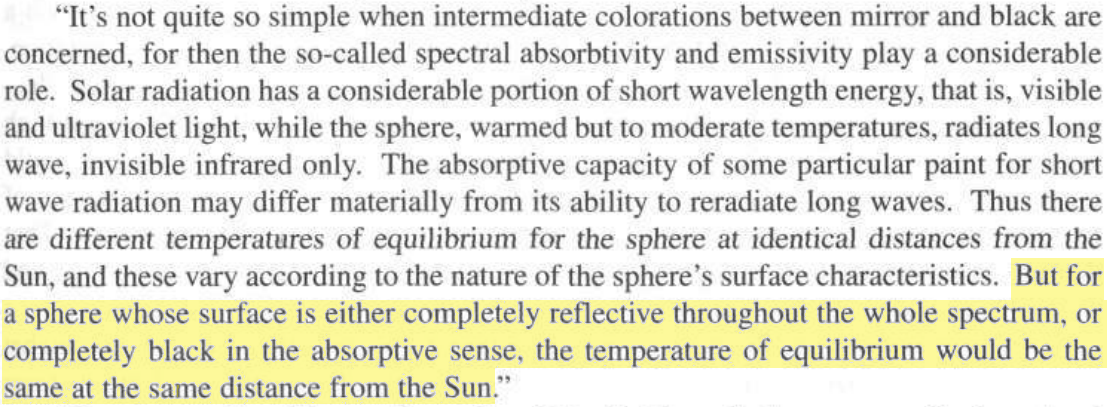
Clark has his boyz head off from Earth for Mars, in a ship rather reminiscent of an English steamer, but I think stuffs up the orbital mechanics. After leaving the jolly old Earth behind, he is saddened when Earth eventually becomes invisible, blotted out by the solar corona. Because of course the path from Earth to Mars is outwards, and so Earth and the Sun will be in line. Oops. von B, by contrast, as you'd expect gets the orbital mechanics right - at least as far as I can tell - but goes wrong in my highlight, where he is explaining temperature maintenance in space (aside: very quaintly, his space station is powered by solar power... but by steam solar power: a mirror boils water, and the spokes of his space station wheel serve to condense it).

This is radiative physics, and somewhat reminiscent of The idealised greenhouse effect model and its enemies. The easy one first: a fully reflective sphere at all wavelengths with no conduction will neither absorb nor emit radiation, and so will maintain whatever temperature it starts with, whatever that might be; there is no "temperature of equilibrium" because there is no transfer to permit equilibriation. But a fully black sphere at all wavelengths (idealised to have a superconducting surface, unless you want to think about the temperature distribution) will not. It will have some equilibrium temperature; if you start it hotter it will cool down, if you start it colder it will warm up. This, incidentally, is from page 93. On page 94 we find the statement that a mirror-polished spaceship will simply retain it's temperature, which is much better, though slightly wrong, because of course the people inside and equipement will emit heat, so it will slowly warm up. So p 93 might be an oversight, or perhaps a translators error; but probably not, because the same error occurs just a little above my quote.

Update: it turns out that Martians exist. They live entirely underground, but their pumping of water from the poles is visible. They are entirely benevolent and more advanced than us, but in need of rejuvenation. There are some tedious dialogues about religion and stuff that I skipped. Despite being more advanced, the Earthmen learn nothing from them; in turn the Martians have at no point listened to Earth radio broadcasts. The return-to-Earth happens with no assistance from the advanced Martians, presumably because von B wanted to prove his point that it could be done.

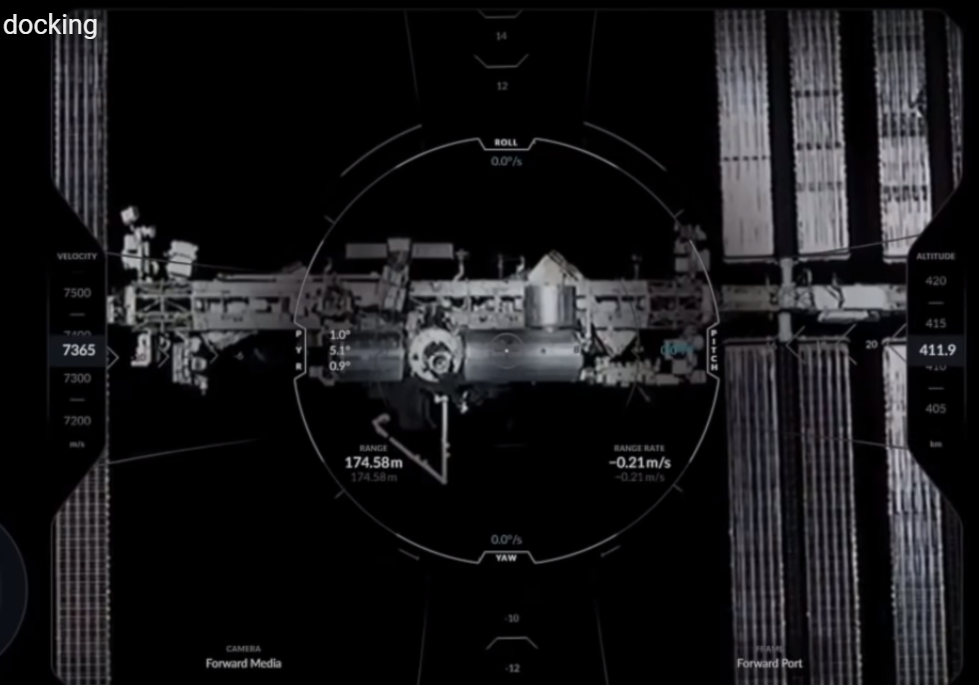
docking

Notes


1. Its also not in constant use. It seems to be available and unused whenever our heroes happen to want to look at it.

2. Also, his propellants are hydrazine and nitric acid. Failing to think of liquid oxygen is odd, I think. For propulsion, that is. There's liquid oxygen for cabin air.

3. Page 102: it turns out that the guidance for the ships will be calculated by giant electronic super-brains, and stored on thousands of magnetic tapes, which tapes will be carried aloft and run by hand through the ship's course-correction facilities. Though a super-special lightweight machine was also to be carried, capable of producing tapes en route.

4. There's also some stuff about nuking the Commies into submission, so cue Tom Lehrer.

2019-02-25

Jobs. Are. Going. Away. Growth no longer creates jobs. Pardon?

calf My headline comes from a twit by mt4, except for the last word and the associated mark of interrogation, which are not his. I'm not sure how much substance there is in this to blog about, but I find, looking back, that I haven't said the obvious1 "jobs are a cost not a benefit" thing very much, so perhaps it's a good idea to have a post for me to reference. But mt in this case is more worried about the jobs going away, which is somewhat different. He should not worry I think; Timmy has told him not to.

Timmy's logic (that human wants are infinite, so there will always be unmet human desires, so there will always be jobs) makes sense to me. Some people react to this in the predictable way: "oh, those sort of jobs . But I wanted a real job, like a coal miner or a lumberjack". That's what Trump and the Trumpists say, of course. Don't be like them. A more plausible objection is that if it's the poor people with the needs they won't be able to pay you; but I think it just doesn't go like that. I could of course be wrong; it isn't as if I'm presenting any evidence, unlike mt's detailed studies.

Speaking of evidence, of course, we could look to the past as our guide to the future. This isn't something you're going to do if you believe the-jobs-are-going-away because, errm, they haven't. The mechanisation of agriculture or spinning didn't lead to vast unemployment; neither did or will the death of coal; and so on. I twot that in the sure knowledge it was a killer reply. mt replied A big question is whether this pattern is some sort of inevitable law which is an advance of sorts, because the original certainty has now turned into a question. We could worry about AI, and indeed I might worry about real AI, but we haven't got that or anything close yet.

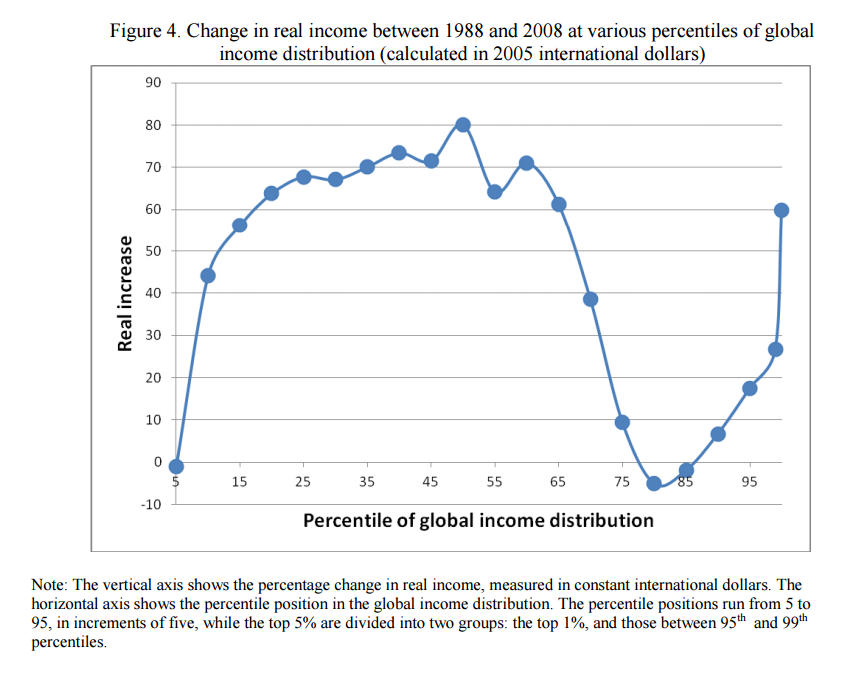
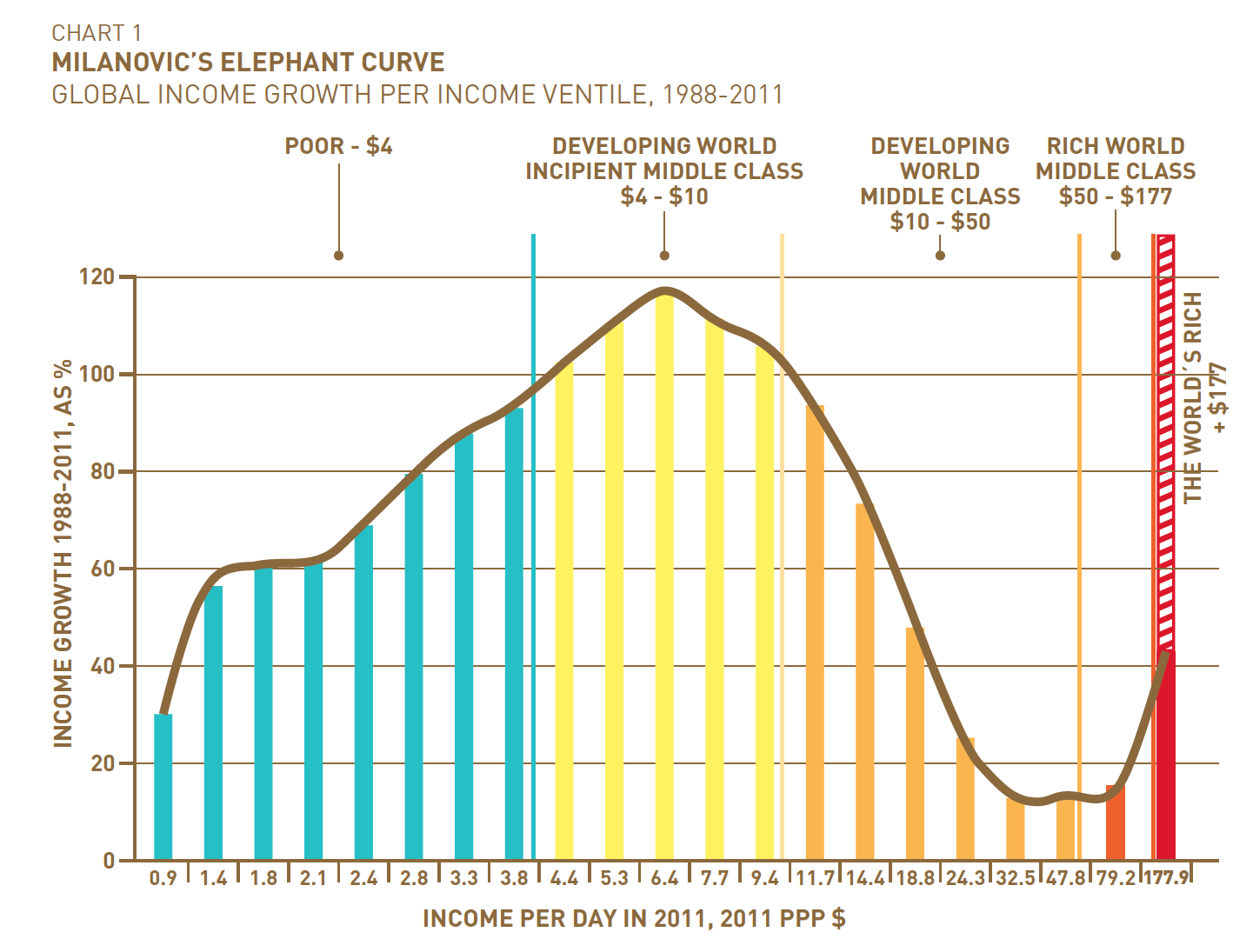
But then comes The main observational evidence is not that employment is shrinking but that it commands smaller wages. Which I think is Not True (but notice that it, too, is a retreat from the original assertion). To examine whether it is true or not you'd need to know whose wages you care about. In this context it is unlikely that mt cares about the global poor, who as we all know are rather less poor than they used to be (as JG helpfully interjects) but this does allow mt to clarify that his sympathy is for Deciles 8 and 9 (western middle class) are having great difficulties, which the graph shows somewhat2, 3.

At which point those not in the know need to know what graph is being talked about, and the answer is this or some variation thereon:

So, OK, there are two points below 0 on that curve, though one of them is so marginally below zero as to be indistinguishable from zero in any statistical sense. And of course, that's ending in 2008, which wasn't a happy year for the world economy. But to turn this into a general summing-up of "commands smaller wages" is not I think realistic. And indeed, here's another version, with a different end point, and a different conclusion in that detail:

The negatives have now gone. Rejoice.

Of course, the future might be different. After all and so on. mt recommends Elizabeth Warren's book on the latter point but I fear she has more than one; and books have many words in them; and I doubt EW; so without something more concrete I won't be pursuing that.


Notes


1. Not obvious to everyone, of course. Indeed vehemently denied by many people. Touched on in Why don’t people pay attention to the future of their own world? in 2017.

2. After this mt and JG wander off into what seems to me a rather odd discussion of "freedom" in the context of freedom to drop out, I think; I don't think that's profitable - to me it resembles the atavistic yearning for Ye Olde Dayes of Happy Peasants.

3. Aside: suppose it were for some reason true that the Western Middle Class were losing out from Globalisation, in the way shown by that graph or more so, but yet the global poor were benefiting as it shows. And that (for inexplicable hand-of-god reasons) you had to choose between that change, and a no-globalisation slight-increase-all-round: which would you choose? Would you choose your local, globally-rich WMC, thereby condemning the globally poor to yet more grinding poverty?

4. This is all a bit personified, but I think mt's views are representative rather than original in this context, so it isn't really personal.

Refs


* Ze Robots are comink
* In the mid 1980s, improved economic conditions for the middle classes led to a dramatic rise in tastelessness
* Paul Voosen: One more time: Despite what you’ve heard, leading cloud scientists are dubious that cooling marine clouds will simultaneously wink out at tripled CO2 levels (retwat by Gavin)
* The Philosophy of Poverty?: My Opening Statement by Bryan Caplan
* The wage decoupling mess by Scott Sumner
* Reflections on the Balan-Caplan Poverty Debate by Bryan Caplan
* Keep on Truckin’ With Economics by DON BOUDREAUX

A child’s garden of wikipedia, part II

52569231_1101942873335365_5705834086749175808_o Piers "mad as a bagful of badgers" Corbyn is sad because I 24/7 replaced good stuff with smears & lies in [his] so-called biography on Wiki. Naturally, I did no such thing, but I thought it might be amusing to find out what I actually did that has riled him so. For some wiki-background that may be relevant, see A child’s garden of wikipedia, part I.

Wiki has a [[Piers Corbyn]] page, whose lede is (currently) the anodyne Piers Richard Corbyn (born 10 March 1947) is an English weather forecaster who owns WeatherAction, which makes weather forecasts. He is the older brother of Labour Party leader Jeremy Corbyn. If you're unfamiliar with his forecasting methodology, think yourself lucky; you can read JA's partial evaluation here if you like. I have 35 edits to the PC page, which you can see for yourself here (arch).

That brings up [[User:PiersCorbyn]] who is (or was; he flounced off in a huff quite some time ago) the wiki-presence of PC. From his contributions you can see he was a one-trick pony, interested only in editing his own page. Which is a bit dodgy because of Wikipedia:Conflict of interest. That isn't absolute, and can be over emphasised, but if you're trying to ram through your own version of your own page, and you've been told about COI several times on your own talk page, then you're going to get blocked. As he was, by me and by that nice Vsmith. The discussion at the COI noticeboard petered out without anything interesting, probably because PC's last edit was on December the 24th so it all became moot.

But what of the substance? Mostly it was this and similar edits. PC would like to be thought of as a British weather forecaster and consultant best known for his ability to predict the weather up to one year in advance through the study of solar activity particularly charged particle and magnetic effects rather than a controversial British weather forecaster and  consultant best known for what he claims to be the ability to predict the [[weather]] up to one year in advance through the study of [[solar activity]], specifically charged particle and magnetic effects. Well, you can see why he would prefer his version but it is less clear why wiki would. That he insisted on adding His scientific advances and independently verified forecasting skill and his ‘climate sceptic’ views on CO2 based theories of global warming have caused distress among some ‘green campaigners’ who frequently spread and inaccurate information about him and his forecasts. This unacceptable activity includes inserting false statements in his biography in Wikipedia so if you are reading this please keep a copy for future reference before it gets falsified. If you want to check anything for yourself please contact Piers Corby himself via the WeatherAction website didn't exactly help his case. So, having tried and failed to edit what he added into something sane, I reverted it; rinse and repeat a few times. Then Vsmith blocked him for 48h for not paying any attention to the rules, whereupon PC said I have got better things to do with my life than piss around with reversion games and that was the last we heard of him.

In my defence, I thought things might be a bit more interesting when I began this post, and having written it I felt reluctant to throw it away.

Refs


* Boris Johnson is a tosser
* Piers Corbyn, his brother and communist weather forecaster

2019-02-21

Moah suing news

52352356_1101948060001513_6245324804245684224_n Nice picture, isn't it? It looks like finger-puppetry, which is why I chose it, but it's supposed to be the "all powerful" hand. Anyway, on with the story.

Judge Tosses Penn. Case, Challenges Legal Merit of Kids Climate Cases says ClimateLiabilityNews, and just like Alsup it's one where the judge has decided that the case is fundamentally politics not law1, and so should be settled by pols not men-in-wigs. The man in a wig is unusually forthright4 in this case: The Clean Air Council and two minors ask me to declare that the United States of America, the President, the Secretaries of Energy and the Interior as well as the Departments themselves, and the Environmental Protection Agency and its Administrator have violated and will violate Plaintiffs’ rights by considering amendments to environmental laws, by “rolling back” environmental regulations, and by making related personnel and budget changes... Plaintiffs thus effectively ask me to supervise any actions the President and his appointees take that might touch on “the environment.” (Id.) Defendants have moved to dismiss... Because I have neither the authority nor the inclination to assume control of the Executive Branch, I will grant Defendants’ Motion.

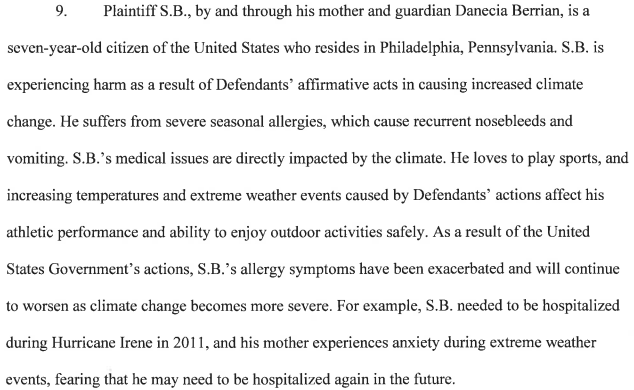
Before I go too far I should comment on some of the claims made. Sadly it seems to be a non-cut-n-pasteable PDF, so here's a screenshot. Meh. The kid would appear to suffer from medical issues, but the attribution to global warming is weak at best and no basis for a court case. It's kinda irrelevant anyway, though, because as CLN so delicately puts it, the judge "tossed2" the case for more fundamental problems than that.

implausible If you make it as far as para 31 and following, you'll see that they focus on the Trumpkin's "Rollbacks", which they assert are built on and motivated by "junk science", and that the govt has thereby effectively waged war on facts, data, motherhood and apple pie3. These are large claims and look more like rhetoric than sober analysis. You don't find out exactly what they mean by Rollbacks until para 141, BTW.

There appear to be some fairly basic legal errors in the case (IANALTG). On standing, hizzoner says Although the Amended Complaint is almost 200 paragraphs long [are these people getting the hint yet that boilerplate verbiage isn't always great?], only three paragraphs (one page) include a description of Plaintiffs or the harms they have suffered. The Clean Air Council make the schoolboy error of failing to even claim any damages, so have no standing. As to the two individuals, they fail on Traceability: Defendants argue that Plaintiffs: (1) fail to trace their injuries directly to Defendants’ actions; (2) ignore the role that third parties have played in causing such injuries; and (3) improperly aggregate “vaguely-defined categories of government actions and inactions.”... I agree that Plaintiffs have not made out traceability. This is the usual kind of problem. Amusingly, there's also Given that Plaintiffs sustained their injuries as early as 2011, those injuries cannot be traced to Defendants, whose challenged actions began in 2017, which is a bit of a "duh who wrote this complaint" kinda thing.

Perhaps most importantly for elsewhere, there's
Plaintiffs simply ignore that Defendant agencies and officers do not produce greenhouse gases, but act to regulate those third parties that do: innumerable businesses and private industries. The materials on which Plaintiffs rely make this clear. 
Um, I've said that before. This is going to be the hurdle at which lots of claims fail. After all that there's some stuff about Right to a Life-Sustaining Climate System, about which el wiggo opines The Third Circuit has held that “there is no constitutional right to a pollution-free environment”  and then tosses a bomb at Juliana: As of this writing, a single court has recognized a substantive due process right analogous to what Plaintiffs urge here. See Juliana v. United States... Yet, the Juliana Court certainly contravened or ignored longstanding authority. And so we end with it appears that the scope of the “fundamental” right Plaintiffs invoke has no clear limit. This, as much as anything, underscores that Plaintiffs do not seek the Court’s assistance in adjudicating a legal dispute. Rather, Plaintiffs disagreement with Defendants is a policy debate best left to the political process. And I agree. I'm all for a political process that addresses GW - via carbon taxes, not the awful Green New Deal - but it looks more and more like the courts are a dead end. My More bad news for photogenic teens has me musing about where to go.

Notes


1. And certainly not about science. Remember how exciting it was, briefly, when "the tutorial" was on? But then the Evil Oil Companies unsportingly put an end to that by agreeing with the IPCC. The rotters! Where's the fun in that?

2. You are, I'm sure, far too sensible to follow a link on "tossed" unless you're of a not-too-delicate disposition. It's one of my all-time favourite Viz cartoons.

3. Yes, I made a little bit of that up. See if you can guess which.

4. Indeed there are hints that he is a little pissed of, speaking of their lengthy, two count Amended Complaint. Perhaps this could be taken as a hint that not everyone needs to go over the same basic science again and again.

Refs


* Old suing: Kivalina v. ExxonMobil Corp.

2019-02-16

Nash-in-nole Emergence-y

nash-in-ole From "Adolf Hitler: my part in his downfall" by Spike Milligan. This is volume 1, things are still funny, no-one has died. Well, no-one he knows, anyway.

Which seems a rather apt lead-in to Trump; you may as well get your Godwins in early and accurately1.

So, is it a nash-in-ole fuckin' emergency? No, of course it isn't. The idea is absurd; no right-thinking person could possibly agree. Only in a nation with debased political discourse could such an idea even be briefly entertained.

However, as in all such things, Trump has people running cover for him. For example:

* Climate change is a national emergency.
* 28 million Americans without health insurance is a national emergency.
* Children in cages is a national emergency.

No. None of these things are national emergencies. They are all problems that you would like solved, but they aren't emergencies. And pretending that they are just provides cover for Trump and his fanbois.

I'm currently reading The Federalist Papers, which is largely Madison selling the proposed constitution by pointing out the numerous checks and balances. He isn't too bothered by the powers of what he calls the "Chief Magistrate"2, relying on the power of Congress (ironically, of the purse) to restrain him if necessary; and of course underlying all is the will of the people.

Update


As a couple of comments have suggested, and as TF says more explicitly, it is possible to see this as Congress deliberately abdicating responsibility. This, I think, is something Madison didn't consider: the constitution depends on each branch being jealous of its rights.

Notes


1. Hint: you can't invoke Godwin to mean "I don't like that" without looking silly.

2. I think he uses the term in a deliberate effort to play down the role. No nobility no king was a big thing at the time.

Refs


* CHAPTER 34—NATIONAL EMERGENCIES
* There Is No National Emergency on the Border, Mr. President by ALEX NOWRASTEH
* Speaking of comedy, there's What would happen to Earth’s Climate and Weather if we had no Moon? at WUWT - but you may prefer We Like The Moon.
* ECONOMISTS’ STATEMENT ON CARBON DIVIDENDS - The Largest Public Statement of Economists in History
* California high-speed rail and the American infrastructure tragedy, explained; or Lessons from the Golden State by Scott Sumner; or Making Tracks in the US by Eli; or CA HSR, RIP (kind of) by Brian.
* Deadlock and Partisan Bitterness - by Bryan Caplan
* The Dangers of Government by Executive - Volckh
* Democracy in Decline? by Loren E. Lomasky
* Apology for a Trainwreck by Bryan Caplan - poverty and sociology
* Is Climate Change like Diabetes or an Asteroid? - Nordhaus
* The Props assist the House by Emily Dickinson - TF

2019-02-10

The truth about big oil and climate change

20190209_LDD001_0 The Economist offers to tell you The truth about big oil and climate change. And on the whole, it does. This is welcome; less than a decade ago their review of Moah Chants of Doot failed to even mention GW1 though to be fair by 2012 they'd given up such nonsense.

However, it is necessary to read what they say if you want to know the truth; just looking at the pix and reading the short words written in big letters and confirming your preconceptions is not a good way of obtaining information. There are any number of people getting this wrong; either egregiously or egregiously.

The easiest way to go wrong is to stop at their sub-title: Even as concerns about global warming grow, energy firms are planning to increase fossil-fuel production. None more than ExxonMobil. Bad oil companies! Bad Exxon! What could possibly excuse such behaviour? If you really can't think of the answer and need to be told, then you need to go back to remedial school4. The answer is the bleedin' obvious: Yet amid the clamour is a single, jarring truth. Demand for oil is rising and the energy industry, in America and globally, is planning multi-trillion-dollar investments to satisfy it. And It would be wrong to conclude that the energy firms must therefore be evil. They are responding to incentives set by society. The financial returns from oil are higher than those from renewables2.

The Economist admits that the market cannot solve climate change by itself which I think is both true and uncontroversial. But it continues Muscular government action is needed. Contrary to the fears of many Republicans (and hopes of some Democrats), that need not involve a bloated role for the state. After a pause for a brief sideswipe at the Green New Disaster, it continues The best policy, in America and beyond, is to tax carbon emissions, which ExxonMobil backs3.

As I Twote:
Setting policy is a task for Govt. Don't blame Exxon if your govt is crap. Mostly, blame your voters.

Disclaimer


Did I mention that my parents in law used to work for Exxon? And that we have benefited financially from this. I've said this before, of course.

Notes


1. They were fairly shitty over CRUgate, too, but then so were the rest of the Meeja.

2. And perhaps in implicit rebuke to those worried about "stranded assets" it notes that the typical major derives a minority of its stockmarket value from profits it will make after 2030. Incidentally, the bit about returns-from-renewables being less is something of a red herring. FF companies know about... FFs. They have no particular advantage in renewables. Although the mindless tend to think "they produce energy. Renewables also energy. So FF companies can do renwables! It logic!" this is not logic, it is wrong. Indeed, as I've argued before - but cannot now find - I would argue that it is better for FF companies not to invest in renewables: that way you have a nice investment choice: if you want to invest in FF you can, if you want to invest in renewables you can. If substantial work in renewables were done by FF companies, the market signals would be all mixed up.

3. Technically it is true that Exxon backs a carbon tax, but their support is weak at best. They were sponsoring sane things all the way back in 2005, I find.

4. Note that you don't have to agree with the answer (though you're wrong if you don't); but you do have to be able to think of the answer; or rather, you should already know it.

Refs


* Who Gets How Much in a Carbon Tax-and-Dividend? - QS
* Cowen on the Egalitarianism of the Economics Profession - by David Henderson

2019-02-09

Old suing: Kivalina v. ExxonMobil Corp.

50732285_2186088528122735_7685062365158572032_o Oddly enough, I missed this one when it first came out a decade ago: Kivalina v. ExxonMobil Corp.. I find it now via ClimateLiabilityNews's Ninth Circuit Nominee Has History of Defending Big Oil, Including in Liability Cases. And there's little to say, other than I would have argued it an obvious precedent for the Alsup case; with the slight difference that the "tenuous" chain of science is stronger; but that's not the key issue. I only wrote this so I have a note.

But while I'm here...

Kavanaugh


Since I previously opined on K, I note the Graun's whinging in Brett Kavanaugh should never have been allowed on the supreme court. This comes in the category of news-that-is-not-news: all we learn is that the Graun has not changed it's "mind", yawn. I pass over the analogy to sub-prime, which is stupid1. Now I look closer, that entire article is an undigested regurgitation of all past grievances; let's pass on to another. The substance is The US supreme court voted 5-4 to block a Louisiana law that would have dramatically reduced access to legal abortions in the state. So the Graun has what it wants (for others) but that isn't enough, because K dared venture a dissenting opinion. The Graun is terribly worried that K will overturn the RvW precedent, and is therefore obliged to ignore K saying All parties... agree that Whole Woman’s Health is the governing precedent for purposes of this stay application. I therefore will analyze the stay application under that precedent. And goes on to argue -correctly I think - that the case turns on competing predictions about whether certain doctors can obtain "admitting privileges". And produces a certainly plausible, and arguably correct, argument that the predictions could have been tested experimentally with no harm. See-also SCOTUSBlog.

The missing element here is the question as to whether the law could possibly do what it purports to do, offer any protection. K's proposal would leave no time for training of any sort, so the doctors would either end up, bureaucratically, with a piece of paper with a rubber stamp on it or not; and why that would do anyone any good is unclear. However, against that, the law is full of instances where pointless rubber stamps are required, so perhaps there's no reason this shouldn't be another one.

My own view is that the usually-omitted context for all of this is not that the SCOTUS is making law but that it is striking down law, or not. The positive law-production is the province of the states, in this case; and being in the middle of The Federalist Papers2, it seems clear that the original constitution was intended to give wide latitude to the various states.


Refs


* Kivalina: And so it begins… (2015)
* Kavanaugh’s views on EPA’s climate authority
* Kavanaugh's other dangerous assault - on the environment?
* BRIEF OF INDIANA AND 14 OTHER STATES AS AMICI CURIAE IN SUPPORT OF DEFENDANTS-APPELLEES - via WUWT (sadly none of my other sources seem to cover this)

Notes


1. The analogy is stupid. My passing over it is sensible. Arguably it would have been even more sensible to treat it with the contempt it deserved and ignore it entirely.

2. Interesting, and I will finish them, but they're something of a burden.

2019-02-08

500,000,000,000 is a small number

frankie Small compared to the number of atoms in the universe, of grains of sand on a beach, or of bacteria in a hooman; but in units of dollars it would be enough to get me out of bed. Written into a political tract it certainly looks like a large number, but we all know that we shouldn't trust political tracts. Which brings me to Cortez the Killer1 via Dave Roberts: global warming at or above 2 degrees Celsius beyond preindustrialized levels will cause... more than $500,000,000,000 in lost annual economic output in the United States by the year 2100.

What is $500 B small in comparison to, in financial terms? Yes, that's right: the US GDP, currently $20 T or if you like, $20,000 B. By 2100 it will be - go on, let's guess a round number - $50,000 B; and so $500 B is 1% of that.

Throwing away 1% of GDP is not something you want to do wantonly3. Which is why you shouldn't adopt the policies in the Green New Deal, because they would cause far more damage than that. Just look at Venezuela4.

Refs


* Having said all that, for balance I should give you someone who likes it: David Roberts.
* David Appell isn't keen on all aspects.
* Caedite eos. Novit enim Dominus qui sunt eius. I must find somewhere to work this is.
* The case of the reviewer who said cite me or I won’t recommend acceptance of your work.
* Making Tracks in the US - Eli.
* They Live.
* Utopia now: The problem with the Green New Deal: A deeply unserious proposal to tackle climate change - the Economist.
* Republicans Have Better Solutions to Climate Change say Greg Walden, Fred Upton & John Shimkus. Their solution is to do nothing; this is better than the GND, but their inability to say "carbon tax" condemns them.
* Another way to fail: Bernie for President says Tamino.

Notes


1. Appropriate, no? And the women all were beautiful / And the men stood straight and strong / They offered life in sacrifice / So that others could go on. / Hate was just a legend / And war was never known / The people worked together / And they lifted many stones / They carried them to the flatlands / And they died along the way / But they built up with their bare hands / What we still can't do today2. Everything was harmonious, and even the human sacrifice was done in an ethnically appropriate manner.

2. This annoys me. Of course we could do it today, if we wanted to. This isn't LotR world, or Plato's Age of Iron looking dimly back to an Age of Gold.

3. Yes, I know. There's a long difficult and currently-inconclusive argument to be had about how accurate any such estimates are, and whether they wildly underestimate the true damages. But today I'm just trying to talk about Timeo Civilibus et dona ferentes.

4. Or that nice Mr Lenin. You may think the pic "unfair". But I like it, and the song.

2019-02-07

Moah costs and benefits

While ATTP tries and fails to find common ground with JC, I rather liked the pic which he found over at Reducing greenhouse gas emissions helps the economy by Patrick T. Brown, PhD1. In the end, it will turn out that there's less to the picture than meets the eye, but it isn't a view I was familiar with, so worth looking.

We start from the assumption that we're on the blue dot at the moment: which is to say, we're burning as much fossil fuel as we possibly can, consistent with making a fast buck. This is obviously a heavy idealisation but I think it is in principle trueish. And from this and smoothness assumptions, we can deduce that the shape of the marginal benefit curve of extra emissions is flat at the point we're at. And therefore we can deduce that as long as the shape of the marginal costs is negative, as we'd plausibly expect, then the "optimal" emissions - if all was accounted for - would be less than they are now.

This is little different from the familiar idea that "social cost of carbon" represents an uninternalised externality consequent on FF burning, and if costed in would reduce FF burning by increasing its costs. Although what this figure does it make it clearer that adding in SCC doesn't then reduce your "optimal" emissions to zero.

If we continue with ATTPs thoughts, we come to It’s already clear that there are economic (and other) benefits to emitting less than we otherwise could. Of course, this doesn’t tell us how much less we should emit, but it does tell us that some kind of optimal pathway involves some level of emission reductions. And here we hit the problems. Firstly, indeed, this kind of schematic gives us little clue as to how big the "optimal" reductions might be - indeed they might be trivial - and the Nordhaus stuff he inlines indicate an "optimal" pathway with apparently flatlining emissions; we've already talked about whether this is plausible or not. But there's also the problem that there's no control knob on the economy marked "FF burning", other than the one we're not prepared to use, carbon taxes2. And this is a problem because you only get to quote the "optimal" results if you do it in the optimal way. If you do it in a distinctly non-optimal way by subsidies and regulation, you get a non-optimal result.

Notes


1. Don't tell anyone, but PTB credits it to Tol. Look closer; his name is even on it.

2. Or cap-n-trade, which is worse.

2019-02-02

A note on fossil fuel subsidies

In the course of discussions on GW, one often encounters statements like direct subsidies for fossil fuels amount to more than US $500 billion per year worldwide. In this case, because of the magic word "direct", you can probably trust that the number is plausible. However, there still remains the problem of interpretation. Who is the statement aimed at? Apparently, the people and government of the West. Unfortunately, that page doesn't really provide references (it makes some token towards them, but since nothing is connected or annotated, their "references" are useless). Some Googling gets me Direct Fossil Fuel Subsidies Worldwide: Half a Trillion Dollars Annually - commentary and findings, whereupon it becomes clear that the numbers are most of a decade old, but never mind (actually it is a bit worse that that, because although the headline is $500B, and the text carelessly says "roughly $500 billion in 2010", as the graphic shows the number is $409B, which does not naturally round to $500B). We discover that $125B comes from Iran+Saudi, quelle surprise. Russia+China are another $60, and India (madly; but their pols are perhaps even more broken that others) are $22B. For a grand total of most of half the $500B more than half of $409B. and we haven't gone anywhere near the West yet.
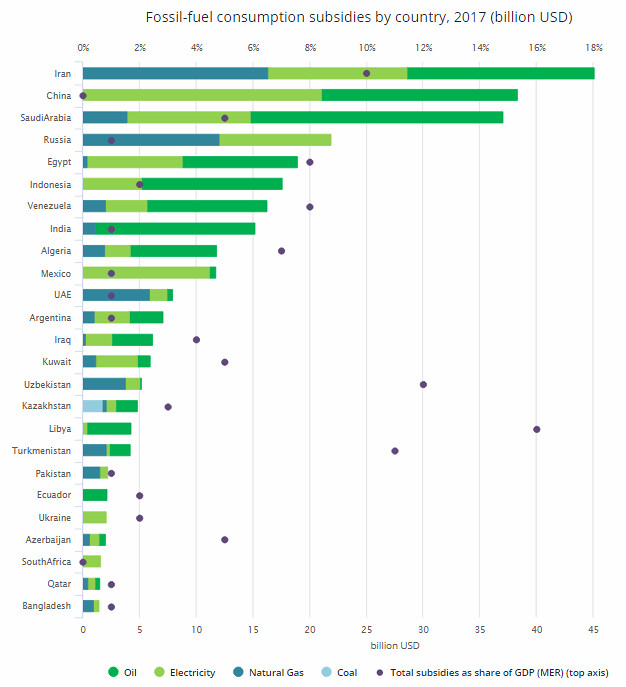
But wait, it gets worse. The number for India is very badly out of date; this for example suggests "only" $8B in 2017. And if I then poke around, I find that the global total for 2017 is "only" $300B.

So, isn't this just a bit shit? How come that of the proudly-touted list of 3200 Belgische wetenschappers en academici, not one of them could be bothered to source their statements properly or check the numbers?

Anyway, here's a fuller pic, from the IEA. As you'll see, and as you'd probably expect, it's a pile of tin-pot energy-banana-republics.

tinpot

Which of course points you to the solution: it's nothing to do with GW, or subsidies specifically; it's "better governance".

Refs


* Imaginary $500B not enough for you? Why not go for $5T instead?
* How to decarbonize? More free market!
* Schumpeterian Profits in the American Economy: Theory and Measurement by William D. Nordhaus; NBER Working Paper No. 10433
* The marten menace: What’s cute, furry and can disable a particle accelerator?
* Corruption is still rife around the world - Economist
* Analysis: Why the UK’s CO2 emissions have fallen 38% since 1990 - Zeke Hausfather
* A rose by any other name by Scott Sumner

2019-02-01

L'affaire Christy

50837219_2006761279392719_3327335112948842496_n John Christy has been appointed to an EPA panel, and people are sad. For an example of a plausible response1, I offer you John Christy Was Just Named An EPA Science Adviser. His Climate Studies Have Been Repeatedly Corrected, from BuzzFeed. For an implausible example, you can have Scientist Who Rejects Warming Is Named to EPA Advisory Board from NotReallyVerySciAm. They kinda give the game away in their subheader: John Christy has advocated for the repeal of regulations on greenhouse gas emissions. This is a crime in NRVSciAm world.

But what are JC's actual crimes? He was one of the first to push the federal government to conduct a “red team, blue team” debate on climate science. That was a decade ago. Now he wants to use his new perch on the agency’s Science Advisory Board to challenge climate science consensus. I noticed him arguing for a Red Team in 2017, along side the other JC, and I'm afraid his arguments didn't impress. But, meh. The Red Teamers are a bunch of clowns who have  hidden behind no-one actually bothering to run a Red Team; if Christy wants to stand up and present his errors to the panel, they'll get rebutted.

There’s a benefit, not a cost, to producing energy from carbon, NRVSciAm report JC as saying, and so contemptible is this statement that they don't even bother to attempt to refute it. But, it is true: burning FFs has benefits and costs; if you want to reduce it to one number of (benefit - cost) then it is a net benefit2.

But wait: NRVSciAm has When asked what his first priority would be as a member of the SAB, Christy said he would try to convince his colleagues that nature is responsible for rising temperatures, not people. If those were JC's actual words, then they would have him bang to rights. But of course they aren't JCs words. Instead, we have “I think it would be to demonstrate to the board what we know about climate and its variability and what’s really going on,” Christy said. “And secondly is our inability to characterize it well with our models.” Notice that NRVSciAm can't let you read JC's words without pre-interpreting for you, just in case you might make up your own mind. I'm not convinced that our inability to characterize it well with our models is particularly accurate but it's within the bounds of reasonable debate.

In contrast to the apparent panic at NRVSciAm at one not-one-of-us getting onto the EPA panel, Gavin rather wisely appears unperturbed: If they want to waste their time going after the endangerment finding, they’re just wasting their time, and better that they waste their time than they do something actually destructive.

Notes


1. In the headline, and much of the article. I think their starting a history of botched research is unjust. They made mistakes, and weren't exactly that forthcoming when others found their mistakes, but meh; that's not unusual. For something I wrote in 2010, try here; but there's loads more history on this one.

2. We've done this before. Remember?

Refs


* Twatter reminds me of John Christy, Richard McNider and Roy Spencer trying to overturn mainstream science by rewriting history and re-baselining graphs by Bart Verheggen from 2014. Which won't improve your view of JC.
* Symposium: Government agencies shouldn’t get to put a thumb on the scales by Jonathan H. Adler: on Auer deference, as compared to Chevron deference.
* [[UAH satellite temperature dataset]]