2019-09-26

Demons Tormenting St. Anthony

Niklaus_Manuel_Deutsch_001The Dems have finally plucked up courage to impeach the Mango Mussolini2. Some people have been longing for this for ages; here for example is CNN being rather hopeful. But... will it work? I'm dubious. "Work" in this context means remove him from office, rather than just provide PR and talking points. The Dems are charging him with betraying his oath of office and the nation’s security by seeking to enlist a foreign power to tarnish a rival for his own political gain. Which sounds bad, put like that. What appears to have happened is that in a phone call to the Ukraine, Trump rather strongly pushed them to pursue corruptions allegations against Biden(s). Many people will interpret this as CIP did. I do, too.

However, there are two obvious lines of defence: (1) Trump was merely expressing the opinion that the Ukraine should forcefully pursue corruption in the country1; and (2) that the connection to the national security of the US is rather weak. So while the Dems will be all for, I think any Repub that wants an excuse to be against will not find it hard to find one, unless something rather more damming comes out. At least, while opinion remains as it is. If in the course of the inquiry enough comes out to turn people against him, that would change things. But so much has already become public and not changed his base support, why would this?

Notes


1. Which is arguably entirely true - that they need to pursue corruption more strongly. What I don't think is true is that Trump gives a toss about that.

2. Per comments: not quite. This is an impeachment inquiry, not an actual impeachment, at the moment.

Refs


* Realignment, Not Upheaval, Defines Our Political Moment by Stephen Davies
* Politics is the problem---trade is the answer by Scott Sumner
* Defending Some of Stephen Moore’s Ideas (Sort of) by Thomas Firey

2019-09-24

Boris Johnson is a tosser

48712863271_b6d44bbb98_o Bojo previously won an award for being the only person I've called a tosser twice; and now tops that by getting a third accolade. The context: Boris prorogued parliament, it-is-to-be-presumed in an effort to avoid parliamentary debate and scrutiny; in particular to avoid them seizing the order and passing a law to force him to ask for an extension to Brexit. That failed, so arguably the case was rather pointless, though we'll see.

My own opinion was that the judges would rule the matter justiciable, because it increases their remit. I'm doubtful that it is fundamentally as opposed to opportunistically good; and think that the matter is political and so outside the court's purview, as the govt argued. The court has an obvious conflict of interest, inevitably. However, given the tenor of the times, there will be general public and MP support for the judges, so they've picked their time well. Given that, Bojo was a fool for risking this1. Judges find law rather than making it at least in theory, and what they've "found" now gives them authority to intervene in pretty well anything they like. Per Hobbes: the Interpretation of all Lawes dependeth on the Authority Soveraign; and the Interpreters can be none but those, which the Soveraign, (to whom only the Subject oweth obedience) shall appoint. For else, by the craft of an Interpreter, the Law my be made to beare a sense, contrary to that of the Soveraign; by which means the Interpreter becomes the Legislator. Note that in this context "appoint" doesn't just mean fire-and-forget; it means control.

Tomorrow - as that wazzock Corbyn just said on the R4 10 pm news - parliament will resume. It will be interesting to see what they manage to do with that. Because arguably all they needed to do, has been done2. Will they manage to "scutinise" him? It would be fun if he had a meltdown.

The judgement itself carefully avoids saying Bojo lied to the Queen, presumably in an effort to keep her out of all this mess: We do not know what the Queen was told and cannot draw any conclusions about it. That is I think a small rebuke to the Scottish meninwigs. The two examples that the courts offer for justicability in para 32 are unconvincing, as well as very old, and don't obviously relate to the matter at hand (para 41 might be more convincing but I didn't look at any of those cases). I think they know they're on very thin ground here. Notice also the weaselly might have been accomplished in para 33; as they know full well, it's too late for that. para 35 points out that there is existing case-law that the analogous dissolution is non-justicable; they then spend a lot of words ignoring that. Para 50 then sets out a vague "standard" that could be interpreted by anyone any way, and para 51 somewhat dishonestly asserts that it's a good standard. After that I think it becomes uninteresting; they've made up their minds and will wrap some words around whatever they want to decide.

Side note: I think the lack of prorogation means there is no Queen's speech, which means if Bojo wanted to put anything tricky into that, he's probably stuffed.

Notes


1. Honesty compels me to confess that my prediction was that they wouldn't do anything like void the progation; but Bojo has higher paid advisers than me. Bojo's main sin is to be a lightweight piece of fluff at a time when someone competent was required; perhaps he was correct to back off last time.

2. Indeed, if they hadn't been prorogued, they'd probably still be vacillating.

3. Sumpers sounded sensible on R4 but what he wrote in the Times does not. Most of it evades the issue, and the bit to the point (Yet the Supreme Court’s judgment should be welcomed even...) is wrong. As, of course, is "Parliament is the supreme source of law".

Refs


* See-also my comment at Is That Cricket? by Bryan Caplan
* Dems go for impeachment; pass the popcorn
* Global schadenfreude shortage looms after huge surge in demand in UK
* Mostly true but false in one v important way that is why ppl keep underestimating him - he's a much more complex person than Cameron who really was just as he seemed says Dom.
* Britain | End of the clown show? - Economist, 2023.

2019-09-22

Words for the word god

tumblr_osmlmgzKN01qi9bubo1_640
He moves in darkness as it seems to me, Not of woods only and the shade of trees.

A three part article, you lucky people. We start with IAMs: oh no, not again (time and again I tell myself I'll stay clean tonight). Kevin Anderson - yes, I fear it is him again - rails that IAMs professionalized the analysis of climate-change mitigation by substituting messy and contextual politics with non-contextual mathematical formalism. ZOMG! "professionalised" used an insult. He'll be telling us that we don't need no steenkin' experts next. But there's a clue to his thinking there: he doesn't like the answers from the IAMs, and wants to wish them away. Rather like the Watties, who don't like the answers from the GCMs and want to wish them away. [Update: note that ATTP has an IAMs article; I'm in the comments.]

Nurture's lead in to the "debate" (not a debate; just two different views) is rather useful, if you read it carefully:
global warming... is one of the greatest threats facing humanity today...It is a complex issue that involves many social, technological and physical processes. To describe the intricate relationships between these processes, scientists have devised computer simulations known as integrated assessment models (IAMs). IAMs are used to generate pathways for climate-change mitigation that are consistent with global temperature targets. Some scientists have suggested that IAMs are no longer fit for purpose and that meeting climate targets will require a radical reinvention of industrial society that the models are not equipped to address.
The key word in there is consistent which "messy and contextual politics" very much isn't. KA's preferred messy stuff is a way of wishing away problems by preventing a consistent view. This is the epicycles stuff all over again. The IAMs are a way of keeping you honest; you can't ask for inconsistent things. To assert that For more than two decades, IAMs have been part of this accelerating failure [to tackle GW] is drivel; that's about as sensible as blaming GCMs for "failing to solve" the problems they show. Ultimately, none of this matters to KA, because he already knows that what is required is immediate and radical change across all facets of society. And so we're back to GND-ery. I don't think people like KA can talk clearly about "the current economic system". If he means overthrowing capitalism, he can fuck off. If he means replacing the current fossil fuel infrastructure with something that doesn't fill the atmosphere with CO2, then there's a conversation to be had, if he can avoid pre-judging how to do it. Pretending they are the same thing, or failing to clearly distinguish them, is going to lead to confusion.

For part two, Twatter again offers a thing, Vaclav Smil: ‘Growth must end. Our economist friends don’t seem to realise that’. It's a fawning2 interview with a guy with a book to sell. We start with the familiar (and probably wrong; depending on how he is defining things; being a Graun article, things are of course not defined): one crystal clarity: that growth must come to an end. Our economist friends don’t seem to realise that... The economists will tell you we can decouple growth from material consumption, but that is total nonsense. But at least it's nice of him to make it clear that he isn't an economist. Some things I at least half agree with: We could halve our energy and material consumption and this would put us back around the level of the 1960s. We could cut down without losing anything important. Life wasn’t horrible in 1960s or 70s Europe. I don't mean the longing for the goode olde dayes (stuff like We are buried under information. It’s not doing anyone any good. makes me think he does so long); I just mean that we could all live simpler lives and be happier. I certainly can't argue with his We are so fat in terms of material consumption. What's quite absent, though, is any suggestion of how to sell that to the masses. I don't think you can. He has no ideas: in reply to How do we move in that direction before the risks become unmanageable? he offers In some places we have to foster what economists call de-growth. In other places, we have to foster growth. This is not an answer, it is an evasion; neither he not his interviewer nor apparently the Graun;s editor seem to realise this.

And part three (and last, you'll be relieved to know): Stop obsessing over your environmental “sins.” Fight the oil and gas industry instead by Mary Annaise Heglar. In Vox, so probably wrong. People are struggling to work out what they should tell people to "do" about GW. There are two obvious temptations: to tell people to clean up their own act - aha, but then that "guilts" people and that's "bad" - or to blame "someone else" which is stupid and leads to people doing nothing. But seems to be where she's going: We need to let go of the idea that it’s all of our individual faults, then take on the collective responsibility of holding the true culprits accountable. But the point is that the composite of all our individual faults is the "true culprit". We are the people emitting CO2. Not fossil fuel companies; they just supply it. They supply it because we buy it. If we stopped buying it, they'd stop supplying it. Markets work like that (unlike, say, the German govt, which is ramming lignite down its citizens throats even though they don't want it3). When suggesting non-personal action the article rapdidy runs off the rails: Organizing neighbors to sue a power plant that’s poisoning the community is a personal action. Yes, but it's also irrelevant: CO2 is not a poison in that sense. Efforts to sue against CO2 are generally stupid and failing. And at the end the article rather than running off the rails just runs into the sand: All I need you to do is want a livable future is sweet, but not actionable1.

While I'm on that article, it has more wrongness, for example Once upon a time, perhaps, we needed a strong grasp of science to understand climate change, but now all we have to do is look at the daily headlines — or out our windows. This isn't true. Understanding GW takes just as much science now as it ever did. Perhaps the author means understanding the importance of GW. That, now, is commonplace in headlines. But cannot be seen out of the window, of course.

Notes


1. You might reasonably ask what my brilliant plan to save the world it. If anyone is kind enough to actually do this, I'll probably write a post on it. But in brief it is (a) education and (b) impose carbon taxes instead and hope that solar photovoltaic saves us.

2. You doubt me? How about You are the nerd’s nerd. There is perhaps no other academic who paints pictures with numbers like you. You dug up the astonishing statistic that... Your one-man statistical analysis is like the entire output of the World Bank.

3. Struck, because probably wrong. Hard coal was subsidised; it looks like lignite probably wasn't.

Refs


* Quiggin Needs a Third Lesson by David Henderson

2019-09-18

Mann vs Ball dismissal: the transcript

MVIMG_20190908_161528 That nice Prof Mann says The official court transcript for the Tim Ball defamation case is now with the validity of the Hockey Stick, data, code, or anything else of that matter. As the transcript shows, the dismissal was due to the fact that continuing litigation was too onerous given Ball's age, poor health & infirmity (and, as his own lawyers pleaded in their filings to the court, the irrelevance of his attacks on me given they were ignored by media): https://www.bccourts.ca/jdb-txt/sc/19/15/2019BCSC1580.htm.

MM, whilst obviously correct that Ball hasn't won on the facts and definitely isn't exhonerated by the ruling, is somewhat evading the main reason for dismissal, excessive delay. As hizzoner puts it: The total time elapsed, from the filing of the notice of civil claim until the application to dismiss was filed, was eight years. It will be almost ten years by the time the matter goes to trial. There have been two periods, of approximately 35 months in total, where nothing was done. In my view, by any measure, this is an inordinate delay...  Additionally, based upon the evidence filed, the plaintiff and his counsel appear to have attended to other matters, both legal matters and professional matters in the case of the plaintiff, rather than give this matter any priority. The plaintiff appears to have been content to simply let this matter languish. Accordingly, I find that the delay is inexcusable.

Bizarrely, the maninawig also asserts that The parties are both in their eighties. Pardon? With echoes of Alsup, he also notes Before concluding, I wish to note that the materials that have been filed on this application are grossly excessive in relation to the matters in issue. I guess people watch too much TV and assume briefs must be enormous to be respectable. And lastly, he has occasion to refer to the case of Hughes v. Simpson‑Sears, as overseen by... Justice Twaddle. Yeesss!

Notes


1. My picture is a portrait of Mr Cooper Penrose by Jacques-Louis David, 1802. Somewhat more restrained than most of his stuff.

Transcript


Since these things seem to have vanished in the past, I'll copy the transcript in here.

IN THE SUPREME COURT OF BRITISH COLUMBIA

Citation:

Mann v. Ball,


2019 BCSC 1580

Date: 20190822

Docket: S111913

Registry: Vancouver

Between:

Michael Mann

Plaintiff

And:

Timothy ("Tim") Ball

Defendants

Before: The Honourable Mr. Justice Giaschi

Oral Reasons for Judgment

In Chambers

Counsel for the Plaintiff:

R. McConchie

Counsel for the Defendant, Timothy (“Tim”) Ball:

M. Scherr

D. Juteau

Place and Date of Hearing:

Vancouver, B.C.

May 27 and August 22, 2019

Place and Date of Judgment:

Vancouver, B.C.

August 22, 2019


[1]             THE COURT:  I will render my reasons on the application to dismiss. I reserve the right to amend these reasons for clarity and grammar, but the result will not change.

[2]             The defendant brings an application for an order dismissing the action for delay.

[3]             The plaintiff, Dr. Mann, and the defendant, Dr. Ball, have dramatically different opinions on climate change. I do not intend to address those differences. It is sufficient that one believes climate change is man-made and the other does not. As a result of the different opinions held, the two have been in near constant conflict for many years.

[4]             The underlying action concerns, first, a statement made by the defendant in an interview conducted on February 9, 2011. He said, “Michael Mann at Penn State should be in the state pen, not Penn State.” This statement was published on a website and is alleged to be defamatory of the plaintiff. The notice of civil claim also alleges multiple other statements published by Mr. Ball are defamatory. It is not necessary that I address the many alleged defamatory statements.

[5]             0690860 Manitoba Ltd. v. Country West Construction, 2009 BCCA 535, at paras. 27-28, sets out the four elements that need to be considered on a motion to dismiss. They are:

a)    Has there been inordinate delay in the prosecution of the matter?;

b)    If there has been inordinate delay, is it excusable in the circumstances?;

c)     Has the delay caused serious prejudice and, if so, does it create a substantial risk that a fair trial is not possible?; and

d)    Whether, on balance, justice requires that the action be dismissed.

[6]             I turn first to whether there has been inordinate delay. Some key dates in the litigation are:

a)    March 25, 2011, the action was commenced;

b)    July 7, 2011, the notice of civil claim was amended;

c)     June 5, 2012, the notice of civil claim was further amended;

d)    From approximately June of 2013 until November of 2014, there were no steps taken in the action;

e)    November 12, 2014, the plaintiff filed a notice of intention to proceed;

f)      February 20, 2017, the matter was initially supposed to go to trial, but that trial date was adjourned;

g)    July 20, 2017, the date of the last communication received from Mr. Mann or his counsel by the defendant. No steps were taken in the matter until March 21, 2019 when the application to dismiss was filed;

h)    April 10, 2019, a second notice of intention to proceed was filed; and

i)       August 9, 2019, after the first day of the hearing of this application, a new trial date was set for January 11, 2021.

[7]             There have been at least two extensive periods of delay. Commencing in approximately June 2013, there was a delay of approximately 15 months where nothing was done to move the matter ahead. There was a second extensive period of delay from July 20, 2017 until the filing of the application to dismiss on March 21, 2019, a delay of 20 months. Again, nothing was done during this period to move the matter ahead. The total time elapsed, from the filing of the notice of civil claim until the application to dismiss was filed, was eight years. It will be almost ten years by the time the matter goes to trial. There have been two periods, of approximately 35 months in total, where nothing was done. In my view, by any measure, this is an inordinate delay.

[8]             I now turn to whether the delay is excusable. In my view, it is not. There is no evidence from the plaintiff explaining the delay. Dr. Mann filed an affidavit but he provides no evidence whatsoever addressing the delay. Importantly, he does not provide any evidence saying that the delay was due to his counsel, nor does he provide evidence that he instructed his counsel to proceed diligently with the matter. He simply does not address delay at all.

[9]             Counsel for Dr. Mann submits that the delay was due to his being busy on other matters, but the affidavit evidence falls far short of establishing this. The affidavit of Jocelyn Molnar, filed April 10, 2019, simply addresses what matters plaintiff's counsel was involved in at various times. The affidavit does not connect those other matters to the delay here. It does not explain the lengthy delay in 2013 and 2014 and does not adequately explain the delay from July 2017. The evidence falls far short of establishing an excuse for the delay.

[10]         Even if I was satisfied that the evidence established the delay was solely due to plaintiff's counsel being busy with other matters, which I am not, I do not agree that this would be an adequate excuse. Counsel for the plaintiff was unable to provide any authority establishing that counsel's busy schedule is a valid excuse for delay. In contrast, the defendant refers me to Hughes v. Simpson‑Sears, [1988] 52 D.L.R. (4th) 553, where Justice Twaddle, writing on behalf of the Manitoba Court of Appeal, stated at p. 13 that:

...Freedman, J.A. said that the overriding principle in cases of this kind is “essential justice”. There is no doubt that that is so, but it must mean justice to both parties, not just to one of them.

In Law Society of Manitoba v. Eadie (judgment delivered on June 27, 1988), I stated my preference for a one-step application of the fundamental principle on which motions of this kind should be decided. The fundamental principle is that a plaintiff should not be deprived of his right to have his case decided on its merits unless he is responsible for undue delay which has prejudiced the other party. A plaintiff is responsible for delays occasioned by his solicitors. I have already dealt with the consequence of the solicitors' conduct being negligent. Once it is established that the delay is unreasonable having regard to the subject matter of the action, the complexity of the issues, and the explanation for it, the other matter to be considered is the prejudice to the defendant. It is in the task of balancing the plaintiff's right to proceed with the defendant's right not to be prejudiced by unreasonable delay that justice must be done.

[Emphasis added]

[11]         Additionally, based upon the evidence filed, the plaintiff and his counsel appear to have attended to other matters, both legal matters and professional matters in the case of the plaintiff, rather than give this matter any priority. The plaintiff appears to have been content to simply let this matter languish.

[12]         Accordingly, I find that the delay is inexcusable.

[13]         With respect to prejudice, such prejudice is presumed unless the prejudice is rebutted. Indeed, the presumption of prejudice is given even more weight in defamation cases: Samson v. Scaletta, 2016 BCSC 2598, at paras 40-43. The plaintiff has not filed any evidence rebutting the presumption of prejudice.

[14]         Moreover, the defendant has led actual evidence of actual prejudice. The evidence is that the defendant intended to call three witnesses at trial who would have provided evidence going to fair comment and malice. Those witnesses have now died. A fourth witness is no longer able to travel. Thus, in addition to finding that presumption of prejudice has not been rebutted, I also find that there has been actual prejudice to the defendant as a consequence of the delay.

[15]         Turning to the final factor, I have little hesitation in finding that, on balance, justice requires the action be dismissed. The parties are both in their eighties and Dr. Ball is in poor health. He has had this action hanging over his head like the sword of Damocles for eight years and he will need to wait until January 2021 before the matter proceeds to trial. That is a ten year delay from the original alleged defamatory statement. Other witnesses are also elderly or in poor health. The memories of all parties and witnesses will have faded by the time the matter goes to trial.

[16]         I find that, because of the delay, it will be difficult, if not impossible, for there to be a fair trial for the defendant. This is a relatively straightforward defamation action and should have been resolved long before now. That it has not been resolved is because the plaintiff has not given it the priority that he should have. In the circumstances, justice requires that the action be dismissed and, accordingly, I do hereby dismiss the action for delay.

[17]         Before concluding, I wish to note that the materials that have been filed on this application are grossly excessive in relation to the matters in issue. There are four large binders of materials filed by the plaintiff on the application to dismiss, plus one additional binder from the defendant. The binders contain multiple serial affidavits, many of which are replete with completely irrelevant evidence. In my view, this application could have been done and should have been done with one or two affidavits outlining the delay, the reasons for the delay, and the prejudice.

[18]         Those are my reasons, counsel. Costs?

[19]         MR. SCHERR:  I would, of course, ask for costs for the defendant, given the dismissal of the action.

[20]         MR. MCCONCHIE:  Costs follow the event. I have no quarrel with that.

[21]         THE COURT:  All right. I agree. The costs will follow the event, so the defendant will have his costs of the application and also the costs of the action, since the action is dismissed.

[22]         The outstanding application, I gather there is no reason to proceed with it now.

[23]         MR. MCCONCHIE:  It is academic, in light of –

[24]         THE COURT:  It is academic.

[25]         MR. MCCONCHIE:  – Your Lordship's ruling today.

[26]         THE COURT:  Right. Thank you, gentlemen. Anything else?

[27]         MR. SCHERR:  No, Your Honour.

[28]         THE COURT:  All right.

[29]         MR. SCHERR:  No, My Lord.

[30]         THE COURT:  Then, we are concluded and you shall have your materials back, which are these binders. Thank you, gentlemen.

“Giaschi J.”

2019-09-16

Twitterfest: Rhode, Maslin, Nelson

poorlyIt was a busy day on Twatter.

That nice RR twote: The world transfers about $1,700,000,000,000 ($1.7 trillion) to oil producers every year. That seemed odd (in fact I mistook it for yet another weary round of the subsidy stuff) but no, it turns out what he really meant was "$1.7 trillion is the notional market value of producing 80 million barrels of crude per day with a current market price of ~$60 / barrel". I'm doubtful that's quite the correct calculation, because there will be various shipping, transfer, middlemen and markups in the way, but perhaps it isn't too far off. Does it tell you anything useful? It gives you a number for the size of the oil market; by comparison, global GDP is approximately $85T, so oil is about 2% of GDP. That makes it seem quite small, really2.

Mark Maslin asserted (via The Conversation): The science of climate change is more than 150 years old and it is probably the most tested area of modern science. In retrospect I feel a bit guilty about disturbing his nice thread with "Most-tested-of-modern-sci is surely bullshit". However, just because you want to emphasise that climate science isn't new, and isn't ill-tested; and because you feel that it has survived rabid attacks by ignorant fools; doesn't give you license to make things up.

All of that made me briefly the poster boy for the Dork Side; Tom Nelson twat: Infamous warmist 
@wmconnolley replies: "Most-tested-of-modern-sci is surely bullshit" #ClimateBrawl and asking for my opinions: just checking: Do you believe that we are currently experiencing a "climate crisis"? What could I do but oblige him: Ha ha, you want my opinions? You're welcome to them. I'm sure you'll love http://mustelid.blogspot.com/2019/08/monckers-him-jump-shark.html; you might actually really like http://mustelid.blogspot.com/2019/06/should-judiciary-be-making-us-climate.html; as for you actual question, maybe http://mustelid.blogspot.com/2019/05/uk-parliament-declares-climate-change.html. This continued for a while, with him trying to force me to answer his silly question, and me trolling him, until he gave up.

FWIW, I think Do you believe that we are currently experiencing a "climate crisis"? isn't a good question. Do you "believe in" global warming? gets the instant and obvious reply "yes". Do you think the Green New Deal is stupid? also gets a "yes". Do you think it is worth debating with people who don't "believe in" global warming? gets "no"1. And for those hard of thinking, "believe in" so carefully placed in quotes amounts to "accept the generally accepted view, as represented by e.g. the IPCC WG 1 reports".

Notes


1. For those who will object "but you do it" the answer is "not very much any more" and I hardly seek out any such "debate". If anyone wants to come here and discuss, fine, they've made an effort and that distinguishes them from 99% of their fellows, so we can talk, until they veer off too obviously into the weeds.

2. By comparison, IT spending on services, infrastructure, and software is on track to rise to $3.8 trillion, according to Gartner's forecast, a 3.2 percent increase from $3.7 trillion in 2018 and you can pull out even bigger numbers if you want to3.

3. Another number, plucked from Mark Maslin's piece, is that "the world’s five largest publicly-owned oil and gas companies spend about US$200m each year on lobbying". Which, using these numbers, would appear to be about 0.01% of the global oil economy.

Refs


* CPI Bias and Happiness
* Regulation and/or Geopolitics
* Money Is the Oxygen on Which the Fire of Global Warming Burns: What if the banking, asset-management, and insurance industries moved away from fossil fuels? by Bill McKibben
* A Celebration of the U.S. Constitution by David Henderson; Or, a reminder of the problems of constitutionalism in times of stress
* On the coast of Yorkshire on a September day
* Sled driver
* Rule of law vs GDP per capita, courtesy of the Lexis Nexis Rule of Law Foundation, via Paul Graham on Twatter.
* Irish Court Rejects Demand for More Aggressive Climate Action

2019-09-15

Wind farms: Corbyn aka Trump

MVIMG_20190906_084903 Or so says the Beeb. Though not in those words; it's not the kind of thing Aunty would say, and indeed it isn't even the kind of thing that they're even capable of thinking; they have been well schooled. No, they write Corbyn says Fife wind farm contract plan 'not credible'. But in the end it amounts to the same thing: Corbyn and Trump both want to direct economic activity, and if allowed to, it would be to the detriment of the people.

Corbyn - well known Islington based expert on steel production, transport, and trade-offs in costs between transport and production - said it was not credible to "drag" manufactured parts 8,000 miles to the wind farm site. He is at least partly right; dragging the parts there would not be credible; but only an idiot of his ilk would think of doing so. Transport by sea, however, is quite efficient.

Corbyn is not the only idiot on this though; step forward Scottish Greens Fife MSP Mark Ruskell who addressed the STUC rally. He said there should be no offshore wind farm leases issued from the Crown Estate without the guarantee of local jobs... Why all this mania for local jobs, other than shameless politicking? It's obviously stupid when Trump does it, I think even the Beeb can see it then.

What then you might ask is the correct place to buy these bits from? The answer is obvious: you don't know. And neither do I. But to a first approximation, I'd guess that whoever offers the cheapest place subject to whatever criteria of reliability the purchasing company feels appropriate would be the best place. The idea that a bunch of idiot pols have anything useful to contribute to the analysis is laughable.

Notes


1. Photo: me, on my trusty hired bicycle "bike", at the back of Qualcomm building AC in San Diego. More exciting pix here.

2019-09-10

Cry havoc and let slip the grapes of boredom

MVIMG_20190909_190105 I'm off in Sunny San Diego in the Quangleplex having fun in the ocean, so have a few moments to post random links, in the absence of anything more exciting to talk about, like the UK turning into a dumpster fire bashing its way down rocky rapids1.

So "French wines show hot dry years are now normal" from physicsworld floated by on Twatter, and triggered my interest in impacts in general and agriculture in particular. The finding is that Grapes in Burgundy are now picked 13 days earlier than the average for the last 664 years. And the advance in harvest dates has been dramatic: almost all since 1988. And, yes, this is a thing but the obvious question is: is this a problem in any way? Of course it isn't a direct problem; even the French are reactive enough to notice the change and set their calendars to "pick a bit earlier". The article can't bring itself to say this, because GW must always be a problem; it sez The wine industry is vulnerable... climate change had begun to warm southern England’s chalky soils to the a degree that made them yield sparkling wines to match qualities pursued in the Champagne region of France. Which is odd phrasing: the word "vulnerable" makes you think of problems; but being able to make decent wine is an advantage. It does link to something about grape picking being harder in higher temperatures, which is all very well, but if the grape harvest isn't falling I can't see that as a major issue.

In other news you won't like, there's Alex Tabarrok on Paul Krugman's Most Evil Idea. And - although this is something of a throwaway - there's a suggestion that an independent central bank might be another part of the separation of powers, which I haven't seen explicitly stated.

Are you interested in my lunch? Also, I've been cycling in San Diego (I am not totally alone; in fact their cycle lanes are pretty good but underused); see Strava which includes pix.

Refs


* The Supreme Court and the administrative state

Notes


1. Image stolen from a metaphor I developed over a series of weekly reports a few months back.

2019-08-22

A dangerous new form of climate denialism is making the rounds?

MVIMG_20190806_080736 So says Twatter, pointing to an exciting Op-Ed in Newsweek. But the newness turns out to be not-so-new (you're astonished, aren't you?): it's just Marco Rubio opining We should choose adaptive solutions. In some ways MR's rather useless article is a step forward, since he is obliged to start Florida will be forced to continue making adjustments in the coming decades because of the changing climate. Trend lines suggest sunny day flooding will become increasingly common as local sea levels rise from a variety of causes. So despite the tell-tale signs of denialism ("continue", suggesting the familiar "climate has always changed" trope; the weaselly "a variety of causes") he's still obliged to confess the reality of sea level rise.

There's then a rather illogical through a carbon tax... The cost would set our state back, depriving us of the resources we desperately need to continue to adapt. So apparently the state raising tax revenue would deprive the state of tax revenue for use in adaption? Or perhaps he imagines that all adaption will be done by private individuals. I bet his retiree-constituents are looking for "the state" aka someone else to pick up the tab, not them as private individuals.

Then comes the interesting Through proactive adaptation alone, the Environmental Protection Agency predicted in 2017, Americans could reduce damage caused by climate change to coastal property through 2099 by 90%. 90% seems a touch on the optimistic side, even for a pol trying to reassure people. Via FOURTH NATIONAL CLIMATE ASSESSMENT: CHAPTER 29: REDUCING RISKS THROUGH EMISSIONS MITIGATION AND SHOUTING A LOT (More than half of damages to coastal property are estimated to be avoidable through well-timed adaptation measures, such as shoreline protection and beach replenishment.2,5,196) I get (it's ref 2) Multi-Model Framework for Quantitative Sectoral Impacts Analysis: A Technical Report for the Fourth National Climate Assessment. U.S. Environmental Protection Agency, Washington, D.C. which says
Without adaptation, cumulative discounted damages to coastal property in the contiguous U.S. are estimated at $3.6 trillion through 2100 under both RCPs. Damages under RCP4.5 are reduced by $92 billion compared to RCP8.5. 
Well-timed adaptation measures significantly reduce cumulative discounted costs to an estimated $820 billion under RCP8.5 and $800 billion under RCP4.5. In comparison, reductions in damages under RCP4.5 are modest, with the majority of benefits projected to occur late in the century.
Ter be onest I have some problems with that. The most obvious is the trivial difference in costs between RCP8.5 and 4.5. That just doesn't seem believable1. Also, I can't really parse the second sentence in the second paragraph. However, overall, while 820 isn't 10% of 3600 it isn't far off, indeed in pol terms it is spot on, so ol' MR isn't totally full of it.

Notes


1. They do notice though, and say:  Global sea level rise is similar under the RCPs scenarios through mid-century. It is not until the second half of the century when the benefits of reduced sea level rise under RCP4.5 become apparent, which are more heavily affected by discounting. In addition, some of the effects on coastal property are due to land subsidence which is assumed to occur at an equal rate under the sea level rise projections of the two RCPs. Could be.

Refs


* We need to save the Amazon, but not for the sake of oxygen
* PC – As In “Patriotically Correct” by DON BOUDREAUX from Alex Nowrasteh
* Harold Demsetz’s 1982 lecture “Competition in the Public Sector” via CH
* Voters can only choose process characteristics and hope for results. Consumers buy results and leave the process to those with specialized knowledge of such things - Thomas Sowell

2019-08-16

Monckers him jump shark

68426185_1226120984250886_2337706435279847424_o You might object that Monckers has already saltated the Chondrichthye but I submit that his most recent missive, faithfully conveyed to wider public attention by the esteemed Dr Seitz pushes absurdity so far that one cannot but wonder if this is not a False Flag Operation.

Stripped of the windbaggery - which is to strip out almost everything - Monckers is sad that the recent somewhat weird Nurture piece "Discrepancy in scientific authority and media visibility of climate change scientists and contrarians" calls him a denier and so on; whether it does I don't know because obviously I didn't bother read it, because it was tedious dull and unoriginal. He wants an apology and threatens legal action if not satisfied; since he won't get his apology but has posted his screed in full public view, one wonders how he will disguise his inevitable climb down. Probably he won't disguise it; the Watties will give him a free pass.

Well, if you didn't like that you can always enjoy the picture. As the caption says, "Confusing medieval depiction of Roman god Saturn devouring his son, which mixes the Greek Chronos (Χρόνος), the personification of time in pre-Socratic philosophy and later literature, known for devouring his own children, with the Titan Cronus (Κρόνος), who castrated his father Uranus with a scythe". I'll skip the bit about what Aphrodite is bathing in.

Update 2019/08/30: Monkers keeps going. I didn't bother read it though.

Alpine climbing routes crumble as climate crisis continues

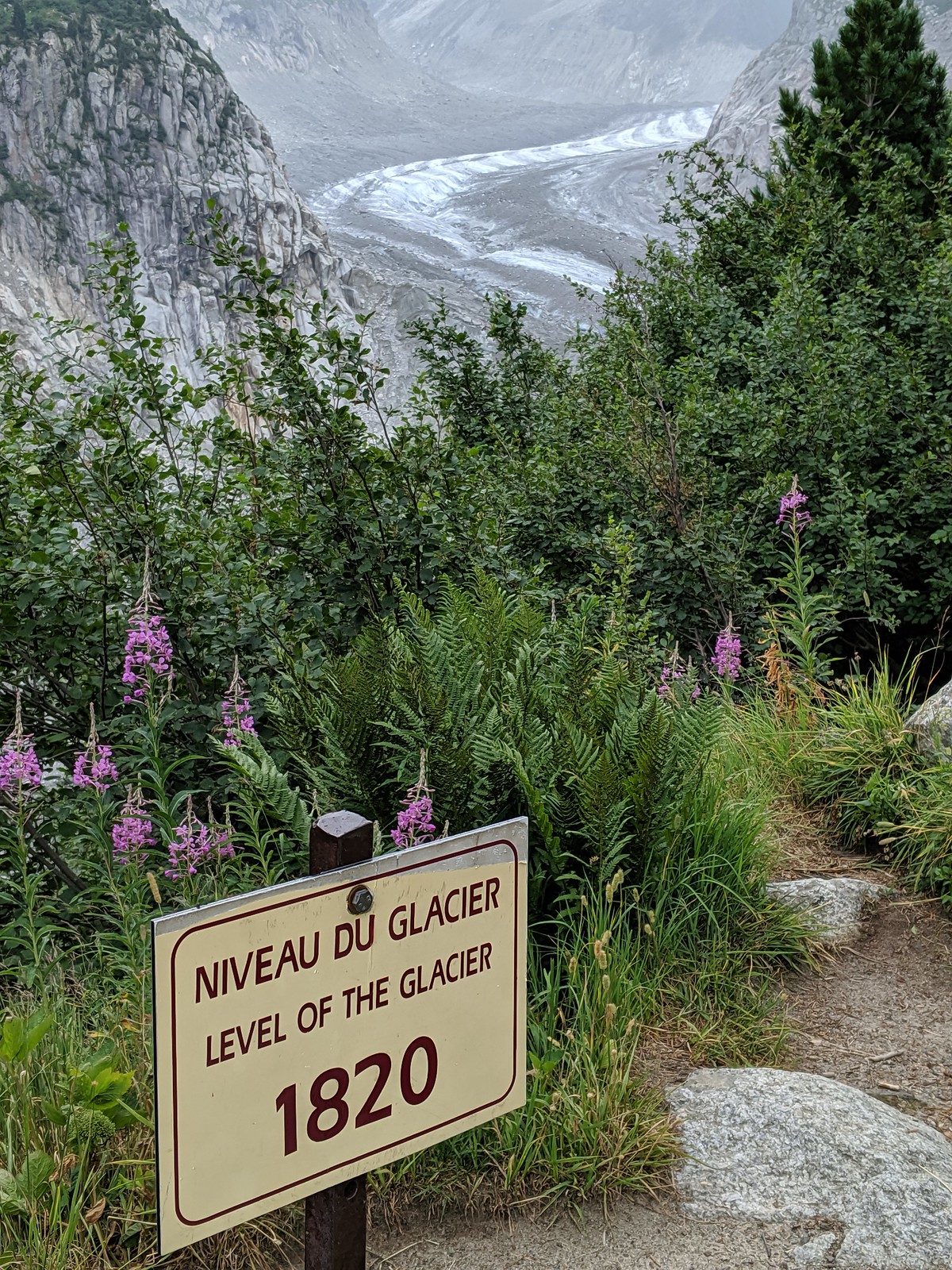
Notes the Graun, and I won't quibble. The most obvious thing you notice when going up is that the glaciers have retreated away from the huts and paths. Here's a sign above the Mer de Glace:

MVIMG_20190727_125052

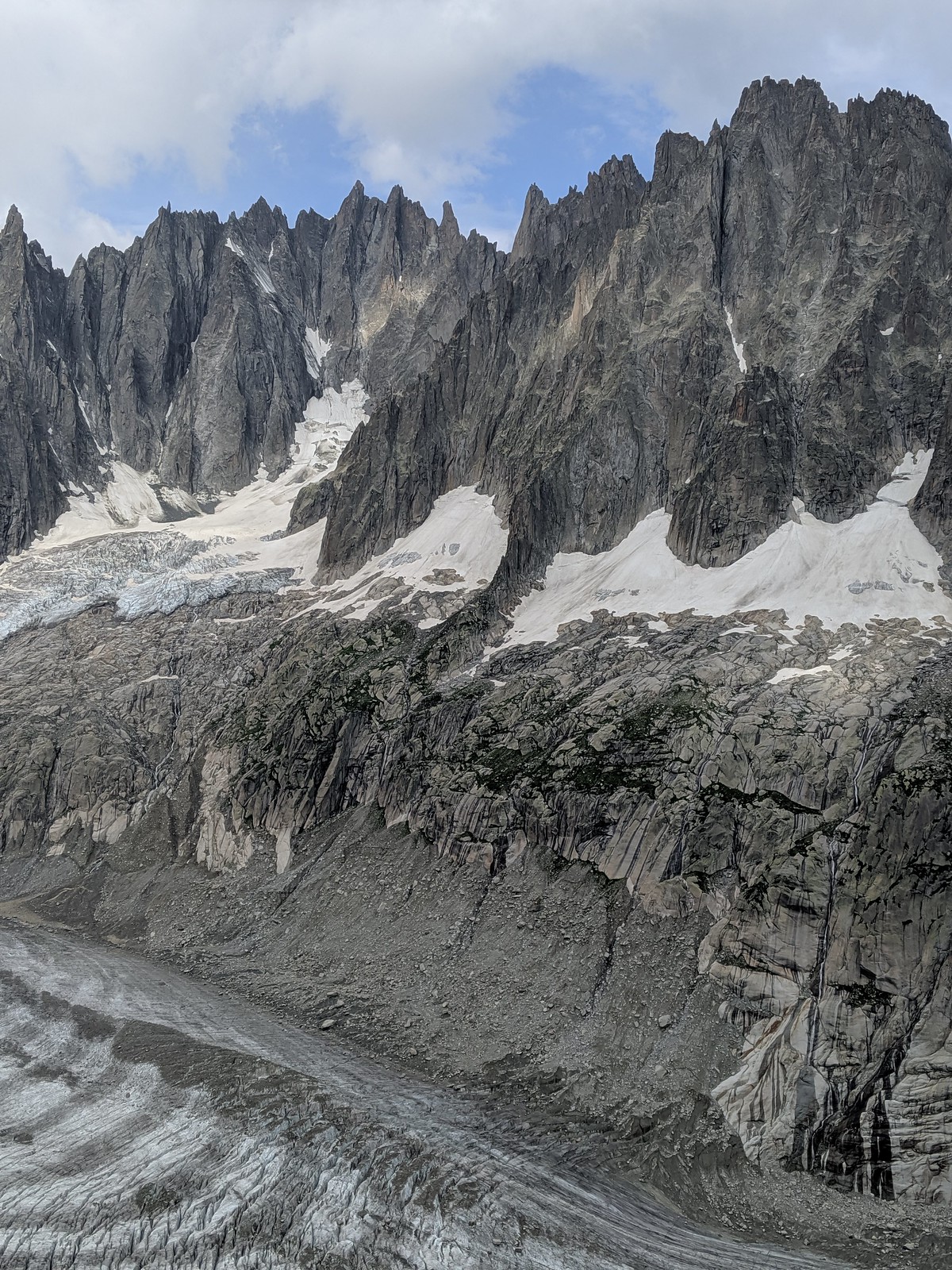
(regrettably it isn't in any other way interesting as a photo). That's above about 100 m of path leading down to about 100 m of ladders leading down to the moraine (the ladders on the other side up to Couvercle are even more exciting) from which you scramble onto the glacier. Looking across from the L (Couvercle) side (as you go up), here's a view across to the Aiguilles, and (if you click for the enlarged version and know what to look for) you can just see the refuge Envers des Aiguilles on the rock rib in the center of the pic.

MVIMG_20190727_091718

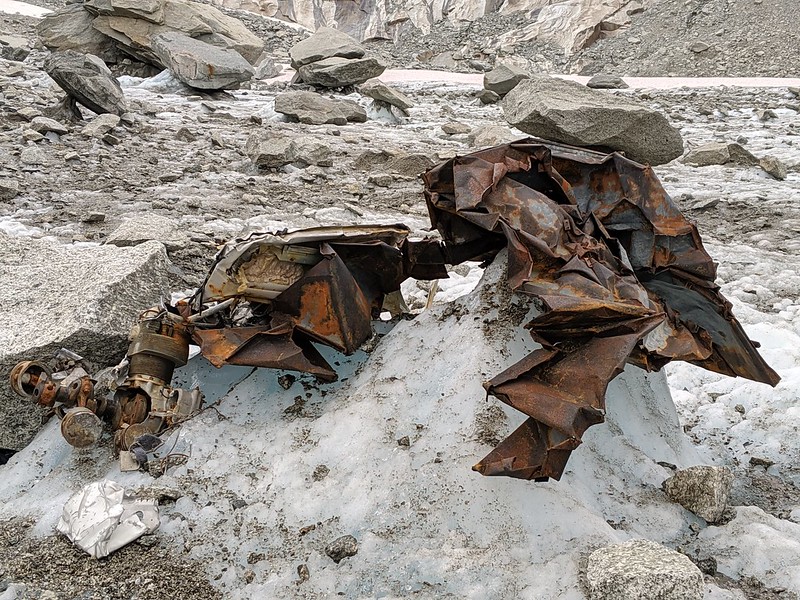
You can also see how massively the glacier has retreated (though to be fair not all of that is recent; it was a long way up the Envers ladders in 1992). As for the old things melting out of the ice, here's part of what I assume is a helicopter crash, unknown vintage, Talefre glacier.

MVIMG_20190726_155556

Also speaking of melting out, the ridge down from the Aiguille du Midi telepherique onto the glacier now has old bales of straw and bits of wood appearing, instead of the pure snow it used to be. Perhaps the residue of some old hut.

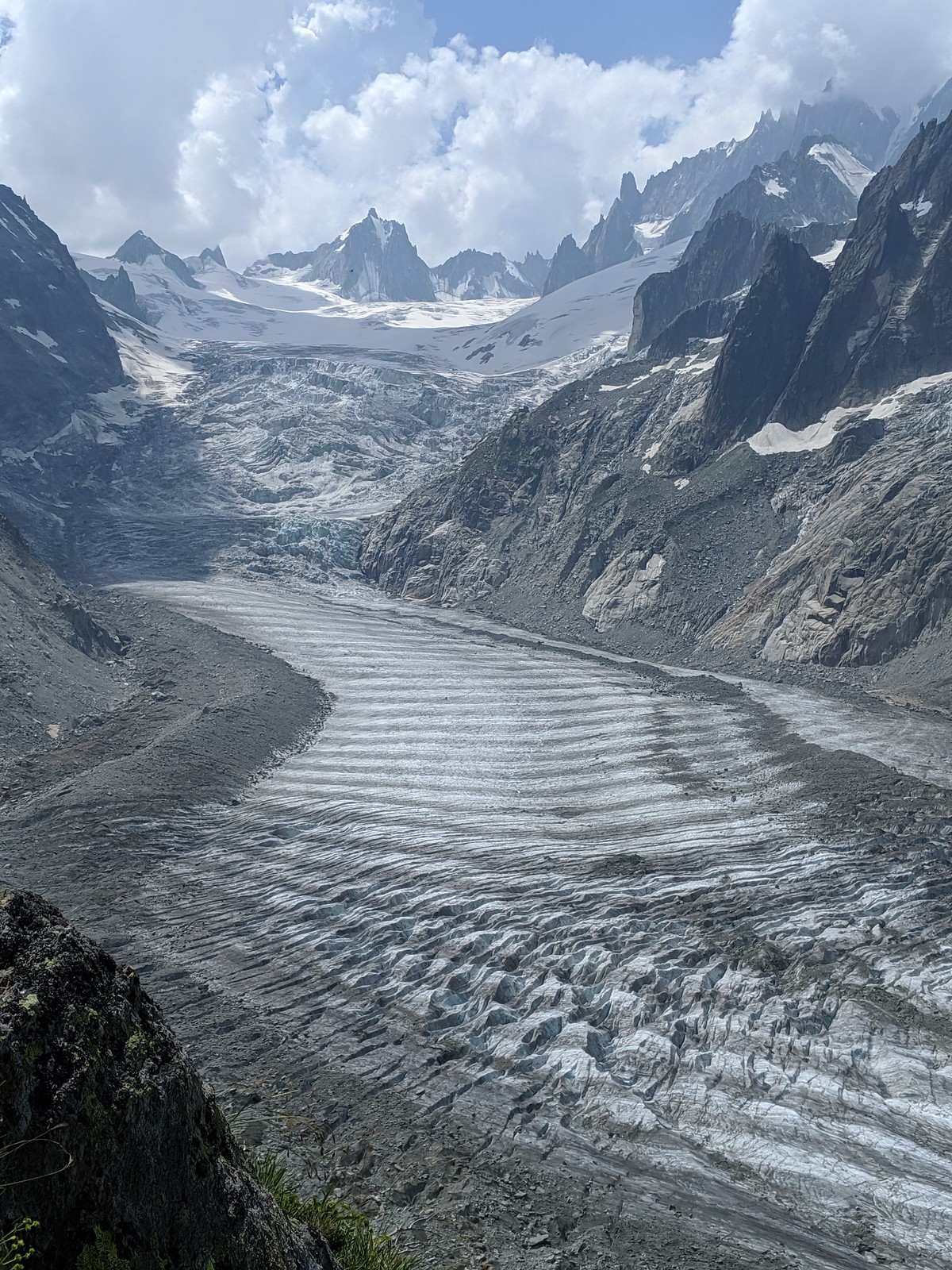
The Mer de Glace is bare and excitingly striped. You can just make out the Requin hut on the ridgeline in the center, in front of the icefall.

MVIMG_20190725_132014

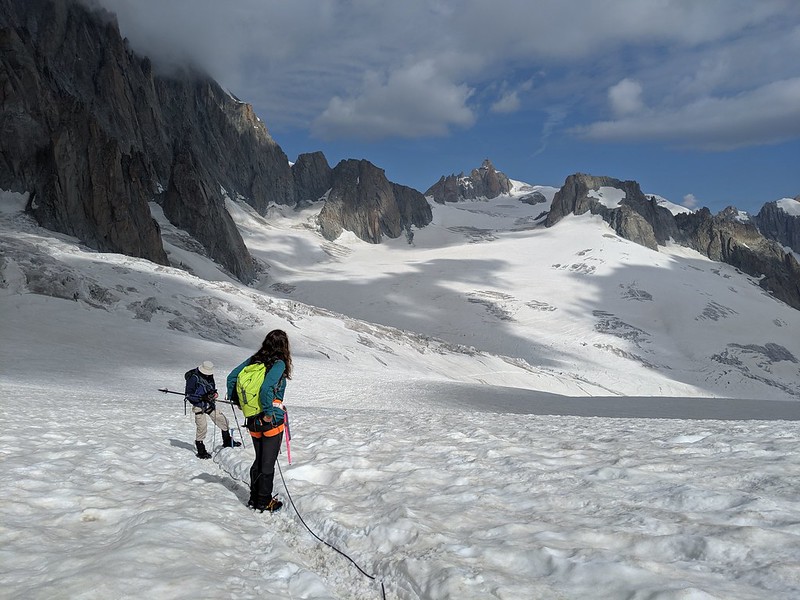
It is sad that the ice is melting, and the character of so many routes is changing. One of the reasons we went to Chamonix this summer is that by comparison, elsewhere, it can be hard to find reliable snow and ice. Mostly the changes are making things harder: the Dome de Neige des Ecrins is no longer Facile due to opening up of crevasses high up; a route we did this year on Pointe Isabella is now icy glacier; glacier; brief ice; rock ridge; snow ridge; rock; snow; and rock; whereas my old guide book shows it as continuous snow before brief summit rock. Though to be fair, that makes the route more interesting.

MVIMG_20190726_075354

Pointe Isabella (the peak on the skyline half-right; the one half-left, apparently lower but actually a bit higher, is the Aiguille du Triolet). Go up the glacier, take the snow-ramp to the R before the ice-fall, get over the icy bit and take the snow ridge (not seen) to the visible snow ridge, leave that to the R for the rock ridge (excellent views of the ice-fall) and then you're on the near-summit ice slopes. Though if you're us you've got to 3650 m at noon, and prudently decide to turn around cos bad weather is forecast.

But the Graun's assertion that everything is falling apart is dubious, I think. The ice is retreating, yes, of course. But there are still acres of good granite to climb on. Here's some of it - there was so much I didn't bother to take proper pix. This is on the way from Cosmiques (Aig Midi on the skyline) to Torino.

MVIMG_20190806_100530

Yes, this post was just a thinly-disguised excuse for some holiday snaps.

Refs


* The Antarctic ice sheet is melting and, yeah, it’s probably our fault - Eric at RC. Refs me!
* Iceland's Okjokull glacier commemorated with plaque
* Mont Blanc: Glacier in danger of collapse, experts warn - 2019 / 09
* Shrinking glaciers: Mont Blanc from the air, 100 years on - 2019 /10

2019-08-10

Another one bites the dust: Theodor Landscheidt

MVIMG_20190728_160940 Those from ye olde dayes will - indeed, it is practically a test of whether you were around then - recall Theodor "don't mention astrology" Landscheidt. He doesn't show up on "mustelid" and only appears in the scienceblogs era via comments, and asides at that, so interest in him faded rather quickly post-death (I only really know of his existence from sci.env, and even then he was curiously shy). But! He is about to die a second time, how malign is fate: WP:AFD will take him down this time (I can't be bothered to !vote; he survived in 2008). There's a User:Landscheidt who apparently coincidentally has been recently adding gumpf to Planet Nine.

Speaking of wiki: if interested you should see the disastrous WP:FRAM.

Anyway, for the records, here is:

* the page history,
* the state of the page when most useful,
* the current page state.

Image: from the tour Batiaz in Martigny; the abeilliary (right); vines (left) and the track up to the tower (center).

Refs


* Freedom Is Not Protected By Its Violation - CafeHayek
* This lack of motivation is connected to another important psychology – the willingness to fail conventionally - Dominic Cummings (yes him)
* My days among the dead - Southey
* The Persistence of Poverty: It's Complicated - by Bryan Caplan
* For Most Things, Recycling Harms the Environment? by Michael Munger; see-also Chasing Rainbows: How the Green agenda defeats its aims

2019-08-08

I'm back

I've been on holiday. You may have noticed the lack of action here. But I'm back now so the usual diet of thinly spread out ill-informed opinions interspersed with bees can resume.

PANO_20190803_102625.vr

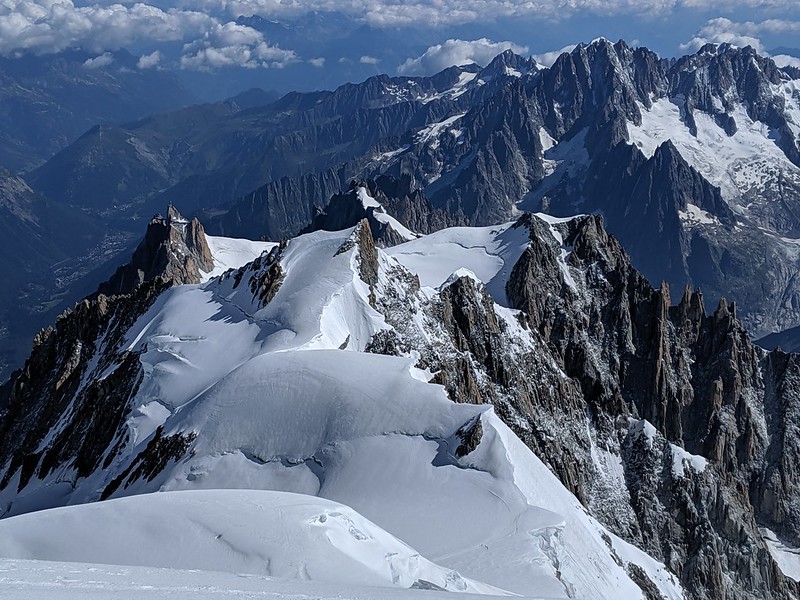
You'll immeadiately recognise the summit of Mt Blanc, 'twas a glorious sunny day though bitterly cold and windy. But don't worry I'll be boring you with more of that anon.

Of course when I say "you'll recognise", I now realise it's pretty hard for me, and I took it. Foreground, left, Miranda in red crouches against the wind and Daniel leans on his ski stick. Further left background is the Aiguille du Midi. So the track leading off left-forward is the top of the Trois Monts route, and the Gouter route goes back behind the pile of people on the right. I'm moderately sure that the peak near-center is Mt Blanc de Courmayeur. We took the Gouter route, but, starting from Tete Rousse.

Refs


* Capitalists need friends - TF.
* France 2019: notes and Troyes.

2019-08-01

France 2019: Mt Blanc: Tete Rousse / Gouter

This is just a inserted-out-of-time post to link to France 2019: Mt Blanc: Tete Rousse / Gouter, on my "personal" blog, mostly for my own reference.

MVIMG_20190803_102856

It was a mixture of the unutterably glorious with slog, but the expected value is very high.

2019-07-16

This year's model

On 5, I thought we were pointing out too far; but as bow there was nothing I could do. And anyway we start at 11, so you want to point out a bit. And then the gun went and we had a clean start through the winds to the lengthen to the rhythm all on autopilot really which is how you want it. After about 20 strokes I glanced down and my heart was at 160 which is good for me so I didn't need to put any more in. Past the outflow and all continued well; by first post we were gently dropping City two which was no great surprise as I'd watched their practice start and it was a little tentative and ragged. Around Grassy we were - and this was a surprise - on station with Nines two ahead, despite their double bucket rig and bucket hats. Everything was smooth, all was well, all the nerves had smoothed out. Half way down the reach Nines bumped Robs with us still nearly on station, which bodes well for tomorrow. The eagerly awaited question of this year was settled there, as Nines one had caught Tabs; and for good measure, Robs one, City one. Tabs three had wound down a bit so we pretended to chase to top finish for the over bump and got to a length, which was fun; but City two and three and possibly Nines three behind got confused and continued past bottom finish, forgetting that they are lower table folk. Trace.

Day 2: we were even more blatantly pointed out today, to the extent that Harry had to back down on 10 to try to correct, and I was so distracted that I only squared up on 5. But despite being able to feel the swerve we still got a good start and gained a little. However, we didn't gain enough, and while it felt fine I think we fell victim to that old bumps trap, the waiting game: grinding them down on the Reach as a plan. As it happens we did end up closing to 3/4 by the bridge, but that's not enough, even though it was more of a serious effort than yesterday's finish: my heart went up to 167 which is very close to my red line. Afterwards, general agreement that tomorrow we should hammer FP, the Gut and Plough reach harder, and some genteel conflict between keeping the rate high off the start - which would be my preference - and needing to settle somewhere. We are, we think, better at rowing than them; they are younger and fitter en masse; to capitalise on our advantage I think we need to push the rating up. Trace.

Day 3: much better pointing, and we tried to execute our "somewhat harder off the start" plan but, well, essentially discovered we were already going as hard as we possibly could. What we also rather ominously got to see was Peterboroug bumping City 2 behind us just after FP, which doesn't bode well. We got a whistle earlier, but still only one. On the finish line, Robs very nearly caught but were just a fraction late, which is sad, as it would have been nice to chase someone slower. Trace. The camera is pointed a little more inboard this time so you get to see my grey beard and astonishing biceps.

Day 4: rain on the way down - rain when I was marshalling W2 earlier - but not raining during the race. After what seems like days of not being pushed from behind, so much have we got used to it, Peterborough have moved up behind us and seem to be catching City boats quite fast. So the thrill is back. We go off the start fast, and keep the rating high down FP, and ever so slightly to our own surprise this works: not only do P stay on station but we get a whistle on Robs before FP. Sadly that doesn't get any closer but then again neither do P. There's a bit of swerving around a bumped-out Robs on Ditton but our cox handles that well; now there's nothing ahead of us but the Reach and... then it's over, with P distant. After that only a night down the Waterman then City and despite my self-promises too much beer. Trace.


Of M2


Paul Holland blogs M2: day1, day2.

2019-07-14

The One Viable Solution To Climate Change?

An article so bad it unites mt and WUWT, albeit for slightly differing reasons. The article by Steve Denning (who?), uncritically channelling a Manhattan Institute report, sees solar, wind and nooks as unviable, and concludes, in mt's rather accurate paraphrase, "Let's get the smart people to come up with something nobody's ever thought of that doesn't have drawbacks!" which has echoes of John McCarthy's solutions.

The article starts with
we are near the theoretical limits of what is possible from efficiency improvements in existing hydrocarbon technology or from wind, and solar energy and battery storage... [and] Hydrocarbons collectively supply 84% of the world’s energy. wind, solar, and batteries provide about 2% of the world’s energy and 3% of America’s.
The second part is meant to show you how piffling renewables are; the first presumably is to convince you that renewables can't grow much more.

But these are both non-arguments. They're direct from the MI report, and I suspect our author hasn't managed to think his way around them, so I will do it for you, in the unlikely event that you can't.

Theoretical limits


The argument that we're close to the limits on efficiency, and are therefore stymied, is silly because that's not where the increase in wind or solar will come from: it will come from more deployment. Which people consistently underestimate. I could write more words, but really his error is that simple.

Nooks: public unease


His killer argument against nooks is public unease. There is truth in this, but to quote the quoteable but not entirely accurate EW at WUWT: Has anyone else noticed how weak green excuses for not embracing nuclear power are? I mean, on one hand greens tell us the world will end in 12 years or by 2050 or whatever, yet in the same breath they tell us nuclear power is too dangerous because there might be a few meltdowns. How could the risk of a few meltdowns possibly be worse than the end of the world? And of course in some places - e..g. France - this unease seems to be overcome. I once thought we would be obliged to overcome this, now I'm doubtful: solar will probably take over instead.

Proportion of supply


Their 2% value isn't really an argument, just a note about the present. And a somewhat deceptive one; this says that renewables (mostly hydro) account for more than 20% of global electricity. It does tell you something about the maturity of wind+solar though: if it is currently a small proportion, we're not well used to integrating large proportions of it into supply. Though the UK survived well enough recently.

Sources


While I'm here, this report from the IEA says that "modern" bioenergy is bigger than hydropower, which is bigger than wind+solar combined. I find that somewhat surprising.

Video


I haven't bored you with rowing for a bit, and didn't have any other pic to hand. Town bumps is next week, we've been tapering and doing a few short starts; I tried pointing the riggercam onboard as an experiment. Yes, two could sharpen his catches a little.

Refs


* Can planting trees save our climate? - RealClimate by Stefan

2019-07-10

The Jeffrey Epstein Case Is Like Nothing I’ve Seen Before?

Quiet, innit? Don't worry, there have been plenty of fireworks behind the scenes. It turns out that there are places where writing "I like stoats" is a mistake. But moving right along - skipping for now the Graun's Molly Scott Cato: ‘It’s the wealthy who are causing climate change’, but don't worry, I'll get back to it5 - we come to The Jeffrey Epstein Case Is Like Nothing I’ve Seen Before; Great wealth insulates people from consequences, but not always, absolutely, or forever by Ken White in The Atlantic. This post will be another attempt to discuss some of the ODOV ideas I tried to discuss in Aristotle's politics. Do not fear! I know this discussion is doomed, just like the previous one: I'm really just writing down my thoughts.

Anyway, let's begin by quoting enough of the article to get the substance of the case:
In 2006 and 2007, [billionaire Jeffrey] Epstein—once a reliable companion of the well connected—faced extensive, detailed allegations that he paid multiple minors for sexual contact and for their services in procuring other minors. Most people, hammered with that kind of evidence, would spend the rest of their lives in prison. But Epstein could afford the lavish attention of a defense team staffed by legal luminaries such as Alan Dershowitz and Kenneth Starr. Most of us hope an attorney will defend us competently at trial, but the superrich can afford to go on the offense. Epstein’s lawyers hounded the U.S. Attorney’s Office for the Southern District of Florida, which was considering federal charges... Epstein’s team secured the deal of the millennium... Epstein agreed to plead guilty to state charges, register as a sex offender, and spend 13 months in county jail, during which time he was allowed to spend 12 hours a day, 6 days a week, out of the jail on “work release.” In exchange, the Southern District of Florida abandoned its criminal investigation of Epstein’s conduct, agreed not to prosecute him federally...
Why did the Department of Justice cut such a deal? the article plaintively cries, before answering with the obvious "because he was very rich"1. There is an ideal that justice is the same for all. Indeed, this is one of the bedrocks of the liberal society, and a society that did not strive towards this ideal would be poorer. But we all know that in practice the ideal isn't true. If you're rich, you can afford better lawyers. In some senses, this is a condemnation of our legal system: a good legal system would be far more immune to quality-of-lawyer in cases. But we2 don't have a good legal system: we have a tolerable4 one. This is the point to recall Adam Smith's quote: Little else is requisite to carry a state to the highest degree of opulence from the lowest barbarism, but peace, easy taxes, and a tolerable administration of justice.... Generally people quote that for the easy taxes bit, and sometimes for the justice part (when contrasting with, say, Russia or Nigeria or Venezuela) but people usually omit the "tolerable" from consideration; or if they include it, they read it as tolerable-or-above. But the thought I wish to think here is that AS meant "at least tolerable, and not too strict". Law is custom, and so an over-strict attempt to adhere rigidly to the written law, if that doesn't fit custom, will not succeed; or will strain society; whichever you prefer3,6. This is but one particular example; there are many others, which of course escape my mind at present.

Update


Not strictly relevant here - I didn't even mention his name - but via the Economist I see Editor’s note: Alexander Acosta announced his resignation on July 12th 2019. See-also Aunty.


Notes


1. As a light side-issue - which is why it's down in the notes - I draw your attention to the article's "The personal attacks on the prosecution likely helped too: Federal prosecutors aren’t used to being on the defensive". I think this is true, but actually just points to a different problem on the other side: rephrased, it could be "FPs are used to being high-n-mighty and having people tremble before them".

2. Countries of the West: the US, the UK, Europe, other happy countries.

3. In a doomed attempt ot prevent people falsely accusing me of suggesting rich malefactors should get off scott-free, I point out that I didn't suggest that, and he didn't.

4. Arguably rather better than tolerable in some ways, in view of the next few sentences, but I couldn't think of a better word.

5. Update: actually, I can't be bothered.

2019-06-23

Should the Judiciary Be Making US Climate Policy?

In the usual way of such headlines, the answer is No. The link is from twatter, the original in Forbes from Nives Dolsak and Aseem Prakash. What do they have to say? Our key point is that asking the judiciary to mandate climate policies might have the unintended effect of concentrating policymaking power in the judiciary, thereby affecting the long-term health of the US democracy. What a brilliantly insightful suggestion, one I've never heard before. Well done for originality chaps. In more detail:
The US constitution outlines the separation of powers in Articles 1-3. It vests the legislative authority with the Congress. The executive branch is supposed to implement the law, while the judiciary is expected to interpret it. Yet, it seems that with the judicialization of politics, the judiciary is accumulating more policy power than what the constitution intended. In the context of climate policy, we focus on two issues: the inability of the Environmental Protection Agency (EPA) and the California regulators to agree on automobile tailpipe emission standards and the Juliana case, where citizens are petitioning the judiciary to mandate a climate policy.
This of course has been done to death elsewhere, most obviously in Alsup but elsewhere: people, desperate for progress because they can't get their faves through Congress, try an end-run with the Judiciary. A nice try if you can do it, but of course it leaves you vulnerable to the bad guys doing the same thing.

Our authors, in their discussion of Juliana-like stuff carefully avoid mentioning Alsup, because it answers their question, and where would talking heads be if questions were actually answered? So let's look at the emissions standards. This one is delicious, as such things often are, and this aspect is new to me: California, as we know, has strict emissions standards which often become national defaults due to the size of the Californian market. They have a "waiver" from the EPA from the Clean Air Act allowing them to set stricter-than-national standards, on the grounds of the particular nature of their pollution1. The Trump administration, desperate to pump CO2 into the atmosphere, would like to remove the waiver. But, can they? This is exactly the kind of question that does belong in the supreme court, so I think our authors are on dodgy grounds arguing the courts should keep out. Someone called Jonathon Adler argues that Trump probably can remove the waiver, for GW type stuff, since the "special conditions" argument doesn't apply to GW. I'm somewhat doubtful on more basic grounds, since it isn't clear what powers the Feds have to restrict State law, except as permitted by the constitution, and I'm not sure what they're claiming in this case: the articles I've seen don't mention this. JH points out the irony of... there is something odd about an administration that has proclaimed its support for “cooperative federalism” now bending over backwards to preclude individual states from making their own regulatory decisions.


Refs


* Happer, Koonin, Lindzen vs Alsup
* Mass starvation is humanity’s fate if we keep flogging the land to death?
* Two areas where I am out of step by Scott Sumner
* Historically Hollow: The Cries of Populism by Bryan Caplan
* A Delight in Despotism: The Case of Vaping by Pierre Lemieux
* Why It Must Be the People Who Preserve the Flame of Liberty by Barry Brownstein
* Should we ban bicycles in major urban areas? by  Tyler Cowen

Notes


1. As I hope is clear, this waiver stuff is new to me. Feel free to correct me (with sources) if I've misinterpreted it.

2019-06-22

A majority of USAnians think someone else should pay for global warming

MVIMG_20190609_154809 In truely shocking news just in, it turns out that people would like someone other than themselves to clean up their own mess, just like children. Idiot Naomi Oreskes twat1 "A majority of Americans hold fossil fuel companies responsible for damages from global warming", and as far as I can tell she did this with a straight face. The survey is here; the most relevant quote is:
When asked more specifically about whether fossil fuel companies or taxpayers should pay for the costs of the damages caused by global warming, a majority of Americans (53%) think fossil fuel companies rather than taxpayers should pay for most or all of the costs. Only 12% of Americans think taxpayers and fossil fuel companies should pay an equal share, and just 6% think taxpayers should pay for most or all of the costs.
This is all wearily familiar. People won't face up to their own actions and want someone else to blame.

Update: Politics: loan sharks and abortions


Suddenly struck by a thought, I'll put it here. Left-wingers are generally keen on generally-available abortions, and right-wingers unkeen. Left-wingers correctly point out that making abortions illegal or unobtainable will do little to suppress demand, leading to people resorting to unsavoury methods. Now for the "analogy". I signal it so you won't miss it. Left-wingers are generally keen on schemes to cap interest rates on loans to avoid "predatory" lending, and right wingers correctly point out that cutting off a source of credit will not reduce demand, leading to those seeking credit to turn to less savoury sources. So in one case one side can recognise supply and demand and the inevitable logic, but are unable to apply it to cases where the answer doesn't favour their desired solution.

Notes


1. Past tense of the verb "to twit". No insult implied, of course.

Refs


* Yet more bollox from Oreskes

2019-06-15

Red team goes down

minty Day one was wet, torrentially so in the morning but merely a bit of rain by The Time. The Red Team went off well, the Yellow team were a shadow of last year's glory, and the Pale Blue team went down to the Minty Blue team who put in an impressively powerful display - a joy to watch. Unbeknownst to me the Purple Team pulled a blinder and got the Yellow team not far from the finish - unprecedented in living memory that far up -, setting up an exciting situation for day two. Which was similarly wet. The Purple team surprised no-one by going all out off the start but the Red team proved strong manly and unflappable, with the Purples fading and caught by another burst of raw power from Minty Blue; the Yellows fell further out of our range of interest. Day three, now sunny, was inevitable, though I won a fiver on it: the Minty Blues took down the Reds with more raw power and quality, and the Purples had nowhere to go. Day four saw the Minties well clear, the Purples as expected closed the Reds off the start whilst I looked elsewhere - at the deeper Blues and the deeper Purples and the still deeper Blues. And yet, there it was, just before the finish: the Reds down to the Purples.

oglaf-dick An allegory for our times, no doubt.

Meanwhile, we return you to our traditional "Red team" cartoon, because this nonsense is coming round again. Really, all I'm going to do is link to Gavin's post We watch long YouTube videos so you don’t have to, in response to some bloke called Steven "Steve" Koonin. But really, the Blue team have already won, which is why no-one dares to set up a Red team, since they're fully aware that it would be an embarrassing failure, as I said in February.

Refs


* The full playlist is here, but there's a lot in that, so you may prefer just day one, day two, day three and day four.
* Digital legibility and incentives towards moral behaviors - TF
* NSC'S JOHN BOLTON OFFERS NEW RED TEAM RATIONALE
* Poke out one of my eyes by Scott Sumner
* Trump White House shelves ‘adversarial’ review of climate science via RS
  64488477_10157195841407350_2552905750171090944_n

62539263_10157198143672350_5041472142923792384_n

2019-06-03

Does J R Oppenheimer ask: can science provide better models for democracy?

60789145_1163461953850123_1190781572601610240_n As with all good headlines, the answer is "no". The question "Can Science Provide Better Models for Democracy?" is asked by mt in a guest post at ATTP's. Fathering it on JRO is a little odd, as is doing it in such a way that you can't really tell so are forced to ask. This is perhaps a quibble, but I found it distracting. And indeed although applying-science-to-politics is clearly what mt is interested in, it isn't clear that it's what JRO is interested in; whether there are elements in the way of life of the scientist which need not be restricted to the professional, and which have hope in them for bringing dignity and courage and serenity to other men, can obviously be applied outside politics; even the social problems of the day and try to think what one could mean by approaching them in the scientific spirit… In short, almost all the preconditions of scientific activity are missing… can be.

However, I now drop that quibble and consider mt's question.

As usual with mt's stuff about politics, whilst I find it interesting and stimulating I also find it almost completely wrong. One piece of wrongness, although not the most important, is Ah but come back those twenty years later, and who has made progress? The scientific landscape is utterly altered, while the political landscape is the same mess. It is certainly true that not all political problems have been solved, but then the same is true of science. But politics progresses: the percentage of those living under democracy has increased in the last 20 years, and is part of a long upwards curve. Extreme poverty is decreasing. General acceptance that all people have equal fundamental "rights" spreads. And so on.

But the main wrongness, to me, is the familiar one: the desire to have govt do stuff for you. If you look at science and at politics, and despair for the progress of pols compared to science, then one reaction is to try to import some science-y-ness into pols; but another is to have govt do less. It hasn't done a very good job (the decrease in poverty, for example, is due mostly to trade / globalisation / captialism, not govt) so the best thing is to have less of it. Sadly, one of the failures of politics since the 1980's is to appreciate the likes of Thatcher and Hayek.

Related to that is Our present problems seem rooted in a lack of ecumenism, a stupid failure to see the commonality of our collective fate... It’s one world. It thrives or fails as one. This is also not really true, and the sort of thinking that leads to top-down failed stuff like Kyoto. Trying to co-ordinate a world that thrives or fails as one is too difficult; problems can only be solved by being broken down into smaller pieces. Thinking of the world is great, as an abstract concept, of course.

Refs


* Electricity from Large Dams Does NOT Count as Renewable Energy by David Henderson
* MUSCLE CARS ON THE INFORMATION SUPERHIGHWAY - RS
* GOP support for Trump has moved from transactional to fanatical
* BRINGING AGW DOWN TO EARTH - RS
* Governed by Imbeciles
* Beware the Candidate with a Plan by Bruce Yandle
* Why don’t people pay attention to the future of their own world?
* Not everyone cares about climate change, but reproach won’t change their minds
* YES, WE HAVE NO AZOLLA - RS
* The 7 Worst Ideas for Regulation This Century by David R. Henderson