Tim Lambert has another nice post Global Warming Sceptic Bingo, with a pleasing number of the refutations from RC or here... its working, folks. I've been a bit busy building recently, but I notice that Tim doesn't have a refutation for We can’t predict the weather a week in advance. How can we do it 100 years in advance?. This may well be a really stupid argument, but lots of people make it, so its worth debunking:
To get you in the right frame of mind, consider an analogy: sea level at the beach. You can't predict the height of the next wave, or even when a wave will strike ten minutes from now. Yet the tide can be easily predicted years (centuries, probably millenia) ahead.
A better analogy is with throwing a (fair) die: you can't predict whether the next throw will be 1, 2, 3, 4, 5 or 6; yet you can be fairly sure that if you throw it 1000 times you'll get very bored. Sorry: If you throw it 1000 times, the average throw will be close to 3.5. And to pursue this a bit more, if you make the die a bit unfair (by, say, making the 6 twice as likely to come up) then you still can't predict what the next throw will be. But you can be sure that the long-term average will go up to... thinks... about 4 1/3.
Weather is, we are fairly sure, intrinsically unpredictable past a certain limit that isn't precisely known, but is about 1 month. In practice, current NWP (limited by computer size, model completeness and starting obs) can be useful out to about 2 weeks at a stretch. The weather is thus chaotic. As far as can be seen, climate isn't. Obviously, some features of climate can be predicted far further out: we know that winter will be warmer than summer, for a trivial example. But what about the trends in global mean temperature over 100 years? In this situation we have an imposed forcing (increasing GHG concentrations) on top of a chaotic system (weather) which appears to average to a non-chaotic system with intrinsic predicatability (climate).
If you trust the models, you can test this: if you start an atmosphere-only model with differences in the starting state differing only at the numerical-accuracy level (which is far below the obs error the NWP starts from) they diverge within a month. But if you then take the long-term mean of the runs, they are the same. If you start coupled models off with small differences and GHG forcing, they again differ on the weather, and the year-to-year variations in the global mean; but the long term trends match.
2005-04-15


2005-04-12
Oh Larsen B
Those of you who remember the late lamented Larsen B ice shelf that collapsed in 1994/5 (was it really 10 years ago...?) may be interested in a track by British Sea Power (ah, those were the days: you know, we really should have intervened in the US civil war...) called "Oh Larsen B". You can hear it here (legally or not I don't know). I quite like it.
Is this the first ever song written for an ice shelf? I suspect so.
The lyrics are:
Quite why they pick the Barents sea when there is a perfectly good Weddell Sea to use instead I don't know. Ditto the 12kyr. And it wasn't packice. Isn't pedantry wonderful.
Is this the first ever song written for an ice shelf? I suspect so.
The lyrics are:
 You're fractured and cold, but your heart is unbroken
 My favourite, foremost coastal Antarctic shelf
 Oh Larsen B, oh you can fall on me!
 Oh Larsen B, desalinate the Barents Sea!

 Oh I, I think it's over again
 Like sawblades through the air, your winter overture
 Cut through everything, and now we're not so sure
 Oh Larsen B, oh won't you fall on me!

 You had 12,000 years, and now it's all over
 500 billion tonnes of the purest packice and snow
 Oh Larsen B, oh won't you fall on me!
 Oh Larsen B, desalinate the Barents Sea!

 Oh I think it's the start of the end
 Like sawblades through the air, your winter overture
 Cut through everything, and now we're not so sure
 Oh Larsen B, oh fall on me!
 Oh Larsen B, oh fall on me!
 Oh Larsen B, won't you fall on me!

 Oh Larsen B, Oh Larsen B
 Oh won't you fall on me!
 Oh you can fall on me!
Quite why they pick the Barents sea when there is a perfectly good Weddell Sea to use instead I don't know. Ditto the 12kyr. And it wasn't packice. Isn't pedantry wonderful.
2005-04-10
UK govt record on climate change
It being election time, its a good time to examine the UK Labour govts record on climate change, and how its actions have matched up to the rhetoric/promises. Perhaps I should put in a note re conflict-of-interest: I'm a green party member (indeed, a candidate in the forthcoming elections) and election agent for south cambridgeshire green party (and their webmaster too).
The general tone of this assessment, in case you want to skip the details, is that the rhetoric has been good but the action disappointing.
I don't dismiss the value of the rhetoric, though. Compare it to the Bush presidency, which has done its best to downplay climate change: Blair has said some strong things, like "What is now plain is that the emission of greenhouse gases, associated with industrialisation and strong economic growth from a world population that has increased sixfold in 200 years, is causing global warming at a rate that began as significant, has become alarming and is simply unsustainable in the long-term. And by long-term I do not mean centuries ahead. I mean within the lifetime of my children certainly; and possibly within my own. And by unsustainable, I do not mean a phenomenon causing problems of adjustment. I mean a challenge so far-reaching in its impact and irreversible in its destructive power, that it alters radically human existence." (#10). Well: you can't get much plainer than that, and Brown says much the same. Greenpeace could ask nothing better, from a speech. In fact (from my own WGI perspective) he has gone rather further than he might (see here too). Whereas Bush has never acknowledged that humans are causing climate change.
So: rhetoric OK, what about action? If you were faced with a challenge so far-reaching in its impact and irreversible in its destructive power, that it alters radically human existence you'd be doing some pretty serious things, yes? Well, no. "The UK government is not doing enough to tackle climate change, according to a report by a parliamentary committee. The Environmental Audit Committee attacked ministers for believing that new technology and market mechanisms will reduce greenhouse gas emissions." (from the BBC; thanks HET). And the reason why is not hard to see, when reports say stuff like: "Eighty-thousand houses need to be demolished yearly for the next decade if the UK is to meet its climate change commitments, research suggests. Such demolition of older houses built to low environmental standards would be four times the current rate, Oxford University researchers said. It would mean the replacement of about 14% of homes, with 220,000 new homes built and others improved. ". (BBC again). The govts isn't going to be keen on spending money on that, when money is tight anyway (arguably they have done a fair job demolishing old houses in Iraq, but that doesn't help). Its a commonplace to note that the only reason the UK is at its current emission levels is that the Thatcher govt encouraged/permitted replacing coal fired power stations with gas. Labour has done nothing comparable; and its given way to the car-driving lobby over fuel prices.
Looking at the Blair speech again, lower down (after a review of some modest things) he says:
The general tone of this assessment, in case you want to skip the details, is that the rhetoric has been good but the action disappointing.
I don't dismiss the value of the rhetoric, though. Compare it to the Bush presidency, which has done its best to downplay climate change: Blair has said some strong things, like "What is now plain is that the emission of greenhouse gases, associated with industrialisation and strong economic growth from a world population that has increased sixfold in 200 years, is causing global warming at a rate that began as significant, has become alarming and is simply unsustainable in the long-term. And by long-term I do not mean centuries ahead. I mean within the lifetime of my children certainly; and possibly within my own. And by unsustainable, I do not mean a phenomenon causing problems of adjustment. I mean a challenge so far-reaching in its impact and irreversible in its destructive power, that it alters radically human existence." (#10). Well: you can't get much plainer than that, and Brown says much the same. Greenpeace could ask nothing better, from a speech. In fact (from my own WGI perspective) he has gone rather further than he might (see here too). Whereas Bush has never acknowledged that humans are causing climate change.
So: rhetoric OK, what about action? If you were faced with a challenge so far-reaching in its impact and irreversible in its destructive power, that it alters radically human existence you'd be doing some pretty serious things, yes? Well, no. "The UK government is not doing enough to tackle climate change, according to a report by a parliamentary committee. The Environmental Audit Committee attacked ministers for believing that new technology and market mechanisms will reduce greenhouse gas emissions." (from the BBC; thanks HET). And the reason why is not hard to see, when reports say stuff like: "Eighty-thousand houses need to be demolished yearly for the next decade if the UK is to meet its climate change commitments, research suggests. Such demolition of older houses built to low environmental standards would be four times the current rate, Oxford University researchers said. It would mean the replacement of about 14% of homes, with 220,000 new homes built and others improved. ". (BBC again). The govts isn't going to be keen on spending money on that, when money is tight anyway (arguably they have done a fair job demolishing old houses in Iraq, but that doesn't help). Its a commonplace to note that the only reason the UK is at its current emission levels is that the Thatcher govt encouraged/permitted replacing coal fired power stations with gas. Labour has done nothing comparable; and its given way to the car-driving lobby over fuel prices.
Looking at the Blair speech again, lower down (after a review of some modest things) he says:
I want today to highlight three key parts of my G8 strategy.
First, I want to secure an agreement as to the basic science on climate change and the threat it poses. Such an agreement would be new and provide the foundation for further action.
Second, agreement on a process to speed up the science, technology, and other measures necessary to meet the threat.
Third, while the eight G8 countries account for around 50% of global greenhouse gas emissions, it is vital that we also engage with other countries with growing energy needs - like China and India; both on how they can meet those needs sustainably and adapt to the adverse impacts we are already locked into..
This isn't impressive. Point 1 is perhaps a nice idea, not sure exactly what it means, probably it means "get the b*st*rd Bush to agree on what everyone else knows" (at least as far as the basic science goes; well we have IPCC, what more do you want?; perhaps the "and the threat it poses" is the point at issue). Point 2 is vague-to-useless. Point 3 looks like a sop to the Bush-y view that developing countries need to sign up too. Nice idea, but with rich folk like us (we are rich, aren't we? People tell us so, but nowadays it seems that both parents in a family need to work whereas in the good old days only one half did...) not doing much, why should the developing folk do more?
And at the end of it all, the reason that there is less action that the rhetoric suggests, and why for example Blair is supporting a new runway at Standsted with little regard to the extra CO2 it will generate, is that while people will generally nod to the dangers of climate change, they don't want action to get in the way of their cheap flights or their driving or... So anyway, its not all Blairs fault: he will, quite often, do what the voters want (the Iraq war being an obvious exception).
2005-04-09
"Honest broker"?
This post is complex. You need to carefully read and refer to the context: RPs posts (and comments thereon) 5th April and 8th April if you want to understand the details (if you just want to know that I'm annoyed with RP, you can probably skip the context :-).
All this starts with RPs "Scientizers. This large and diverse group actively works to frame the climate issue as a scientific debate under the expectation that if you win the scientific debate then your political agenda will necessarily follow. This group is comprised mostly of scientists of one sort or another. I would include here the dueling science-cum-politics weblogs Realclimate.org and Climateaudit.org (we had an exchange with Reaclimate folks a while back). I would also include here CATO's Patrick Michaels..."
Naturally enough, various RC folks including me objected to being lumped in with the objectionable Michaels, not least because of comments RP himself has made about Michaels. And I object to the assertion that we're doing this because "...political agenda will necessarily follow". RP seems to have a real problem believing that things can be done for good science not for political reasons.
However, my real problems with RP are his response post, on 8th April. Much of this is to do with language, words and nuances. I think RP is spinning things. From my point of view, the language he uses is slippery, not straightforward, designed to lead you into his viewpoint rather than argue you into it. I find this hard to put into words.
1. RP starts with "Firstly, there is the honest broker who seeks to expand (or at least clarify) the scope of choice". At this point, all is fine: "honest broker" is a nice phrase, sounds good, not quite sure what it means and doesn't seem to fit the scientific context, but never mind. If you're making a choice - like, how should we consider our future CO2 emissions policy - then the scope of that choice can clearly be clarified by, say, better predictions. Ie, by science. But then, RP defends himself with I equate "scope of choice" with "openly discuss policy options". Which I find bizarre. Its just a complete disconnect. Words mean what I say they mean, humpty-dumpty stuff.
2. RP says I "wonders why I [RP] differentiate between RealClimate and Journal of Climate". No, of course I don't wonder that, because to differentiate us is easy. What I said was "Finally, your saying "there is plenty of discussion of climate science with no extra-scientific context. Just look at the Journal of Climate..." is misleading - you are using that to imply that RC isn't in that state, without ever presenting any arguments for why." (refer back to Gavins comment and further). I'm saying, RC is science - which it is - with no policy (or as little as we can manage). RP has created a strawman to avoid answering the point: which is contained in his response to Gavin: "You appear to be under the impression that no discussion of climate science can take place without having an explicit or implicit policy agenda." Of course I believe that there is plenty of discussion of climate science with no extra-scientific context - RP has now twisted this to try to exclude RC from the pure-science arena.
3. RPs My interpretation of the RealClimate blog is that prevailing opinion there is that the political debate on climate centers on science. Where on earth does he get this from? RC doesn't have a lot (anything?) to say on what the political debate centers on. Were you to ask me (about the US pol debate) I'd say that it has a distressing tendency to ignore the science (RPs post trying to paint Prez Bush as accepting the scientific consensus is more sleigh-of-hand).
4. His point 3 - the wide scope of the category he has stuffed RC into - just seems to be some kind of laziness. Or perhaps, RC is unique, and it really is the only climate-science blog out there.
5. RPs response to Stephan (number 2 in his list) is a travesty, and the quote from a previous post "[RealClimate] claims to be "restricted to scientific topics and will not get involved in any political or economic implications of the science." This is a noble but futile ambition. The site's focus has been exclusively on attacking those who invoke science as the basis for their opposition to action on climate change shows this for me. RC has concentrated on presenting the science; and where we've been attacking people or positions we've been attacking the most obvious abuses of climate science. As it happens (and RP has nothing to say to this) the most obvious abuses of the science are coming from the septic/denialist side - which is unsurprising, because the weight of science is against them.
6. Response to Eric. Another travesty. If the folks at RealClimate think that the political debate about climate is in fact not about science then I'd be happy to be corrected. This completely misses the point: whether or not the political debate involves science doesn't affect whether the scientific debate involves politics. We're doing our best to stick to the science, to provide people - ordinary folk and policymakers too - with good information about the science. Who does what in terms of policy is not up to us. RP is obsessed with policy, presumably because its his bread and butter, but there is no need to drag everyone else into it.
All this starts with RPs "Scientizers. This large and diverse group actively works to frame the climate issue as a scientific debate under the expectation that if you win the scientific debate then your political agenda will necessarily follow. This group is comprised mostly of scientists of one sort or another. I would include here the dueling science-cum-politics weblogs Realclimate.org and Climateaudit.org (we had an exchange with Reaclimate folks a while back). I would also include here CATO's Patrick Michaels..."
Naturally enough, various RC folks including me objected to being lumped in with the objectionable Michaels, not least because of comments RP himself has made about Michaels. And I object to the assertion that we're doing this because "...political agenda will necessarily follow". RP seems to have a real problem believing that things can be done for good science not for political reasons.
However, my real problems with RP are his response post, on 8th April. Much of this is to do with language, words and nuances. I think RP is spinning things. From my point of view, the language he uses is slippery, not straightforward, designed to lead you into his viewpoint rather than argue you into it. I find this hard to put into words.
1. RP starts with "Firstly, there is the honest broker who seeks to expand (or at least clarify) the scope of choice". At this point, all is fine: "honest broker" is a nice phrase, sounds good, not quite sure what it means and doesn't seem to fit the scientific context, but never mind. If you're making a choice - like, how should we consider our future CO2 emissions policy - then the scope of that choice can clearly be clarified by, say, better predictions. Ie, by science. But then, RP defends himself with I equate "scope of choice" with "openly discuss policy options". Which I find bizarre. Its just a complete disconnect. Words mean what I say they mean, humpty-dumpty stuff.
2. RP says I "wonders why I [RP] differentiate between RealClimate and Journal of Climate". No, of course I don't wonder that, because to differentiate us is easy. What I said was "Finally, your saying "there is plenty of discussion of climate science with no extra-scientific context. Just look at the Journal of Climate..." is misleading - you are using that to imply that RC isn't in that state, without ever presenting any arguments for why." (refer back to Gavins comment and further). I'm saying, RC is science - which it is - with no policy (or as little as we can manage). RP has created a strawman to avoid answering the point: which is contained in his response to Gavin: "You appear to be under the impression that no discussion of climate science can take place without having an explicit or implicit policy agenda." Of course I believe that there is plenty of discussion of climate science with no extra-scientific context - RP has now twisted this to try to exclude RC from the pure-science arena.
3. RPs My interpretation of the RealClimate blog is that prevailing opinion there is that the political debate on climate centers on science. Where on earth does he get this from? RC doesn't have a lot (anything?) to say on what the political debate centers on. Were you to ask me (about the US pol debate) I'd say that it has a distressing tendency to ignore the science (RPs post trying to paint Prez Bush as accepting the scientific consensus is more sleigh-of-hand).
4. His point 3 - the wide scope of the category he has stuffed RC into - just seems to be some kind of laziness. Or perhaps, RC is unique, and it really is the only climate-science blog out there.
5. RPs response to Stephan (number 2 in his list) is a travesty, and the quote from a previous post "[RealClimate] claims to be "restricted to scientific topics and will not get involved in any political or economic implications of the science." This is a noble but futile ambition. The site's focus has been exclusively on attacking those who invoke science as the basis for their opposition to action on climate change shows this for me. RC has concentrated on presenting the science; and where we've been attacking people or positions we've been attacking the most obvious abuses of climate science. As it happens (and RP has nothing to say to this) the most obvious abuses of the science are coming from the septic/denialist side - which is unsurprising, because the weight of science is against them.
6. Response to Eric. Another travesty. If the folks at RealClimate think that the political debate about climate is in fact not about science then I'd be happy to be corrected. This completely misses the point: whether or not the political debate involves science doesn't affect whether the scientific debate involves politics. We're doing our best to stick to the science, to provide people - ordinary folk and policymakers too - with good information about the science. Who does what in terms of policy is not up to us. RP is obsessed with policy, presumably because its his bread and butter, but there is no need to drag everyone else into it.
2005-04-05
Betting on climate
James Annan is up to something in his betting-on-climate type ideas: http://www.ideosphere.com/fx-bin/Claim?claim=GW2030. I haven't read the details yet but it looks interesting.
2005-04-04
Burning my past
We're having building work done, starting tomorrow: the conversion of some shed-type things at the back of the house into a childrens living room. The planning has been going on for ages; its something of a shock for it to finally start, and so soon. And so I've spent today trying to clear the outhouse where we kept four bikes, various garden tools, endless plant pots and reams of vague junk that might be useful one day. And then the inhouse room I used as a carpentry "workshop", with even more immemorial pots, tins, cartons and boxes full of "useful" things. Some of them I've sorted carefully and put into the loft (to throw away next year, ha ha), others into the shed I built at the bottom of the garden, lots of junk wood onto a big bonfire, some given away to a friend with a real fire; and for some stuff I've bitten the bullet and binned it. For example, a pile of various electrical cables I pulled from a skip at the back of the CAD centre 5 years ago... oh dear.
The obvious motto, of course, is don't accumulate junk. But its soooooo tempting. Most of the broken-but-fixable things I binned have a history and I can remember it; I find it hard to sever ties with the past. The pencil box I made in woodwork at school, that lost its lid years ago. Gone. A tin of screws and nuts and stuff I inherited from my grandfather. Gone.
I got more ruthless as I went along, of course: being time-limited is the only way, or I would still be agonising over things. But will I learn this lesson and start applying it to the piles of stuff still in the house...?
The obvious motto, of course, is don't accumulate junk. But its soooooo tempting. Most of the broken-but-fixable things I binned have a history and I can remember it; I find it hard to sever ties with the past. The pencil box I made in woodwork at school, that lost its lid years ago. Gone. A tin of screws and nuts and stuff I inherited from my grandfather. Gone.
I got more ruthless as I went along, of course: being time-limited is the only way, or I would still be agonising over things. But will I learn this lesson and start applying it to the piles of stuff still in the house...?
2005-04-02
Global warming is not from waste heat
This is yet another myth I forgot, that GW might be due not to GHG's but to waste heat. This is not a totally stupid idea: back in the 1970's people considered it.
From this, global energy use in 1990 was 13.2 TW. It'll be a bit bigger now I suppose. So what is a terawatt? Its a billion kilowatts, err, so that makes it 1e12 watts. All of that ends up as waste heat somehow. I think the area of the earth is 4*1.3e14 m2. So the average global forcing is... 13.2e12/(4*1.3e14) = 0.025 W/m2. Compared to which, the well mixed GHG's are about 2 W/m2 TAR spm fig 3. So waste heat is about 1/80th of the GHG forcing. Which is clearly small globally, and probably so locally too.
[Note: this calculation is wrong, at least in the long term. See here.]
From this, global energy use in 1990 was 13.2 TW. It'll be a bit bigger now I suppose. So what is a terawatt? Its a billion kilowatts, err, so that makes it 1e12 watts. All of that ends up as waste heat somehow. I think the area of the earth is 4*1.3e14 m2. So the average global forcing is... 13.2e12/(4*1.3e14) = 0.025 W/m2. Compared to which, the well mixed GHG's are about 2 W/m2 TAR spm fig 3. So waste heat is about 1/80th of the GHG forcing. Which is clearly small globally, and probably so locally too.
[Note: this calculation is wrong, at least in the long term. See here.]
2005-03-31
Solar errors
For those of you interested in solar-climate connections, I strongly recommend reading DamonLaut2004.pdf from which one may quote gems such as: Analysis of a number of published graphs that have played a major role in these debates and that have been claimed to support solar hypotheses [Laut, 2003; Damon and Peristykh, 1999, 2004] shows that the apparent strong correlations displayed on these graphs have been obtained by incorrect handling of the physical data. The graphs are still widely referred to in the literature,and their misleading character has not yet been generally recognized. Readers are cautioned against drawing any conclusions, based upon these graphs, concerning the possible wisdom or futility of reducing the emissions of man-made greenhouse gases. In particular the analysis of Eigil Friis-Christensen and Knud Lassen's 1991 Science paper is interesting.
Thanks to Thomas Palm for pointing out the link, over on sci.env.
2020 update: see-also 2007's The Use of Damon and Laut.
Thanks to Thomas Palm for pointing out the link, over on sci.env.
2020 update: see-also 2007's The Use of Damon and Laut.
2005-03-28
Tim Lambert is good for your health
Or at least, he is good for my visitor-count, which more than trebled to an all-time record of 300+ on friday after he mentioned my most excellent post on GW myths. And I got another $0.29 in google adsense fees, taking my total to a dizzying $1.63, only $98.27 from my first paycheque :-).
TL also found this junk from Paul so I have another one to add to the myths: that heat pollution is a significant source of warming (this one isn't intrinsically silly, though the post by Paul certainly is: people did use to worry about it, till they realised it was small compared to CO2 effects).
TL also found this junk from Paul so I have another one to add to the myths: that heat pollution is a significant source of warming (this one isn't intrinsically silly, though the post by Paul certainly is: people did use to worry about it, till they realised it was small compared to CO2 effects).
2005-03-26
More myths of the Near Future
I thought 11 myths was fair going (#10 wasn't exactly carefully reasoned, though true) but still I forgot a few. Thanks to those who reminded me. I'm at my mothers house now with (horrors) only a dial up line and no wireless connections, so I'm a bit crippled for facts (who says greenies aren't in favour of technological advance?). But I'll post these myths here now, and probably do an update in a day or two with added facts - in the meantime, anyone who has a nice fact to fill in is welcome to comment.
1. Its all models Well obviously the measurements of the current temperature rise aren't (except the ones from the satellites, which do have to be passed through a model, ha ha, so its ironic that the same people who will argue "its all models" tend to prefer the satellite record...), nor are the observed rise in GHG's. But projections of future change inevitably come through models. But these models are themselves constrained by observations (match to the past century) and theory (basic radiative transfer; feedbacks; etc).
Consensus science is not science. Incredibly, some people are capable of arguing something along the lines of:
This is obviously silly. It is true that science isn't done by consensus - but so what: no one is saying it is. But when you're thinking of science advice to policy making, you ought to follow the consensus/majority view.
I've sort-of done this before.
3. All the scientists say the same thing because otherwise they will lose their jobs. This one fails to explain the existence of skeptics like Lomborg, Lindzen, Spencer or Svensmark. And it fails completely to understand the nature of scientific society. It isn't some kind of Sekret Kabal. Its an open process: if there are holes in a theory, you can make a name for yourself by pointing this out. I would say that consensus-busting papers stand more chance of being published (on an assumption of equal technical merit) than those supporting it: purely because of the requirement for novelty which journals impose.
4. Water vapour is the dominant greenhouse gas. Well no, it isn't (since I blogged this myself, I'm embarassed to have forgotten it). Its the submissive GHG :-)
5. CO2 saturates within 1m/10m. This one is fairly technical so not very popular as a myth, because it requires a bit to even understand it. The idea is that increasing CO2 won't matter, because the CO2 absorption regions are saturated anyway. Now this isn't one of my strong points (Josh?) but as I understand it this is why the radiative response to CO2 is linear (v low CO2 levels) to sqrt (moderate) and log (current levels).
6. There are not enough fossil fuels available to increase CO2 levels. This one is fairly rare and I'm not sure anyone really believes it. Oil might run out but I don't think there is any shortage of coal, tar sands and misc gunk to get us to at least four times pre-industrial CO2. I find it hard to believe that the future emissions scenario constructers failed to consider this point.
7. Its all the sun. Solar forcing has probably increased over the last century, but as far as can be told its small compared to GHG's. And it has (I think) decreased recently (last few decades)). The solar stuff tends to rely on correlations, whose significances are hard to assess - because the std statistical analyses rely on you doing the assessment once, not on keeping searching for things to correlate till you get a result. Mention here for Paul Farrars work on aliasing of ENSO onto the cloud signal, and the changing-their-minds stuff about polar or mid-latitude clouds. And the bit about the dodgy numbers at the ends of the record (Laut?). Sorry: life is hell without a proper connection...
8. Its all hype to get funding. This one has a grain of truth to it. Agencies do tend to look favourably on proposals which are relevant to the real world. Amusingly, this is probably why a number of solar type folk have got interested in GW and are pushing the solar-GW connection: its good for funding. Which shows up the converse: of the skeptics, plenty have tenure; plenty of tenured people aren't skeptics. But if you want large funds and high salaries... you don't go into science to start with, or stay there.
9. CO2 lags temperature in cores. In facts its pretty hard to tell whether is does or not, because the CO2 comes from the air trapped in the bubbles but the temperature signal comes from the ice itself. And this leaves an uncertainty as to the age of the CO2 relative to the ice, because the pores in the ice only close off slowly - leaving uncertainties up to about 800 y in high cold cores like Vostok. And when you're plotting picture to play with the data yourself, its hard to know what adjustments have been made, so be careful. However, having said that, I think that what indications there are do tend to indicate temperature leading CO2. But: this is not terribly relevant. Trying to explain the last 800 kyr of ice ages, there is a puzzle as to the size of the forcing, which needs an amplifier to produce the size of response. CO2 feedback is one candidate. In which case, you would expect T to lead CO2. But in the case of current climate change, we know full well that the forcing is CO2, not temperature.
10. Fred Singer has anything useful to say about global warming. The traditional number 10: not one that many people believe. Did you know that of those listed on the board of advisers to SEPP, three are dead? Play a fun game: see if you can guess which they are (no cheating by looking at the wiki page).
1. Its all models Well obviously the measurements of the current temperature rise aren't (except the ones from the satellites, which do have to be passed through a model, ha ha, so its ironic that the same people who will argue "its all models" tend to prefer the satellite record...), nor are the observed rise in GHG's. But projections of future change inevitably come through models. But these models are themselves constrained by observations (match to the past century) and theory (basic radiative transfer; feedbacks; etc).
Consensus science is not science. Incredibly, some people are capable of arguing something along the lines of:
- Science is not done by consensus
- There is a consensus on X
- Therefore, X is wrong.
This is obviously silly. It is true that science isn't done by consensus - but so what: no one is saying it is. But when you're thinking of science advice to policy making, you ought to follow the consensus/majority view.
I've sort-of done this before.
3. All the scientists say the same thing because otherwise they will lose their jobs. This one fails to explain the existence of skeptics like Lomborg, Lindzen, Spencer or Svensmark. And it fails completely to understand the nature of scientific society. It isn't some kind of Sekret Kabal. Its an open process: if there are holes in a theory, you can make a name for yourself by pointing this out. I would say that consensus-busting papers stand more chance of being published (on an assumption of equal technical merit) than those supporting it: purely because of the requirement for novelty which journals impose.
4. Water vapour is the dominant greenhouse gas. Well no, it isn't (since I blogged this myself, I'm embarassed to have forgotten it). Its the submissive GHG :-)
5. CO2 saturates within 1m/10m. This one is fairly technical so not very popular as a myth, because it requires a bit to even understand it. The idea is that increasing CO2 won't matter, because the CO2 absorption regions are saturated anyway. Now this isn't one of my strong points (Josh?) but as I understand it this is why the radiative response to CO2 is linear (v low CO2 levels) to sqrt (moderate) and log (current levels).
6. There are not enough fossil fuels available to increase CO2 levels. This one is fairly rare and I'm not sure anyone really believes it. Oil might run out but I don't think there is any shortage of coal, tar sands and misc gunk to get us to at least four times pre-industrial CO2. I find it hard to believe that the future emissions scenario constructers failed to consider this point.
7. Its all the sun. Solar forcing has probably increased over the last century, but as far as can be told its small compared to GHG's. And it has (I think) decreased recently (last few decades)). The solar stuff tends to rely on correlations, whose significances are hard to assess - because the std statistical analyses rely on you doing the assessment once, not on keeping searching for things to correlate till you get a result. Mention here for Paul Farrars work on aliasing of ENSO onto the cloud signal, and the changing-their-minds stuff about polar or mid-latitude clouds. And the bit about the dodgy numbers at the ends of the record (Laut?). Sorry: life is hell without a proper connection...
8. Its all hype to get funding. This one has a grain of truth to it. Agencies do tend to look favourably on proposals which are relevant to the real world. Amusingly, this is probably why a number of solar type folk have got interested in GW and are pushing the solar-GW connection: its good for funding. Which shows up the converse: of the skeptics, plenty have tenure; plenty of tenured people aren't skeptics. But if you want large funds and high salaries... you don't go into science to start with, or stay there.
9. CO2 lags temperature in cores. In facts its pretty hard to tell whether is does or not, because the CO2 comes from the air trapped in the bubbles but the temperature signal comes from the ice itself. And this leaves an uncertainty as to the age of the CO2 relative to the ice, because the pores in the ice only close off slowly - leaving uncertainties up to about 800 y in high cold cores like Vostok. And when you're plotting picture to play with the data yourself, its hard to know what adjustments have been made, so be careful. However, having said that, I think that what indications there are do tend to indicate temperature leading CO2. But: this is not terribly relevant. Trying to explain the last 800 kyr of ice ages, there is a puzzle as to the size of the forcing, which needs an amplifier to produce the size of response. CO2 feedback is one candidate. In which case, you would expect T to lead CO2. But in the case of current climate change, we know full well that the forcing is CO2, not temperature.
10. Fred Singer has anything useful to say about global warming. The traditional number 10: not one that many people believe. Did you know that of those listed on the board of advisers to SEPP, three are dead? Play a fun game: see if you can guess which they are (no cheating by looking at the wiki page).
2005-03-24
Myths of the Near Future
This post is about myths of global warming, but calling it that would be dull; it was going to be called Fables of the deconstruction but MotNF seemed better and perhaps more obscure. Partly, its a feeble attempt to gain wordshare by recycling some old posts, but there is some new stuff. To save time and space I haven't trawled for the evidence of people that believe these myths.
1. In the 70's, everyone was predicting an ice age: fairly common in disrespectable circles but comprehensively refuted by the excellent if over-long and byzantine http://www.wmconnolley.org.uk/sci/iceage/, and more comprehensibly by www.realclimate.org/index.php?p=94. Yes I know I mentioned this only recently (and JF picked up on it).
2. Its all the Urban Heat Island: no it isn't: see The Surface Temperature Record and the Urban Heat Island. In fact, recent evidence suggests less UHI that reported by the IPCC TAR.
3. The surface may be warming but satellites show the atmosphere is cooling: not true: depending on how you built the satellite record, it shows a warming of between 0.08 oC/decade and 0.26 oC/decade, from 1979 to 2004 (ish). See http://en.wikipedia.org/wiki/Satellite_temperature_measurements for the details. There is a kernel of truth to the myth: once upon a time (last in 1996) the satellite record did show cooling, but never as large as the warming it now shows.
4. The hockey stick is broken and therefore the current warming is not unusual: the MBH98 "hockey stick" graph was groundbreaking in its day, but there are now several other reconstructions: the best pic I know of is at http://en.wikipedia.org/wiki/Image:1000_Year_Temperature_Comparison.png. But... its by no means clear at the moment which (if any is correct); and all show the current temperatures and rate of rise to be unusual. Its also true that the hockey stick is not quite as important as the septics often like to claim: What If … the “Hockey Stick” Were Wrong? at RealClimate is interesting.
5. The current CO2 rise is natural, not man-made: this one is totally absurd. To believe this, you have to believe that CO2 and other GHG's were stable at pre-industrial concentrations for thousands of years, then suddenly, just as humans started emitting them, some natural process started emitting them, while at the same time removing from the atmosphere an equivalent quantity of the man-made GHGs (yes I know about the resident fraction...). This is the obvious argument; more complex ones from isotopic measurements can be made, e.g. at How do we know that recent CO2 increases are due to human activities? (update). BTW, notice I've used "man-made": I could have said "anthropogenic" but this is just man-made said in greek.
6. Climate is always changing. True, but so what? We care about the magnitude and speed of current and likely future changes; "climate is always changing at current rates" is definitely false; its all about timescales. See Why do people say... Climate change 'is the norm'?
7. Global warming will cause cooling! Or, the "Day after tomorrow" effect; or Thermohaline shutdown: people love this one because it appears paradoxical. The basic idea (twisted so badly by TDAT (as I understand it; I never watched the stupid movie) that its unrecognisable) is that GW will, by freshening the waters of the north atlantic, lead to a shutdown of the thermohaline circulation, a shutdown of the gulf stream, and therefore massive cooling over northern Europe. THC shutdowns have probably occurred in the past, as a result of freshwater discharges, but only while there are large ice sheets over north america. The Gulf Stream is not the same thing as the THC. And as far as can be told, the probability of a THC shutdown is not high: in fact, it doesn't happen "by itself" in coupled models runs, you have to force it to happen; what you get is instead a slight slowdown and although there is a cooling tendency from the slowdown, the overall effect is warming, even over northern europe. The TAR, section 9.3.4.3 Thermohaline circulation changes is good, as always.
8. The ozone hole and climate change. Not really a myth, just a confusion: the connections between ozone hole (or, better, ozone depletion) and GW is thin. They are: (a) ozone holes require very cold conditions; GW will warm the troposphere but (possibly confusingly) cool the stratosphere where the ozone is; hence, there will be a tendency for GW to cause more depletion. OTOH CFC levels are expected to decline. (b) ozone depletion represents a radiative forcing of the climate system, overall a net negative forcing: ie, it tends to cool the troposphere and surface (c) both GW and OD tend to cool the stratosphere; this cooling is observed but not as useful as it might be as a fingerprint of GW, because of the ozone changes.
9. The greenhouse effect keeps greenhouses warm: not so.
10. Nils-Axel Mörner has something useful to say about sea level rise: fortunately, very few people believe this one... perhaps this is why...
11. Uncertainty. Once the septics have run through about every other excuse they are down to pressing the virtues of uncertainty: that because we don't know in enough detail the effects and size of GW, we should do nothing yet. Of course they don't really mean "do nothing"; they mean "do nothing to reduce our emissions of GHG's". This seems to be the current position of the Bush govt: obliged to admit the reality of the current temperature rises, and even describing it as "sharply rising" (thus stomping on the std.septics, but they keep quiet about that), the POTUS continues... We do not know how much our climate could, or will change in the future. We do not know how fast change will occur, or even how some of our actions could impact it.. Well, this isn't really right: we do in fact know that emitting CO2 will warm the climate. But anyway, (as Michael Tobis has argued on sci.env better than I can, sadly I can't find it right now) uncertainty should make you feel unsafe, not be some sort of we-don't-know-its-ok cocoon.
Well, thats enough myths for now. If I've forgotten some, I hope you'll let me know.
1. In the 70's, everyone was predicting an ice age: fairly common in disrespectable circles but comprehensively refuted by the excellent if over-long and byzantine http://www.wmconnolley.org.uk/sci/iceage/, and more comprehensibly by www.realclimate.org/index.php?p=94. Yes I know I mentioned this only recently (and JF picked up on it).
2. Its all the Urban Heat Island: no it isn't: see The Surface Temperature Record and the Urban Heat Island. In fact, recent evidence suggests less UHI that reported by the IPCC TAR.
3. The surface may be warming but satellites show the atmosphere is cooling: not true: depending on how you built the satellite record, it shows a warming of between 0.08 oC/decade and 0.26 oC/decade, from 1979 to 2004 (ish). See http://en.wikipedia.org/wiki/Satellite_temperature_measurements for the details. There is a kernel of truth to the myth: once upon a time (last in 1996) the satellite record did show cooling, but never as large as the warming it now shows.
4. The hockey stick is broken and therefore the current warming is not unusual: the MBH98 "hockey stick" graph was groundbreaking in its day, but there are now several other reconstructions: the best pic I know of is at http://en.wikipedia.org/wiki/Image:1000_Year_Temperature_Comparison.png. But... its by no means clear at the moment which (if any is correct); and all show the current temperatures and rate of rise to be unusual. Its also true that the hockey stick is not quite as important as the septics often like to claim: What If … the “Hockey Stick” Were Wrong? at RealClimate is interesting.

5. The current CO2 rise is natural, not man-made: this one is totally absurd. To believe this, you have to believe that CO2 and other GHG's were stable at pre-industrial concentrations for thousands of years, then suddenly, just as humans started emitting them, some natural process started emitting them, while at the same time removing from the atmosphere an equivalent quantity of the man-made GHGs (yes I know about the resident fraction...). This is the obvious argument; more complex ones from isotopic measurements can be made, e.g. at How do we know that recent CO2 increases are due to human activities? (update). BTW, notice I've used "man-made": I could have said "anthropogenic" but this is just man-made said in greek.
6. Climate is always changing. True, but so what? We care about the magnitude and speed of current and likely future changes; "climate is always changing at current rates" is definitely false; its all about timescales. See Why do people say... Climate change 'is the norm'?
7. Global warming will cause cooling! Or, the "Day after tomorrow" effect; or Thermohaline shutdown: people love this one because it appears paradoxical. The basic idea (twisted so badly by TDAT (as I understand it; I never watched the stupid movie) that its unrecognisable) is that GW will, by freshening the waters of the north atlantic, lead to a shutdown of the thermohaline circulation, a shutdown of the gulf stream, and therefore massive cooling over northern Europe. THC shutdowns have probably occurred in the past, as a result of freshwater discharges, but only while there are large ice sheets over north america. The Gulf Stream is not the same thing as the THC. And as far as can be told, the probability of a THC shutdown is not high: in fact, it doesn't happen "by itself" in coupled models runs, you have to force it to happen; what you get is instead a slight slowdown and although there is a cooling tendency from the slowdown, the overall effect is warming, even over northern europe. The TAR, section 9.3.4.3 Thermohaline circulation changes is good, as always.
8. The ozone hole and climate change. Not really a myth, just a confusion: the connections between ozone hole (or, better, ozone depletion) and GW is thin. They are: (a) ozone holes require very cold conditions; GW will warm the troposphere but (possibly confusingly) cool the stratosphere where the ozone is; hence, there will be a tendency for GW to cause more depletion. OTOH CFC levels are expected to decline. (b) ozone depletion represents a radiative forcing of the climate system, overall a net negative forcing: ie, it tends to cool the troposphere and surface (c) both GW and OD tend to cool the stratosphere; this cooling is observed but not as useful as it might be as a fingerprint of GW, because of the ozone changes.
9. The greenhouse effect keeps greenhouses warm: not so.
10. Nils-Axel Mörner has something useful to say about sea level rise: fortunately, very few people believe this one... perhaps this is why...
11. Uncertainty. Once the septics have run through about every other excuse they are down to pressing the virtues of uncertainty: that because we don't know in enough detail the effects and size of GW, we should do nothing yet. Of course they don't really mean "do nothing"; they mean "do nothing to reduce our emissions of GHG's". This seems to be the current position of the Bush govt: obliged to admit the reality of the current temperature rises, and even describing it as "sharply rising" (thus stomping on the std.septics, but they keep quiet about that), the POTUS continues... We do not know how much our climate could, or will change in the future. We do not know how fast change will occur, or even how some of our actions could impact it.. Well, this isn't really right: we do in fact know that emitting CO2 will warm the climate. But anyway, (as Michael Tobis has argued on sci.env better than I can, sadly I can't find it right now) uncertainty should make you feel unsafe, not be some sort of we-don't-know-its-ok cocoon.
Well, thats enough myths for now. If I've forgotten some, I hope you'll let me know.
2005-03-23
Search terms...
I've been poking into the stats for my website, http://www.wmconnolley.org.uk/. Astonishingly, I've used up 800+M of my rate quota this month, this may mean I need to buy a better service before long. If I read the stats right, not that many of my referrals are from searches, but of those that are, the top are:
I don't understand "still life" or "watch tv" (we don't have one!).
Oh... and did I mention that my wife got through to the second round of the advanced III category EPTA piano competition, playing Rachmaninov Etudes Tableaux in F minor, G minor and C major? Well she did.
1 301 28.05%  bee
2 103  9.60%  head lice
3  74  6.90%  bees
4  64  5.96%  potty
5  30  2.80%  old shed
6  29  2.70%  legoland
7  20  1.86%  swarm of bees
8  13  1.21%  still life
9  13  1.21%  swarm
10 11  1.03%  watch tv
I don't understand "still life" or "watch tv" (we don't have one!).
Oh... and did I mention that my wife got through to the second round of the advanced III category EPTA piano competition, playing Rachmaninov Etudes Tableaux in F minor, G minor and C major? Well she did.
2005-03-22
Gone a bit quiet.
Things seem to have gone a bit quiet. I haven't posted much recently (and my traffic has suffered... though I suppose it could be because people read via the excellent PlanetFleck, I do :-). RealClimate had quite a big gap from late Feb to early March (incidentally, the RC site counter has just gone over 200k). Though there have been some good ones recently (glaciers; CO2 lifetime; two reports from IPCC AR4 meetings): and Will spring 2005 be a bad one for Arctic ozone? was quite prescient since just this week we've measured ozone down to 230 DU in Cambridge. And sci.env has been pretty dull: there really isn't a lot of news recently.
I did have a letter printed in the New Scientist: in response to some tedious skeptic (here, but you need a subscription to read the interesting bits), I said:
I did have a letter printed in the New Scientist: in response to some tedious skeptic (here, but you need a subscription to read the interesting bits), I said:
Kevin Mayfield manages to make two errors in one short letter (5 March, p 32). The second (confusing weather with climate) is commonplace. The first (believing that 30 years ago an ice age was predicted) is less common but just as wrong. See: www.realclimate.org/index.php?p=94 for a readable explanation or www.wmconnolley.org.uk/sci/iceage/ for more detail.
but this is hardly a new thing.
2005-03-18
Cafe Scientifique: afterwards
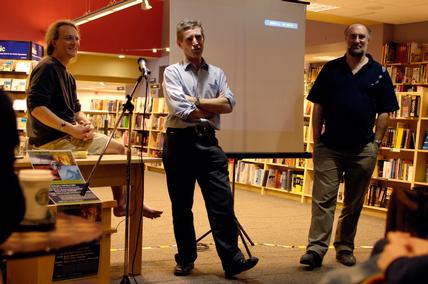
I posted that I was doing a talk at Cafe Scientifique on Wednesday 16th, and now I've done it, and the photo is the proof: me (left); Howard Griffiths (centre) and Pete Convey (right). Its at the question time, afterwards.
So... how did it go, I hear you ask? Quite well, I reply. A decent audience (70+), I presented my stuff well (aided by having 20 mins, about twice as long as I was originally expecting) and so did the others with theirs. You can if you wish read my ppt presentation (or my sxi presentation, if you prefer :-) at http://www.wmconnolley.org.uk/sci/gw/ but I fear you may find it unilluminating without my voiceover.
I was midly disappointed by the questions afterwards. Where have all the skeptics gone, for one thing. And perhaps a lack of deep knowledge for another (obviously you wouldn't expdct DK from everyone, but I would have hoped for a few). Perhaps everyone was quite convinced... Also the bios (somewhat to my surprise) were able to find plenty of examples of cl ch showing up in the biology, but nothing you could call bad, in and of itself.
And afterwards to the Castle for some Oyster Stout with friends.
2005-03-17
Spring!
 Its spring, and the flowers are out, and once again I've neglected to dig my allotment thoroughly over the winter, and stuff like that.
To celebrate, here is a picture of a daffodil with the sun behind it that I took on the rec today.
There was a good sunset too, with hints of iridescence in the upper clouds.
Meanwhile, says the news, Brent Crude is now over $56 per barrrel, due to surging demand, especially from China :-(
2005-03-13
Global warming news from Het Taylor
Het maintains a long long list of links to GW news at http://www.autobahn.mb.ca/~het/gwnews.html. Its somewhat intimidating because there is so much there. One game to play is to visit and see how many links are dark blue, because you've visisted those already. I score quite a few (well he has the good taste to link here, and to wiki, and RC :-) but I'm missing quite a few Quark Soups I should have read - I seem to check PlanetFleck nowadays, and QS doesn't have an RSS feed :-(
[Update 2005/03/17: I discover that Het is HET: Harvey Elmer Taylor. Sorry about that. It makes no real difference, but it does alter my mental picture of him: I thought Het sounded Dutch, and I portrayed him as a somewhat dour Dutch chap, perhaps a bit like a bargee with a pipe and a cap. Now I know he is a Harvey, well, I'm not sure what a Harvey looks like :-)]
[Update 2005/03/17: I discover that Het is HET: Harvey Elmer Taylor. Sorry about that. It makes no real difference, but it does alter my mental picture of him: I thought Het sounded Dutch, and I portrayed him as a somewhat dour Dutch chap, perhaps a bit like a bargee with a pipe and a cap. Now I know he is a Harvey, well, I'm not sure what a Harvey looks like :-)]
2005-03-12
Wot I did in February
New science being a bit thin on the ground (I'm doing some interesting stuff at work comparing radiosonde data with S+C MSU around Antarctica, and finding quite good agreement, but thats not ready for the world yet) I thought I'd point you towards:
http://www.wmconnolley.org.uk/diary/2005/02/
ie, what I did in february.
http://www.wmconnolley.org.uk/diary/2005/02/
ie, what I did in february.
2005-03-07
Cafe Scientifique
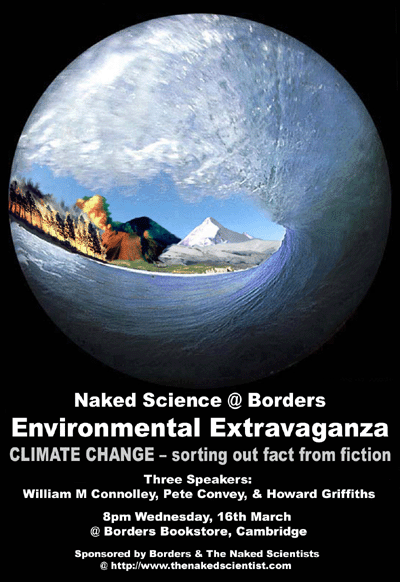 I 'ad that Brian G come inta me office - looking shifty - I knows sumfink were up - sure 'nough, 'e sez to me (sorry, I'll give up the accent now) "would you like to be famous" (or words to that effect). Distaining the obvious "but I am already" I listened to what he had to say, which was an invitation to take up an invitation he had to appear at "Cafe Scientifique" (if you still see a poster for some cyborg stuff, its because they haven't updated it from last time...) which is part of the naked scientists. TNS's, manfully swallowing their disappointment at getting humble me rather than the somewhat more famous Brian, have nonetheless put a brave face on it, so if you're in Cambridge next wednesday evening (16th March, 8pm) then come along to Borders and listen (and contribute if you like) to a panel discussion on Climate Change.
[Updated to include picture: someones been having fun with stoatoshop!]
2005-03-05
Wikipedia as soap opera
While I'm fighting the good fight over the various Global warming related articles on Wikipedia, Miriam has been taking another approach - wiki as soap opera. It started when she followed the RFC against me, and continued in the various edit wars. I keep urging her to get an account - it takes only a few seconds - and to start posting on, say, classical music; but no; she is a lurker.
But wiki as a soap opera can provide you with hours of entertainment if you want, with the added thrill that at any time you feel like, you can participate. Soap opera is all about conflict of course, so a good place to start is Requests for arbitration. This is, as the page says, the end of the dispute resolution process, when all else has failed. One that I have an passing interest in is the case of 172, who I only know from his unwise protect of the GW page. Elsewhere he may be quite sensible, but he has certainly riled some people and it looks like his case will be accepted - ie considered for arbitration. See also the 3 reverts rule enforcement page for the full bizarre history - he ended up having a blocking war with other admins, only ended when Ed "capricious" Poor stepped in and de-sysop'ed them all. Ed gets away with lovable-but-stupid things like this because it all works out well in the end (so perhaps they aren't stupid...). I got an hours ban for sarcasm from him just recently (and M says I should have got another for this). Hmpf. The other case I've been interested in (indeed I started the RFA) is RFA:JonGwynne who (thank goodness) now appears to have gone away entirely, presumably since the case went so badly against him.
Other places to look for exciting conflict on wiki are Requests for comment where people can list pages or people they think are bad, biased or in some way in need of comment from the wider community. Browsing that recently I picked Wave-particle_duality and made some notable improvements... I think... well check the history. Why don't you pick one on the list and go and help it out?
Another way to follow strands is to pick a page - GW, or any page - and click on the "history" tag at the top, to find the list of contributors, then click on one of the users who has contributed to see their user page, then click on "user contributions" (probably in the "toolbox" in the sidebar to the left, though this can vary if you have a different "skin" selected) to see what else they have been up to. Miriam does this for the GW related pages to see if the people I am in conflict with to see if they have genuine and productive edit histories elsewhere.
And if all else fails, you can look at the Recent changes list.
But wiki as a soap opera can provide you with hours of entertainment if you want, with the added thrill that at any time you feel like, you can participate. Soap opera is all about conflict of course, so a good place to start is Requests for arbitration. This is, as the page says, the end of the dispute resolution process, when all else has failed. One that I have an passing interest in is the case of 172, who I only know from his unwise protect of the GW page. Elsewhere he may be quite sensible, but he has certainly riled some people and it looks like his case will be accepted - ie considered for arbitration. See also the 3 reverts rule enforcement page for the full bizarre history - he ended up having a blocking war with other admins, only ended when Ed "capricious" Poor stepped in and de-sysop'ed them all. Ed gets away with lovable-but-stupid things like this because it all works out well in the end (so perhaps they aren't stupid...). I got an hours ban for sarcasm from him just recently (and M says I should have got another for this). Hmpf. The other case I've been interested in (indeed I started the RFA) is RFA:JonGwynne who (thank goodness) now appears to have gone away entirely, presumably since the case went so badly against him.
Other places to look for exciting conflict on wiki are Requests for comment where people can list pages or people they think are bad, biased or in some way in need of comment from the wider community. Browsing that recently I picked Wave-particle_duality and made some notable improvements... I think... well check the history. Why don't you pick one on the list and go and help it out?
Another way to follow strands is to pick a page - GW, or any page - and click on the "history" tag at the top, to find the list of contributors, then click on one of the users who has contributed to see their user page, then click on "user contributions" (probably in the "toolbox" in the sidebar to the left, though this can vary if you have a different "skin" selected) to see what else they have been up to. Miriam does this for the GW related pages to see if the people I am in conflict with to see if they have genuine and productive edit histories elsewhere.
And if all else fails, you can look at the Recent changes list.
Subscribe to:
Posts (Atom)