 Reference Wikipedia:Articles for deletion/Joseph D'Aleo. Humiliatingly for Smokey Joe, the final delete reason is "The result was soft delete. Based on minimal participation, this uncontroversial nomination is treated as an expired PROD". Or, in other words, no-one cared. How the GW wars have faded.
2022-07-15
Joseph D'Aleo suffers soft delete
Reference Wikipedia:Articles for deletion/Joseph D'Aleo. Humiliatingly for Smokey Joe, the final delete reason is "The result was soft delete. Based on minimal participation, this uncontroversial nomination is treated as an expired PROD". Or, in other words, no-one cared. How the GW wars have faded.


2022-07-13
Capitalism, Socialism and Democracy
 Capitalism, Socialism and Democracy is a book by Joseph "Creative Destruction" Schumpeter: "one of the most famous, controversial, and important books on social theory, social sciences, and economics" if you can believe wiki. I recommend it. I read it about six months ago and was going to blog it, but realised I really couldn't remember enough detail to do so properly.
Happily, that nice Pierre Lemieux has recently reviewed it. And he focusses, as anyone who cares must, on quite what did JS really mean? Because, contrary to what all who have read Mises or Hayek know full well, his words say that socialism is possible and that capitalism was on the way out. But was he being ironic? My answer is both yes and no: in describing how socialism is possible, he describes a whole series of modifications to "pure" socialism that would be necessary, and never actually says that at the end of all that, he's pretty well re-invented capitalism1. As to the inevitable end of capitalism, I think there's both an evil influence of Marxist historicism which is, wrong, obvs; quite a bit of poking fun at the worthless "intellectual elite"; and more correctly a recognition of the creeping influence of statist over-regulation, which is correct, alas equally obvs.
Notes
1. Ideally, at this point I'd support this with quotes and such, but I'm afraid you're out of luck there.
2022-07-01
WV v EPA
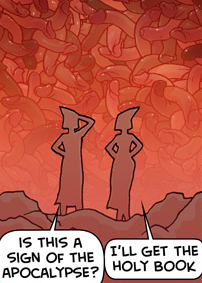 Kavanaugh’s views on EPA’s climate authority and Kavanaugh's other dangerous assault - on the environment? refer. Spoiler: I have little new to say. This post is, of course, occaisioned by West Virginia v. EPA. You may wish to read SCOTUSblog's take. Reading the opinion and dissent, my impression is that both sides seem to be somewhat losing patience with each other.
To recap my opinions: which way to decide this is a matter of interpretation; either way is defensible; overall I'm inclined to agree with the majority.
The Agency ultimately projected, for instance, that it would be feasible to have coal provide 27% of national electricity generation by 2030, down from 38% in 2014
The judgement doesn't make much of this, but I would: the much-vaunted plan was shite to begin with. It aimed to get coal down to 27% by 2030. And by 2022, without the plan in place, coal is... 22%. So what was all the fuss about? The plan was totally pointless. The idiot govt should just stop this nonsense.
Absurd US Supreme Court decision leaves climate leadership in limbo?
From a twit by Mann, this piece by Trenberth, who really should know better. But, as roughly typical of that-kind-of-viewpoint, worth a breakdown. Calling the decision absurd is just wrong. KT leads with "As an expert on the science of climate change..." but hasn't realised that is irrelevant; the science wasn't an issue, as it wasn't in Alsup. He then mixes it up with "The decision is designed to tie the hands of EPA scientists to fight pollution and to protect air, water and our families from the climate crisis" but that isn't really true either. The EPA retains all those "ordinary" powers; what it doesn't get it power to regulate CO2, unless congress clearly states that it should.
Refs
* The Supreme Court throttles Joe Biden’s climate agenda - Economist
* Democrats Designed the Climate Law to Be a Game Changer. Here’s How - NYT. A claim that the IRA defines CO2 as a pollutant, to get around this judgement. We'll see.
* Trump taxes: Supreme Court clears Democrats to see returns - so much for the SCOTUS being a tool of Trump: Mr Trump hit out at the Supreme Court on Wednesday and said it had "become nothing more than a political body". "Why would anybody be surprised that the Supreme Court has ruled against me, they always do!" he wrote in a post on his social media platform Truth Social. He merely appointed some of them: they have no loyalty to him, or to anyone else.
* 2025: Family Guy on SCOTUS.
* 2026: Hyperventiallating, Aunty shrieks Trump revokes landmark ruling that greenhouse gases endanger public health, not caring that it was actually the EPA. RC is somewhat better but not actually good: EPA’s final* ruling on CO2.
2022-06-29
I dislike rights-based language
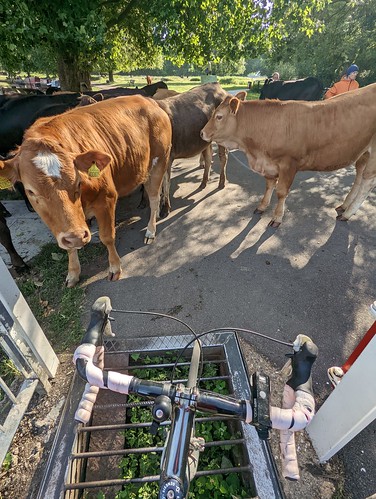 I've said this before1, alas in the middle of posts that no-one read, so I'm going to say it again to make it more explicit: I dislike rights-based language.
To quote myself from The Trials of the State, chapter three, and Rawls, continued "The model is of course Congress shall make no law respecting an establishment of religion, or prohibiting the free exercise thereof; or abridging the freedom of speech, or of the press which does not give you a defined right of free speech, instead it prevents the government from preventing your free speech". And this is better because it makes it clear that only the government is constrained. And that is so because only the government is overwhelmingly powerful.
Just like separation of powers it can be helpful and a convenient shorthand to use words like "rights", but only if you are also able to recast your arguments into forms that don't use those words.
In the case of "the govt shall not..." it is clear what is intended, even if there may be some fuzzy edges. In the case of "rights" it really isn't clear what is meant at all.
[Update: 2024/03: another thought, is that the "Congress shall make no law..." version is intrinsically conflict-free. If Congress makes no law about A, and not about B either, then there is non conflict. Whereas is law grants you a right to X, and someone else a right to Y, these often do conflict.]
The problem with SCOTUS looking to whether a “right” is “deeply rooted in our history or traditions” is that our history and traditions are filled with genocide, slavery, brutality and misogyny. Why should we limit our “rights” to things that have only existed for those in power?
I'm kinda padding out a thin post with this, taken from a Twit by George Takei. But he does at least put the word right into quotes. The answer, of course, is that there is no reason for such a limit, and indeed that limit doesn't exist. Things like gay marriage are now permitted; or, better said, discrimination (by govt) against gays is now forbidden. But if you want to create new "rights", you have to create them anew, not by finding them in old texts, where they aren't. The USAnians even have a mechanism for this: constitutional amendments. These only work for things that a large marjority agree on, which is as it should be: "rights" are big important things, and should be things that the mass of the citizenry accepts (I'm being imprecise; "rights" can be granted by Congress too; see for example Legislation: BOSTOCK v. CLAYTON COUNTY, GEORGIA).
Notes
1. 2024/06: found it: The rule of law from 2017.
Refs
* Anti-State is Anti-Freedom, Part 1: Yaron Brook and Don Watkins against anarcho-capitalism, chez Bryan Caplan. Showing the Randistas to be keen on rights, with predictably vague definitions; but Rand was no academic.
* Some of the worst "rights" type nonsense comes from ECHR and climate; see refs in Yet moaah climate suing.
2022-06-22
Church and State
 SCOTUS strikes again: Court strikes down Maine’s ban on using public funds at religious schools. And, as far as I can tell, they were correct. Read the judgement here.
The point at issue is the first amendment clause Congress shall make no law respecting an establishment of religion, or prohibiting the free exercise thereof.... But what does it mean? For the case in point, I don't much care about the "free exercise" portion, the interesting bit is "make no law respecting". The natural interpretation of this would be that no (federal, but by incorporation state) law can say anything about religion. And so banning use of public funds on religion is as prohibited as diverting funds specifically to religion, or any particular religion.
However, there's a "doctrine" of "separation of church and state", which can be reasonably read to say that the state shouldn't fund the church. The dissent (p24) leans heavily on that doctrine: On the other hand, the Establishment Clause “commands a separation of church and state.” But, just as with Separation of powers, which isn't in the constitution, neither is separation of church and state. It is only a handy guide to interpretation; it can't override the actual words.
However, the decision itself it largely based on the FE bit, contra my wise advice, on the grounds it protects indirect coercion or penalties on the free exercise of religion, not just outright prohibitions. This is plausible, but to me rather wifflier. So I guess I'm obliged to conclude that they got the right answer, but not for all the right reasons.
Update
I was looking for someone being really really sad about this, and it looks like Noah Smith is a good example. I think he's talking about this case, and also the Gunz stuff. I'm doubtful his The Court is kind of going crazy right now, with a bunch of activist decisions that most people hate is true; but it is interesting that his solution is court packing; see-also Me on USAnian politics. Since I don't say so explicitly there, I'll say it here: I think packing is a bad idea, at least in part because I don't think the Supremes are crazy.
The New Yorker isn't happy either, but is predicatably long on complaint and short on ideas; it has none beyond the vague "It is long overdue to end the Court’s undemocratic role in U.S. society" which is not actionable.
Another example of having no idea what to do is Op-Ed: How to move forward after the destruction of Roe vs. Wade. Don't be fooled by the title. Yes, I've switched from C+S to RvW without even noticing... because in the matter of dislike-but-don't-engage, things seem analoguous. See-also A [sic] eulogy to Roe.
Uupdate: moah gunz
Gunz, gunz, gunz, gunz, everybody loves gunz. Anyway: New York State Rifle & Pistol Association v. Bruen: A minor impact on gun laws but a potentially momentous shift in constitutional method is reasonably thoughtful. But notice towards the end, where he discusses the balance in the amount of regulation required. Is 16 hours of classroom instruction really needed? His answer is that some was valuable, about 2-3 hours was useful, but 16 was excessive. So I think this looks like over-regulation, and I think it is vulnerable, and in my roll-back-the-state mood, I'd welcome that. But I'd hope that, pre-emptively, DC would reconsider the amount it forces people to take.
Refs
* America’s Supreme Court requires Maine to include religious schools in a tuition programme: America’s Supreme Court is eroding the separation of church and state - Economist
* The Armalite and the ballot box; Gunz: constitutionalism and majoritarianism
* Reason: Alito's Leaked Abortion Opinion Misunderstands Unenumerated Rights: The Supreme Court justice is wrong when he says abortion rights aren't deeply rooted in American history.
* Basement Fertility and Immigration Charities, Please Forgive Black Markets and Blame Government Instead - Bryan Caplan
* Who Sees Which Political Falsehoods as More Acceptable and Why: A New Look at In-Group Loyalty and Trustworthiness by Jeff Galak and Clayton R. Critcher via Twatter.
* Two Libertarians Debate Abortion
* Alito's Junk History About Lochner
* Voters in Kansas decide to keep abortion legal in the state, rejecting an amendment. By about 60-40, which the BBC describes as "overwhelmingly".
* 2023/06: Dobbs was a fundamentally lawless decision, says someone who has confused anger with thought: an all too common response. People are bad at separating "I didn't like this decision" with "this decision cannot be justified". In case I haven't said it elsewhere: the Dobbs decision, whilst you may not like it, was a reasonable interpretation of the constitution.
* 2023/11: The Effects of the Dobbs Decision on Fertility.
* 2024/03: Fewer states allow abortions, yet American women are having more: Economist.
* 2022/05: Recent considerations in Roe vs Wade.
2022-06-20
Mayflies
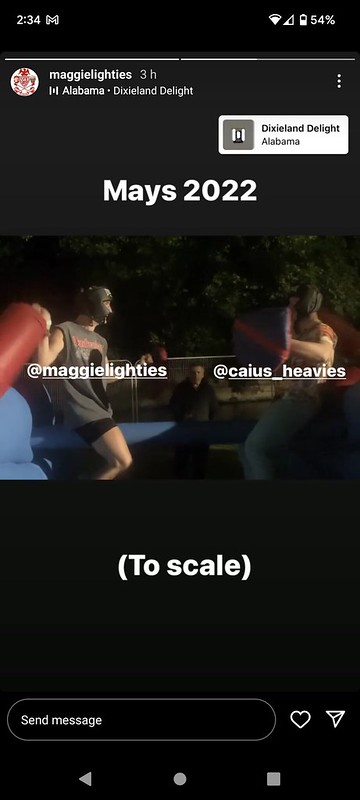
 Another year over and deeper in debt... this is Caius M2, though it was hard to distinguish them from M11. The separation at the catch is nice, something that this apparently respectable video doesn't like. It was a good year; lots of exciting action; some excellent and some achingly poor rowing; Caius and Newnham retained their headships.
If I was going to say nice things about everyone who deserved it, I'd be here forever, so as a token: congratulations to Queens' M1 for their blades, after a few dull years; and to Christ's W1.
Aanyway, this post is just a link to the full 37 video Mays 2022 playlist. Mays was run for the first time since 2019; I also took a few vidz at Oxford Summer Eights.
Update: alas, no-one qualified (arch).
Refs
* Lents, 2022.
Notes
1. Because they were good, not because M1 were poor :-) (2023/03: this video comes my way). Alas, they only went up three because they only good, not also lucky. And of course they were easily distinguished, since M1 wasn't bucket rigged, but I mean that from the quality of rowing, you couldn't easily tell which was the top boat.
 |
 |
 |
2022-06-09
Governments have largely failed to seize their chance to rearrange their energy supplies away from fossil fuels?
 In the face of momentous events people who really ought to know better are saying silly things like "Shocking: So far, governments have largely failed to seize their chance to rearrange their energy supplies away from fossil fuels. Instead, we are witnessing a global “gold rush” for new fossil gas production". This comes from stuff like The world is going through a major energy crisis as a result of Russia’s invasion of Ukraine. So far, governments have largely failed to seize their chance to rearrange their energy supplies away from fossil fuels.
 But what is this "chance" that they are failing to seize? What the fuckwitted Pootin war has given the world is, at least for the moment, effectively a nice large carbon tax. It would be great if theses fools could at least celebrate that, but of course they are too dumb to do so.
But other than that, there's no great "chance" lying around to be seized. Solar and wind have got no cheaper.
Update: other dumb stuff
Climate risk is financial risk by - yes, you guessed it - that nice Gernot Wagner. It is more telling-other-people-how-to-do-their-jobs stuff: we have invented this brilliant new concept called GW that you've never heard of now you must use it for everything no not in that way; in the way we prescribe.
Refs
* AUDUBON SOCIETY ANNOUNCES NEW FIELD GUIDE TO THE PRONOUNS OF NORTH AMERICA by VVatts Up With That
* Biden's Short-termism Not Surprising by Pierre Lemieux
* Why are nuclear power construction costs so high? Part I by Brian Potter
* There is nothing so absurd, says Cicero, which has not sometimes been asserted by some philosophers: but where did I use the Orwell version, about common versus intellectuals? Aaahhh... it was wrt McTaggart.
* Some favourites from RMG.
* 30 Years as a Professional Archaeologist - Martin Rundkvist
2022-06-07
Why Paternalists Must Endorse Epistocracy?
 Via Bryan Caplan but more specifically https://philpapers.org/rec/BREWPM. Generally I hate stuff with wanky philosophic words in it, but in this case Wiktionary tells me it means Rule by citizens with political knowledge, or a proposed political system which concentrates political power in citizens according to their knowledge which I suppose is fair enough. And this is of interest since whenever a discussion on democracy continues long enough someone - quite likely me - will bemoan the general stupidity of the general populace and ponder some means to restrict the francise to non-clowns; which usually means people like them or me; see-also Starship Troopers. Anyway, they say:
 ...we are “predictably irrational” in the pursuit of our interests. Paternalists from both the social sciences and philosophy use these findings to defend interfering with people's consumption choices for their own good. We should tax soda, ban cigarettes, and mandate retirement savings to make people healthier and wealthier than they’d be on their own. Our thesis is that the standard arguments offered in support of restricting people’s consumption choices for their own good also imply support for “epistocratic” restrictions on people’s voting choices for their own good...
Which is plausible. In the end, they come up with most of the correct arguement against: Last, there is a practical objection to paternalistic regulation of the vote: state agents might abuse their new powers. They end up dismissing this, but they are wrong to: corruption or incompetence in consumption choice regulation is undesireable, but limited, and fixable within the political process. Corruption of who-can-vote is, potentially, not fixable.
Refs
* Education - Our World in Data
2022-06-03
Yet moah climate suing
 A Peruvian farmer takes on Germany’s largest electricity firm, says El Econo. Peruvians doing wacky things is not necessarily news, but since the Economist is interested, perhaps I am. Previous stuff refers, weakly. From El E: Saúl Luciano Lliuya... teamed up with Germanwatch, a German green NGO, to sue RWE, Germany’s largest power company and Europe’s second-largest emitter, for belching nearly 7bn tonnes of greenhouse gases between 1854 and 2010. This, he says, has put his house at risk of a devastating flood. Mr Luciano Lliuya’s claim asks RWE to pay 0.47% of the costs of implementing it. That calculation comes from a study published in 2014 by Richard "Dick" Heede... which found that the activities of 90 large industrial emitters collectively accounted for 63% of the carbon dioxide and methane emitted between 1854 and 2010. This share is further broken down to the company level, laying the responsibility for 0.47% of historical emissions at RWE’s door.
But that 0.47% is wrong, of course: RWE didn't emit 0.47%. More, why sue RWE? Because the Krauts might be a soft touch. El E adds Court documents suggest that the German judges may consider that climate impacts were foreseeable from 1958, when the amount of CO2 in the atmosphere began to be recorded each day which is really very stupid indeed and will only fly in a heavily politicised court, if even there. Also note that they aren't even suing for damages.
El E adds And in any case that project is well within the local government’s budget. The fact that it has sat around for six years has more to do with bureaucracy and corruption. Local beliefs complicate matters. When sophisticated flood-warning systems were installed in two neighbouring villages, threatened by different lakes, the locals destroyed them.
2022-05-24
Bad beekeeping: spring recolte 2022
 Another post for my record, and perhaps your interest.
Note to self: please make up new frames for the Autumn so I can take out the crystallised ones. At least... five; and better more.
Saturday: to my new apiary aka N+N's garden, to see what state the girls are in. The answer turns out to be:
 There things went better than I'd expected: it was not totally crystallised, instead about half or perhaps more span out. That lasted until dusk around 9:30, so more processing was postponed for a day.
"East" aka two-super is not in good shape (quite possibly directly related to the aforementioned swarming) with almost no stores, and brood in the top super, and - probably related to that - bees trying to get into the top super from outside. Sigh.
Well, I tried to shake the bees down into the brood box, and put it back together, and hoped.
"West" aka three-super is much better. All three supers were nearly full, alas of semi-crystallised honey. And that is my fault for doing it this weekend rather than the last; but life has been busy. In my defence the rape is still yellow albeit faded. And so I go through the hive, patiently wiping bees off frames and moving the cleared frames off to a spare super a little way away - see pic. I've never gone for the "clearing" using bee escapes method, since wiping works pretty well. And through all of this the bees were kind and patient. We - Nk helped, the wheelbarrow was full of compost and hence unavailable - humped the frames down to the porch, where the old giant bandsaw provided a helpful table for decapping and spinning.
There things went better than I'd expected: it was not totally crystallised, instead about half or perhaps more span out. That lasted until dusk around 9:30, so more processing was postponed for a day.Or perhaps two, as it turned out I was busy in London all the next day. Returning on Monday, what had been fairly liquid on Saturday had turned distinctly gloopy, but the worst case - of turning hard inside the spinner, which I've had before - hadn't happened; so I duly drained / forced all the honey out, took it home, warmed it enough to filter, duly filtered it, and now it sits in bowls awaiting jars. And it will probably set again.
Refs
2022-05-23
Clash of the titans: Mann vs Gates, with a side of Hossenfelder
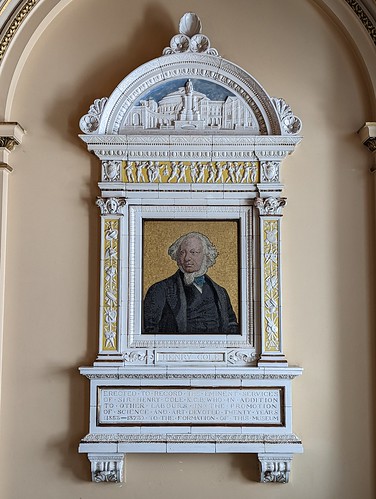 Mann is sad about Gates' disappointing and somewhat defensive answer to the question I posed to him via the Graun.; Hossenfelder says I'm with @BillGates on this one. Claiming that solving climate change is simple because we have the technology misses the point. This isn't a technological problem. It's a social, political, and economic problem.
Mann's "question" is one of those "it's not really a question it's more of a statement" kind of questions. He begins You’ve said you don’t know the solution for the politics of climate inaction and also that we need a “miracle” to address the climate crisis. But the obstacles aren’t physical or technological at this point (my bold).
To understand the question you need to know that Mann is referring to Gates in 2016 - which is odd in itself; a lot has happened in six years - and that the word "miracle" doesn't have its conventional meaning of something requiring divine intervention; indeed, it has pretty well the oppostive meaning: of something that is quite likely to happen (another example of a miracle according to Gates is the polio vaccine). Mann continues "The only real obstacle is having the political will to invest adequately in those technologies and put in place market incentives that accelerate the needed clean energy transition".
Gates's answer It’s weird to have… I mean, how do you think we’re going to make steel? How do you think we’re going to make cement? Most of the emissions are from middle-income countries. And the ability of either asking them to bear the huge premium and cost of clean approaches, or asking rich countries to subsidise that, that collective action problem is not likely to be solved with current green premiums. So it’s almost like he doesn’t acknowledge all the different sources of emissions. That’s weird... I don’t understand why he’s acting like he’s anti-innovation also seems off point to me, although consistent with his previous opinion that we do need FutureTech. I think there are three position: A: we can and will solve GW with TodayTech; B: we could do that but actually we'll use FutureTech at least in part; and C: we need FutureTech. I think B is correct; Mann is too much on A, and Gates on C. And Hossenfelder has misread everyone (Mann isn't saying it is simple-cos-we-have-tech; and Gates isn't saying the problems are primarily political).
Which is uncannily a replay of Half of emissions cuts will come from future tech, says John Kerry. And Mann, there, was again saying "no, we'll use current tech". Mann's point, I think, is "lack of tech is not the problem, and waiting for FutureTech is a bad idea", which is true, but uninteresting at least to me, because everyone agrees... although Gates manages to give the impression that he doesn't: there isn't a huge premium to clean tech; solar is competitive in a great many places. Mann's assertion that the problem isn't "physical" is doubtful; part of the problem is indeed the vast amounts of existing physical infrastructure.
Gates, oddly, makes no reply on the "political will" part. Perhaps he just hates politics and doesn't want to talk about it - many tech folk do, for the obvious reasons - and is counting on tech to solve the problem. Which I think it will, if the pols don't fuck things up too badly.
Score: Mann loses points for a badly phrased question; and for failing to analyse Gates' reply, but Gates loses more for getting the wrong answer.
So, in the end, this is all heat-and-noise with no real progress in the discussion.
Refs
* Timmy says No: We don’t want, desire or even care about how much any one company invests in itself. We do care that the system as a whole continues to invest. For investment in doin’ stuff is what makes that future richer.
* Quotation of the Day… from Ludwig von Mises’s The Anti-capitalistic Mentality.
* Was Einstein Reading "Worlds in Collision" When He Died? - hint: no. See https://en.wikipedia.org/w/index.php?title=Talk:Immanuel_Velikovsky&diff=1089910100&oldid=1089849142
* SDB and Me: An Autobiographical Exploration by Bryan Caplan
* How much innovation is necessary to see off fossil fuels? Mark Jacobson in The Economist.
2022-05-19
Mundus vult decipi, ergo decipiatur
 Misinformation is in the news, with the demise of the regrettable Disinformation Governance Board. Bryan Caplan correctly points out that insufficient attention is given to those doing the believing; and this is something I've been saying for a while and still am. Volockh also like Bryan's post, and quietly like me point to their earlier post on the subject.
My pic: Maggie, winners of Champs Eights head. Vair nice, try to avoid noticing that bowside are fractionally early. More similar.
Refs
* Deep State Constitutionalism from Volokh: "...taps into a deficiency of the conservative legal movement: namely, its exclusive focus on the law "as it is" at the expense of the underlying abstract normative principles that justify the positive law of our written Constitution".
* The follies of the world: ATTP is still beating back the forces of darkness at World Atmospheric CO2.
* All news is bad news; And the really bad news is that it's your fault by Matthew Yglesias
2022-05-12
A piece of Olde Englande
To Swinbrook, near my mother's house. First a bluebell wood, which is lovely, though there isn't much to say about it. Not strictly speaking public.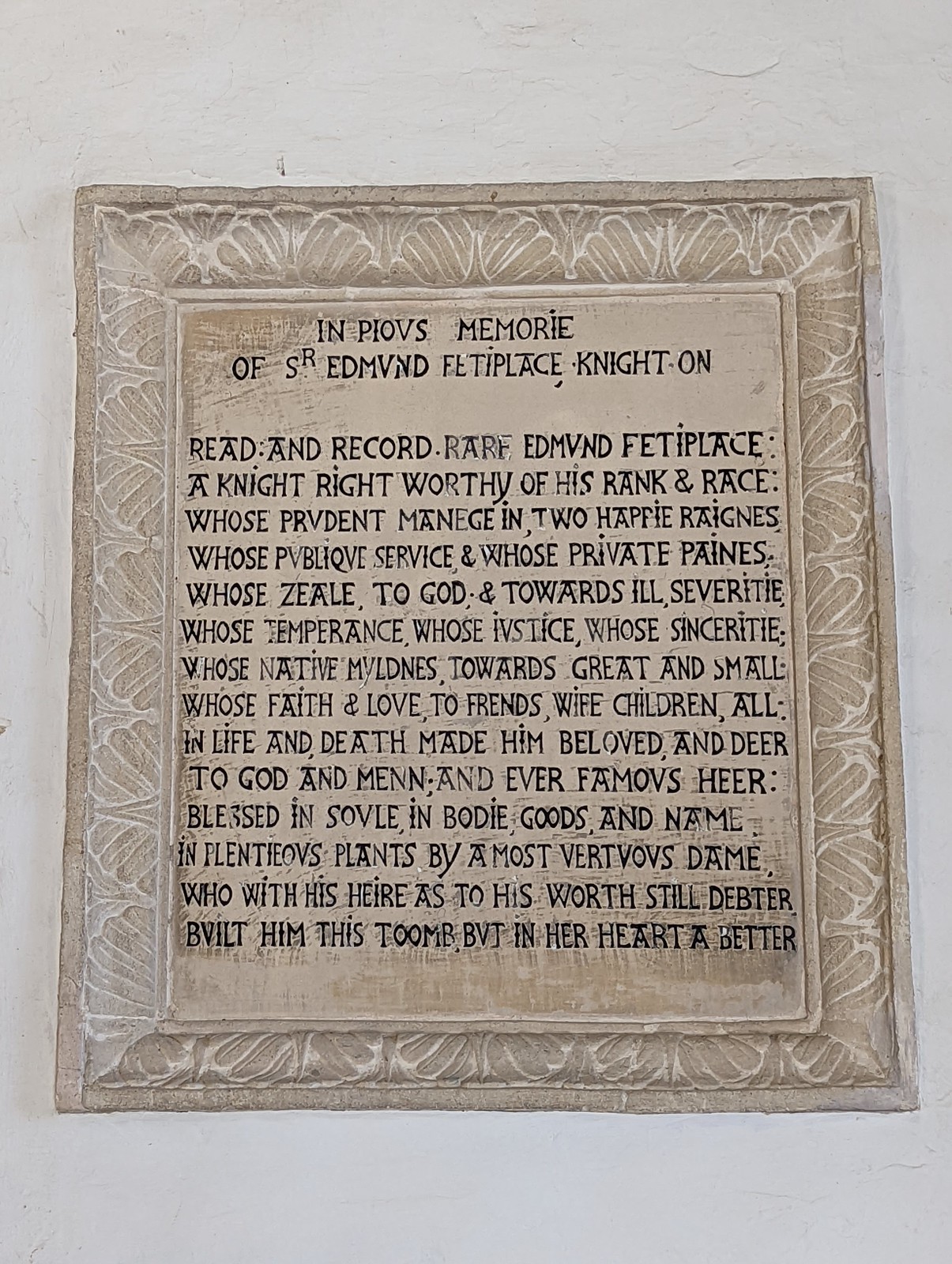

There's a line of pollarded willows along a tiny stream, also lovely.

Swinbrook itself is a tiny village mostly hidden behind walls, the marvel is the church, and the Fettiplace memorials.

A general view. Other pix here.

The older ones are weirder, the postures being so stiff and unnatural; the newer ones are more believable. Yet more proof that our ancestors were weirdos. There's a poem, I think to the one who commissioned the first monument:
See-also the table of benefactions, which shamelessly reveals that they lost Charles Fettiplace's £100 gift of 1713. Outside, some old tombs.

The curious "killer Dougal" effect isn't intentional: the bundle is apparently intended to represent a woolsack, the wealth of the region. And coming somewhat more up to date, the ill-fated Unity Valkyrie.

The nearby Swan Inn is decent, and has tolerable taste in toilet posters.
2022-05-06
Recent considerations in Roe vs Wade
 The recent events require no introduction. I maintain what I said before, though I think it likely they will uphold the precedent now looks likely to prove unprescient2.
That the dispute is bad-tempered and irreconcilable is itself uncontroversial, but in case you think otherwise, here are some words from the Graun and elsewhere: Samuel Alito has provoked an astonishing outpouring of jarring adjectives this week. “Appalling and heinous” – Vanity Fair; “acidic and extreme” – Slate; “dreadful and repugnant” – the Washington Post; “scathing and dismissive” – Los Angeles Times... will eviscerate federal abortion rights in America... Alito’s attack was so brutal and direct it still left many dumbstruck... Alito will forever be known as the supreme court justice who destroyed a woman’s right to control her own body and who set the US on a regressive course pointing back to the 17th century. I've only provided one side there; but I presume you don't doubt that the other side is just as certain of its fundamental rightness.
Side note: people often say, as the Graun does above, that repealling RvW would destroy "a woman’s right to control her own body". But the RvW judgement explicitly states that "For the stage subsequent to approximately the end of the first trimester, the State, in promoting its interest in the health of the mother, may, if it chooses, regulate the abortion procedure in ways that are reasonably related to maternal health". So RvW does the very thing that people rage about. FWIW, I find this part spurious: it is, or should be, clear that the mother's interest in her own health is higher than that of the state, and therefore the state cannot have any right to legislate, on health grounds, over her interests. But I rather suspect that few would be prepared to accept this obvious point as a general principle3. Rather, the only plausible balance to be considered is between rights of the individual and the unborn-right-to-life. No, I am not going to say what I think that balance should be, because why would you care?
[Update 2024/03: I begin to wonder if this could be framed as a free speech issue?]
Reading Roe v. Wade Is a Bad Decision That Ought to Stand I find "Legal authorities broadly agree on Roe’s constitutional defects... Roe can’t be repaired, much less thrown out, without doing more constitutional harm. For the sake of good governance, the court’s conservatives should rediscover deference to long-established precedent, and leave this rash and wrongly decided law alone". I am sympathetic to this and almost agree, but I also find the argument that it was wrongly decided persuasive. More importantly, I think that it should be decided by politics... perferrably by a generic constitutional item along the lines of "the state shouldn't do things it has no need to do". Again, this unobjectionable point is a principle that few would sign up to when made general.
Alito's leaked draft1 refers to the history of abortion law; and people have disgreed with his interpretation. If you're sufficiently originalist this might matter, but I'm not, so I think I can simply not care about that aspect unduly.
I return to the point of the democratic system: to provide a means for resolving these conflicts, where we've agreed they are irreconcilable. One amelioration, per Sumpers, is people will accept decisions they disagree with as long as they accept the legitimacy of the decision-making process. Which is of course why so much political speech is devoted to making you think the process is unfair. So we learn that leaving these decisions with the Supremes will lead to what we observe: people doing their best to delegitimise the court, which is bad. It would I think be more acceptable if done by state governments: then at least you can say: if you don't like it, vote against it, or move.
Another advantage of deciding at state level is that we have a natural experiment: what happens if <thing X> is banned in some places and permitted in others? We know we are not all-wise; it is good to allow experiment, in moderation.
Another, partisan, advantage, if you're a Dem, is that this would surely lead to more votes for Dems in upcoming elections. That's a fairly important point, and one that in the heat and dust I don't see emphasised as much as it should be.
Finally, I see this - and similar - as symptoms of our water-fatness. We really are so rich, considered as a society as a whole, that we can afford to waste vast quantities of highly paid people's time on this stuff. This makes idiots like Putin think the Cold West is decadent so he can invade Ukraine; but what he missed was the bit about us being so rich.
Update
As so often, a chance by-way provides a far more insightful comment than all the fluff: from Volokh, a review, making the point that there is a deficiency of the conservative legal movement: namely, its exclusive focus on the law "as it is" at the expense of the underlying abstract normative principles that justify the positive law of our written Constitution. This reminds us that even if you "believe" in the constitution, you should not treat it as holy writ, but grounded in "underlying abstract normative principles". But note that doesn't give you leave to simply write what you like into it, or ignore any bits you don't like. Interestingly, the underlying article refs Bostock.
Notes
1. 2022/06/24: the final decision is now released. Obama doesn't like it, but underneath the flowery words look for the contradictions. the freedom enshrined in the Fourteenth Amendment of the Constitution requires all of us to enjoy a sphere of our lives that isn’t subject to meddling from the state — a sphere that includes personal decisions involving who we sleep with, who we marry, whether or not to use contraception, and whether or not to bear children sounds great, but then our freedoms are not unlimited — society has a compelling interest in other circumstances, for example, in protecting children from abuse or people from self-harm. Asserting that we aren't free to self-harm sounds arbitrary to me; Obama is happy for the state to intervene whenever he wants to, but not when he doesn't. There's no principle; it's just case-by-case whatever he feels like.
2. Abortion got debated in Church and State.
3. See The morality of not meddling in other people's business.
Refs
* Via JM on Twatter, a paper The New Abortion Battleground that goes on endlessly about possible legal complications of inter-state juristictional fights. Not very useful, because it comes to no conclusions, other than to show that many things are possible.
* Are we living in a land Where sex and horror are the new Gods?
* Legislation: BOSTOCK v. CLAYTON COUNTY, GEORGIA.
* America’s Supreme Court faces a crisis of legitimacy says the Economist, worrying that "Nine berobed judges striking down laws approved by elected politicians poses a “countermajoritarian difficulty”" - ah, so they are in favour of striking down RvW, one assume?
* The Case for Ending the Supreme Court as We Know It by Keeanga-Yamahtta Taylor in the New Yorker. A long whinge, I include it for the brevity and fatuousness of it's attempts to think of what else you might do.
* Someone else (Paul Kahn as it happens) tries to discuss whether the constitution or reading thereof should get priority over precedent. But the discussion is unilluminating, since it has clearly been written to support the predetermined answer. Precedent can be overruled, it decides (anyone who dislikes Dredd Scott has no alternative answer) but the reasoning doesn't really help: The case law is working out the meaning of the principles by which we live. As those principles develop, some past decisions will look like missteps. But it does at least note the conflict between common law and constitution.
* More on the Dangers of Price Controls - CH.
* Bryan Caplan: The Putin and the Pea.
* More of me on RvW and RBG: http://wmconnolley.blogspot.com/2020/09/ruth-bader-ginsburg-died-on-september.html
* Misinformation About Misinformation - Bryan Caplan. Makes some of the same points I have. "Blaming listeners for their epistemic vices sounds bad. It makes the accuser sound elitist, if not arrogant. Blaming a few high-status liars for the world’s problems is a lot more compatible with Social Desirability Bias than blaming billions of low-status fools who fail to choose to exercise their common sense". Volokh comments and points to demand-side problems.
* Justice Samuel Alito’s draft opinion overruling Roe v Wade insists that it endangers no rights other than abortion, but this disclaimer follows pages of reasoning that suggest the opposite - the Economist.
* There Is a Reason Why Roe v. Wade's Defenders Focus on Its Results Rather Than Its Logic
Bad beekeeping chez M+S
 Another day, another swarm o' bees. Although perhaps I should not be too casual: they are welcome, and my last was in 2020 (the 2021 one got away, if I recall correctly; ah yes, see pix: they evaporated).
Whose bees these are I don't know; they were found by a friend just outside her garden about a kilometer from my apiary which, according to the apiary keeper, had been showing signs of "activity" a few days earlier. So they could be mine.
That's the close up view (zoom in! You can see detail!); a more distant view is here, showing my trail of destruction into the hedge, the stepladder, and the bees about 9 feet off the ground, though it doesn't show the ditch. The next step is to dump them into a box (forgive the lack of pix of that stage, as holding a box with one hand whilst shaking a branch covered in bees with the other already uses all my hands), shown here. And then they can be driven back to the apiary - still with my veil on - and dumped into a spare hive.
Which hive is N's. The moss is only superficial. It is a polystyrene hive: they are said to have many advantages: they don't warp or rot, and the bees don't stick them together. The sheet was for wrapping up the box-o-bees while in transit.
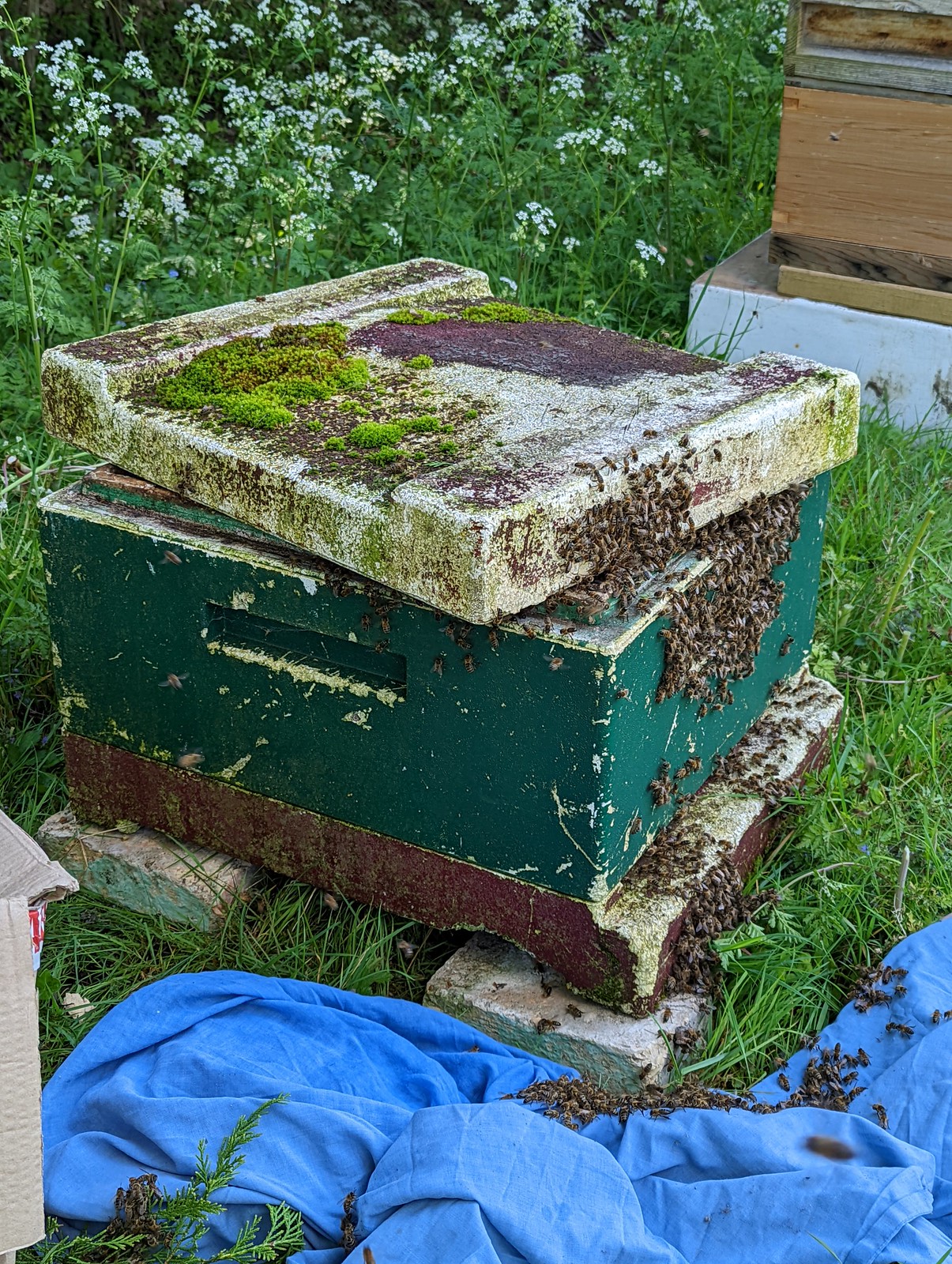
This is the post-dumped-in phase, in which they are slowly crawling into the hive, following their queen. So it has all worked out well. Pic with more context here.
Vidz of some of this are at Youtube.
2022-05-02
Why does the Evil Empire want to be paid in roubles?
 Time for another post, before people start worrying about my health. If you want to read something very stupid indeed, you can read Why is Vladimir Putin demanding Russian gas is paid for in roubles? in, you guessed it, the Graun. Timmy says the obvious. My only answer is that you have to pay in roubles, but at a stupid made-up exchange rate. Tenuously related, my Gas excitement from 2006.
Other than that, my best hope from The Evil Empire strikes seem to be realised. And as a bonus, that thing that almost never happens, is happening: the evil doing badly in just retribution for their evil. A hopeful omen.
My picture is The Road to Calvary (full pic), which has no relevance other than me seeing it at the Fitzwilliam. Although in some ways striking it is a clear rip-off of Bosch, and the painters have somehow lost inspiration for variety in the faces.
Speaking of my health, it looks like 7:35.3 is my 2k for the season, though I may hope to improve it later.
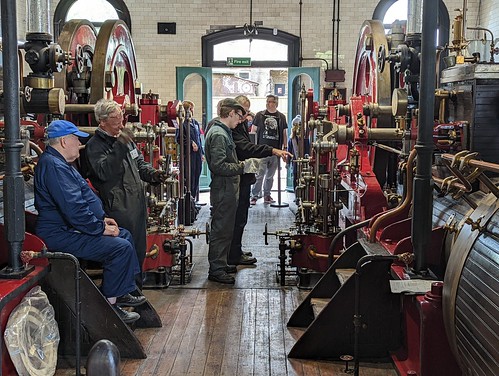
In other local news, the Museum of Technology was running its engines this bank holiday weekend. This pic shows the chimney (right, by the river, with smoke blowing right); in the middle the old gasometers, now long gone; our new house is in the empty patch of land on the right by the river bank as it runs downstream out of the picture.
Refs
* On Protectionism and the Dignity of Protected Workers (see-also Bryan Caplan on government employment).
* Feeling Around for Something Human Why do Russians support the war against Ukraine? Shura Burtin investigates.
2022-04-16
Salus populi suprema lex
 A placeholder post to keep Tom off my back while I write up Aristotle's Physics3.
Salus populi suprema lex: the quote is from Cicero, and means The health (welfare, good, salvation, felicity) of the people should be the supreme law2. There's actually an extra "esto" you need to shove in to make good latin, but it kinda reads nicer without, or at least I presume that's what the people who made my monument1 thought. It is also the form that the Inns of Court use, and their latin is likely better than mine.
Like quite a lot of things, it sounds good, certainly good enough to write on a monument or use as your great seal. Nowadays, if you search for the phrase on Google your results fill up with fuckwitted colonials who think that taking the word "health" literally is amusing. Idiots. Anyway, where was I? Oh, yes...
It has a regrettably collectivist, as opposed to individualist, slant. The welfare of the entire populace demands that your individual rights should be overridden? Then over they go... You see the problem I hope. Or not even individual rights: taken literally, it offers the sovereign the ability to cast any specific law aside, in favour of the "supreme" law: in both early modern and classical contexts, salus populi was often used to justify the 'arbitrary' power of the sovereign, in the words of one random source I found on the internet. From context, and as this argues, the maxim is only supposed to apply in times of emergency; but alas people can be rather slippery about what counts as an emergency.
Will that do for now? Not one of my best, I know.
Refs
* Primitive communism by Manvir Singh via Econlib
Notes
1. On Berkhamstead common.
2. Partial context, from an archive of Loeb: In the field they shall hold the supreme military power; they shall be subject to no one; the safety of the people shall be their highest law.
3. Which turns up much-delayed and mis-titled as Après ma mort, je ferai tomber une pluie de roses.
2022-04-14
Coronavirus days: tag, I'm it
 I have finally been zapped. As far as I know, for the first time. As a 58-year-old male in good physical condition who has been Double-Vaxxed and Boosted, I feel no fear and indeed feel little in the way of ill effects: just an irritating sore throat and cough.
However the test means I am working from home to protect my co-workers, and not attending the Works Easter Do (postponed from the Christmas Do) this evening, which is regrettable. I am doubtful that my co-workers require any protection, any more than I do from them; anyone Vulnerable won't be in the office anyway. The official NHS advice that I find does recommend staying at home, but doesn't insist on it.
As it happened I went back to the Old Place yesterday, but didn't interact with anyone.
Update: two days later, still it, but more faintly. Cough much better, barely there.
2022-04-06
Digital technology supports decarbonisation only if appropriately governed (high confidence)?
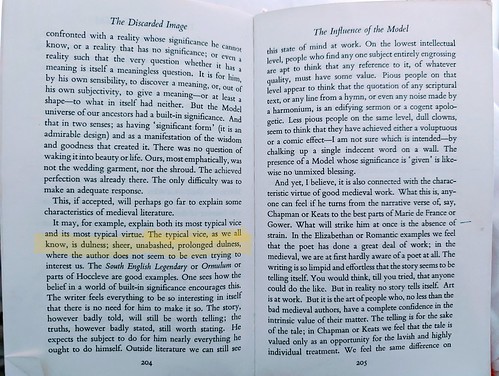 I'm glancing over the IPCC AR6 WGIII SPM, and so far am unimpressed. This is a "summary for policymakers" by people who have forgotten what "summary" means and who have never worked with policymakers. FFS, I'm 14 pages in and they've barely said anything interesting; if I was a policymaker I'd throw it at my wonks and tell them to produce a real summary.
And then we get things like my headlike, which tells you that this is written by and for people who want to fiddle.
I imagine there is something of interest in there somewhere though, so I might read on.
2022-04-02
Frederick Engels Socialism: Utopian and Scientific
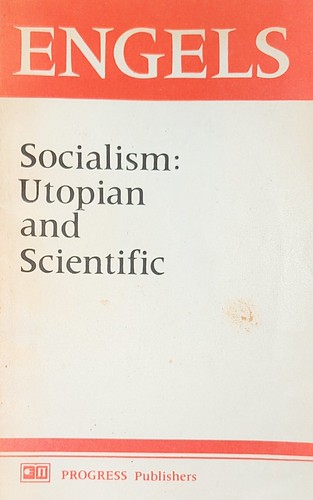 FFS, why am I reading this stuff? Mostly, because this slender pamphlet has turned up again in the chaos of our house move. If you're interested in an in-depth or - heavens forfend - sympathetic and knowledgeable review of this stuff, look elsewhere. I knew before I started that I was going to despise it, and only bothered read it to find out why. Should you wish to read the thing yourself, you can, courtesy of marxists.org. Wiki has an uninteresting article with no real analysis from which I'll leave you to find the historical context. My edition was printed in the late and distinctly unlamented USSR.
 As befits any kind of socialst work, it begins in factionalism: it was written as part of the forgotten conflict of Anti-Dühring. We then get large slabs of turgid historical analysis, some of it direct quotes from Marx himself. For example "The real progenitor of English materialism is Bacon. To him natural philosophy is the only true philosophy, and physics based upon the experience of the senses is the chiefest part of natural philosophy. Anaxagoras and his homoeomeriae, Democritus and his atoms, he often quotes as his authorities. According to him the senses are infallible and the source of all knowledge. All science is based on experience, and consists in subjecting the data furnished by the senses to a rational method of investigation." Which is all spiffy, but Democritus's atomism, though it turned out to be correct, had fuck all to do with observation; it was made-up like so much of antient Greek physics (see-also: Après ma mort, je ferai tomber une pluie de roses). So it is weird to see Engels uncritically quoting Marx apparently talking bollox. And all of it irrelevant to his purpose, as far as I can tell.
Engels is convinced that in "Dialectics" he has found some interesting and valuable new way of thinking. In attempted proof of which he attempts to co-op science: Nature is the proof of dialectics, and it must be said for modern science that it has furnished this proof with very rich materials increasingly daily, and thus has shown that, in the last resort, Nature works dialectically and not metaphysically; that she does not move in the eternal oneness of a perpetually recurring circle, but goes through a real historical evolution. In this connection, Darwin must be named before all others. He dealt the metaphysical conception of Nature the heaviest blow by his proof that all organic beings, plants, animals, and man himself, are the products of a process of evolution going on through millions of years. But, the naturalists, who have learned to think dialectically, are few and far between, and this conflict of the results of discovery with preconceived modes of thinking, explains the endless confusion now reigning in theoretical natural science, the despair of teachers as well as learners, of authors and readers alike. This is of course drivel. Dialectic is a discourse between two or more people holding different points of view about a subject but wishing to establish the truth through reasoned argumentation. Dialectic resembles debate, but the concept excludes subjective elements such as emotional appeal and the modern pejorative sense of rhetoric. But whilst the idea of striving for the truth by allowing different viewpoints to contend is indeed valuable, this isn't a lesson that communism managed to learn. And of course once you've found that truth dialectics loses its value; to expound what you know can be done linearly.
Just what is Socialism, though? I'm glad you asked, because big E has the answer: so now modern industry, in its complete development, comes into collision with the bounds within which the capitalist mode of production holds it confined. The new productive forces have already outgrown the capitalistic mode of using them. And this conflict between productive forces and modes of production is not a conflict engendered in the mind of man, like that between original sin and divine justice. It exists, in fact, objectively, outside us, independently of the will and actions even of the men that have brought it on. Modern Socialism is nothing but the reflex, in thought, of this conflict in fact; its ideal reflection in the minds, first, of the class directly suffering under it, the working class. I hope that makes it clear for you. Alas for me it doesn't, so I'm forced to think for myself. And what comes out, in quote after quote in the little pamphlet, is: socialism is not liking capitalism. You don't actually have to have any clear idea of what socialism actually is - towards the end, it turns into unicorns-farting-rainbows while the state withers away - but you do need to know what you hate; which is increasing prosperity.
2022-04-01
Lucia Liljegren is not notable
 Those with long memories will remember Lucia Liljegren, though I don't think she figured much here. But! At least I care enough to note that she isn't notable: Wikipedia:Articles for deletion/Lucia Liljegren was closed as Delete. Is there anything else to say? I think not.
2022-03-16
Opinions alter, manners change, creeds rise and fall, but the moral law is written on the tablets of eternity
 A quote, from Lord Acton. And apparently an inspiring one, since (inevitably in this day and age) you can get it on a fridge magnet. If Lord Acton's Philosophy of History by Crane Brinton in The Harvard Theological Review can be believed, it is the basis for his judgements of history; for his theory of history. But, is it true? I think not: from my conclusion there: morals, law and politics are under-determined by the defensible theoretical foundations. And thus, different people / groups build conflicting superstructures; and fail to realise that the bits they disagree about are the optional bits.
That it isn't true is likely going to be a problem for Acton, I suspect; though I haven't quite ground through the Liberty Fund edition of some of his works; so the exact nature of the flaw it causes in his reasoning is yet to be revealed. Acton was a staunch Catholic2, so I suspect (somewhat like Doubty Descartes) he managed to convince himself that all morality must necessarily equate to his church's morality.
I note that history, and recent history, teaches us that most problems don't arise from this little matter, but through much coarser problems of poor governance or poor thinking.
Refs
* Paul Graham explains philosophy. Note the "confusion over words" recalling Popper.
* ACX: Justice Creep.
* DB: quote of the day, discussing Hayek: Perhaps, as seems to have happened today (as it has in the past), the people begin to distrust all claims to expertise and seek simpler, more intuitive, solutions.
* Cowen on Labor Econ Versus the World by Bryan Caplan
* Is accurate forecasting of economic systems possible? An editorial comment; by Irene Scher & Jonathan G. Koomey
* Reflections on the Ukrainian Refugees by Bryan Caplan
* Said Marcus Garvey, in urging blacks to undercut union wages as a means to employment and combating union racism, “the only convenient friend the Negro worker or laborer has in America at the present time is the white capitalist.” - via CH.
* Idol Words - ACX.
Notes
1. My picture is from The freethinkers' pictorial text-book: showing the absurdity and untruthfulness of the Church's claim to be a divine and beneficent institution and revealing the abuses of a union of church and state by Heston, Watson.
2. Staunch in the faith, but at the same time believing in liberty, and hence implacably opposed to papal infallibility.
2022-03-11
The Evil Empire strikes
 No doubt about where I stand, then1. Ukraine: Work as if you live in the early days of a better nation kinda refers; it is interesting to review the comments there, especially: "The last thing Putin wants is another Chechnya or Afghanistan". I nearly wrote something when the Russkies were massing on the border, and then nearly wrote something soon after; but am able to resist no longer. Don't look for any informed analysis, mind you.
So, the situation: after massing troops on the border for "exercises" for months, the Evil Empire finally decided to invade Ukraine. And it seems to be going badly for them6: the expected swift progress has not materialised, the Ukrainians are fighting back, and the Cold West has gathered it's courage and imposed significant sanctions4 and handed over a few anti-aircraft and anti-tank weapons, which I support. The price of oil and wheat is up, but... well, we'll worry about that later.
Many things are unclear, including why the Evil Empire decided to do this. Mostly, that means why Putin decided to do this: for it is a country almost without checks and balances, run - it would appear - by the whim of one man. And run badly2. I decline to speculate on exactly why they did this stupid thing; there are quite enough speculations out there already, feel free to pick your own. But the pattern - of an Evil Autocrat getting into power - is sadly all to common: Gaddafi, Assad, Putin3. It becomes clear that governance is hard, and perhaps we have been mislead by the success and growth of democracies in the last, say, century; it is all to easy to suppress the voices of the people.
Making predictions at this point is unwise, but I will express my hopes that the plucky Ukrainians remain plucky, and stall the Russkies for long enough for the assault to fall apart; this does not seem implausible. More tenuously, I could hope for Putin to be overthrown, but this seems unlikely; more realistically, for him to not escalate to implausible levels (nukes; or mass indiscriminate shelling of cities). The difficulty there is seeing what could be a plausible endgame: perhaps, the answer is that he, like his army, is not as formidable as appeared, and will retreat to oppressing his own people instead of someone else.
We have, unexpectedly, what is effectively the gift of a carbon tax7; but I don't see anyone being grateful. Am I grateful? Perhaps I am. The extra is going to those that pump oil not governments, but I don't find myself too bothered by that. That it is happening so suddenly, and it cannot be predicted how long it will last, is regrettable.
What is Putin afraid of?
The foolish rhetoric does, as usual, hide a kernel of truth: that Putin is afraid of Russia gradually failing, and happy joyful prosperous free market economies springing up around it. In the long run, Russian failure under Putin was inevitable, even before this stupid war.
Notes
1. Yes, I know: safely in England well away from any fighting.
2. I think that a country run without checks-and-balances by even one good man would be badly run, but Putin is without doubt not good, indeed he is bad.
3. Most of the Gulf States are hardly paragons of democracy and we prop them up, so I can't say the West is blameless in such matters either.
4. But see-also Bryan Caplan on sanctions. I'd like to think we could manage more imaginative policies like Make Desertion Fast but our leadership can't think fast in unexpected ways. Or perhaps even slowly.
5. My image is a reminder that hope - or at least rhubarb - springs eternal.
6. Hurrah! Nonetheless we must remember that it isn't the individual Russkies who are evil - mostly - it is the system they are trapped in. Although, if they could stop believing in dumb myths about pan-Russianism or whatever, that would help.
7. Except (2022/06) Ted Nordhaus: Russia’s War Is the End of Climate Policy as We Know It: Ironically, geopolitical strife and energy scarcity will do more for the climate than decades of ardent policies.
2022-03-05
The flower of poor thinking is to lack influence
 Or, The First Step Toward Saving the Planet Is Ignoring the Economists by Andrew Dessler in Rolling Stone. You may well say that being published in Rolling Stone gives you more influence than a humble blogger and I would be forced to agree. So it goes.
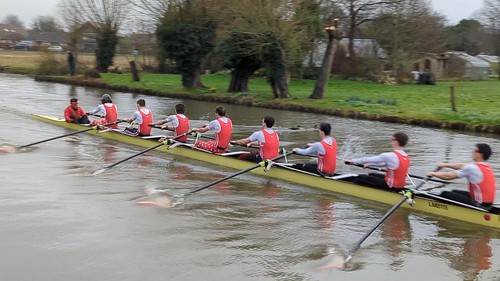
Speaking of how it goes, my picture shows LMBC rowing over comfortably ahead of Caius to retain the Lents headship. For connoisseurs of mud, the towpath was horrible, since it rained, lightly, almost all week. But despite the Covid-induced break, everyone seemed to remember how to bump.
The nub of AD's analysis is "The U.N.’s latest climate report shows that we don’t know how expensive the climate crisis will be, which means cost-benefit analyses weighing how to combat it are pointless". The new report is really quite long though, and AD doesn't provide any quote from it demonstrating that his assertion is true, so I think that very basic step can be regarded as Unproven (do feel free to provide a suitable quote in the comments). Furthermore, if we genuinely had no idea how expensive it would be, we would have no basis for action at all (a quote below shows this isn't true). However, let's assume that the IPCC (why has AD switched from "IPCC" to "UN"? Odd; perhaps he is trying to put off the right wing nutters) does indeed say that; why would it demonstrate that economic thinking, including CBA, is pointless? His end point is revealing in this regard: As the latest IPCC report says, “The cumulative scientific evidence is unequivocal: Climate change is a threat to human well-being and planetary health. Any further delay in concerted anticipatory global action on adaptation and mitigation will miss a brief and rapidly closing window of opportunity to secure a liveable and sustainable future for all.” Do we really need a cost-benefit analysis to convince ourselves to address this threat? Taken all that at face value, no, we don't need a CBA to decide to do something. But we do need a CBA to decide what to do. Because a large number of solutions from different people are proffered, and we cannot do them all; and many of them, whilst appearing brilliant and obvious to their proponents, appear stupid to others. How shall we decide what to do? Shall we just accept arbitrary diktak? Or should we do... that which involves least use of resources?
I have said this before - but cannot now find it, so will have to repeat myself - that avoiding economic thought is often a way of saying "do what I want". Which is generally bad.
AD's prime example of why CBA is bad is During the Obama administration, the social cost of carbon... was estimated to be $35. The Trump administration altered some of the assumptions that led to his estimate, particularly how much they valued future generations versus ours, and how much they valued people outside the U.S. versus those who live in America. They estimated the social cost of carbon to be as low as $1. But this was politics, not economics. Calling CBA bad because of Trump is just dumb.
Is there any virtue to AD's piece at all? If there is, it isn't the quoting Franta bit. His discussion of "Obama’s climate bill" isn't great either: although, as he notes, some made hyperbolic claims about the costs, he is firstly wrong to attribute those claims to economists: they were made by pols. Secondly, he is wrong to assert that reality disproved those claims: since the bill didn't come into action, we'll never know what costs it would have had. Thirdly, as he mentions but doesn't think about, even without the bill the aims of the bill were achieved. So all those making hyperbolic claims about how necessary the bill were, have been proved wrong by reality. My guess is that AD would have been one of those people, but I can't be bothered to find out.
Refs
* The flower of justice is peace
* Make Desertion Fast by Bryan Caplan
* A Populist Attack on Big Tech by David Henderson
* Not So SWIFT by David Henderson; A SWIFT and sure way to punish Russia by Scott Sumner
* "It could be said of democracy that all theory was against it and all experience for it." - TF
* What Should Economists Do Now? by Mikayla Novak
* The Age of the Judicial Thoroughbred aka Benjamin Barton’s The Credentialed Court.
* Should we care about the world after 2100?
* Waging the War of Ideas, via What the EA community can learn from the rise of the neoliberals, via ACX.
* The Actual Food Problem - via Timmy. Not sure it is, but "fertiliser used to be 55 per cent of the cost of his business, but will now be near to 80 per cent..." is interesting.
* Oxford’s Sustainable Law Programme establishes the Climate Litigation Lab
Subscribe to:
Posts (Atom)