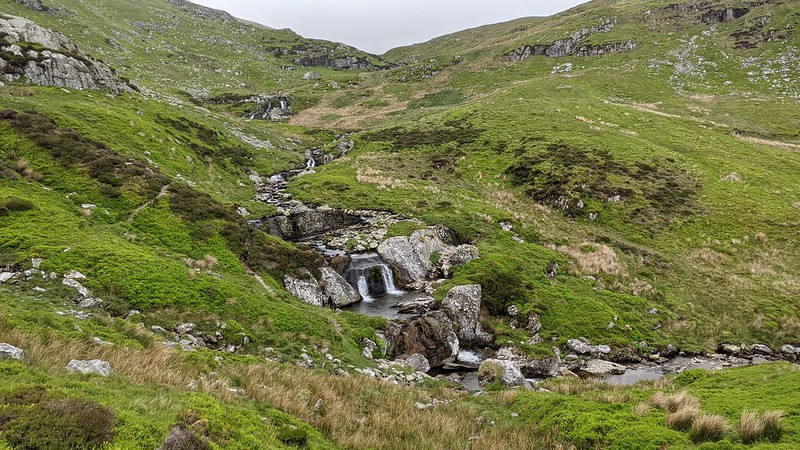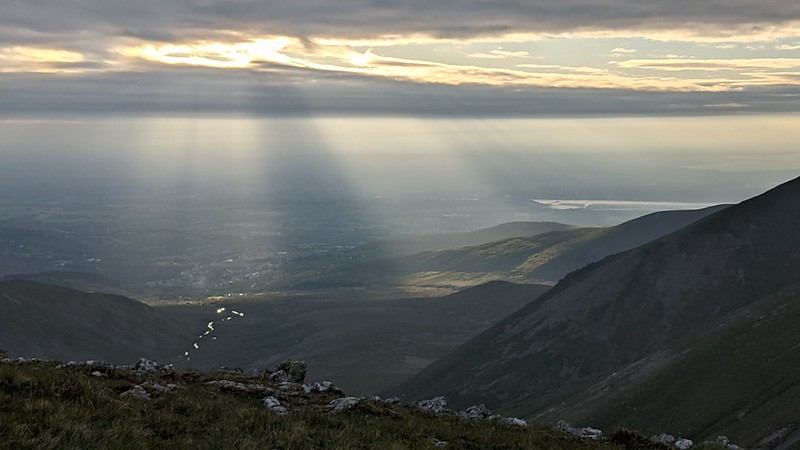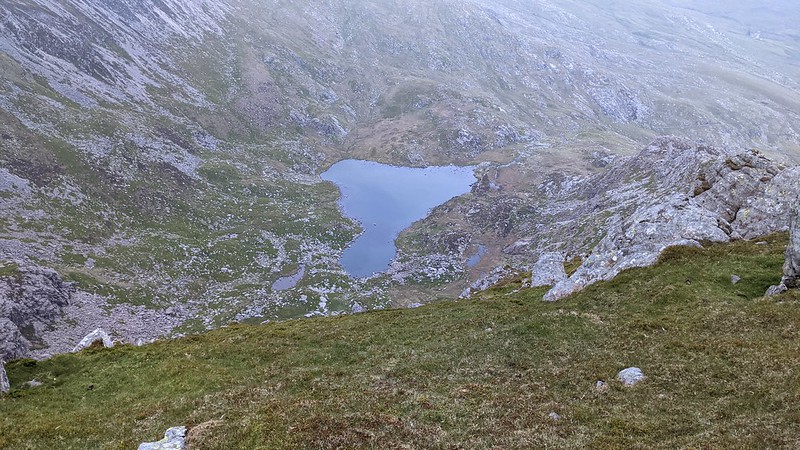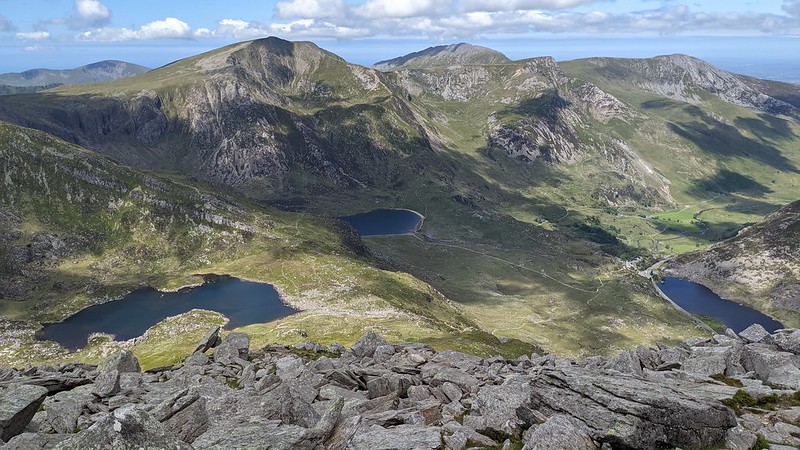
2021-08-29

The Problem with Nordhaus?

IMG_20210811_165348_742 Time to stop bashing those who are nominally on my side, and bash people on the other side, errm, well sort of. The offender today is David R. Henderson of Econlib, although really at Hoover. DH isn't one of the better Econlib folk, though he's generally sensible on economic matters (I've reffed him e.g. here, tangentially) but on GW he goes a bit mad; perhaps this is a good place to drag out my newly-discovered Proverbs 21:16: The man that wandereth out of the way of understanding shall remain in the congregation of the dead.

Let's begin by establishing to our own satisfaction that DH is on the clueless-septic fringe: he says Nordhaus challenged a Wall Street Journal article by sixteen scientists who were/are global warming skeptics. There's an arch of the WSJ thing here; it features the usual suspects like Happer and Lindzen, as well as somewhat more surprising nutters like Armstrong, who knows fuck all about GW. DH's problem of course is that he too knows so little about GW that he takes their self-description as sixteen scientists who, implicitly, has some clue as to what they're talking about at face value. He is also so bad at updating that he even approvingly quotes their dumb Perhaps the most inconvenient fact is the lack of global warming for well over ten years now. FFS, I thought everyone had given up on the "hiatus" ages ago. I don't think I bothered talk about the WSJ drivel at the time; if you want more detail, try RC.

OTOH, back on the basic econ, he makes several (ex?-)commentators here look like nutters: "innovation generally has contributed to economic growth and economic well-being. But how is the growth from innovation split between the innovators and the consumers who benefit from innovation? In a 2004 study published by the National Bureau of Economic Research, Nordhaus wrote: Only a minuscule fraction of the social returns from technological advances over the 1948-2001 period was captured by producers, indicating that most of the benefits of technological change are passed on to consumers rather than captured by producers. How minuscule? Nordhaus estimated the innovators’ gain to be only 2.2 percent of the overall value they create. The rest is competed away". It is so hard to find people competent at both GW and Econ.

And in other places DH is simply mixed: [Nordhaus] claims that the company suppressed the science of climate change and funded “climate deniers.”. So the suppression claim is of course nonsense (and remains nonsense, even when people who should know better like Rahmstorf twit it), but the funding of denial is I think true.

Incidentally, DH is kicked off by Nordhaus's The Spirit of Green: The Economics of Collisions and Contagions in a Crowded World. And he sez in a 355-page book, Nordhaus hardly discusses the science at all, apparently expecting that an argument from authority is sufficient. Which is to misunderstand; more, I think, signs that DH hasn't been keeping up to date. The point is that the science is now generally agreed (see, e.g., the Alsup case; even the oil companies agreed to take the IPCC as given); why would Nordhaus discuss it, other than to give the general conclusions?

What should DH do? The obvious: write about things he understands: economics, and perhaps the related governance issues. And where he wants to talk about things whose science he doesn't understand, like GW, he should accept authority (which in this case is obviously the IPCC), because this is the only thing you can plausibly do. His mistake is to cherry pick some "experts" with opinions that suit his leanings; per Feynmann, the easiest person to fool is yourself.


2021-08-26

Yet more bollox from Supran

Who knew what when? refers, obvs. But today's lesson is taken from a twat by Geoffrey Supran, pushing an amicus brief wot he has writ in conjunction with a pile of the usual suspects. As is traditional, it is badly written, starting with At least 50 years ago, Defendants [the usual Evil Fossil Fuel Interests] had information from their own internal research, as well as from the international scientific community, that the unabated extraction, production, promotion, and sale of their fossil-fuel products would endanger the public. Defendants failed to disclose this information... yes, that's right: the EFFI are being accused of failing to disclose info from the international scientific community. This makes no sense at all. Being slightly less literal, they knew nothing that the ISC didn't know, so accusing them of failing to disclose duplicate info makes no sense either.

And now I look, FFS, this is just recycled drivel - or perhaps my use of the word "traditional" was more approriate than I thought - so you'll have to forgive me the picture, it too is traditional - from Yet more bollox from Oreskes. It is the same junk they wrote then. Give me strength.

But I shall struggle on a bit further because I can recycle one of my own posts. They continue, "In 1959, physicist Edward Teller delivered the earliest known warning of the dangers of global warming to the petroleum industry, at a symposium held at Columbia University. Teller described the need to find energy sources other than fossil fuels to mitigate these dangers, stating a temperature rise corresponding to a 10 per cent increase in carbon dioxide will be sufficient to melt the icecap and submerge New York....". But the point is that Teller was hopelessly wrong, as I said before. No-one should, or did, act on Teller's warning, because at that point, no-one knew. As Teller so helpfully demonstrates.

Note that this is all orthogonal to the question of "was there a PR campaign to delay and obfusticate", to which the answer is Yes.

Notes

1. I briefly covered the suit in Yet moah climate suing.

Refs

* TALIBAN PROMISES FIRST CARBON NEGATIVE JIHAD

* Book review: Colonialism, the Golden Years

* Book review: Labyrinths

* Book review: Euthyphro

2021-08-18

Afghanistan

PXL_20210815_100741012 So, Afghanistan has "collapsed"3. This is hardly surprising, since we've1 spent two decades propping up corrupt incompetents; without the prop, they cannot stand.

I'm with Hobbes: the worst thing is civil war. Our prop sustained eternal civil war, as we didn't have the resolution required to end it, so leaving was the best thing to do2.

The speed of collapse surprised me, as well as people who should have known better. So the system was even more rotten than we thought. OTOH, we had warning of this, in the sense of an example, ISIS in Iraq, had we thought to think of it. However, that the system would collapse was obvious; sadly, I neglected to write that down in advance.

This is distinctly Hard Luck for a variety of Afghans who would prefer a more Western lifestyle, aka freedom and the Great Society rather than Tribalism. OTOH, such people don't seem prepared to fight for what they want; they seem to have acquired our fatness and rather forgotten the blood-of-patriots bit alongside the tree-of-liberty bit; preferring (I extrapolate from very limited information) to leave the fighting to the proles.

I've seen various saying that it is sad that it comes to this, after we "gave them freedom"; but I don't think you can really "give" people freedom; they have to take it.

Updates


The Economist: America's shambolic withdrawal from Afghanistan has left the country on its knees. How can America and its allies rectify such a dire mistake? But this is wrongthink: firstly, it wasn't a mistake, and secondly the USA and friends can do little to "rectify" it other than get out of the way.

As to the shambolicity: meh. Possibly it could have been done well, but I think that was asking too much. So much of USA-in-Afghanistan (and Iraq) has been done appallingly badly - indeed, everything other than the initial inevitable military victory - that expecting something better than bad is unreasonable.

2021/08/20 The chaos on the runway contrasted with the Taliban’s nearly bloodless capture of Kabul a day earlier sez The Economist. And... who was in charge of the runway? Yes, that's right: the West. Not the Taliban. I wonder how long they will tolerate those troops? They may perhaps be quite happy to see a pile of "troublemakers" leave. Or All Afghanistan is secure, but the airport which is managed by the Americans has anarchy, as the Taliban put it.

2021/09/18: in a final burst of incompetence: Afghanistan: US admits Kabul drone strike killed civilians.

Predictions


Words are cheap, predictions are hard. So these will be wrong, but they might be in the right direction. I think all the current panic - which effectively says that anyone who ever talked to a Westerner needs to leave now to avoid being strung up or worse - will turn out to be just so much panic. The Taliban will string up few if any, at least for past "crimes", because: why should they? They have won, at least for now. They don't have a long-term strategy (do they want to remain a local tribal theocracy, or join the league of nations? They don't know). Women's rights... are unlikely to get better quickly and are likely to get somewhat worse (but my suspicion is that WR were only ever improved in urban areas and remained poor in most of the country) but if the country can have peace, will improve in the long-term. Peace will also improve everyone's right not to get blown up or be otherwise killed or be poor (recall Smith). If the West avoids meddling - as it should - then the Panjshir valley stuff will fizzle out to overall Taliban control.

From the West, we seem to be tying ourselves into knots: we've classified the Taliban as terrorists (even though, as far as I can tell, they aren't (they have blown people up in Afghanistan, of course, but that was in the course of a civil war)) and have blocked their money, and somehow we're going to have to unwind that position. Doubtless we will, in time. We will continue to pontificate pointlessly about Rights.

Other people's bad takes


Kissinger (is he really still alive?) has a go in the Economist. Let's look:
* We entered Afghanistan amid wide public support in response to the al-Qaeda attack on America launched from Taliban-controlled Afghanistan: this isn't true. The USA got twatted, and the public wanted to twat someone back, so they did. But that was the extent of public support. It was easy for aggressive pols to parlay that into boots-on-the-ground, and doubtless a poll at the time would have seen Joe Public thumbs up, but really support was ignorant and shallow.
* We convinced ourselves that ultimately the re-establishment of terrorist bases could only be prevented by transforming Afghanistan into a modern state with democratic institutions and a government that ruled constitutionally: which is what they always do. Because (as big K fails to think through) they have no other plan. Having twatted the govt, they needed to replace it. They could not replace it with a structure that would have reflected the actual tribal power structure (waves hands: don't mistake me for an expert on Afghanistan) because that would be undemocratic; they have nothing else to fall back on. K refs himself in 2010 saying the attainable outcome is likely to be a confederation of semi-autonomous, feudal regions configured largely on an ethnic basis, dealing with one another by tacit or explicit understandings but his only idea towards that is regional diplomacy rather than national: thin stuff, and no longer mentioned in 2021.

Weirdly, the Afghan army doesn't blame itself, if a three-star general in the Afghan Army writing in the NYT can be believed. But of course it is the same old excuses all over again: It’s true that the Afghan Army lost its will to fight. But that’s because of the growing sense of abandonment by our American partners and the disrespect and disloyalty reflected in Mr. Biden’s tone and words over the past few months. The Afghan Army is not without blame. It had its problems — cronyism, bureaucracy — but we ultimately stopped fighting because our partners already had. This fails to understand that the Afghan army had to be the primary in all this; not (what it actually was) some dangling appendage of the USA that gave up when the USA "disrespect"ed it. But, he gets some points for mentioning corruption.

Economist: After Afghanistan, where next for global jihad? The biggest danger is in poor, unstable states where insurgents already control territory. But as they themselves say: Bad government creates an opening for jihadism. When a state is unjust, its citizens may imagine that one run by jihadists might be better. Even if they do not take up arms, they may quietly support those who do. Many rural Afghans decided that Taliban justice, though harsh, was quicker and less corrupt than government courts, and that Taliban checkpoints were less plunderous... The long-term solution is to build less awful, less exclusive states... Donors can offer advice and cash, but ultimately it is up to locals to build institutions that work. I think that last bit is wrong: that all the West should offer is advice and cash. The advice is ignored, the cash is stolen. Something better, more forceful, is required. But the force must be to build good govt, not to prop up bad.

Other people's good takes


From Hazlitt (p 72): It has been observed again and again how the morality of savage tribes decays and disintegrates when they are confronted by the utterly alien moral code of their "civilized" conquerors. They lose respect for their old moral code before they acquire respect for the new one. They acquire only the vices of civilization. The moral philosophers who have preached root-and-branch substitution, in accordance with some "new" ill-digested and oversimplified principle, have had the effect of undermining existing morality, of creating skepticism and indifference, and of making the rules by which the individual acts "a matter of personal taste."

Premature Imitation and India’s Flailing State (and Econ 101, the Drug War, and Afghanistan) are good on the issue of corruption, and the thorny issue of why.

Update 2021/12: they are clearly short of stuff so I gave the British Red Cross £100 to spend there. 2022/12: and another £100.

Refs


* History is not a master but a teacher. It is full of evil. It is addressed to free men who choose among its examples. Like experimental science – in which many unsuccessful experiments prepare the way to discovery.
* A Taliban-run Afghanistan will be less isolated than the West may hope. But no country will feel comfortable with it - Economist.
* The Afghanistan occupation and the Japan occupation: We learned the wrong lessons from our post-WW2 success by Noah Smith
* The shocking reality of Afghanistan today (via Sky). I know, I know, there's far worse.
* Al Jazeera English: The West is getting Afghanistan wrong – again.
* Afghanistan: Social media users delete profiles over fear of attack - is the Beeb getting short of real news?
* No Forgiveness for People Like You - Executions and Enforced Disappearances in Afghanistan under the Taliban - HRW
* [2023/04] Taliban ban on women has forced UN into ‘appalling choice’ - the UN chooses rules over helping people.
* [2023/05] Life under the rule of the Taliban 2.0: For half of Afghans the mullahs’ regime is less bad than feared - Economist: The Taliban have improved economic-law enforcement across the board... “The core competency of the Taliban government is the enforcement of laws and orders... If we find you are doing corruption and we implement Sharia laws on you, you will not do corruption again.” To acknowledge such progress is less a tribute to the Taliban’s harsh methods than an indictment of the corrupt, nato-backed governments the Islamists replaced.

Notes


1. "We" means the Cold West, but of course mostly the USA.

2. "best" but not good. One might perhaps attempt to argue that only now two decades have passed is it obvious how useless the Afghan elite are; but I think it was obvious at least a decade ago.

3. Far in arrears (2025/10) I realise that of course A has not collapsed; what has collapsed is the corrupt incompetents we tried to impose; instead, it has phase-transitioned to a stable-looking although not very pleasant-looking native govt.

2021-08-16

Three weeks around the Monte Rosa Group

Well, I'm home. I hope you missed me.

  PXL_20210811_134132579 
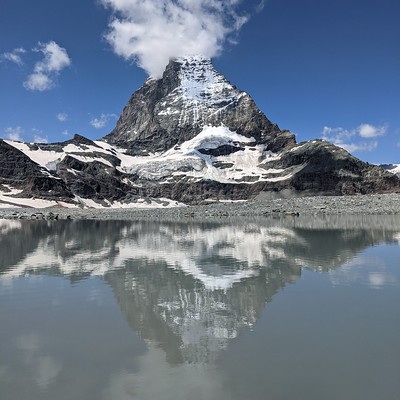
Pic: the Matterhorn, seen from the Hornli Hutte. It is awesome. No, I didn't climb it, though I did have a small try. A full travelogue will be produced in due course. Oh, and for those who still don't know where I went to, the answer is Roku.

Full write-up over here.

2021-07-25

The end of an era

I have left Qualcomm for a brave new world. Blogging here is pretty thin so I shall keep up the suspense by not telling you where I'm going. Feel free to make amusing guesses in the comments.

Everything has been terribly amicable - which for the English is a sure sign - so I offer no dirt. The answer I've given most often is "13 years is a long time" which is true enough. 13 years is also about how long it is since we last scrubbed out the kitchen bin, and as I discovered that leads to a visit from Beelzebub, Lord of the Flies.

Leaving during homeworking is weird.

Refs


* My farewell song was Sheryl Crow - Leaving Las Vegas. It definitely wasn't Eminem.

2021-07-19

Book Review: The Righteous Mind

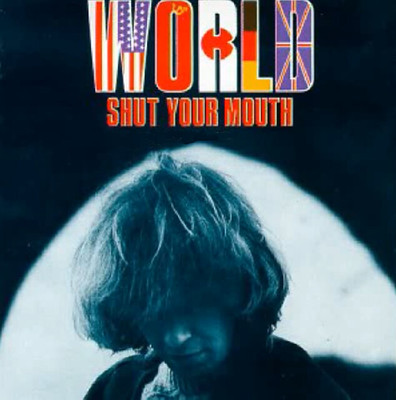
Julian Cope Following in CIPs footsteps, only nine years behind the times. There's no hurry. I'm interested from the perspective of foundations-of-morality-and-law6, to put my biases up front; and so will ignore sections orthogonal to that. I want to argue for an abstract morality; I can cope with what I think is JH's evolution-influenced morality if I can fit it into a paradigm that only certain moralities are possible; that others fail to produce stable societies. This is a long and I think worthwhile book, even if I didn't agree with all of it. This review doesn't really do it justice; it is more about my own preoccupations. Now read on.

Chapter one: where does morality come from?


Conclusions:

* The moral domain varies by culture. It is unusually narrow in Western, educated, and individualistic cultures. Sociocentric cultures broaden the moral domain to encompass and regulate more aspects of life.
* People sometimes have gut feelings-particularly about disgust and disrespect-that can drive their reasoning. Moral reasoning is sometimes a post hoc fabrication.
* Morality can't be entirely self-constructed by children based on their growing understanding of harm. Cultural learning or guidance must play a larger role than rationalist theories had given it.

If morality doesn't come primarily from reasoning, then that leaves some combination of innateness and social learning as the most likely candidates. In the rest of this book I'll try to explain how morality can be innate (as a set of evolved intuitions) and learned (as children learn to apply those intuitions within a particular culture). We're born to be righteous, but we have to learn what, exactly, people like us should be righteous about.

I'm happy with most of that, and if I keep agreeing with him this may be a short review (in particular I think I can make it not contradict The Enlightenment Project's "sought to found [morality] on the rational choice of its subjects rather than on tradition or local prescription")5. That Western morality is "narrower" is good; refer to Popper / Hayek. The third point isn't quite self-contained: he is referring to a previous theory that morality comes mostly from harm-is-wrong. He finds himself forced to abandon this theory: most obviously in sociocentric (non-individualistic) cultures, but to a lesser extent in the West, non-harm taboo-violations are viewed as immoral. However, the interpretation is the charm...

Consider one of his taboo-violation-as-immorality stories: a family accidentally runs over their pet dog and kills it. No-one sees. They take the dog inside and eat it. No-one knows. Is this immoral? Essentially everyone squirms at this and (apparently) when he gave this as a test, people kept making up spurious reasons why people might have been harmed. I think it is kinda1 immoral4, and the harm is that they are harming themselves or "their soul". they are knowingly violating a strong taboo in their society; they know they cannot tell anyone else; this stress will damage them2, and having people with "damaged souls" is bad for society, i.e. it harms others  (I don't think you're obliged to agree with me here. But I hope you're surprised like me that JH failed to think of it). So we can end up with a principle-of-morality as not-violating-taboo, without having to care when thinking in the abstract just what the taboo is.

Update: 2025/10/11: apparently, people try to make "intuitive repugnance" into a moral principle. That's wrong, obvs; it is allowed to be a guide, but it has to be justifiable by reason in arrears. Bryan Caplan makes a case for repugnance being generally wrong as a guide; likely, he is correct when we're reacting to new things in old ways.

Chapters two, three and four are not relevant for my purposes (but I read them).

Somewhere along the line, JH notes that while people's reason is poor at picking up errors in their own instinctive judgements, it can be good at picking up others'. This feels true. What he doesn't bring out of that is that slow conversation - blogs perhaps - can be a better way of talking than F2F discussion.

That concludes part I.
PXL_20240323_134151801

Chapter 5: beyond WEIRD morality


WEIRD philosophers since Kant and Mill have mostly generated moral systems that are individualistic, rule-based, and universalist. That's the morality you need to govern a society of autonomous individuals. But when holistic thinkers in a non-WEIRD culture write about morality, we get something more like the Analects of Confucius, a collection of aphorisms and anecdotes that can't be reduced to a single rule. Confucius talks about a variety of relationship-specific duties and virtues (such as filial piety and the proper treatment of one's subordinates). But this is confusing morality-schemas with actual concrete codes-of-morality. Kant isn't producing a specific code; Confucius is; or even more, producing a guide to a code; which would naturally be illustrated by examples.

Towards the end of the chapter he comes close to saying he can understand how the Repubs might not be evil; but you can tell he really still believes in the Dems.

Chapter six (Taste Buds) is probably introducing an important-to-him idea, but is thin. He considers care/harm, fairness/cheating, loyalty/betrayal, authority/subversion, sanctity/degradation but really all the first four fit under harm.

Chapter 7: the Moral Foundations of Politics


Kinda goes though the same pairs as chapter 6, but slightly differently. But... well, example: We are the descendants of successful tribalists, not their more individualistic cousins. I think this is true, but irrelevant to morality6. It can explain instincts and behaviour, but not morals. Or one of the most important insights into the origins of morality is that "selfish" genes can give rise to generous creatures, as long as those creatures are selective in their generosity. Altruism7 toward kin is not a puzzle at all. Altruism toward non-kin... Robert Trivers published his theory of reciprocal altruism... evolution could create altruists in a species where individuals could remember their prior interactions with other individuals and then limit their current niceness to those who were likely to repay the favor. This too is true, but is again mixing instinct and morality. Altruism is not a moral requirement: you are not required to behave altruistically. If someone behaves A to you, you are semi-required to reciprocate, but that's different. Discusses disgust/sanctity in the context of food-gathering by omnivores, which again may explain our visceral disgust, but again not morality... and has effectively been re-purposed into taboo enforcement3.

Is some of this stuff backwards? He uses the idea of "the sanctity of the natural environment", as indeed do many others, but this is inappropriate: rather, it is retrofitting the word "sanctity" on, in order to trigger the desired emotions. Now I get to the end, I discover that what he was trying to tell us is how/why these pairs evolved.
PXL_20210712_205446118~2

Chapter 8: the conservative Advantage


This seems close to the core of the book, judged by the title: it applies his theories to explain... well, why some people are Repubs. Betraying the biases of his audience, perhaps, he doesn't seem to need to feel any urge to explain why some people are Dems. 

But, to his credit, he is pushing against the all-too-common narrative of "explaining away" Repubs as damaged-in-childhood or somesuch.

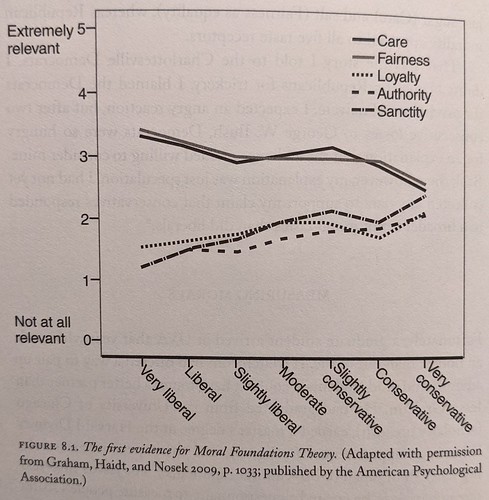
Instead (see pic) he finds that Libs weigh Care+Fairness highly, nearly to the exclusion of all else; whereas Cons weight them all about equally. He doesn't make the obvious point that one could assert that weight-all-equally seems closer to the default; so that Libs are the ones who need explaining.

After a bit he realises that Cons also care about fairness, but in a different way: fairness of opportunity rather than outcome; but that the questions he had used to characterise fairness were more about outcome. So the throws in a liberty/oppression axis too.


That concludes part II.

Chapter 9: Why are We so Groupish?


Altruism, but possibly only or perhaps more strongly in groups. Group selection: a thing or not? But (p 199) his key is that "groupishness" is one of the "magic ingredients" for civilisational success. If that's right, then whether it is produced by evolution or conscious thought doesn't matter: it is, in his telling, a prerequisite for civ. Some of this requires faster evolution, and he proposes that there's been more genetic pressure in the Holocene. Indiv vs Group morality: a real thing? See-also Shikasta.

Chapter 10: the Hive Switch


My hypothesis in this chapter is that human beings are conditional hive creatures. We have the ability (under special conditions) to transcend self-interest and lose ourselves (temporarily and ecstatically) in something larger than ourselves... can only be explained "by a theory of between-group selection,"... an adaptation for making groups more cohesive, and therefore more successful in competition with other groups. I think I don't mind giving him that, but don't think I have to greatly care. I'm more dubious about If the hive hypothesis is true, then it has enormous implications for how we should design organizations, study religion, and search for meaning and joy in our lives. I can give him "study religion". But as a way of searching for meaning it seems desperately fake, even if it makes some people happy. Ditto, for organisations. He uses it to explain why marching makes good armies. I can't see it making good software engineers.

The yearning to serve something larger than the self has been the basis of so many modern political movements. Here's another brilliantly Durkheimian appeal:
[Our movement rejects the view of man] as an individual, standing by himself, self-centered, subject to natural law, which instinctively urges him toward a life of selfish momentary pleasure; it sees not only the individual but the nation and the country; individuals and generations bound together by a moral law, with common traditions and a mission which, suppressing the instinct for life closed in a brief circle of pleasure, builds up a higher life, founded on duty, a life free from the limitations of time and space, in which the individual, by self-sacrifice, the renunciation of self-interest... can achieve that purely spiritual existence in which his value as a man consists.
Inspiring stuff, until you learn that it's from The Doctrine of Fascism, by Benito Mussolini. And so we discover there is good and bad hivishness. My interpretation is that if your life is empty of meaning, you can get some fake meaning out of hivishness, but it's fake. Because life has no extrinsic meaning. Anyway, whilst this is relevant to politics etc its straying some distance from morality.

Chapter 11: Religion is a Team Sport


What is it good for? In other words the very ritual practices that the New Atheists dismiss as costly, inefficient, and irrational turn out to be a solution to one of the hardest problems humans face: cooperation without kinship. Again, I have no problem giving him that. But not Societies that forgo the exoskeleton of religion should reflect care fully on what will happen to them over several generations. We don't really know, because the first atheistic societies have only emerged in Europe in the last few decades. They are the least efficient societies ever known at turning resources (of which they have a lot) into off spring (of which they have few). 

However we do (at last) get his "defn" of morality: Moral systems are interlocking sets of values, virtues, norms, practices, identities, institutions, technologies, and evolved psychological mechanisms that work together to suppress or regulate self-interest and make cooperative societies possible. Unfortunately he is then obliged to add: My definition of morality was designed to be a descriptive definition; it cannot stand alone as a normative definition. (As a normative definition, it would give high marks to fascist and communist societies as well as to cults, so long as they achieved high levels of cooperation by creating a shared moral order.) But I think my definition works well as an adjunct to other normative theories. So yes it may describe morality but it also describes not-morality. Whereas The field of normative ethics is concerned with figuring out which actions are truly right or wrong. 

This is all getting a bit confused, and we end up with I don't know what the best normative ethical theory is for individuals in their private lives. But when we talk about making laws and implementing public policies in Western democracies that contain some degree of ethnic and moral diversity, then I think there is no compelling alternative to utilitarianism. I think he's wrong in this conclusion - and it isn't clear how he deduces it from what goes before - and I think Popper agrees. Utilitarianism is broken.

Chapter 12: Can't We All Disagree More Constructively?


Dems have a harder time understanding Repubs than vice versa. Social capital; moral capital, the fundamental blind spot of the left; I rather agree with that. Both liberals and conservatives are partly wrong and partly right. The wonders of markets and spontaneous order; the healthcare / supermarket analogy. Liberals preferring intelligent design. But, alas, he has no answer to the question from which his chapter takes its name.

Conclusions


(These are mine. JH has a conclusions chapter, but its really just recapitulation) So, in the end, I think the answer to "why good people are divided" is simply that morals, law and politics are under-determined by the defensible theoretical foundations. And thus, different people / groups build conflicting superstructures; and fail to realise that the bits they disagree about are the optional bits.

Hayek, characteristically hard-to-read, wrote: It is a sign of the immaturity of our minds that we have not yet outgrown these primitive concepts and still demand from an impersonal process which brings about a greater satisfaction of human desires than any deliberate human organization could achieve, that it conform to the moral precepts men have evolved for the guidance of their individual actions. This is the antidote to Haidt: where we should be going.

Postscript


I feel moved to add a postscript (quote from from Hayek, via CH): His [Mandeville’s] main contention became simply that in the complex order of society the results of men’s actions were very different from what they had intended, and that the individuals, in pursuing their own ends, whether selfish or altruistic, produced useful results for others which they did not anticipate or perhaps even know; and, finally, that the whole order of society, and even all that we call culture, was the result of individual strivings which had no such end in view, but which were channeled to serve such ends by institutions, practices, and rules which also had never been deliberately invented but had grown up by the survival of what proved successful. The reason I do this is to remind me... there may (or may not) need to be a certain substratum (social / moral capital) to allow society to function at all; but one should remember the virtues of individuals acting on top of that.

Notes


1. At this point, I'm not committing myself to yes-or-no. I'd rather say it is clearly gray.

2. And now I think of it, this is exactly what the "magicians" in Stations of the Tide do: deliberately violate taboos, in order to train themselves to... evil; hardness of will.

3. And JH doesn't know why or how: As with the Authority foundation, Sanctity seems to be off to a poor start as a foundation of morality. Isn't it just a primitive response to pathogens? And doesn't this response lead to prejudice and discrimination? Now that we have antibiotics, we should reject this foundation entirely, right? Not so fast. The Sanctity foundation makes it easy for us to regard some things as "untouchable," both in a bad way (because some thing is so dirty or polluted we want to stay away) and in a good way (because something is so hallowed, so sacred, that we want to protect it from desecration). If we had no sense of disgust, I believe we would also have no sense of the sacred. And if you think, as I do, that one of the greatest unsolved mysteries is how people ever came together to form large cooperative societies, then you might take a special interest in the psychology of sacredness. Why do people so readily treat objects (flags, crosses), places (Mecca, a battlefield related to the birth of your nation), people (saints, heroes), and principles (liberty, fraternity, equality) as though they were of infinite value? Whatever its origins, the psychology of sacredness helps bind individuals into moral communities. When someone in a moral community desecrates one of the sacred pillars supporting the community, the reaction is sure to be swift, emotional, collective, and punitive (emphasis mine).

4. I find support for roughly my viewpoint (or perhaps more accurately: my viewpoint is roughly in agreement with H) in Hazlitt's The Foundations of Morality6: And this principle has the widest bearings. We do and should obey rules, in law, manners and morals, simply because they are the established rules. This is their utility. We cooperate better in helping to achieve each other's ends by acting on rules on which others can count. We cooperate by being able to rely on each other, by being able to anticipate with confidence what the other fellow is going to do. And we can have this essential mutual confidence and reliance only if both of us act in accord ance with the established rule and each knows that the other is going to act in accordance with the established rule. Still better, he is somewhat echoing Hayek. So: that people are able to violate taboos is evidence that they will not follow the generally established rules. And it is no good saying "oh but it was a one-off".

5. Actually for societies-in-practice I have to back off that "rational founded", and retreat to "underdetermined". See-also the link to the ACX review below. And then I should emphasise more his "Western morality is narrower" as a virtue. So the project to found morality rationally is good, taken together with that leading to less things being covered by the moral domain, and that being a sign of, in the absence of a better word, a more advanced civilisation.

6. See my review of The Foundations of Morality, which provides a correct description.

7. Since this is my post for "altruism" as seen by web search, I'll put this here: Crémieux asks "You must take a pill: If >50% pick blue, everyone lives. If not, red pills live and blue pills die. What do you choose? The answer is red: if everyone does that, everyone lives. Only false-altruists take the blue; although on his poll, that's about 40% dead, which is sad. The follow up is "...5% of the pills are mislabeled. Factor this in if need be", In this case I thik the answer is blue: taking red is no longer a safe choice even for the selfish, and if everyone thinks clearly, they should choose ble and everyone lives.


Refs


* Reviewed at ACX, 2022: says some things worth reading; but seems all rather off the point to my mind; rather focussed on (a) socialism (why?) and (b) Trump as a counter-example; I think incorrectly. The point missed is not that Haidt can explain people's political opinions; rather that we should expect people to have different opinions, because morality is underdetermined by fundamentals and people fill the gap with local/group norms.
* Political self-government depends on moral self-government - via CH.
2021-06-24

Separation of powers

bc1fc476-3108-48bc-b6d3-b09ed916e40b_IMG_20210622_144550_110 Separation of powers, as any fule kno, refers to the division of a state's government into branches, each with separate, independent powers and responsibilities... The typical division is into three branches: a legislature, an executive, and a judiciary... The term "tripartite system" is commonly ascribed to French Enlightenment political philosopher Baron de Montesquieu... In The Spirit of the Laws (1748)1. Let us consider it in the context of the Constitution of the United States, which reappears in the context of Collins v. Yellen: the removal restrictions on the head of the FHFA violate the Constitution’s separation of powers because they infringe on the president’s authority over executive-branch decision-making.

And having said that, all I wanted to do was to make a brief point: that although SOP underlies the constitution, it isn't explicitly present. The word "separation" occurs nowhere. Wiki comments In combination with the Vesting Clauses of Article Two and Article Three, the Vesting Clause of Article One establishes the separation of powers and this is true, but it only does so implicitly. Nonetheless, people find it convenient to speak of "the Constitution's SOP" as though it was an explicit thing, because without it we'd have to speak in absurd circumlocutions.

Belatedly, it occurred to me to wonder who else has noticed this. Wiki doesn't seem to have, but unsurprisingly others have. For example: In his recent work, Manning has made a good case for the proposition that the separation of powers is not a principle of the U.S. Constitution.6 The Constitution, says Manning, “adopts no freestanding principle of separation of powers. The idea of separated powers unmistakably lies behind the Constitution, but it was not adopted wholesale.”7 (The contrast here may be between the federal Constitution, which, as Manning points out, contains no Separation of Powers Clause,8 and some of the state constitutions which, at least textually, do.)9 I think Manning has made a reasonable case... But notice how tentative and cowardly he is. He is a f*ck*ng scholar who unlike me has time to read the full thing. He should damn well know, not rest his judgment that someone else has probably made a reasonable case.

Notes

1. Somewhat controversially, that wiki article also says the separation is "so that the powers of one branch are not in conflict with those of the other branches". That is distinctly dubious; see here.

Refs

* What If We Wrote the Constitution Today?; The National Constitution Center’s Constitution Drafting project. Looking at the libertarian version, I find In completing this project, we’ve focused, as the original Constitution’s authors did, on protecting “negative” rights— that is, rights against being interfered with— instead of creating “positive rights,” such as a right to education, or health care, or other things that must be provided by others. Classical liberal theory holds that the only valid rights are things like free speech, private property, and the right to be left alone, and that so-called positive rights are not rights at all, but privileges that government can only give one person if it has taken away the rights of another which I like. See-also Rawls, continued.

* Mortality risk attributable to high and low ambient temperature: a multicountry observational study (via Lomborg): Most of the temperature-related mortality burden was attributable to the contribution of cold.

* Two Facts about Mass Transit and Cars by David Henderson

* Flawed Heatwave Report Leads to False Headlines in Major Media - Cliff Mass

2021-06-22

Some of the Welsh three thousanders

Many years ago, Howard "kneepads" Roscoe, who in those days was responsible for doing silly things, drove to Wales to do the three thousanders; that is, the fourteen peaks over 3000 foot high, done in a day. Wittily, he fell on the descent from Snowden, broken his ankle, hobbled back to his van conveniently left in the Llanberis pass and then drove home - not wishing to be stuck in a Welsh hospital for days on end - changing gear as infrequently as possible to avoid pain. I had no desire to emulate him, and don't know the ground as well, so this trip was to recce the area. For <reasons> I ended up starting at the Carneddau end; and - ironically - skipped the Snowdon section due to my left knee hurting. And, rain. Now read on.

Saturday: Carneddau

Having driven from Oxford - I have various excuses for not taking the train - I stayed overnight at the "Grand" hotel in Llandudno (by the Great Orme! Gogarth! I've never been to Gogarth) and after some regrettable car-park comedy1 dropped my plan to walk out of Conwy on the coastal path in favour of starting from Abergwyngregyn (more conveniently known as "Aber falls"), which has a very convenient off-main-road parking spot. There's a broad path up to the Aber falls, and a scree path up the side of said falls, and then it gets more open and rather nice. See GPS trace, which also has more pix, as of course does Flickr. Elevation gain on the day, 1670 m, total distance 28 km.

PXL_20210612_101823175

However, I'd decided to do Drum; although only 770 m (3000 feet = 914 m) it was kinda there, and I wasn't in a hurry, so I took a rather eccentric contouring path above Llyn Anafon. In retrospect, taking the earlier valley of Afon Anafon would have made more sense. But! I wasn't there to make sense.

Somewhere around here my trail shoes - which were a decade old and inherited from Maz - started to fall apart; I tied them up with cord. Happily it was just the sole separating from the "basket", which latter proved quite robust. Here's the Llyn, and a pano from Drum.

PXL_20210612_124842984

Incidentally I had no physical map with me at all; I was relying on Google maps, and OS snippets from the 3k website (Carneddau section); this worked, though Google maps are pretty blank up there. At this point it is all very soft and gentle; here's Foel Fras, 942, the first.

PXL_20210612_143048605

The summit is rocky and there's an exciting trig pillar. And so things proceed; see GPS trace. In poor viz, it could easily be a nightmare.

Continuing from Foel Grach (GPS trace) which has an emergency shelter (pix: ext; int). Yr Elen is off on a spur of about 1 k's (easy) ridge; here's a pano of it looking back to Carnedd Llewelyn and down to lake Ffynnon Caseg. Note kewl cloud.

PXL_20210612_181207538.PANO

It was getting on for... around 8 pm at this point, but the day was lovely and the light holding well. I stopped for my evening porridge at a low wind-break-shelter under Carnedd Dafydd, looking over Afon Llafar towads Bethesda.

PXL_20210612_193242282

Pushing on I got over the rather dull bulk of Pen Yr Ole Wen (although it was about 10 pm there was a large party on top) and starting descending to my intended bivvi spot on the outflow of Ffynnon Lloer beside which - you can just see if you know where to look - someone had camped.

PXL_20210612_203624048

It was getting quite dark when I got down, so here's my bivvi spot taken the next morning. I had with me a rubbish old thin closed-cell carrymat, and an exciting expensive new Thermarest Uberlite, which I even inflated. Then I thought (a) this turf is so lovely I don't need the Uberlite; and (b) this turf is interspersed with pokey heather that might puncture my Uberlite. So I did without it.

Sunday: Glyders

Last night had been moderately windy, but this morning was still, and I was forced up by the midges. Not zillions of them, but enough to keep me moving. So, descent (GPS) to the road, just at the head of Llyn Ogwen. I tried (see GPS) to head straight up, but it isn't really possible, so ended up pathing around, then up, following some other folk; but from about 600 m up I was on the nose.

PXL_20210613_053449507 

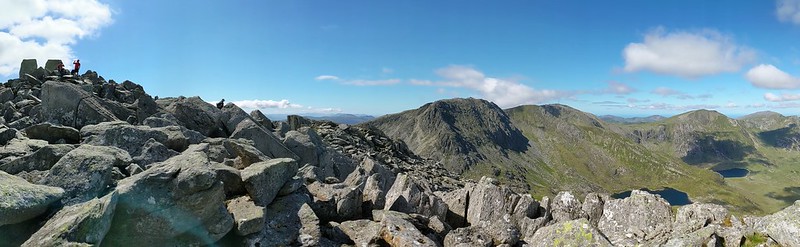
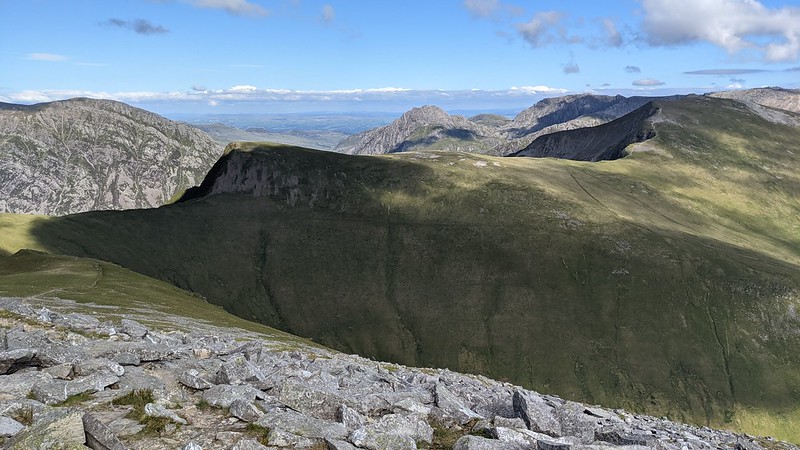
Tryfan - and indeed the Glyders generally - seemed to me somewhat less friendly than the Carneddau, more inclined to have summits awkwardly covered in giant boulders. From Tryfan I progress over Glyder Fach and Fawr (GPS) and down to Llyn y Cwn (see-also last October). From near the top of Tryfan:

PXL_20210613_104441213

Llyn Ogwen in the valley, R; Idwal centre; Boclwyd, L. G Fawr beyond, I think. From the summit:

PXL_20210613_091731390.PANO

Adam and Eve far L (no, I didn't), Fach centre (you go up the paler scree-y stuff L of the more solid ridge R). And so on down to the lake. It was sunny, I was hot and sweaty, and so went for a swim, although brief, for it is not warm. I failed to take an afternoon pix; here's an evening one, with me camped out:

PXL_20210613_204128330

It was a beautiful evening. But! I haven't finished the hot afternoon yet. I contemplated my future, specifically how to deal with Elidir Fawr; I didn't like the "std" descent from that to the road, nor did I want to camp by the road. So I resolved to leave my pack (sadly I didn't think of that till past Y Garn), do E Fawr and return to the lake (GPS). In terms of ascent or distance, this doesn't really make sense, because the "std" path gets you down to the road only a km away from where I ended up descending, and the road is nearly level at that point. Hey ho; it did get me a nice campsite. What it also got me (because I foolishly didn't replenish my water bottle in the stream) was very thirsty.

PXL_20210613_163209499

This is from E Fawr looking back to F Goch and a more distant Y Garn (947 m). It's all rather nice. Back at the lake I made my evening porridge and dozed. Late on, it grew a bit windy, so I put on the bivvy bag.

Monday: Llanberis

Monday woke me with a brief small shower at about 5 am, so I pulled all my spare gear into my rucksac and dozed again. At around 7 rain set in and continued. I was happy to discover that my three decade old bivvi bag is still waterproof. How to get out of it and into "walking mode" was going to be a bit tricky since I hadn't of course set up the tarp last night. So I did it spasmodically in the morning and it just about worked, with my head as one "pole". I then set off to descend, which is a real path, honest, just not a very well marked one (GPS). Eventually I found and followed the fenceposts down.

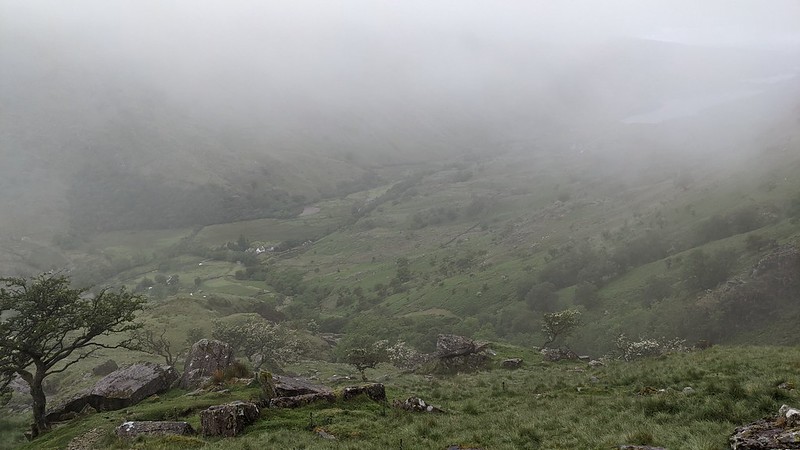
PXL_20210614_085049100

About half way down I did come out of the cloud, here we see rather more typical Welsh scenery. The plan now called for me to walk up the Llanberis pass to the Youth hostel, but alas my left knee was unhappy, and the peaks were completely enveloped in cloud. I decided on sanity and walked down to Llanberis, which is quite a long way (GPS). Better pic to Llanberis; and view of the path up from the road. And here we are safe and sound n Pete's Eats.

PXL_20210614_112900719

After: to the Castle Hotel in Conwy.

PXL_20210615_195510855

PXL_20210615_091236905.PANO~2

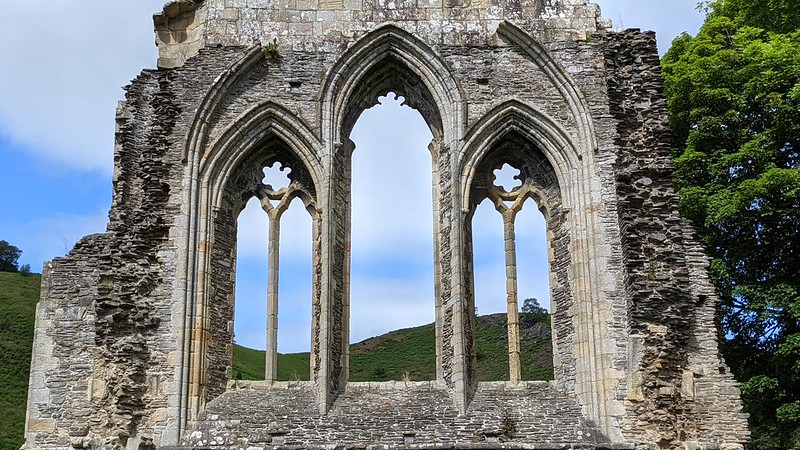
On the way home: Valle Crucis.

PXL_20210616_094054842

Notes

1. Booked via https://www.yourparkingspace.co.uk/ in Tesco's carpark. Alas, Tesco had never heard of them, so I didn't feel able to leave the car. After some subsequent correspondence, they admitted they'd mis-described the place (as being in the nearby leisure center) and refunded my fee.

Kit

For my records. Minimal. ME S'bag (forgot the inner), bivvi, light carrymat, Uberlite, tarp, 2 x skipole; light rucksac; green waterproof coat; fleece; thin long-sleeve; hat; neckwarmer; socks; trailshoes; u'pants x 1. Kindle. Petzl. Gas cyclinder, screw-on stove, pan; misc. Porridge sachets x 10; raisins; 4 x Bounty. 3 x tins of vine leaves. Oatcakes. 1 L water. See-also. Energy pack (used for watch multiple times; down to 2/4 lights after second phone recharge).

Refs

* Wales: Caernarfon, and the hills beyond

2021-06-20

Rawls, terminated

PXL_20210620_122949436 Dear reader, I have grown sick of Rawls. He is so endlessly prolix; he re-states himself so often; one never knows when one is at the final version of whatever he is pushing. And he is so often and thoughtlessly wrong. 

It got to the point where I seriously wondered if he was being dishonest. But I think he is merely blind to things he would rather not see. 

Please refer to Rawls: some initial quibbles and Rawls, continued if you can bear it.

To summarise:

* his conception of the Veil of Ignorance is not coherent3;
* his assertion that people behind said veil would agree is wrong;
* his assumption that all are risk-averse is wrong;
* his idea that socio-economic stuff should be mixed in with justice is wrong;
* the comparisons that he so casually asserts can be made between radically different societies cannot be made.

Now we come to chapter 3. I find The two principles of justice, however, seem to be a reasonable proposal. In fact, I should like to show that these principles are everyone's best reply, so to speak, to the corresponding demands of the others. In this sense, the choice of this conception of justice is the unique solution to the problem set by the original position. He needs this; because he wants an unique solution. Framed the way he does, though, he will not get an unique solution. This is because, unlike Hobbes, his solution is not constructive. Instead, his solution consists of him pulling out his favoured principles and saying "now I am going to show you a list of other things and I think you'll agree mine is best" (I am not joking). Whereas Hobbes proceeds, logically, step by step, deducing everything he says from what has gone before (as an aside, Hobbes is wrong, because the correct solution - or so I say - is not an unlimited Sovereign; but Hobbes argument is good, and most people will not be able to point at the flaw. Whereas Rawls is riddled with obvious errors. Also, Hobbes language (stemming, I suspect, from his erudition) is vastly superior).

Quoth Rawls: I shall simply take as given a short list of traditional conceptions of justice, for example those discussed in the first chapter, together with a few other possibilities suggested by the two principles of justice. I then assume that the parties are presented with this list and required to agree unanimously1 that one conception is the best among those enumerated. We may suppose that this decision is arrived at by making a series of comparisons in pairs2. Thus the two principles would be shown to be preferable once all agree that they are to be chosen over each of the other alternatives... Now admittedly this is an unsatisfactory way to proceed. It would be better if we could define necessary and sufficient conditions for a uniquely best conception of justice and then exhibit a conception that fulfilled these conditions. Eventually one may be able to do this. For the time being, however, I do not see how to avoid rough and ready methods... For the present, no attempt is made to deal with the general problem of the best solution. I limit the argument throughout to the weaker contention that the two principles would be chosen from the conceptions of justice on the following list.

He then proceeds to list his "two principles" vs various versions of utilitarianism. Since utilitarianism doesn't work (everyone knows this, don't they? I don't have to prove it), this gives him an easy win. But he has carefully excluded just-his-first-principle from the comparison.

That gets me to the end of Chapter three, and of Part I entirely. Woot.

Update: Fifty Shades of Gray

John Gray, who I'll get to in a moment, notices some of the problems with Rawls, in his Enlightenment's Wake. In particular, in Agonistic Liberalism, he points out that Rawls' work is anti-political (p 76 in the Routledge paperback edition). I think this is true, in the sense that Rawls wants, not rule by philosopher-kings, but rules devised by same; and in this way he has fallen into the trap that Plato left him. Gray's contention is that Rawls expects too much: that he wants to deduce too much, he expects too much to be determined from his principles. And as I said above, he can't have this. Gray concludes that politics will have to solve conflicts of rights, whereas Rawls waves the conflicts away (p 72, "contoured").

Update: An Approach to Teaching Rawls And Income Inequality

[2023/05] Michael Munger offers some empirical observations as to whether people would indeed choose as Rawls says they would.

Refs

* Rawls’ Problem of Stability - Michael Huemer.

* Rawls on Liberty [2023].

* WHAT ARE THE MODERN CLASSICS? THE BARUCH POLL OF GREAT PHILOSOPHY IN THE TWENTIETH CENTURY finds Rawls at #3. FFS.

* NotebookLM discusses this (probably private to me).

Notes

1. How will Rawls force them to agree unanimously? Will he beat them with sticks?

2. He has not heard of Condorcet.

3. 2026/02: I'm writing this without the benefit of the text in front of me, but I think I need to quality my criticism a little on this point. While it is true that his notion is incoherent, and I think his text badly written and unclear, the actual VoI isn't really a problem for his theory. Let me try an explain.

The VoI, as he tries to make it, cannot even in theory be done - unlike, say, Hobbes' version - but nonetheless we can perhaps agree that in theory an excellent or perhaps even the best way to design a constitution, or the principles behind a constitution, would be to involve the people concerned - to make sure they actually care enough to do it right and consider all the trade-offs - and to make sure that they are unbiased to their own societal position: so they don't just consider the interests of the rich, or the clever, or the strong, or the men, or whatever. We would not actually want everyone in the discussion - we don't want the stupid designing this thing, we only want the elite to design it - but we want to get the elite to do so, cognisant of the possibility that they might end up as proles in the new society. If we could then agree that the principles that come out of this thought experiment are indeed the finest, we can then effectively forget exactly where they come from and agree that they are the finest. OTOH, having writen it like that, it really isn't clear that the VoI is needed at all; after all, Rawls has produced his principles, which he argues are the finest and would be produced under the VoI, without losing his identity as a nice high-middle-class-low-upper-class ivory tower academic.

None of this abates my other criticisms: the principles he puts forward are wrong, the idea that they would be agreed on unanimously is laughable, and all the rest.

2021-06-18

Rawls, continued

PXL_20210615_134224182 Rawls: some initial quibbles refers; and don't miss the thrilling conclusion, Rawls, Terminated. Before I forget, a note: his is a theory of Justice but, it is not a theory of criminal justice. In it, everyone is assumed to obey the law. This is sensible; knowing what is just is different from knowing the penalties for those who are unjust.

Overall: Rawls is trying to construct a schema for Justice; he introduces the Veil of Ignorance to facilitate this. Unfortunately, he decides to mix in "social justice" or "economic justice", which 
1. requires him to be able to solve f(justice-rules)=society and be able to evaluate society(person) and compare between different rule-sets. This isn't possible, so the comparisons he depends upon cannot be done.
2. assumes that everyone is completely risk-averse, and so asserts that given the choice between 
* society_A; and 
* society_B which differs from A only in that you have (a 50% chance of a 10% decrease in prosperity and a 50% chance of a 100% increase in prosperity),
everyone would chose A. This is false1, so large swathes of the work become invalid.

We continue into chapter 2. He states in a provisional form the two principles of justice that he believe would be chosen in the original position (p 60):

1. each person is to have an equal right to the most extensive basic liberty compatible with a similar liberty for others. 

2. social and economic inequalities are to be arranged so that they are both (a) reasonably expected to be to everyone's advantage, and (b) attached to positions and offices open to all.

The first is, I think, reasonable. Per "quibbles", it can be quibbled, but nonetheless I don't want to; I and I think almost anyone would accept it - well, in principle; actually I'm going to quibble the details in a moment.

As to the second, I think I get as far as "social and economic inequalities are to be arranged..." and say "No! Stop!". I do not want you, or the govt, to "arrange" social and economic inequalities, as part of a consideration of Justice, and likely not at all.

(b) needs further sub-quibbling: as written it is ugly; what he wants to say there should be part of a more general statement about non-discrimination. And "open to all" does not preclude age, aptitude or rectitude tests, for example.

Coming back to 1, I dislike rights-based language (see The Trials of the State, "Chapter 3: Human Rights and Wrongs"). We're in social-contract land here, remember, so the correct formulation is expressed in terms of the liberty that you give up (we all give up similar) and/or the restrictions that the govt is allowed. The model is of course Congress shall make no law respecting an establishment of religion, or prohibiting the free exercise thereof; or abridging the freedom of speech, or of the press which does not give you a defined right of free speech, instead is prevents the govt from preventing your free speech.

He regards 1 as prior to 2, so I also need to quibble the placement of 2b, which should be part of 1.

Continuing (p 62): the two principles (and this holds for all formulations) are a special case of a more general conception of justice that can be expressed as follows. 

All social values-liberty and opportunity, income and wealth, and the bases of self-respect-are to be distributed equally unless an unequal distribution of any, or all, of these values is to every one's advantage. 

Injustice, then, is simply inequalities that are not to the benefit of all.

This is wrong. Mixing up economic factors amidst liberties is a category error (as is "are to be distributed", which implies a distributor. But there is none, unless we accept an all-powerful govt, which I suspect he does but this is a terrible error). And his defn is injustice is I think untenable. The nearest thing we have to an exemplar is the US constitution, and none of the original seven articles involve "social and economic" matters (article one empowers regulating interstate commerce, but I think that's not-in-the-sense-he-means). I think you have to go down as far as the eight amendment which "protects people from having bail or fines set at an amount so high that it would be impossible for all but the richest defendants to pay" to get even close, and that's not very close.

Still on p 62: Imagine, then, a hypothetical initial arrangement in which all the social primary goods are equally distributed: everyone has similar rights and duties, and income and wealth are evenly shared. This state of affairs provides a benchmark for judging improvements. This idea would be reasonable (we think of something basic and imagine improving it) except it is the how-to-divide-a-fixed-pie fallacy. In the real world, nothing is so static; changing the distribution of wealth changes the rate at which wealth accrues. Example: Amazon makes us better off (how do we know? Because we use it. If it didn't, we wouldn't) and the price for having that available is Bezos becoming really very rich indeed: inequality. The fixed-pie mindset isn't trivial: it is very much the difference between the "progressive" and "capitalist" mindsets. Rawls is, I think, going to tie himself up in knots over this; my solution, as I've said, is to leave the economics out of justice entirely.

Usually, Rawls speaks as though of a static society. Occasionally - e.g. p 78 - he admits of the possibilities of change and improvement. However, he also needs to be able to compare, effectively numerically, societies or the positions of folks in same; and it isn't clear he has any way of doing so between two changing societies, except in the trivial case of one being strictly better than the other for everyone.

On p 75 we find The intuitive idea is that the social order is not to establish and secure the more attractive prospects of those better off unless doing so is to the advantage of those less fortunate. However, this is presuming several things: one of them is his unexamined - probably not even thought out - implicit assumption that society will be deterministic from the principles of justice established. This is unlikely to be true: establish some principles and keep them fixed; then repeat ten times: setup some laws, form a society: and you will get ten different societies. And of course, those societies will be unpredictable in principle. So his people, behind the VoI, cannot make the judgement (would these rules be "to the advantage of those less fortunate"?) he is expecting of them.

To make any sense of this we have to admit that we're actually thinking of a rather different situation: us, in today's society, thinking about making small enough incremental changes (ha ha: so we're really in Hayek-world) that we could meaningfully make the comparisons he needs. But then we're not behind the VoI and our prejudices return. This can be rescued: because we're really only interested in the abstract principles of justice - we don't actually believe this is a programme that will be followed through in practice - so we can perhaps recover our judice.

p 85 and on discusses perfect, imperfect and pure procedural justice. Perfect is when, if you follow the rules, you get the right answer: cutting a cake fairly can be done by the person cutting choosing last (no collusion). A criminal trial, even if conducted fairly, may reach the wrong result and thus the process is Imperfect. A Pure process is one where there is no right result, and so is "just" as long as the process is followed: a game of cards, for example. We then try to apply this: Suppose that law and government act effectively to keep markets competitive, resources fully employed, property and wealth... widely distributed by the appropriate forms of taxation, or whatever, and to guarantee a reasonable social minimum. Assume also that there is fair equality of opportunity underwritten by education for all; and that the other equal liberties are secured. Then it would appear that the resulting distribution of income and the pattern of expectations will tend to satisfy the difference principle. In this complex of institutions, which we think of as establishing social justice in the modern state, the advantages of the better situated improve the condition of the least favored. Or when they do not, they can be adjusted to do so, for example, by setting the social minimum at the appropriate level. As these institutions presently exist they are riddled with grave injustices. But there presumably are ways of running them compatible with their basic design and intention so that the difference principle is satisfied consistent with the demands of liberty and fair equality of opportunity. It is this fact which underlies our assurance that these arrangements can be made just. So I think what he is saying here is close to what he should say: effectively, that if we run the system forwards, and the system itself is not unjust, then the end result will be just, even if not all receive the same shares. He then notices (p 87) the immense advantages of this: you don't have to keep track of an endless variety of circumstances. But how he fits this into his previous work, I don't know.

p 90-91: considering Utilitarianism, he notes that requires maximising some utility function, and that can't be done (he isn't quite brave enough to say that) whereas he asserts his difference principle can do better (but only relatively so, which is why he doesn't want to absolutely reject max-util, cos he needs some of it himself). This isn't convincing.

Refs

* There is one clear monopoly in this ecosystem, however: the state. Any legislative or regulatory restriction on Big Tech will not be a triumph of the oppressed over the powerful. It will be yet another instance of the already powerful wielding the state’s machinery to compel private companies to do what they want, likely at the expense of their market competitors or political enemies. Such reforms are far more likely to be censorship than to reduce censorship, in the strictest sense. Don't Try To Fix Big Tech With Politics via CH.

Notes

1. It is false even if you, personally, would choose A because you happen to be risk averse. But many people, including me, would choose B; and you ought to know that, even if your personal choice is A.

2021-06-17

Rawls: some initial quibbles

1623945332945-e78214c8-45eb-4a5e-ae14-ae34dfc1a9cb_ I'm re-reading1 Rawls' A Theory of Justice, because John Gray was interested in him. I may - but probably won't - do a full review; for the meantime, here are some quibbles. Some of these may amount to what Rawls calls Intuitionism; but I'm only on chapter 1.

[See-also: Rawls, continued and terminated; and Sandel: Liberalism and the Limits of Justice; and Rawls on Liberty.]

Laws and institutions no matter how efficient and well-arranged must be reformed or abolished if they are unjust


Rawls asserts that Justice is the first virtue of social institutions, as truth is of systems of thought. A theory however elegant and economical must be rejected or revised if it is untrue; likewise laws and institutions no matter how efficient and well-arranged must be reformed or abolished if they are unjust. With respect to theories I agree. With respect to laws, I am dubious. We shall try a thought experiment, but first we need to understand "just" a little3: I think that in this context Rawls would regard laws that arbitrarily discriminate as unjust (notice I haven't had to tell you what is just). So, imagine: you have a choice of laws A or B. Laws A provide a mediocre standard of living, but treat all equally. Laws B strongly favour the blue-eyed (perhaps they can strike the grey-eyed; or take their property; or somesuch) and so Rawls regards them as unjust; but - by some bizarre quirk of dynamics - provide a significantly higher standard of living.

Are we obliged to reject laws B? Which is to say, are we obliged to prefer Justice to Prosperity? I don't think we are. Reasonable people can disagree2. Later ("The Priority Problem") Rawls "solves" this problem by ranking the principle of equal liberty prior to the principle regulating economic and social inequalities. This means, in effect, that the basic structure of society is to arrange the inequalities of wealth and authority in ways consistent with the equal liberties required by the preceding principle. This is course "solves" the problem, by fiat; if he wants people to chose it behind the veil, he'll need to justify this fiat.


I shall even assume that the parties do not know their conceptions of the good


He's discussing the Veil of Ignorance stuff. But what does "the good" mean here? Later on, he says "it hardly seems likely that persons... would agree to a principle which may require lesser life prospects for some" so I think that "life prospects", which I will equate with prosperity, can be considered as a good that they do know. I think by "the good" that they don't know he is meaning things-admitted-to-be-opinion, such as choice of music or favourite colour.

The fundamental agreements reached in it are fair


We're trying to decide on principles of justice under the VoI: Since all are similarly situated and no one is able to design principles to favor his particular condition, the principles of justice are the result of a fair agreement or bargain. For given the circumstances of the original position, the symmetry of everyone's relations to each other, this initial situation is fair between individuals as moral persons, that is, as rational beings with their own ends and capable, I shall assume, of a sense of justice. The original position is, one might say, the appropriate initial status quo, and thus the fundamental agreements reached in it are fair. This explains the propriety of the name "justice as fairness": it conveys the idea that the principles of justice are agreed to in an initial situation that is fair. (my bold).

Sub-quibble: his calling his theory justice-as-fairness is rhetoric-in-the-bad-sense: attaching a "good" label to your theory in order to make your theory more attractive5.

But now notice that Rawls has assumed that people will agree. Is this likely? Actually, no. In his highly-abstracted version, they would, but only because secretly he thinks of all these people as like him, and his friends. But the VoI doesn't get you uniformity behind the veil. The people behind the veil will be shuffled, when they enter society, but behind the veil they have the same distribution of intelligence as present society. This will range all the way down to people too stupid to understand the VoI, and who are very unlikely to agree with the intellectual elite. Rawls needs to add more heavyweight assumptions in here. I think what he really means is that the discussion should only occur amongst the intellectual elite; at this stage, there is no reason to include the stupid or the average. Although, since the Utilitarians whom he opposes were undoubtedly amongst the Elite, even this is unlikely to be enough.

Update: having read further, I think I underestimated how incoherent and ill-described the VoI is. It is a handwavy thing that can get you into the right frame of mind, but it is hard to be more specific than that. Since it is also Rawls' major contribution, that's bad news for him. On p 139 we have it is clear that since the differences among the parties are unknown to them, and everyone is equally rational and similarly situated, each is convinced by the same arguments but this isn't true, unless the "parties" have been rigourously uniformised to the point of no longer being people. In the unlikely even that you want even more words, the Stanford Encyclopedia of Philosophy will supply some. But they won't help.

2026/07/06: I think I quibble the "bargain" element of "fair agreement or bargain". Because there's nothing to bargain about; bargain implies different people valuing different things differently, and therefore having something to exchange. Here, he assumes agreement, not difference. Although he may be pretending otherwise, perhaps that's why he uses the word; it may also be an echo of Smith.

Utility


Rawls is not keen on inequality, but he would like to make this seem something other than a personal preference: Offhand it hardly seems likely that persons who view themselves as equals, entitled to press their claims upon one another, would agree to a principle which may require lesser life prospects for some simply for the sake of a greater sum of advantages enjoyed by others. Since each desires to protect his interests, his capacity to advance his conception of the good, no one has a reason to acquiesce in an enduring loss for himself in order to bring about a greater net balance of satisfaction.

Note: in saying no one has a reason to acquiesce in an enduring loss for himself Rawls has forgotten his VoI: of course, no-one knows what their place will be; Rawls means to say "risk of an enduring loss".

Consider two societies: in A, income is $1 per day, fixed for life. In B, you are assigned at birth an income chosen from a uniform distribution of [$0.5, $10] per day. Rawls is asserting that reasonable people would reject B in favour of A. But I don't think they would4.

Rawls is here, I think, attempting to counter utilitarianism. I think utilitarianism is wrong; but that doesn't make Rawls right.

Update: 2024/12


Thinking - good heavens - recently I realised another problem with Rawls, which stems from his bizarre communistic claim that our talents are common property; see Sandel: Liberalism and the Limits of Justice for the basis of that, though I didn't discuss it in this series of posts. The follow-on problem is just whose "collective asset" are these talents? Rawls, characteristically, doesn't say. But if they belong to the nation state, then you're not allowed to move from your country to another without the permission of that country; because you're taking away "your" talents, which Rawls has declared common property. You can avoid this by making your talents a global common property I suppose, but that would appear to imply redistributive taxation across countries. Perhaps Rawls does indeed support that.

Refs


* M offers Justice by Michael "Tyranny of Merit" Sandel, which has a chapter on Rawls. You might read it if you want a quick intro to VoI and related; but (like so many books reviewing so many other philosophers) it isn't a critical analysis; it is too timid.
* Someone else being nice about Rawls: The Unexpected Persistence of John Rawls. Worth a ref, but I don't buy it.


Notes

1. Many years ago I had a copy, but I grew disenchanted about 1/3 of the way through and recycled it. This from 2008 (see the comments) provides some discussion, but clearly I hadn't read it by then. Thx Mfd+J for loan of their copy.

2. Lest this example be thought utterly implausible, proponents of colonialism could argue for B.

3. I, of course, subscribe to Hobbes' defn of Just. We may also wish to consider Hayek on the matter: "The test of the justice of any particular rule is thus whether its universal application is possible because it proves to be consistent with all the other accepted rules" (see here; Essays on Liberalism and the Economy, Volume 18).

4. John Rawls’ Unrisky Business from Slate in 2002 says much the same.

5. Actually, it may be worse than that. Reading Sen, I think the "fairness" may actually be "fairness in the socialist sense", i.e. "stealing other people's stuff"; see the ABC-flute example there.