 By Louis Arnaud Reid. Another product of, so I suspect, some Cambridge Prof keeling over and his library making its way to Oxfam. LAR was - if I can believe his wiki entry2 - almost entirely concerned with aesthetics, which may account for his somewhat strange choice of subject and title. Nonetheless the book is nicely bound and from the times - 1936 - when people didn't spam out the volumes of rubbish they do now; and whilst I think largely wrong it did encourage me to think.
The main problem is that it is a discussion of ideas of, around, related to and suggested by morality, but he doesn't actually know what morality is and so - somewhat like The Evolution of Morality - he ends up reduced to saying things about things related to or near; but they don't work. Of course, you and I know about The Foundations of Morality.
Let's quote from page 95: So in morals there are also, I think, two problems. One is a more formal problem, the problem of duty and right, the problem of the adjustment of our actions to the concrete situations with which life presents us, the problem of what is fitting in this particular case. The other is the problem of content, the problem of what we are striving to realize and embody and express through and in our actions, the problem of good. What he is discussing here is the problem of how to act morally, not the meta-problem of what morality actually is. The first part is fine, in the second alas he has allowed himself to be overshadowed by Plato and Aristotle and wander off into the form of the Good3. Morality is not to lead us to some teleological Good; the "end" it leads us to is rather more Darwinian: human flourishing, if I am allowed a flourish; or survival, if we must be more brutal.
I note here that he is whiffly about religion; or if you prefer, he is careful to avoid committing himself. The last four chapters are about religion, but I convict him of cowardice for not clearly expressing his own views. Page 188 presents I suppose that a great deal of morality commonly so-called may be said to be secular. It manifests itself in actions whose roots do not go down much deeper than custom, tradition, social convenience, comfort, happiness; interpreted perhaps in a liberal or even in a noble way. We tell the truth, behave politely, decently, are reasonable and just to our neighbours; we do not 'let down' our friends. We do it because we have been brought up to do it, because it is pleasanter for all to live in that way, because indeed society would be intolerable if everyone began to act otherwise and so on. From which I think we can tell that he finds conventional morality shallow; but he is certainly wrong to find custom and tradition shallow. Nonetheless the picture he presents here could have lead him to Hazlitt's correct viewpoint, had he thought about it instead of disdaining it.
But probably central is his analogy between art and morality: If the artist is not wise, if he is not an artist and remains a tyro or a student, he may take these rules too seriously; he may try to make pictures according to formula - as the unbudding versifier will write not-incorrect sonnets according to the 'rules'. And the results will never be anything other than exercises for the training of a talent which is not there. For the rules have to do with the parts; they are conceptual guides dealing with the partial rather than intuitions apprehending the whole, they are concerned with the means rather than with the all-pervading Purpose (in an inclusive sense). It is partly the same in morals. In moral situations, which become to a considerable extent stereotyped, and in the 'situations' of common life in society, we rightly make some use of rules derived from the moral experience of the past. These are the rules of duty, exemplified not in ten, but in a great many more, commandments; rules and duties of justice, fidelity, benevolence, courage, sexual self-control, and so on. But the moral human being compares with the art-student. The vast majority of human beings are tyros and remain tyros. They never reach moral adolescence. Morality to them means the obedience to the conventional rules of duty, and when a man does 'his duty', they think he does what is required of him, that this is 'morality'.
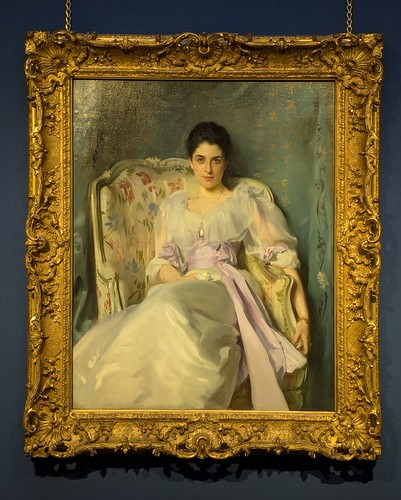 This is all wrong. Unlike great art, which is creative - and great art is the only thing he is perpared to consider as art - morality is not creative. Quite the opposite: it is a set of rules that we apply to situations in life. Meeting with "creative" morality in everyday life would be an unpleasant surprise just as it is to meet "creative" law. You know the sort of people who would tell you that their morality is "creative": people trying to excuse bad actions. Apart from anything else, most morality is negative: it is largely injunctions against actions: thou shalt not kill, that should not steal, thou shalt not bear false witness. None of these are creative acts. If we must have an analogy, morality corresponds to watercolours of daffodils exhibited by gentlefolk in village hall exhibitions that LAR would not admit as art.
Continuing The morally wise man who, like the true artist, is exceptional, is on the other hand an individual who does individual things and who is not a type working from formulae. He takes rules for what they are worth as valuable bits of generalized experience, which must not be traversed without good reason, but which are general guides, warning signs, signs which keep him from bias and undue egoism. They are to be taken, realized, absorbed and forgotten in the creative business of living. This is all deeply suspicious and leads to Beyond Good and Evil which leads to Evil. I shall unwisely sympathise with him somewhat: now we see what morality really is, we can excuse some immorality from the great, if the end result is greater flourishing. But I doubt his role for the "morally wise man".
LAR is aware of this problem: It may still be said that a view of morality as an inspired thing is all very well, but that poets and prophets are few and far between. Not merely does inspiration occur rarely in the lives of most people, but the majority lack it completely. If we haven't vision and inspiration, what are we to do? The 'artist' who is without vision and inspiration can take to selling soap, but the moral life cannot be evaded in this way and if the only real morality is inspired morality, most decent human beings must remain forever 'immoral'. Had we not better peg along with the rules that we have, and which are good enough for most men? And should not ethics stick to its honest account of this, rather than fly into the realms of fancy? This is a real difficulty which he hopes to return to at a later stage, but alas that is in the religion section so fails. The solution to the difficulty is to abandon the desire for inspired morality. We don't need it. People don't do bad things out of ignorance of how to act morally.
Conventional morality is not static, of course, though LAR seems to feel that it is: The point of view which I have been putting forward is in some respects similar to M. Bergson's distinction between 'closed' and 'open' morality, 'closed' morality being conservative of the forces of a static and limited society, 'open' morality being that of prophets and saints bringing new ways of feeling into the world. Again I think he errs: the evolutionary drift of morality isn't lead by and doesn't need saints and prophets, however much the religiously inclined might like to think so.
Lastly, I alluded above to morality being largely negative; LAR might be aware of this but it isn't where his heart is: what is morally due from us, is an intention to realize in a concrete subjective-objective situation the maximum good that could be realized in that situation. This is wrong. Even in situations where morality calls for a positive action from us, it rarely if ever requires the "maximum good", if that is even meaningful. A good-faith effort is all that is required.
Notes
1. My picture is The Progress of a Soul: The Victory, by Phoebe Anna Traquair, Nat Gal, Edinburgh.
2. In fact I do not really trust it: it has most of the marks of enthusiasm.
3. Page 105: ...moral goodness and rightness belong to living actions or intentions ex-pressive of an inner attitude to Good. Goodness implies absolute sincerity and absolute objectivity of mind... oh dear.
4. I liked this so much that I have updated my tagline; it is a long time since this blog has been about science.
Meta
I asked Gemini to "read and critique" this post. The response is adequate but not exceptional. I rather like its trailer on "Tone and Style": The writing is classically conversational, dismissive, and charmingly uncharitable4 in the way old-school blog posts excel at being (e.g., "I convict him of cowardice," "oh dear"). It relies heavily on a shared understanding with the reader ("Of course, you and I know..."), making it highly readable if somewhat intellectually impatient with LAR's mid-century academic prose.
But what of the "Weaknesses and Blind Spots" I hear you ask? It says:
• Misinterpreting the Artistic Analogy: Connolley dismisses LAR's art-student analogy too quickly. LAR isn't necessarily arguing for inventing new moral truths out of thin air. Instead, he is highlighting that rigid rule-following without situational judgment fails in complex scenarios. Just as a master painter knows when to bend the rules of perspective to achieve a greater truth, a morally mature person must navigate conflicting duties (e.g., lying to protect an innocent life).
• Over-indexing on Negative Morality: Connolley claims that most morality is negative ("thou shalt not"). While negative constraints are essential for baseline social stability, this ignores the massive domain of positive duties—such as charity, compassion, heroism, and community building—which cannot be neatly codified by rigid prohibitions and do require a degree of creative moral problem-solving.
• The "Saints and Prophets" Dismissal: He argues that the evolutionary drift of morality does not need moral innovators. Historically, this is tough to defend. Moral progress (e.g., the abolition of slavery, civil rights, animal welfare) is almost always spearheaded by exceptional, non-conformist individuals who challenged the conventional, "shallow" morality of their era.
These are all reasonable but not-quite-right. Responding to each:
* "lying to protect an innocent life" is a classic thought-experiment but incredibly rare in real life, and if it does occur, requires no great moral sophistication to solve. "navigate conflicting duties" almost never requires moral innovation.
* I did wonder if I should say something about positive morality. I stick by my most-is-negative; admitting the obvious, that some-is-positive, is no problem. But charity, compassion, community building (a) require no moral innovation; (b) are not required to your greatest exertions.
* I agree that progress is often (seen to be) spearheaded by exceptional, non-conformist individuals but that isn't the same thing as a saint-or-prophet: what these individuals have is energy, activism, conviction; not necessarily any new morality. Having said that, I don't really object to a few S-or-Ps: what I object to is the idea they have anything to do with everyday morality.


No comments:
Post a Comment