My pic shows a sunrise at Argeles-sur-Mer. I had a few days there, doing not very much, at the end of two months in France, having taken some unpaid leave.2023-09-28
A summer away
My pic shows a sunrise at Argeles-sur-Mer. I had a few days there, doing not very much, at the end of two months in France, having taken some unpaid leave.2023-07-25
ClientEarth loses high court fight with Shell over climate strategy
Sez the Graun, having previously drooled over the directors being personally sued. The ostensible reason for the lawsuit was that the directors were not acting in the best interests of the company, and that the claimants ClientEarth were therefore damaged. But this was obvious wank, and the ManInAWig seems to have spotted that. "the management of a business of the size and complexity of that of Shell will require the directors to take into account a range of competing considerations" is the right answer; and so just as in the much-heralded Alsup, the court isn't the right venue for solving these issues. In a way, it is great that our society is so rich that we can afford to pour money down the drain in this way; just as well there's no backlog of real judicial cases needing attention.Refs
2023-07-21
Abuse of non-linear
People are prone to saying things like "But impacts of climate change are different — they are non-linear" by which they mean scary, dangerous, worrying, problem-causing. But this is an abuse of terminology. A damage function that is, say, zero up to 2 oC and zillions above that is non linear; a damage function that is lots below 2 oC and zero above is also non-linear. But we only care about the first sort.In the real world, pretty well everything is non-linear. So saying that the impacts of GW are non-linear is trivial and uninteresting, in and of itself. People segue far too casually from "non-linear" (trivial) to "thresholds exist" (largely undemonstrated) to "we're passing those thresholds and terrible things are happening" (using insurance in the US as an example is a terrible idea because the markey is so heavily distorted by regulation and govt intervention that market prices often don't apply).
Thresholds are lovely things in simple theoretical models but I think less applicable to the real world. Everything is fuzzy, distributed: there are rarely absolute thresholds.
Other confusions
Is GW accelerating? Just recently Hansen asserts "We did not say that the global temperature record to date shows an acceleration of the global warming rate". And yet Hansen-2020 says "Record global temperature in 2020, despite a strong La NiƱa in recent months, reaffirms a global warming acceleration that is too large to be unforced noise". Perhaps the addition data after 2020 to 2023 shows a slow-down?
Refs
* Are the impacts of climate change non-linear?
* Neoclassical tipping points of no return.
* Economists greatly underestimate the price tag on harsher weather and higher seas. Why is that?
* ATTP's Abandoning the idea of an “optimal pathway” for climate policy makes me think of On getting out more. This is Jonathan Koomey's stuff; it is all so badly broken that it is hard to know where to start; see my comments chez ATTP.
* American universities have an incentive to seem extortionate. They are much cheaper than the “crisis of college affordability” suggests.
* Tipping points: AH likes good ones but doesn't like bad ones. Arf.
2023-07-17
UK installations of heat pumps 10 times lower than in France, report finds
From the Graun: The UK is lagging far behind France and other EU countries in installing heat pumps, research has shown, with less than a tenth of the number of installations despite having similar markets. Only 55,000 heat pumps were sold in the UK last year, compared with more than 620,000 in France. Twenty other European countries also had higher installation rates than the UK.The report continued: "We should try to understand why this difference is occurring". Ha ha, only joking, of course it didn't. Instead we get the familiar: "The MCS report, titled Heat Pump Rollout in France and the UK 2023, called on the government to make heat pumps mandatory for all new homes...". Why this insistence on force over understanding always?
On a similar topic, we have Michael Mann saying "Good doesn't defeat evil by trying to reason with it, normalize its underlying vices, or understand its ill-founded sense of grievance. Good defeats evil by defeating it. That was true of the American civil war. And that is true going into the 2024 U.S. election." Confusing war and elections is a bad idea. And convincing yourself that you don't need to understand "the other side" is a really bad idea. What does "defeating" your "opponent" mean? Even in a war, fighting to the death is the worst option; in an election, the metaphor just confuses you, because "winning" means to persuade your opponents supporters to support you instead. And you persuade them by, ideally, reasonning with them; and you do that most effectively by understanding them.
Refs
* Heat pumps: more than 80% of households in Great Britain ‘satisfied with system’?
* Book review: The Anome / The Brave Free Men / The Asutra.
* How Much Do Intellectuals Matter? Review of America's Cultural Revolution, by Chris Rufo.
Warming: increases in variability as well as mean?
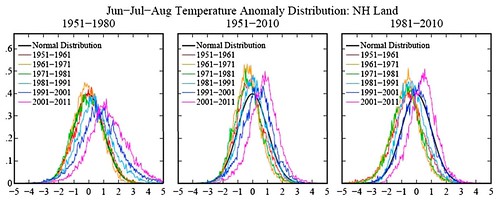
Global warming makes the globe get warmer on average, with - naturally enough - year to year variabililty. If you're interested in detecting GW then looking at the average is best, because its a nice stable statistic amenable to analysis. But it is also a pretty boring statistic, since it's gone up by ~1 oC in the last century, leaving people prone to respond "is that it? Temperature changed by 10 oC during the course of today", or whatever. So people tend to prefer to find something more exciting to talk about.Notes
2023-07-12
Morality is custom
Since Law is custom, and morality is a sort of localised short-range-interaction law, it follows that morality ought to be custom too. Having thought and written that, it seems uncontroversial; people are used to the idea that morality is customary.This is not the same as morality-is-arbitrary, which people sometimes assert. There is a not-clearly-defined ground of morality necessary for a society to be stable enough to last long enough to develope customs1, 2. If you decided to assert that "theft is morally acceptable" you wouldn't last long, even if your law prohibited theft.
Refs
* On morailty, 2008. Not really satisfactory, because I'm not distinguishing L from M, but the direction is correct.
* The Case for Libertarian Friendliness.
* Human Deaths from Hot and Cold Temperatures and Implications for Climate Change (Patrick Brown, Breakthrough Institute) via RP.
* Natural Variability, Attribution and Climate Models #6 - Science of Doom.
* The Foundations of Morality.
Notes
1. Hence the fairly common assertion that "without religion, you have no morality" is wrong.
2. See-also my Book Review: The Righteous Mind.
2023-07-06
Law is custom
I have frequent need to say "law is custom" and yet the post I use to link those words to - Hayek vs Hobbes and the theory of law - isn't the right one, even if it is in the right direction. What I want is a more explicit reference to James Coolidge Carter's "Law: Its Origin Growth and Function". I recommend that you read it.Downdate: what I wrote in 2018
2025/06: And public opinion
Public opinion bolsters judicial action in part because court decisions do not enforce themselves. Judges have little direct coercive authority and must rely on public support and the cooperation of officials in other branches of government. Such cooperation and support is more likely if a ruling has substantial public approval. Most judges, especially those on the Supreme Court, are well aware of this connection.
Refs
2023-07-01
Gay cakes part two: Gay websites
But not Grindr or any of that stuff. No, this is the Supremes weighing in on whether people can be forced to make things they don't want to make. And the answer is no, which is the correct answer, and I think for the correct reasons, too. Read a more sober analysis at Supreme Court rules website designer can decline to create same-sex wedding websites.Affirmative action
Economic perspective
Refs
2023-06-22
Mayflies
Notes
Refs
2023-06-20
The world’s nations could switch to 100% renewable energy in a few years?
Just a quickie, since I seem to be on a roll. Via Twatter, cleantechnica says "Mark Jacobson and his colleagues at Stanford University have published a new study in the journal Energy & Environmental Science that claims 145 of the world’s nations could switch to 100% renewable energy in a few years using renewable energy technologies available today... The cost of making the changeover to 100% renewable energy would be... $62 trillion".Can you see the problem? Hmm, well: this past year, total world investments in clean energy were about $1.7t. To spend $62t at 1.6t/y would take 34 years; and anyway only ~$600b of that was renewable power. Of course that £1.7t per year is likely to go up; were you to assume it doubles every year then it would take ~5 years; but that isn't going to happen.
So this is a familiar problem: yes, we can transition to renewables, but no it won't happen in just a few years, we simply lack the industrial and other capacity to do so. Can I have my John McCarthy badge now?
Having written that, I can now try skimming the study itself. I see it makes the usual "it generates jobs" error; it tells you that these people are not economists but it also warns you to be cautious, which is nice.
Refs
* Measured by the ratio of billionaire wealth to GDP, the US has less inequality than Sweden or France
* Perhaps you'd like to read AH being enthusiastic about the prospects for solar?
* UK installations of heat pumps 10 times lower than in France, report finds
* Vattenfall says it is stopping British Norfolk Boreas offshore wind farm
2023-06-19
Bandit Hoekstra
AukeHoekstra, a useful source for renewal energy factz, laments that we can't bankrupt [oil companies] before we have weaned ourselves off oil. And this is part of a mish-mash of the usual leftist economic confusions.BH is sad that oil & gas companies are giving windfall profits to shareholders instead of re-aligning towards clean energy. But why? What else should they do with their profts, except give them to the people that own the companies, or invest them in their business. Only in some bizarre statist fantasy would they direct them towards whatever BH deems most worthy. And he thinks that governments should aim to starve and bankrupt them a.s.a.p. which is distinctly "nice company you've got there, be a shame is something happened to it" type language. It doesn't occur to him that if people stop buying their products the oil companies would be starved without any need for govt muscle.
But that's not all, oh no, that is not all: he also objects to giving subsidies and windfall profits to the oil companies. But this too is bollox: he isn't. The subsidies stuff is largely drivel; and no-one is "giving" windfall profits, other than the people buying the product. That people continue to buy the product despite its price increasing demonstrates how much they value it. If govts care to provide an alternative that is better and cheaper then that would be one solution; although just letting the market do it would be better.
Refs
* Degrowth and the monkey's paw.
* The Case Against (Most) Books - contains some words I'll want to reference one day. Though it weirdly and uncritically refs this piece which gets the Galileo story completely wrong, sigh.
2023-06-16
Subsidies, reprise
Via Twatter, yet more subsidies stuff. This time they've decided to consider fossil fuels, agriculture, and fisheries together, presumably so as to get a bigger number. And so they do; about $1.25t direct, compared to ~$500m when thinking only of fossil fuels. Unfortunately - even though this is at least nominally a World Bank report - they are distinctly sloppy in their language: Governments spend a large percentage of their budget on subsidies that exacerbate air pollution and affect the agriculture and fisheries sectors. The magnitude of subsidies for fossil fuels, agriculture, and fisheries is vast and likely exceeds US$7 trillion per year in explicit and implicit subsidies — or approximately 8 percent of global GDP. So here they give the impression that govt spend on subsidies is ~8% of GDP. But of course that's bollox, because that $7t includes "implicit" subsidies, which aren't seen in GDP. If you include only direct, you'd get a rather less impressive 1.4%. Note that explicit Ag subsidies are bigger than FF, and fisheries ones are significantly smaller; implicit Ag subsidies appear to be wildly uncertain, ranging from ~$500b to $5t (but I think much of that in turn comes from GHG effects, so there may be double-counting with the FF subsidies). We get stuff like For fisheries, the largest implicit subsidy is the lack of effective regulations to reduce overcapacity and prevent overfishing, which shows you how far away from the usual meaning of the word "subsidy" we have drifted.Another amusing point is that when looking at Ag subsidies, they are easily able to see - it's their first point - that Richer countries spend more on agricultural subsidies than poorer countries, even when seen relative to total agricultural production. But when looking at FF direct subsidies, they are unable to say anything about what kind of countries subsidise more. Could that be because when you look, the answer is that its the banana republics, not the West, doing the subsidising? There is a sliver of good news though: Implicit subsidies for fossil fuels... the local impacts of air pollution and global climate change constituting more than 75 percent of the total: so the banana republics are damaging themselves mostly, rather than us. This means that recommendations like Policy makers must fully reflect the health and societal costs of air pollution in the price of fossil fuels are dubious; because most of the damage / implicit subsidy occurs in what you burn and how you burn it, not how much you burn (see e.g. box 2.3). Indeed I'm somewhat dubious that their focus on FF is correct; they need to include "dung".
Perhaps I should note that I'm all for removing harmful subsidies. But I'm doubtful that a somewhat meally-mouthed report that can't bring itself to be honest about who is doing the subsidising, and which sez stuff like Subsidies are important tools that governments can use, is going to help.
Incidentally: I don't think they include negative subsidies (e.g. the EU's ETS) in their totals, and probably should.
Refs
* In Debate Over Railway Safety Bill, J.D. Vance and Donald Trump Are Leaning to the Left
* ‘Power and Progress’ Review: Technology and the New Leviathan: Deirdre N. McCloskey on Daron Acemoglu and Simon Johnson.
* Orwell’s Falsified Prediction on Empire.
* Diversity Really is Our Strength.
* OECD: Fossil fuel subsidies added up to at least $373bn in 2015?
* BBC More or Less: Behind the Stats: Do fossil fuels get $7 trillion in subsidies? The answer of course is no.
2023-06-15
Meet the Money Behind The Climate Denial Movement: Reprise
In Meet the Money Behind The Climate Denial Movement? I queried the assertion that Nearly a billion dollars a year is flowing into the organized climate change counter-movement, discovering that it was unsubstantiated: from the info given it was simply impossible to tell. Weirdly, I was not the only one object to such; I discover that persons with whom I probably don't wish to be associated say things like Climate activists often repeat the myth that Big Oil is pouring millions into climate scepticism. The reality is that Big Green's billions are driving climate alarmism worldwide. Although that's not quite the text I want; I want, firstly, In 2019 the climate activist and UCL Geography Professor Mark Maslin wrote that oil companies were spending $200 million a year promoting something he termed “climate change denial”. The ‘dark forces’ claim has been in regular use ever since. That's $200m/y not $1b/y, which is something of a disparity. But it's only oil.But (via a source I'll get back to in a moment) that at least provides a ref, which is How the oil majors have spent $1Bn since Paris on narrative capture and lobbying on climate by influencemap. Somewhat weirdly, that quotes the five supermajors as spending over $1b in 3 years, or ~300m/y; and refers to a 2022 update which bumps that up to $750m/y. But I doubt there's any real hope for consistency in these numbers. Having now skimmed the report, I don't think they provide enough detail to know if they've done it well or not. I'm doubtful; I think I can leave it at that.
Back to my source, which is I'm afraid to say Ben Pile, and his topic is The monolith of climate smear-mongering. He too (after a few preliminary flings) takes issue with influencemap's methodology; I leave you to judge his prose. But he then continues on to How big is the green blob, compared to big oil? which might be interesting. If he's done it well. Picking those that have funded influencemap, and then adding their total spend, he comes to 1.275b/y, or in his words In total, InfluenceMap’s funders are making grants of roughly $1.2 billion per year to climate change lobbying. Can we rely on his arithmetic? Given that he is trying to criticise "the other side" for sloppy accounting, we'd hope that he would in return strive for precision.
He estimates $478m/y for the climateworks foundation, wot I've never heard of. But they have financial information. Which allows us to see their form 990s, year by year. They've had a good 2021: income has more than doubled over 2020, as have grants. But their total expenses for the year is only $180m which is waay smaller than $478m, and not all of that can be lobbying anyway. Number 2 is the IKEA foundation, for which BP claims $334m/y; from their own report I find USD 118.7 million (62%) to climate action (SDG 13). But I think from the context that much of the money is double-counted in the sense that any one grant can count towards a number of different areas. So that's two strikes for BP and I can't be bothered to go to the third.
My overall conclusion is that no-one is producing any reliable numbers in this area.
2023-06-05
Scientists warned about climate change in 1965. Nothing was done?
More of the same, of course, so I won't waste too much of your time. knowablemagazine says: A report to the US president sounded an alarm — humankind was ‘conducting a vast geophysical experiment’ by burning fossil fuels and filling the atmosphere with an ‘invisible pollutant.’ But a slick campaign by Big Oil led to confusion, politicization and dire consequences for the planet. But as usual, we should pause and wonder if this is actually true. And, as usual, it isn't. The report to the Prez is truthy - and that was in 1965. The mag then asks So why weren’t climate scientists listened to earlier? Why did this warning direct to the president of the United States not lead to any significant efforts to change course for decades thereafter? And Oreskes (for it is her, as I'm sure you guessed) replies But by the 1980s... the science becomes more specific, more quantitative. And in 1988, the IPCC, the Intergovernmental Panel on Climate Change, is created specifically to summarize and assess the scientific evidence on this problem, in order to report to governments, who would then act upon it... that’s when the fossil fuel industry changes course. And that’s when they make what I consider to be a fatal and, in my opinion, tragic choice: Rather than accepting the science and beginning to think how they could change their business model to address the problem, they go down the path of disinformation and obstruction. And that is true too, or true enough for our purposes.So what is false: the idea that we knew what was going on in 1965, and Evil Oil Companies somehow derailed this. Because that is drivel: by their own timeline, there was more than two decades between their precious report of 1965 and the disinfo. The truth, of course, is that we didn't know what was going on as early as 1965.
Note that the report-to-the-Prez in 1965 is only truthy, because they fail to note that the bits dealing with CO2 are shuffled off into an appendix; see Retread: Just 90 companies caused two-thirds of man-made global warming emissions?
Refs
* How an Early Oil Industry Study Became Key in Climate Lawsuits?
* Truth Serum: The Other Ehrlich Bets: Desroches/Geloso/Szurmak's Analysis
2023-05-31
Heat pumps: more than 80% of households in Great Britain ‘satisfied with system’?
So claims the Graun, h/t Twatter. What the Graun won't do, because they are clown journos who don't understand the concept of sourcing, is link to the study they are relying on. But I digress.Speaking of digressions: while induction stoves are nice and I personally prefer them to gas, only idiots write things like "Cooking with a gas stove is like smoking indoors". Let's try to retain some connection to reality folks.
So, back to the study (pdf). And we care, because heat pumps are a nice and probably efficient way to electrify us, and reduce our dependence on evil Putingaz. So we'd like people to like them, if possible. But reading the Graun, our radar should be triggered by the phrase "broadly similar levels of satisfaction" compared to conventional heating; and then you notice that the Graun provides no way to compare; well, they don't want you to think for yourself; they'd rather do the thinking for you. So, oh yes as I was saying, back to the study.
You'll immeadiately think of a lot of reasons why this survey can't really be that much use, and you'll be right: those with heat pumps are likely a different demographic to those without; those who have deliberately decided to try this new-fangled tech, ditto; and so on. Interestingly, one problem - that there are more gas boilers - isn't a problem here; they have ~2k heat pump responses and ~1k gas. But if we ignore all those caveats for the moment, and ignore their words, we can look at figs 11 and 12 to compare. Following them (I think) I'll pick the percentage of "very satisfied" + "fairly satisfied" as my Key Metric.
For gas, for the category "hot water", that gets you 94% and for heat pump, 88%. For "space heating", 85% vs 83% (I'm reading these by eye of course so don't complain if I'm a percentage point off). For running costs, 59% vs 67% (Higher levels of satisfaction with running costs are likely to reflect the high efficiency of heat pumps and the high cost of gas during the 2022-2023 cost of living crisis. It may also reflect that heat pump users are on average likely to be more affluent, meaning that costs are less of a concern.). There are other categories; my impression is that gas wins, by a little, more often than not. The report says that Nearly three-quarters (73%) of heat pump users had the same or higher levels of satisfaction with their heat pump compared to their previous heating system but I would place little reliance on that, since anyone who has bothered to switch over is likely motivated. This is supported by fig 14, which shows that people who moved into a property whose previous owner had installed a heat pump where, marginally, net less satisfied than with gas.
So, overall, this is reasonable support for heat pumps not being a disaster area, and generally being about as good as gas.
2023-05-17
Bad beekeeping, spring 2023
From closer up things are not bad, there is honey in all five supers
but perhaps the pattern is not all that could be desired.
I predict pain and effort when I come back in a week or two to take some honey off.
We'll see.
Update: recolte
I ended up taking off three supers, saving my poor old back by trundling them into the car with the aid of N's wheelbarrow. I wanted to do them at my leisure at home, foreseeing (per the above) some pain. However, things turned out surprisingly well: very little had set, and much of that was probably from a previous year. I could have taken off more I suppose, but some of it wasn't very capped, and I like to leave them something, and three fairly full supers is quite enough to manage in one go.

Update: return
On a warm sunny Sunday a week later I took the spun supers back
The hive was fine before; they were happy during; and fine after. Note the woodpecker damage in the top super in the wheelbarrow. I ended up (by happy chance) swapping that for one of N's supers, and took that home to repair in due course.
Uupdate: autumn.
Refs
* My apiary.
2023-05-15
How an Early Oil Industry Study Became Key in Climate Lawsuits?
Another in the who-knew-what-when games, from the Yale Environment 360. I think it is yet more proof that people are lying to themselves and are going to get badly disappointed when this hits a competent court1; but in the meantime people are presumably getting paid for this trash, and making reputations out of it.Aanyway, what they're getting over-excited by now is a 1968 paper commissioned by the American Petroleum Institute, the powerful fossil fuel trade group, and written by Elmer Robinson and Bob Robbins, scientists at the Stanford Research Institute. The claim made is that it shows that the science around climate change was clear. Of course, it does no such thing, which anyone vaguely sane could tell without reading it, because we all know that the science wasn't clear in 1968.
They provide a link to excepts (though as far as I can tell not to the whole thing) helpfully highlit to guide your eye. But if you allow your eye to slip away from their guidance (yellow) to my guidance (green) you find "Whether one chooses the CO2 warming theory as described in detail by Revelle and others or the newer cooling prospect indicated by McCormick and Ludwig, the prospect for the future must be of serious concern".
So far from the science being clear, they weren't even sure what direction the temperature trend would be. Which is unsurprising, because we all know that in 1975 the NAS wrote we do not have a good quantitative understanding of our climate machine and what determines its course. Without the fundamental understanding, it does not seem possible to predict climate.
Notes
1. That the Supremes recently denied oil companies moves to get some cases moved from state to federal courts doens't help anyone very much, I think. A whole pile of lawyers get lucky, because they get to make a pile of money. The state courts will decide whatever, and the decisions will get appealled to the Supremes, which will throw them out if they've been stupid.
Refs
* ACX: Galton, Ehrlich, Buck.
* Hard to Sue: A Feature Not a Bug.
* The moral costs of markets: Testing the deterioration hypothesis.
* NIMBY Is Economic Illiteracy: Denial of the obvious, not self-interest, is what strangles construction; or NIMBYism and Economic Ignorance.
* All Medications Are Insignificant In The Eyes Of God And Traditional Effect Size Criteria: interesting in itself, but also in that it really has taken this long to think of using synthetic data.
* How much money can electricity storage earn with power price arbitrage? (or: "where should you build your battery?")
2023-05-09
What’s behind the dangerous new notion that democracy should be left to the well-educated?
Asks Democracy, a Journal of Ideas. They are less than complimentary about that nice Bryan Caplan, but it is his twat that alerts me to the article. But then again, they haven't understood what Bryan, or the Libertarians or the Free-Marketeers are saying; so their attempts to have a conversation are doomed to failure.To give the overall answer first, Bryan's view - well, and mine, but he is rather more famous, and for all I know I got it from him - is that democracy doesn't work very well in a number of respects1, that free markets are to be preferred when possible, and so the ideal direction to aim in is to push more decision-making into FM and out of D. This is of course entirely against the tenor of the times - so much so that the authors of our piece aren't even able to read it.
I continue with some quibbles: railing that Donald Trump was elected against the wishes of the majority of American voters is foolish. He was validly elected, get over it, stop whinging. Worse, this is an unreasoned attack on anything-but-simple-majoritarian-D and that is bad, because of the amount of unreason in that area is already too large. My view is that you have bigger problems; and especially if you're trying to start a conversation, leading off with partisanship is foolish.
The main bugbears of the article are Some right-wing intellectuals... argue that democracy should be shrunk down or even replaced by new systems of rule, where the intelligent and knowledgeable (i.e., those who believe in neoclassical economics and efficient markets) would be privileged over those too foolish and uninformed to understand their own best interests. Firstly, the "i.e. those who" is wrong; but that barely matters because while there are those arguing for limited francise (or so I assume; I don't read them) there are few and they aren't important, because - duh - it just isn't going to happen. There are far too many dumb schmucks out there who know very little, but they know that getting their pork off the state depends on them having a vote - in some obscure way that they don't understand and don't need to - and so are not going to give up that token-entitlement.
The solution to D's woes? Fixing democracy will require a myriad of reforms. Just in the United States, this includes preventing gerrymandering, getting rid of the filibuster, guaranteeing voting rights, and constraining the power of an anti-democratic Supreme Court. This is nonsense of course: the Supremes aren't anti-democratic, indeed technically they come to their decisions by voting; they just aren't elected by the bulk of the population, thank goodness. Putting them under democractic control would be a bad idea. As to the rest of the wish-list, I would be happy to see less gerrymandering; hating the filibuster just smacks of impatience; and you have all your voting rights already2. Further down he posits the brilliant idea that we should start experimenting with new institutions that might better harness disagreement; but this works rather better unconstrained by govt.
Penultimately, our authors have got the std critique wrong: it isn't that pols and voters are stupid and that clever people could do better; it is that pols are human beings; voters rationally put little thought into their voting; and people do better looking after their own affairs than other people's; that the right answer is seldom obvious and will rarely be found by something imposed top-down but is more likely found by experiment.
Anyway, that's enough ripping up their stuff. To return to what I'm pushing: coercion is bad, monopoly is bad, therefore govt is bad. And yet, some govt is needed. And yet, that doesn't mean that all the govt we have is needed; indeed, most of it isn't, and we would be better off served by people acting freely.
Oh, and lastly, I forgot to throw out the usual: D is a means to and end - flourishing society - not an end in itself; it has no intrinsic virtue, unlike freedom which has. See-also Meritocracy, democracy and competition.
Refs
* What to DO about big problems?
* In Defense of Merit in Science twat Dawkins.
* Political Capitalism: How Economic and Political Power is Made and Maintained.
* Book review: Saving the Appearances - Owen Barfield.
* All the arguments against EVs are wrong.
* The Volokh Conspiracy: A Flawed Attack on "Libertarian Elitism" About Voter Ignorance: ILYA SOMIN.
* And just so I can maybe find this one day in the future: delegitimising the Supremes / SCOTUS for your own political benefit because "the other guys" are in control is bad / reckless / foolish; e.g. see Michael Shellenberger (for it is he) criticising Pelosi.
Notes
1. Anyone mindlessly quoting Churchill in response will be spammed, as a sort-of Godwinning. Incidentally, in a jibe that I've only just thought of: that politics works badly is shown rather well by the sort of people you see at the top.
2. Recently, the UK has introduced photo-ID for voting. This is a shameless attempt by the Tories to disenfranchise some Labour folk but I don't care; voting is taken entirely too much for granted; anyone who can't be bothered to get themselves one of the many valid forms of ID doesn't deserve to vote.
2023-04-28
The alternative to Atlas Shrugged
I exepct most of my readers are eagerly awaiting some alternative to accepting the conclusions of AS, so I thought I'd provide mine.And so my1 thesis is that what saves us is innovation escaping the control of the government; or perhaps of any large bureaucracy. Old things grow schlerotic, but the overall economy survives that. And thus her solution - all the innovative people disappearing off West to rebuild - isn't necessary, and is instead translated into the innovative people leaving, or rather not joining, but not physically.
Notes
1. My brilliant thesis is of course not original but right now I can't find someone else saying the same thing.
2. My pic shows the Queens' crew of 1963, which post-dates the publication of AS, but pre-dates my birth by a year. It may not resonate with you, but in this era when any Cambridge college getting to the Friday is considered a major achievement, actually winning is from a different age of the world. Although that's only the Thames; go back another half century and they would be winning the Grand.
Refs
* Following on from the comments, SA's A THRIVE/SURVIVE THEORY OF THE POLITICAL SPECTRUM seems relevant. I quite like the underlying concept, but have reservations about the conclusions. Or perhaps you prefer Liberals Read, Conservatives Watch TV?
2023-04-24
Meet the Money Behind The Climate Denial Movement?
Spring is in the air and my irises are out, so you get to share the joy. But joy is not what you come here for so I rapidly continue onto...