Lubos Motl is a string theorist who thinks his opinions on GW are worth something [1]. Normally they aren't, but since he believes that warming and cooling are equally likely in the future, there is scope for a bet in which both sides think they are getting good odds.
James already has even odds on warming/cooling over the next decade from some unwise Russians, which is a good bet if you can get it (I've offered to share the exposure with him but he isn't taking; I'd even offer a premium). Lubos doesn't offer even odds (he isn't stupid, after all). He is looking to bet on a straight warmer/cooler from 2003 to 2013. He reasons that those who accept the consensus would think the odds of this to be about 1:100 on warmer; his odds are 1:1; so splitting the difference with a geometric mean gets 1:10 and he offers a bit less than this.
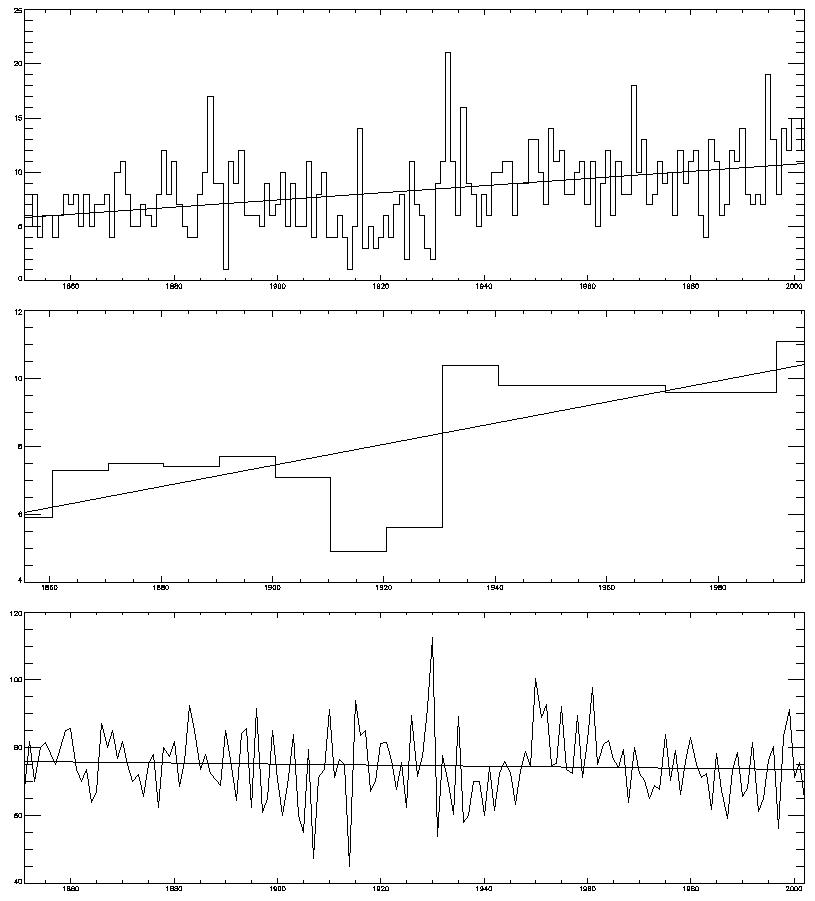
 The trouble is interannual variability. The shorter the time period, and the fewer years for your endpoints, the more chance of the "wrong" result coming out even if the overall trend is upwards. To illustrate this, here is the CRU annual global temperature record (click for larger version). The bottom pic is a blow-up from 1970 (arguably the warming didn't start till the mid-70s due to sulphates, so I'm slightly doing myself down by starting from 1970, but no matter, I fudge that later), the two red stars (and the green ones ten years later) show the (as it happens, two) pairs of years when the temperature 10 years later was cooler. Since we all agree that the data since 1970 show warming (even those who believe the data is contaminated by UHI, alien spaceships and bits of string still agree that the data displayed show warming). If you choose a predition-time of 5 instead of 10 years, then there are 12 such pairs (5 is particularly bad: the values are (13=0; 12=1; 11=2; 10=2; 9=3; 8=3; 7=2; 6=9; 5=12).
 So anyway, a rather rough calc (projecting the past into the future) then gives odds of cooling between 2003 and 2013 at about 2-3 to 25. Lets call it 1:9 (i.e. I think a fair bet is me putting up 9X for a chance of winning X; then my expected gain is 9/10*X-1/10*(9X)=0). So taking geometric averages (which Lubos asserts is "fair") gives odds between me and Lubos at about 1:3.
Lets do a quick sanity check on whether 1:3 seems fair to us both. If Lubos is right (in his assesment of the odds as 1:1), his expected gain is 0.5*3X-0.5*X = X. If I'm right (at 1:9) my expected gain is 9/10*X-1/10*3X = 6/10*X. Oops. Wrong: they should be the same. So we require odd 1:y such that 0.5*y-0.5 = 9/10-1/10*y, i.e. (y-1)/2 = (9-y)/10, i.e. 12y = 28, y = 7/3 (quick check: (7/3-1)/2 = 2/3 ?=? 2/3 = (9-7/3)/10 yes). In which case our expected gains are both 2/3 of our stake. So it looks like geometric averaging is wrong. Interesting, because it sounded plausible. I think that equalising expected gain is the way to get a fair bet, and the error in my calc above isn't immeadiately obvious. Also it pushes the odds into my favour, so I'll leave it for the moment.
So there we are: I offer Lubos (or anyone else credible) odds of 3:7 that 2003 is cooler than 2013 (ie, if 2013 is cooler I pay over 7*X; if its warmer I get 3*X; X negotiable but at least 500; currency dollars or pounds). I have (rather faint) hopes of getting better odds out of Piers Corbyn, so anyone interested had better strike now while the iron is hot & before I discover the flaw in my logic above...
OTOH difference-of-two-years is a noisy statistic. A better bet is on trends. From the above data, the trend is about 0.18 oC/decade. For the future, Lubos predicts a trend of 0; I predict same-as-the-past; splitting the difference, what about an even-odds bet on a trend, between 2003 and 2013 (inclusive; standard LS fitting) of above/below 0.09 oC/decade? As it happens, doing that since 1970 produces 3 11-year periods when the trend has been less than 0.09. I'd be more comfortable with trends. For one thing, it makes the bet more interesting, as you can compute the trends out at 5,6,7,8,9 years with some hope of guesing the 10th; whereas with diff-of-years the last is less predictable so the tension is less.